
PING AN OF CHINA(02318)

Search documents
智通ADR统计 | 1月7日





智通财经网· 2026-01-06 22:17
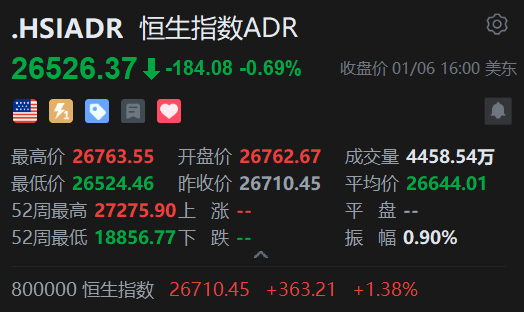
Market Overview - The Hang Seng Index (HSI) closed at 26,526.37, down by 184.08 points or 0.69% from the previous close [1] - The index opened at 26,762.67 and reached a low of 26,524.46 during the trading session [1] - The trading volume was 44.585 million shares, with an average price of 26,644.01 [1] Major Blue-Chip Stocks Performance - HSBC Holdings closed at HKD 127.849, down 0.74% compared to the Hong Kong close [2] - Tencent Holdings closed at HKD 630.832, down 0.26% from the Hong Kong close [2] - Alibaba Group (W) saw a decline of 1.31%, closing at HKD 150.800 [3] - China Ping An increased by 4.96%, closing at HKD 72.000 [3] - Meituan (W) had a slight increase of 0.66%, closing at HKD 106.100 [3] ADR Performance - Tencent's ADR price was USD 630.832, reflecting a decrease of 0.26% compared to its Hong Kong stock price [3] - Alibaba's ADR was USD 146.902, down 2.58% from its Hong Kong counterpart [3] - HSBC's ADR closed at USD 127.849, down 0.74% compared to its Hong Kong price [3]

平安产险5个案例入选信通院“金信通”金融科技创新应用案例
Feng Huang Wang Cai Jing· 2026-01-06 14:40
在车险、财产险风控领域,平安产险整合大模型技术构建"事前预防、事中预警、事后复盘"的三位一体 数字化风控体系。2025年上半年智能减损规模达64.4亿元,通过AI审计与SNA模型,每年新增识别欺诈团 伙超1000个,实现风险全链路闭环管理。 针对网络安全保险新兴领域,平安产险打造业内首个网络安全保险风险评估与定价一体化平台,实现大、 中、小企业网络安全风险的一键评估与精准定价功能。该平台通过风险评估模型与报价器联动机制,支 持差异化保险方案定制,有效提升网络安全保险展业效率。 客户服务创新方面,客户全生命周期服务智链体系融合数据挖掘、零代码平台和人工智能技术,成功突破 客户需求精准洞察、服务方案动态优化、关系链智能匹配三大核心能力,提升客户关系匹配效率,缩短需 求响应周期。该模式已在浙江区域实现18万团体客户服务覆盖,并完成全国17家分公司的标准化复制。 近日,由中国信息通信研究院主办的第五届(2025)"金信通"金融科技创新应用案例征集活动结果发布,平 安产险五项实践成果通过专家评审入选。其中,《基于时空数据预测模型的农灾全流程风控系统》获 评"智领"案例称号,《企业网络安全保险智能风控平台》获评"智新"案 ...
中国平安现2笔大宗交易 总成交金额2564.04万元
Zheng Quan Shi Bao Wang· 2026-01-06 14:32
中国平安1月6日大宗交易平台共发生2笔成交,合计成交量34.50万股,成交金额2564.04万元。成交价格 均为74.32元。 进一步统计,近3个月内该股累计发生6笔大宗交易,合计成交金额为5929.00万元。 证券时报·数据宝统计显示,中国平安今日收盘价为74.32元,上涨2.71%,日换手率为1.38%,成交额为 108.68亿元,全天主力资金净流出1.92亿元,近5日该股累计上涨4.44%,近5日资金合计净流出14.17亿 元。 1月6日中国平安大宗交易一览 | 成交量 (万股) | 成交金额 (万元) | 成交价格 (元) | 相对当日收盘折 溢价(%) | 买方营业部 | 卖方营业部 | | --- | --- | --- | --- | --- | --- | | 25.00 | 1858.00 | 74.32 | 0.00 | 广发证券股份有 | 招商证券股份有限公司北京 | | | | | | 限公司总部 | 景辉街证券营业部 | | 9.50 | 706.04 | 74.32 | 0.00 | 广发证券股份有 | 招商证券股份有限公司北京 | | | | | | 限公司总部 | 景辉街证券营 ...

1月6日南向资金净买入28.79亿港元
Zheng Quan Shi Bao Wang· 2026-01-06 14:32
Core Viewpoint - The Hang Seng Index rose by 1.38% on January 6, closing at 26,710.45 points, with a net inflow of HKD 2.879 billion through the southbound trading channel [1]. Group 1: Market Activity - The total trading volume for the southbound trading on January 6 was HKD 133.353 billion, with a net buying amount of HKD 2.879 billion [1]. - The Shanghai Stock Exchange's southbound trading had a total transaction amount of HKD 81.029 billion, with a net buying of HKD 0.975 billion, while the Shenzhen Stock Exchange had a transaction amount of HKD 52.324 billion and a net buying of HKD 1.903 billion [1]. Group 2: Active Stocks - In the Shanghai Stock Exchange's southbound trading, Alibaba-W had the highest transaction amount of HKD 50.49 billion, followed by SMIC and Tencent Holdings with transaction amounts of HKD 44.27 billion and HKD 41.10 billion, respectively [1]. - Alibaba-W recorded a net buying amount of HKD 20.61 billion, despite a closing price drop of 1.31% [1]. - China Mobile had the highest net selling amount of HKD 8.75 billion, with a closing price decrease of 0.12% [1]. Group 3: Shenzhen Stock Exchange Activity - In the Shenzhen Stock Exchange's southbound trading, Alibaba-W also led with a transaction amount of HKD 43.74 billion, followed by Tencent Holdings and SMIC with HKD 28.76 billion and HKD 20.96 billion, respectively [2]. - The highest net buying stock was Ping An Insurance, with a net buying amount of HKD 10.81 billion, and it closed up by 4.96% [2]. - Tencent Holdings experienced the highest net selling amount of HKD 8.15 billion, while its closing price increased by 1.28% [2].


港股通1月6日成交活跃股名单
Zheng Quan Shi Bao Wang· 2026-01-06 14:22
Group 1 - The Hang Seng Index rose by 1.38% on January 6, with southbound trading totaling HKD 133.35 billion, including HKD 68.12 billion in buying and HKD 65.24 billion in selling, resulting in a net buying amount of HKD 2.88 billion [1] - The southbound trading through Stock Connect (Shenzhen) had a total trading amount of HKD 52.32 billion, with net buying of HKD 1.90 billion, while the trading through Stock Connect (Shanghai) totaled HKD 81.03 billion, with net buying of HKD 0.98 billion [1] - Active stocks in southbound trading included Alibaba-W with a total trading amount of HKD 94.23 billion, Tencent Holdings with HKD 69.86 billion, and SMIC with HKD 65.23 billion [1] Group 2 - Among the stocks, China Ping An had a net buying amount of HKD 18.40 billion, closing with a price increase of 4.96%, while Alibaba-W had a net buying of HKD 16.19 billion [2] - Xiaomi Group-W, SMIC, and Alibaba-W were among the stocks with the highest consecutive net buying days, with 4 days for Xiaomi Group-W and SMIC, and 3 days for Alibaba-W [2] - The total trading amount for China Ping An was HKD 32.79 billion, with a net buying of HKD 18.40 billion, while Tencent Holdings had a total trading amount of HKD 69.86 billion with a net selling of HKD 8.04 billion [2]

上市险企新旧准则切换所得税切换测算:OCI选择权的两面性,税务追溯对现金流影响有限
ZHONGTAI SECURITIES· 2026-01-06 13:32
Investment Rating - The industry investment rating is "Increase Holding" [2] Core Viewpoints - The tax adjustment for listed insurance companies has a limited overall impact, primarily affecting cash flow rather than profit and loss statements or balance sheets [5][10] - The new accounting standards provide insurance companies with an OCI option, which reduces the impact of interest rate fluctuations on net profit [5] - The average effective tax rate for listed insurance companies has been low, with rates of 10%, 8%, -1%, -6%, 12%, and 17% from 2020 to Q3 2025, indicating a disconnect between tax burdens and actual operating performance [5][12] - The estimated taxable profit difference for listed companies under the new and old standards is projected to be 42 billion in 2023 and 93 billion in 2024, with a significant portion of this difference being attributable to insurance contracts [5][18] Summary by Relevant Sections Tax Adjustment Impact - The tax adjustment is expected to have a minimal effect on operating cash flow, with an average impact of 2.27% across listed insurance companies [5][18] - Specific companies like New China Life and China Life may experience a more significant impact, estimated at around 14% for New China Life [5][18] Financial Performance - The listed insurance companies have seen record high pre-tax profits in the first three quarters of 2025, exceeding the total profits of 2024 [11] - The actual income tax paid has not kept pace with rising profits, indicating a potential for future tax liabilities [12] Recommendations - The report suggests focusing on companies such as China Life (A/H), Ping An (A/H), China Pacific Insurance (A/H), New China Life (A/H), and China Property & Casualty Insurance (A/H) for investment opportunities [5]


资产负债双轮驱动,A股保险板块两日累计涨超11%
Mei Ri Jing Ji Xin Wen· 2026-01-06 12:11
Core Viewpoint - The A-share insurance sector has experienced a strong rise since 2025, significantly outperforming other financial sectors and the CSI 300 index, driven by policy benefits, improved fundamentals, and favorable market conditions [1][2]. Group 1: Performance and Growth - The five major listed insurance companies in A-shares have shown substantial annual growth rates, with stock price increases of 21.21% for China Ping An, 10.39% for China Life, 26.60% for China Pacific Insurance, 35.87% for China Re, and 46.03% for New China Life in 2025 [2]. - The insurance sector's performance has outpaced that of banks and securities, indicating a robust upward trend in the market [2]. Group 2: Fundamental Support - The strong performance of insurance stocks is attributed to two main factors: better-than-expected growth in new insurance policies and a recovering equity market, which has led to increased investment from insurance funds [3]. - In the first eleven months of 2025, the insurance industry's original premium income reached 5.76 trillion yuan, reflecting a year-on-year growth of 7.6%, with life insurance companies seeing a 9.1% increase [3]. Group 3: Market Dynamics - The "opening red" phenomenon in 2026 is expected to sustain the high demand for insurance products, further supporting the ongoing bullish trend in the insurance market [4]. - The stability of long-term interest rates and increased equity allocation are anticipated to enhance investment returns, while the return of dividend insurance products is expected to optimize the cost structure for listed insurance companies [5]. Group 4: Regulatory and Policy Environment - Recent regulatory adjustments have lowered risk factors for insurance companies, potentially releasing significant capital for investment in the stock market, estimated to exceed 1 trillion yuan if fully allocated [6]. - The insurance sector is expected to see an influx of approximately 600 billion yuan in new capital entering the market in 2026, driven by favorable policies and market conditions [6].

保险股开年成“亮眼的仔”,政策与业绩双轮驱动板块普涨
Bei Jing Shang Bao· 2026-01-06 11:18
Core Viewpoint - The A-share insurance sector has shown remarkable performance at the beginning of 2026, continuing the strong trend from 2025, with major companies experiencing significant stock price increases [3][4]. Group 1: A-share Performance - As of January 6, 2026, major A-share insurance companies such as Xinhua Insurance and China Pacific Insurance saw stock price increases exceeding 5%, while China Life and Ping An rose over 2% [1][3]. - On the first trading day of 2026, all five major A-share listed insurance companies recorded gains of over 5%, with Xinhua Insurance leading at an increase of 8.87% and China Pacific at 7.52% [3]. - The stock prices of Xinhua Insurance and China Pacific reached historical highs, while Ping An closed at 72.36 yuan per share, marking a five-year peak [3]. Group 2: Industry Fundamentals - The insurance industry has shown solid growth, with total premium income reaching 5.76 trillion yuan in the first eleven months of 2025, reflecting a year-on-year increase of 7.56% [3]. - Life insurance companies experienced a premium income growth of 9.1%, while property insurance companies saw a 3.9% increase, indicating a stable development trajectory for the industry [3]. Group 3: Market Drivers - Analysts attribute the strong performance of insurance stocks to a combination of policy benefits, improved earnings, valuation recovery, and favorable capital allocation [4]. - Recent regulatory changes aimed at encouraging long-term investments by insurance funds have alleviated market concerns regarding investment restrictions, facilitating a systematic valuation recovery for the sector [4]. - The current market sentiment, risk appetite, and liquidity are favorable for the stock market, benefiting the equity allocation of insurance funds [4][5]. Group 4: Future Outlook - The insurance sector is expected to continue its upward trend in 2026, supported by a favorable liquidity environment and the potential for double-digit growth in new business value (NBV) [5]. - The easing of policies has provided insurance companies with enhanced operational support, contributing to performance improvements [5]. - The characteristics of insurance stocks make them attractive for passive investment, further solidifying their position in the market [5].


北水动向|北水成交净买入28.79亿 内资抢筹大金融板块 全天加仓中国平安超18亿港元
Zhi Tong Cai Jing· 2026-01-06 11:13
北水抢筹大金融板块。中国平安(02318)、中国人寿(02628)、中金公司(03908)分别获净买入18.4亿、5.88亿港元、1.85亿港 元。消息面上,国金证券发布研报指出,2026年开门红高景气的延续是本轮保险行情持续的重要支撑。从负债端的展望 来看,存款搬家有望驱动新单与NBV双位数正增长,利差继续改善,分红险转型将助推行业市占率进一步提升。该行还 表示,建议继续重点关注春季躁动行情下低估值券商的补涨机会,强烈推荐估值及业绩错配程度较大的优质券商,建议 关注AH溢价率较高、有收并购主题的券商。 智通财经APP获悉,1月6日港股市场,北水成交净买入28.79亿港元,其中港股通(沪)成交净买入9.75亿港元,港股通(深) 成交净买入19.03亿港元。 北水净买入最多的个股是中国平安(02318)、阿里巴巴-W(09988)、中国人寿(02628)。北水净卖出最多的个股是中国移动 (00941)、腾讯(00700)、华虹半导体(01347)。 | 股票名称 | 买入额 | 卖出额 | 买卖总额 | | --- | --- | --- | --- | | | | | 净流入 | | 阿里巴巴-W HK 09 ...
智通港股通活跃成交|1月6日


智通财经网· 2026-01-06 11:04
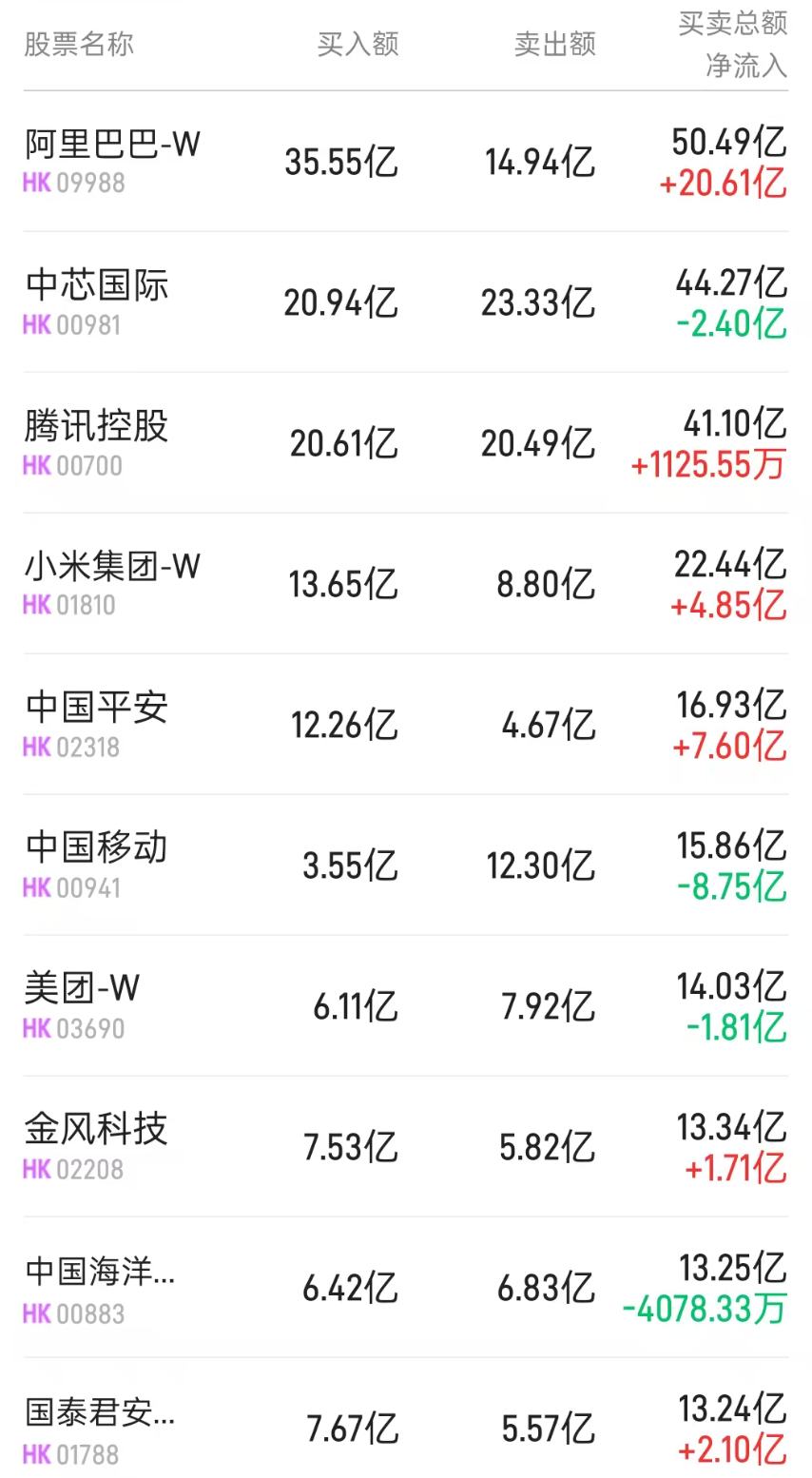
Core Insights - On January 6, 2026, Alibaba-W (09988), SMIC (00981), and Tencent Holdings (00700) were the top three stocks by trading volume in the Southbound Stock Connect, with trading amounts of 5.049 billion, 4.427 billion, and 4.110 billion respectively [1] - In the Southbound Stock Connect for the Shenzhen-Hong Kong Stock Connect, Alibaba-W (09988), Tencent Holdings (00700), and SMIC (00981) also ranked as the top three, with trading amounts of 4.374 billion, 2.876 billion, and 2.096 billion respectively [1] Southbound Stock Connect Trading Activity - **Top Active Companies in Southbound Stock Connect (Shanghai-Hong Kong)** - Alibaba-W (09988): Trading amount of 5.049 billion, net buying of +2.061 billion [2] - SMIC (00981): Trading amount of 4.427 billion, net selling of -0.240 billion [2] - Tencent Holdings (00700): Trading amount of 4.110 billion, net buying of +11.255 million [2] - Xiaomi Group-W (01810): Trading amount of 2.244 billion, net buying of +0.485 billion [2] - China Ping An (02318): Trading amount of 1.693 billion, net buying of +0.760 billion [2] - **Top Active Companies in Southbound Stock Connect (Shenzhen-Hong Kong)** - Alibaba-W (09988): Trading amount of 4.374 billion, net selling of -0.442 billion [2] - Tencent Holdings (00700): Trading amount of 2.876 billion, net selling of -0.815 billion [2] - SMIC (00981): Trading amount of 2.096 billion, net buying of +0.262 billion [2] - Xiaomi Group-W (01810): Trading amount of 1.644 billion, net buying of +11.316 million [2] - China Ping An (02318): Trading amount of 1.586 billion, net buying of +1.081 billion [2]