GWMOTOR(02333)

Search documents
智能、舒适全面升级,全新坦克400开启预售
Zhong Guo Qi Che Bao Wang· 2025-10-23 06:40
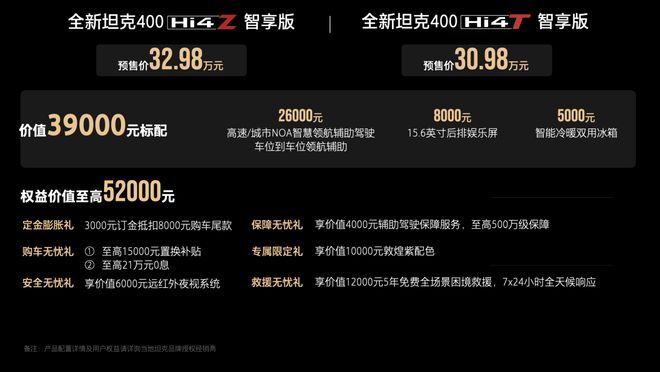
Core Points - The all-new Tank 400 has been launched with a pre-sale event, featuring two versions: Hi4-Z Intelligent Edition priced at 329,800 yuan and Hi4-T Intelligent Edition priced at 309,800 yuan [1] - The pre-sale offers six exclusive benefits for customers who place orders during this period [1] Group 1: Product Features - The Tank 400 is the only off-road SUV globally that covers a full power matrix, including gasoline, diesel, Hi4-T, and Hi4-Z, catering to diverse travel needs [4][9] - The Hi4-Z architecture allows for optimal energy distribution and performance, achieving a 0-100 km/h acceleration in just 4.3 seconds and a pure electric range of 200 km under WLTC conditions [9] - The Hi4-T Intelligent Edition features an upgraded second-generation Hi4-T architecture with a motor power of 130 kW and torque of 495 Nm, enhancing off-road capabilities [10] Group 2: Design and Aesthetics - The Tank 400's "Dunhuang Purple" color is inspired by ancient Dunhuang murals, utilizing a custom-developed pearlescent paint for a unique visual effect [8] - The vehicle's paint features an eight-layer composite finish and advanced spraying technology to ensure a smooth and vibrant surface [8] Group 3: Technology and Comfort - The Tank 400 is equipped with the Coffee Pilot Ultra driver assistance system, providing comprehensive coverage for urban and highway scenarios [11] - It includes a 5.4L onboard refrigerator with a wide temperature range and a 15.6-inch entertainment screen, enhancing the travel experience for passengers [13] - The vehicle features high-quality Nappa leather seats with ventilation, heating, and massage functions for added comfort during long journeys [13]



2026款金刚炮焕新上市,8.98万元起助力奋斗者创富前行
Zhong Guo Qi Che Bao Wang· 2025-10-23 01:48
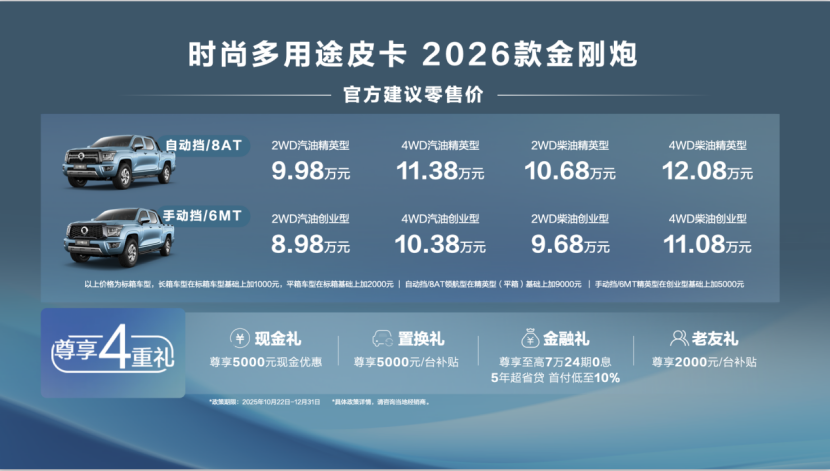
Core Viewpoint - The launch of the 2026 model of the Great Wall Motors' King Kong Cannon marks a significant update in the pickup truck segment, targeting the needs of modern entrepreneurs with enhanced features and competitive pricing [1][16]. Product Features - The 2026 King Kong Cannon is positioned as a "fashionable multi-purpose pickup" with two versions: 6MT starting at 89,800 yuan and 8AT starting at 99,800 yuan [1]. - The new model features a fourth-generation 2.0T engine, with maximum torque of 400 N·m for the diesel version and 360 N·m for the gasoline version, showcasing superior performance in climbing and load-bearing capabilities [4]. - The 8AT model is equipped with a ZF 8AT transmission, known for its high efficiency and smooth shifting, with a response time of just 0.3 seconds and a transmission efficiency of 98% [6]. Practicality and Design - The 2026 model includes a 1.82-meter flatbed with no internal protrusions, enhancing loading efficiency and allowing for a reduction in trips from three to two [7]. - The payload capacity has been increased by 20% due to the addition of an extra leaf spring, and the design includes ten cargo hooks for secure loading [7]. - The vehicle's ground clearance has been raised by 20 mm, improving off-road capability, while the low cargo bed design facilitates easier loading and unloading [9]. Safety and Quality Assurance - The model features a comprehensive safety system with a new generation ESP, ABS, and EBD, ensuring enhanced driving safety [6]. - The vehicle's structure includes a high-strength cage and a large-section trapezoidal frame, with over 98% high-strength steel, providing superior durability and safety [14]. - Great Wall Motors has a robust service network with over 2,000 sales and service points across the country, ensuring customer support throughout the ownership experience [14]. Market Position and Future Outlook - Since its launch in 2022, the King Kong Cannon has achieved a cumulative production of 100,000 units and consistently ranks among the top three in the pickup market [3]. - The company aims to continue its commitment to long-term innovation and user orientation, promoting the popularity of pickups in both domestic and global markets [16].

8.98万元起售,2026款金刚炮焕新上市
Qi Lu Wan Bao· 2025-10-23 01:36
Core Viewpoint - The 2026 model of the King Kong Cannon, a versatile pickup truck, has been launched with competitive pricing and promotional offers, aiming to strengthen its market position in the pickup segment [1][3]. Product Launch and Pricing - The 2026 King Kong Cannon is available in two models: the 8AT starting at 99,800 yuan and the 6MT starting at 89,800 yuan, accompanied by various promotional offers totaling up to 19,000 yuan [1]. Market Performance - Since its launch in 2022, the King Kong Cannon has achieved a cumulative production of 100,000 units and consistently ranks among the top three in single model sales in the pickup market, with the AT model being the second best-selling and the flatbed model leading in sales [3]. Manufacturing Excellence - The manufacturing facility in Jingmen is recognized as a high-end off-road vehicle production base and the only non-body-on-frame factory in China, showcasing advanced intelligent production capabilities [5]. Engine and Performance - The 2026 model features a new fourth-generation engine with a 2.0T powertrain, delivering maximum torque of 400 N·m for diesel and 360 N·m for gasoline, making it the leader in the pickup industry for torque [7]. - It is equipped with the ZF 8AT transmission, known for its efficiency and smooth shifting, enhancing the driving experience [7]. Safety and Handling - The vehicle boasts a minimum turning radius of 5.95 meters, the best in its class, and includes advanced safety features such as the latest generation ESP stability system and four-wheel disc brakes, ensuring superior braking performance [9]. Cargo Capacity and Design - The 2026 King Kong Cannon features a class-leading flatbed length of 1.82 meters, enhancing its loading capabilities, and has increased its payload capacity by 20% with improved suspension [11]. - The design includes practical features like factory-installed cargo lighting and a user-friendly infotainment system, enhancing usability for customers [13]. Durability and Reliability - The vehicle's structure is designed for high strength, with over 98% high-strength steel in the frame, and has undergone extensive corrosion testing, ensuring long-term durability [18]. - The brand's commitment to quality is reflected in its extensive experience in the pickup market, with over 2.8 million global users [16]. Future Outlook - The company aims to continue innovating and expanding its product offerings, promoting the King Kong Cannon as a reliable partner for modern entrepreneurs, and enhancing its global presence in the pickup market [20].
长城汽车智能四驱电混技术破解多项全球性难题
Zheng Quan Ri Bao Zhi Sheng· 2025-10-22 16:39
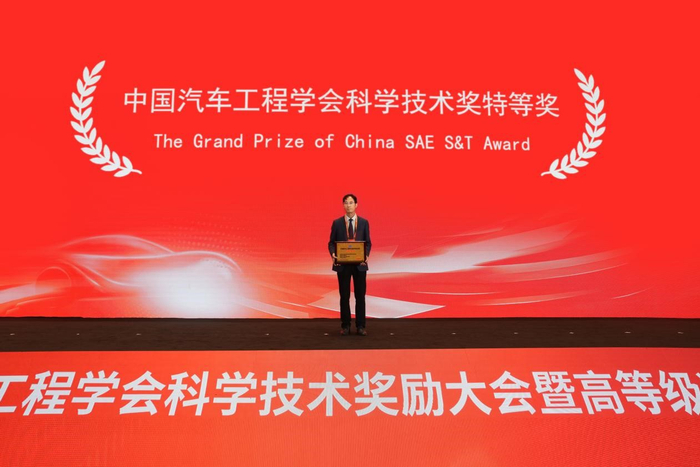
Core Insights - Great Wall Motors won the "Science and Technology Progress Award" for its project on hybrid four-wheel drive technology, marking the first time this top honor has been awarded in the hybrid technology field in over 30 years [1] - The Hi4 technology, which is a breakthrough in hybrid four-wheel drive, addresses several global challenges in the sector and has led to the development of China's first single-motor 9-speed parallel hybrid four-wheel drive system [1][2] Technology and Innovation - The Hi4 technology features a dual-motor multi-gear series-parallel four-wheel drive configuration, overcoming the technical limitations of traditional dual-motor systems [1] - As of September 2025, Hi4 technology has secured 122 authorized invention patents across six technical fields and has contributed to the formulation of nine national standards [1] Market Performance - By the end of 2024, vehicles equipped with Hi4 technology achieved cumulative sales of 410,000 units, generating sales revenue of 91.3 billion yuan [3] - In Australia, from January to September 2025, Great Wall Motors sold 39,300 units, a year-on-year increase of 23.7%, capturing a market share of 4.3%, making it the leading Chinese brand in that market [3] Competitive Landscape - The domestic market is highly competitive, with notable technologies from BYD, Geely, and Chery also vying for market share, alongside the rise of pure electric off-road vehicles posing new challenges to hybrid technology [3] - The market strategy of Hi4 emphasizes "four-wheel drive experience at two-wheel drive prices," but its success will depend on the overall product strength, brand marketing, and cost control of the vehicles it powers [3] Industry Implications - The award for Hi4 technology signifies a significant advancement for Chinese automotive companies in core off-road vehicle technologies, previously dominated by foreign brands [2] - The recognition of Hi4 technology as a leading innovation reflects the capability of domestic enterprises to achieve original breakthroughs in core technologies, although the journey from technological breakthroughs to industry leadership remains ongoing [3]
拉内需、带出海,解密长城汽车Hi4技术体系背后的社会经济价值!
第一财经· 2025-10-22 13:29
Core Viewpoint - The article emphasizes that technological breakthroughs, exemplified by Great Wall Motors' Hi4 technology system, are essential for driving economic development and enhancing competitive advantage in the automotive industry [3][4][16]. Group 1: Technological Advancements - Great Wall Motors' Hi4 technology system has been recognized for its comprehensive capabilities, focusing on addressing pain points in new energy vehicle usage, and consists of "3 engines + 9 modes" to enhance performance and user experience [4][6]. - The Hi4 technology system has led to significant sales growth, with 410,000 units sold by the end of 2024, generating revenue of 91.3 billion yuan and contributing 5.8 billion yuan in taxes, showcasing the economic benefits of technological innovation [6][10]. Group 2: Market Dynamics - The Hi4 system has democratized access to four-wheel drive technology, reducing costs and making advanced features more accessible to consumers, thus driving demand in the SUV market [8][10]. - From 2020 to 2024, Great Wall Motors' market share in the hard-core off-road vehicle segment increased from 10% to 52%, while the overall share of domestic brands rose from 26.9% to 80%, indicating a significant shift in market power towards Chinese brands [10][12]. Group 3: Global Expansion - Great Wall Motors is leveraging the Hi4 technology system to enhance its international presence, exporting to 19 countries and contributing to the "Belt and Road" initiative, thereby increasing the global influence of Chinese automotive brands [12][14]. - The Hi4 system's modular design allows for adaptability in various global markets, breaking the stereotype that Chinese vehicles are only economical, with Great Wall's off-road models competing at an average price of 450,000 yuan in overseas markets [14][16]. Group 4: Industry Implications - The breakthrough of the Hi4 technology system is seen as a pivotal factor in reshaping the global competitive landscape for hybrid technology, providing a "Chinese solution" for the development of new energy vehicles [14][16]. - The recognition of Great Wall Motors' technological advancements through awards reflects the industry's acknowledgment of the importance of core technology in driving industrial upgrades and expanding market influence [16].
为硬核越野注入智能豪华基因 全新坦克400开启预售30.98万元起
Zhong Guo Jing Ying Bao· 2025-10-22 13:27
Core Viewpoint - The new energy technology is redefining the off-road SUV market, transitioning it from a niche to a mass market, with Great Wall's Tank brand as a key player in this transformation [2]. Group 1: Product Launch and Features - The Tank 400 was launched with two power versions: Hi4-Z Intelligent Version priced at 329,800 yuan and Hi4-T Intelligent Version priced at 309,800 yuan [2]. - The Tank 400 emphasizes mech aesthetics, hardcore off-road performance, and intelligent luxury configurations, aiming to set a new benchmark in the trendy off-road SUV market [3]. - The Hi4-Z architecture allows for optimal energy distribution and usage, addressing issues like low power in single-gear hybrid mode and high fuel consumption in urban settings [3][4]. Group 2: Performance and Technology - The Tank 400 Hi4-Z Intelligent Version features a peak power of 600 kW, achieving 0-100 km/h acceleration in 4.3 seconds, and offers a pure electric range of 200 km under WLTC conditions [4]. - The Hi4-T Intelligent Version has upgraded motor power to 130 kW and torque to 495 Nm, with charging efficiency improved by nearly 100%, allowing for fast charging from 30% to 80% in just 16 minutes [4]. - The vehicle is equipped with three differential locks for enhanced off-road capability and features the Coffee Pilot Ultra driver assistance system for comprehensive urban and highway coverage [4]. Group 3: Comfort and User Experience - The Tank 400 includes a 5.4L onboard refrigerator with a temperature range from -6°C to 50°C, and a 15.6-inch rear entertainment screen certified for low blue light [5]. - It is powered by the third-generation Coffee OS3 system, featuring an 8295 chip for smooth user operation and the Coffee GPT voice model for precise command recognition [5]. - The pre-sale of the Tank 400 offers six exclusive benefits for early reservations, enhancing the purchasing experience for young users [5].
拉内需、带出海,解密长城汽车Hi4技术体系背后的社会经济价值!
第一财经网· 2025-10-22 13:04
Core Insights - The core viewpoint of the articles emphasizes the significance of the Hi4 technology system developed by Great Wall Motors, which has been recognized for its contribution to the automotive industry and its role in driving economic growth through technological advancements [1][5][10] Technological Breakthroughs - Great Wall Motors' Hi4 technology system has emerged as a leading force in the intelligent electric hybrid four-wheel drive sector, showcasing a comprehensive driving system with "3 engines + 9 modes" that addresses the pain points of new energy vehicles [3][5] - The Hi4 system offers five key technical advantages: speed, smoothness, quietness, fuel efficiency, and safety, enhancing the performance boundaries and user experience of new energy products [3][5] Economic Impact - The introduction of the Hi4 technology has led to a significant increase in sales, with 410,000 units sold by the end of 2024, generating revenue of 91.3 billion yuan and contributing 5.8 billion yuan in taxes, exemplifying the economic benefits of technological innovation [5][6] - The technology has enabled Great Wall Motors to lower the cost of high-end intelligent electric hybrid four-wheel drives, making them more accessible to consumers and driving domestic demand [6][8] Market Dynamics - Great Wall Motors has increased its market share in the hard-core off-road vehicle segment from 10% in 2020 to 52% in 2024, while the overall share of domestic brands rose from 26.9% to 80%, indicating a significant shift in market power towards Chinese brands [8][10] - The Hi4 technology system has disrupted the long-standing technological barriers imposed by foreign brands in the off-road hybrid sector, enhancing the competitive landscape for Chinese manufacturers [8][10] Global Expansion - With the support of the Hi4 technology system, Great Wall Motors has expanded its international presence, exporting products to 19 countries, including Australia and New Zealand, thereby enhancing the global influence of Chinese automotive brands [6][10] - The modular design of the Hi4 system allows for adaptability in various global markets, challenging the stereotype that Chinese vehicles are only suitable for the economy segment, as evidenced by the competitive pricing of Great Wall's off-road models in international markets [10]
奔驰实施30000人裁员计划,离职人员最高可获50万欧元补偿;长城汽车公布新款坦克400预售价:30.98万起丨汽车交通日报
创业邦· 2025-10-22 10:18
Group 1 - Great Wall Motors announced the pre-sale of the new Tank 400, starting at 309,800 yuan [2] - From January to September 2025, the top ten automotive companies sold a total of 20.431 million vehicles, accounting for 83.9% of total automotive sales [4] - Mercedes-Benz is implementing a major layoff plan affecting 30,000 employees, with severance packages up to 500,000 euros for senior management [3][5] Group 2 - Ford is recalling over 1.448 million vehicles in the U.S. due to rearview camera malfunctions [4]


乘联分会:10月1-19日全国乘用车市场零售112.8万辆 同比下降6%
智通财经网· 2025-10-22 09:01
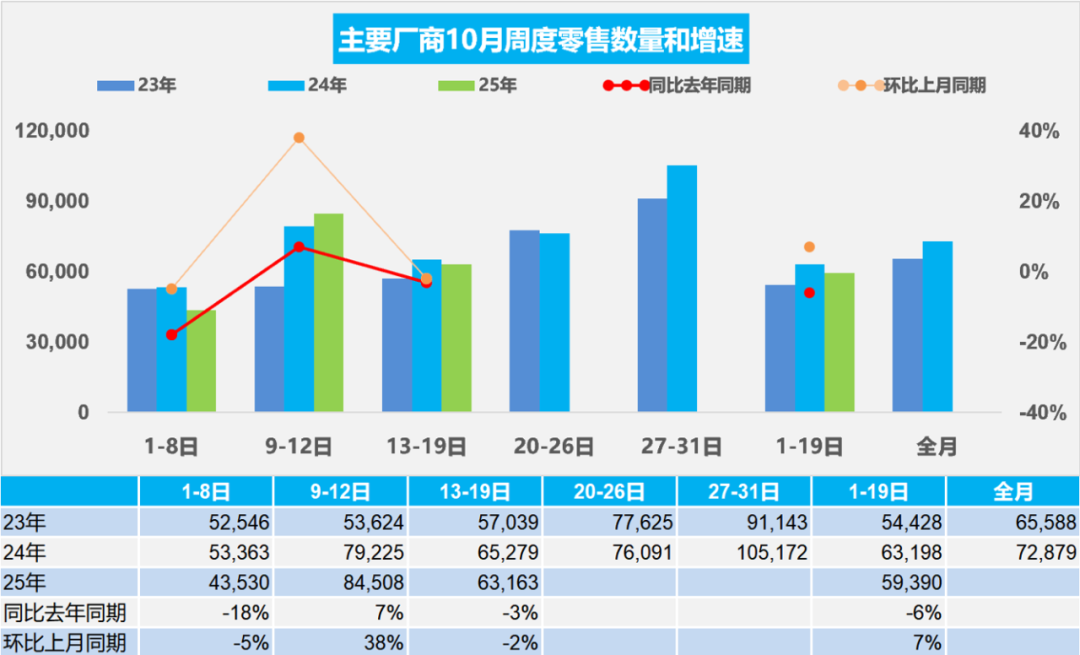
Core Insights - The retail sales of passenger cars in China from October 1 to 19 reached 1.128 million units, representing a year-on-year decline of 6% but a month-on-month increase of 7% [1][2] - Cumulative retail sales for the year reached 18.136 million units, showing a year-on-year growth of 8% [1][2] - The retail sales of new energy vehicles (NEVs) during the same period were 632,000 units, marking a year-on-year increase of 5% and a month-on-month increase of 2%, with a penetration rate of 56.1% [1][2] Passenger Car Market Overview - Retail sales from October 1 to 19 totaled 1.128 million units, down 6% year-on-year but up 7% month-on-month; cumulative sales for the year reached 18.136 million units, up 8% year-on-year [2][5] - Wholesale figures for the same period were 1.155 million units, down 5% year-on-year but unchanged from the previous month; cumulative wholesale for the year reached 22.002 million units, up 12% year-on-year [2][9] New Energy Vehicle (NEV) Insights - NEV retail sales from October 1 to 19 were 632,000 units, up 5% year-on-year and 2% month-on-month, with a cumulative total of 9.502 million units for the year, reflecting a 23% year-on-year increase [2][5] - NEV wholesale during the same period was 676,000 units, up 6% year-on-year and 5% month-on-month, with a cumulative total of 11.123 million units for the year, showing a 30% year-on-year growth [2][9] Market Trends and Influences - The market experienced a slow start in October due to holiday effects and a previous surge in September driven by government incentives [5] - The traditional peak season of "Golden September and Silver October" is expected to boost sales, although tightening subsidy standards and the impending expiration of tax incentives may affect consumer enthusiasm [5][11] - The export market for Chinese automobiles has shown positive growth, particularly in the NEV segment, with increasing competitiveness against international brands [9][11]
三大优势打造潮酷越野SUV价值标杆,全新坦克400预售30.98万元起
Zhong Guo Jing Ji Wang· 2025-10-22 08:47
Core Insights - The all-new Tank 400 has officially launched its pre-sale, offering two configurations: Hi4-Z and Hi4-T, priced at 329,800 yuan and 309,800 yuan respectively [1] - The vehicle emphasizes "mecha aesthetics, hardcore performance, and luxury intelligence," aiming to set a benchmark for trendy off-road SUVs and cater to the younger demographic [1] Design and Aesthetics - The Tank 400 features an original mecha aesthetic, breaking away from mainstream automotive design with 74,595 straight lines, 64,598 flat surfaces, and 21,532 angles, appealing to the fashion-forward youth [3] - A new color option, Dunhuang Purple, inspired by the Dunhuang Mogao Caves, utilizes a custom-developed pearlescent paint and an eight-layer composite finish for a smooth and vibrant appearance [4] Performance and Specifications - The Hi4-Z version boasts a peak power of 600 kW, achieving 0-100 km/h in 4.3 seconds, with a WLTC range of 200 km in pure electric mode [4] - The Hi4-T version features an upgraded second-generation Hi4-T architecture, with motor power increased to 130 kW and torque to 495 Nm, enhancing performance and charging efficiency [4] - Fast charging capabilities have improved, allowing 30-80% charge in just 16 minutes, with a charging speed increase of 30% [4] Intelligent Features - The Tank 400 is equipped with the Coffee Pilot Ultra driver assistance system, covering urban and highway scenarios, along with a parking system that supports over 200 parking types [6] - Comfort features include a 5.4L onboard refrigerator with a temperature range of -6°C to 50°C, and a 15.6-inch rear entertainment screen certified for low blue light [6] - The vehicle also includes high-quality Nappa leather seats with ventilation, heating, and massage functions, enhancing the travel experience [6]