
China Life(02628)

Search documents
老年群体健康险市场迎变,“照护服务纳入赔付权益”求解结构性矛盾
Xin Lang Cai Jing· 2026-01-20 01:04
Group 1 - The health insurance purchasing difficulties faced by the elderly population are gradually being addressed, with policies encouraging the introduction of dedicated health insurance products for this demographic [1][2] - Shanghai's recent measures highlight the need for specialized health insurance for the elderly, acknowledging the unique health risks they face and advocating for differentiated product designs rather than generic offerings [1][2][4] Group 2 - The current health insurance market for the elderly is characterized by structural contradictions, with limited product availability and high restrictions, leading to a mismatch between existing offerings and the actual needs of older adults [2][5] - Existing products like "惠民保" provide broad coverage but primarily address immediate medical expenses rather than the ongoing care and management needs of the elderly, indicating a gap in the market [4][5] Group 3 - The introduction of care services as a compensation right in health insurance represents a significant innovation, allowing for earlier intervention in chronic disease management and rehabilitation, which aligns more closely with the needs of the elderly [6][7] - Major insurance companies are increasingly focusing on health management and care services, expanding their offerings to better serve the elderly population [7][8] Group 4 - The insurance industry faces challenges in product innovation for the elderly, with a tendency to replicate Western models without adequately addressing local needs [8][9] - Companies are encouraged to balance profitability with policy compliance by adopting a layered approach to product design, integrating health management as a risk control tool, and collaborating with public services to mitigate risks [9][10]


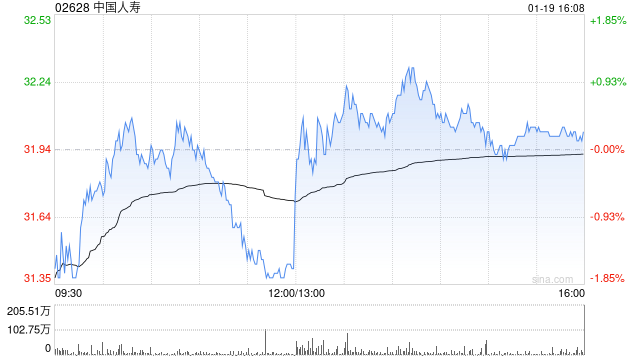
中国人寿遭贝莱德减持约2079.18万股 每股作价约32.69港元
Xin Lang Cai Jing· 2026-01-19 23:58
Core Viewpoint - BlackRock has reduced its stake in China Life Insurance by selling approximately 20.79 million shares at a price of HKD 32.6945 per share, totaling around HKD 680 million, resulting in a new holding of approximately 516 million shares, representing a 6.94% ownership stake [2][4]. Group 1 - BlackRock sold 20,791,754 shares of China Life Insurance on January 13 [2][4] - The sale price per share was HKD 32.6945, leading to a total transaction value of approximately HKD 680 million [2][4] - After the reduction, BlackRock's remaining shares in China Life Insurance are approximately 516 million, equating to a 6.94% ownership stake [2][4]

多家险企发布2025年度理赔报告 信息技术助力服务效率提升
Zhong Guo Zheng Quan Bao· 2026-01-19 23:17
Core Insights - The insurance industry has shown a stable claims scale for 2025, with major insurers enhancing their protection capabilities and many small to medium-sized insurers experiencing significant business growth [2][3] Claims Scale Stability - The total number of claims for China Life exceeded 62.24 million, a year-on-year increase of 7%, with total claims amounting to over 100.4 billion yuan, up 10% [2] - Ping An Life reported 4.958 million claims with a total payout of 41.51 billion yuan, while Xinhua Insurance had 5.01 million claims totaling 14.7 billion yuan [2] - Smaller insurers like Zhongyou Insurance saw customer service numbers exceed 2.49 million, a growth of over 370%, with claims amounting to 3.2 billion yuan, up over 90% [2] - The claims acceptance rates for several insurers remained high, with China Life, CITIC Prudential, and Ping An Life at 99.8%, 99.7%, and 99.2% respectively [2] High Payouts in Critical Illness Insurance - Critical illness claims accounted for a significant portion of total payouts, with Ping An Life reporting 261,000 claims totaling over 20.86 billion yuan, representing over 50% of total claims [3] - The average payout for critical illness and death claims was notably high, with Zhonghong Insurance reporting average payouts of 181,500 yuan and 184,500 yuan respectively [3] - There exists a substantial coverage gap between critical illness payouts and treatment costs, with Zhongyou Insurance indicating an average payout of 100,000 yuan against an average treatment cost of 400,000 yuan for malignant tumors [3] Growth Potential in Critical Illness Insurance - Analysts predict that the aging population and increasing demand for better medical resources will expand the potential customer base for critical illness insurance, leading to a sales growth period [4] - Medical claims accounted for the highest proportion of total claims for China Life at 60.6%, and over 65% for Cigna Life [4] Technological Empowerment in Claims Services - The integration of information technology has significantly accelerated claims processing times, with Xinhua Insurance reporting an average processing time of 0.5 days for small medical claims under 5,000 yuan [5] - Ping An Life's "111 Fast Claims" service has improved efficiency, with 93% of automated claims being processed within 60 seconds [5] - China Life has implemented a "one-day claim" service for critical illness claims, allowing for same-day processing for eligible cases [6] - The focus on IT in the insurance sector has shifted towards intelligent underwriting and claims systems, with major insurers adopting digital solutions to replace manual processes [6]

信息技术助力服务效率提升
Zhong Guo Zheng Quan Bao· 2026-01-19 21:11
Core Insights - The insurance industry has shown a stable claims scale for 2025, with major insurers enhancing their protection capabilities and small to medium-sized insurers experiencing significant business growth [1][2] - Critical illness insurance and medical insurance exhibit complementary characteristics, with high claim amounts and high frequency of claims respectively [1] Claims Scale Stability - In 2025, China Life Insurance reported over 62.24 million claims, a year-on-year increase of 7%, with total claims exceeding 100.4 billion yuan, up 10% [1] - Ping An Life had 4.958 million claims totaling 41.51 billion yuan, while Xinhua Insurance reported 5.01 million claims with a payout of 14.7 billion yuan [1] - Smaller insurers like China Post Insurance saw customer service numbers exceed 2.49 million, a growth of over 370%, with claims amounting to 3.2 billion yuan, up over 90% [1] High Claim Amounts in Critical Illness Insurance - Critical illness claims accounted for a significant portion of total payouts, with Ping An Life reporting 261,000 claims totaling over 20.86 billion yuan, representing over 50% of total claims [2][3] - Other insurers like Xinhua Insurance and Zhonghong Insurance also reported critical illness claims as the highest payout category in 2025 [2] High Average Payouts - Zhonghong Insurance reported average payouts for critical illness and death claims at 181,500 yuan and 184,500 yuan respectively [3] - Sunshine Life indicated average payouts for death and critical illness claims at 143,000 yuan and 90,000 yuan respectively [3] - There exists a significant protection gap between critical illness payouts and treatment costs, with China Post Insurance noting an average payout of 100,000 yuan against an average treatment cost of 400,000 yuan for malignant tumors [3] Technology Empowering Claims Service Upgrades - Many insurers have significantly accelerated payout speeds due to technological advancements, with Xinhua Insurance reporting an average processing time of 0.5 days for small medical claims under 5,000 yuan [4] - Ping An Life's "111 Fast Claim" service has improved, with 93% of automated claims being processed within 60 seconds, and the fastest payout occurring in just 8 seconds [4] - China Life Insurance has implemented a "one-day payout" green channel for critical illness claims, allowing eligible cases to be processed on the same day [4] IT Developments in Insurance - Analysts note that insurers are increasingly focusing on IT developments in smart underwriting and claims systems, with leading insurers adopting digital employees and intelligent audits to replace manual processes [5]
贝莱德减持中国人寿(02628)约2079.18万股 每股作价约32.69港元
智通财经网· 2026-01-19 11:34
Group 1 - BlackRock reduced its stake in China Life (02628) by 20,791,754 shares on January 13, with a price of HKD 32.6945 per share, totaling approximately HKD 680 million [1] - After the reduction, BlackRock's latest shareholding stands at approximately 516 million shares, representing a holding percentage of 6.94% [1]

专属商业养老保险利率超存款 八成收益超3%
2 1 Shi Ji Jing Ji Bao Dao· 2026-01-19 10:34
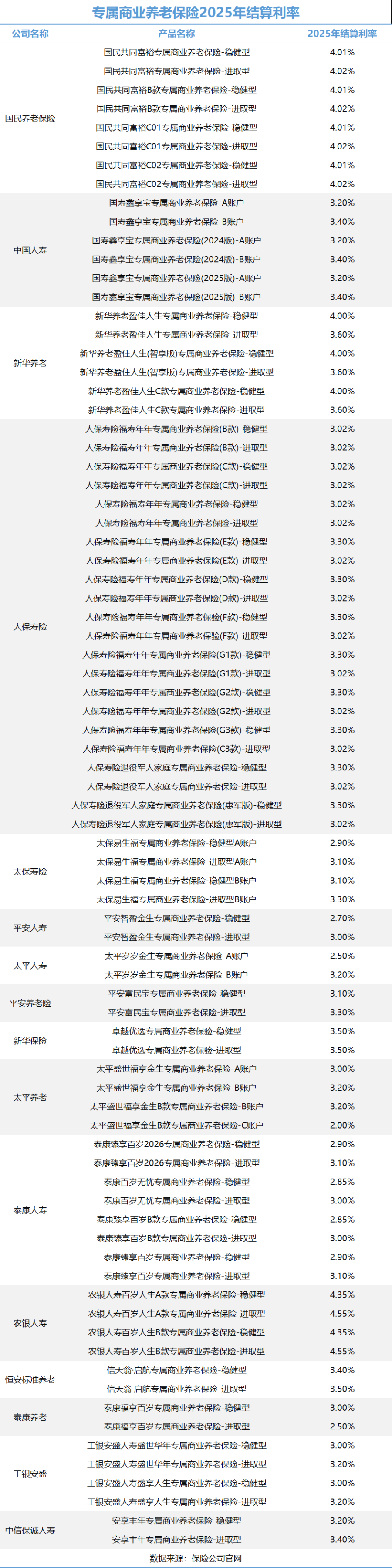
Core Viewpoint - The recent disclosure of 2025 settlement rates for exclusive commercial pension insurance products by multiple insurance institutions highlights a promising investment opportunity amidst declining bank deposit rates and fluctuating wealth management product values. The majority of these products offer competitive returns, with over 80% of them exceeding a 3.00% settlement rate for 2025 [1][2][8]. Summary by Category Insurance Product Performance - A total of 40 exclusive commercial pension insurance products have been reported, with settlement rates for stable accounts ranging from 2.00% to 4.35%, and for aggressive accounts from 2.50% to 4.55% [1][2]. - Among these products, 70 accounts (87.5%) have a settlement rate exceeding 3.00% [1][2]. - Notably, the products from Nongyin Life and Guomin Pension have all their settlement rates above 4.00%, with Nongyin Life's stable and aggressive accounts both at 4.35% and 4.55%, respectively [8]. Market Context - The backdrop of declining deposit rates has led to increased difficulty for investors seeking stable returns, prompting a shift towards pension insurance products as a viable alternative [2][8]. - The trend of "deposit special forces" among young investors reflects the growing demand for higher interest rates, which has become increasingly challenging to find in traditional banking products [2]. Product Structure and Design - Exclusive commercial pension insurance products are designed with both stable and aggressive accounts, allowing for a balance between guaranteed returns and potential higher yields [10][14]. - The unique structure of these products enables insurance companies to adopt long-term investment strategies, optimizing returns despite a low-interest environment [9][10]. - There is a notable phenomenon where some stable accounts are yielding higher returns than aggressive accounts, contrary to typical expectations [11]. Target Audience and Flexibility - These products cater to the needs of flexible employment groups, offering more adaptable payment options compared to traditional annuity insurance [12][14]. - The ability to choose between different account types and adjust contributions provides consumers with a tailored approach to retirement planning [13][14]. Regulatory Environment - The regulatory framework for exclusive commercial pension insurance includes mechanisms for monitoring settlement rates and ensuring financial stability, which enhances consumer confidence in these products [20].
大行评级|花旗:预期寿险股将迎来历史性机遇,偏好中国人寿及中国平安
Ge Long Hui· 2026-01-19 08:55
Core Viewpoint - Citigroup forecasts a historic opportunity for life insurance stocks driven by wealth reallocation as retail investors seek higher reinvestment yields due to a large amount of bank deposits maturing [1] Life Insurance Sector - Profit margins for life insurance companies are expected to remain stable, as the reduction in pricing interest rates in September last year offsets the margin erosion caused by a shift towards participating products [1] - The firm favors industry leaders such as China Life and Ping An, anticipating a significant K-shaped growth differentiation between leading insurers and smaller firms amid ongoing regulatory tightening [1] Property and Casualty Insurance Sector - The firm projects a 4% growth in industry premiums, with further improvement potential in the combined cost ratio under favorable regulatory conditions [1] - Key drivers for this growth include the rationalization of expenses towards non-auto insurance businesses, ongoing regulatory reinforcement in auto insurance cost management, and gradual liberalization of pricing for new energy vehicle policies [1] - Leading property and casualty insurers are expected to benefit the most, likely delivering industry-leading performance [1]

荣获四大奖项 中国人寿书写金融高质量发展答卷
Xin Lang Cai Jing· 2026-01-19 07:54
Core Insights - China Life Insurance Company has received multiple industry awards, including the "Annual Insurance Protection Brand Award" and the "Annual Insurance Corporate Social Responsibility Award," reflecting its leadership in the insurance sector and commitment to social responsibility and digital transformation [1][3]. Group 1: Business Performance - In the first three quarters of 2025, China Life achieved total premiums of 669.645 billion yuan, a year-on-year increase of 10.1%, with new premiums reaching 218.034 billion yuan, up 10.4% [1]. - The company reported double-digit growth in total premiums, new premiums, and renewal premiums, with total premiums expected to exceed 700 billion yuan by the end of 2025 [1]. Group 2: Product and Service Development - China Life is focusing on value creation and efficiency improvement by diversifying its product offerings, including life insurance, annuities, and health insurance, leading to balanced growth in new premiums [2]. - The company has implemented a dynamic adjustment mechanism linking predetermined interest rates to market rates, significantly reducing the rigid costs of new business liabilities [2]. Group 3: Social Responsibility - China Life has established a comprehensive inclusive insurance service system, leveraging its extensive network of 18,000 institutions to serve various demographics, including the elderly and small businesses [3]. - The company has provided approximately 11.2 trillion yuan in risk protection for small businesses and individual entrepreneurs, benefiting over 32 million people [3]. Group 4: Rural Development and Green Initiatives - In 2025, China Life deployed 1,020 village support staff to assist in 1,085 aid points, covering 227 million rural residents with life insurance, providing a total coverage amount of 27.99 trillion yuan [4]. - The company is actively involved in green development, integrating green standards into its investment processes and participating in renewable energy projects [4]. Group 5: Cultural Development - China Life is enhancing its corporate culture by launching the "Corporate Culture Gene Renewal" project, which aims to align its cultural values with sustainable development [6]. - The project emphasizes the integration of traditional and modern financial cultures, focusing on core values such as integrity, innovation, and compliance [6]. Group 6: Digital Transformation - China Life has developed a "one-stop" online insurance digital space, improving service efficiency and customer experience through technology [8]. - The company has processed over 58,000 online claims, achieving a service handling time improvement of over 50% compared to traditional methods [8]. Group 7: Future Commitment - The recognition from various awards serves as both motivation and responsibility for China Life to continue enhancing its core competencies and leading the industry towards high-quality development [9].
保险巨头盯上了50万亿到期存款
Xin Lang Cai Jing· 2026-01-19 07:37
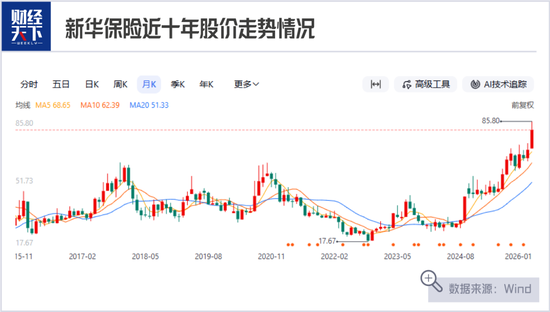
Core Viewpoint - The insurance sector is experiencing a significant rebound at the beginning of 2026, with insurance stocks rising sharply and sales of insurance products improving due to low deposit rates and favorable market conditions [1][19]. Group 1: Stock Performance - Insurance stocks have seen substantial gains, with New China Life leading with a 17.78% increase as of January 16, 2026. The top five listed insurance companies have all recorded double-digit growth over the past three months, with increases ranging from 10.32% to 23.83% [2][20]. - Historical data indicates that since 2014, there have been five notable bullish trends in the insurance sector, with stock market performance being a key catalyst for these trends [2][20]. Group 2: Sales Performance - The insurance industry is witnessing a resurgence in sales, with reports of significant premium collections, such as one company surpassing 3 billion yuan in first-year premium within four days after New Year [5][23]. - The total insurance premium income in China reached 5.76 trillion yuan by November 2025, marking an increase of 400 billion yuan from the previous year [5][23]. Group 3: Product Trends - The rise in sales is attributed to the popularity of participating insurance products, which combine protection and investment features. These products have become attractive due to their lower guaranteed rates and the current low-interest environment [6][24]. - Major insurance companies are focusing on participating insurance products, with new offerings featuring guaranteed rates around 1.75% and projected returns between 3.5% and 3.9% [7][25]. Group 4: Investment Performance - The total investment income of listed insurance companies reached 887.5 billion yuan in the first three quarters of 2025, reflecting a year-on-year increase of 35.64% [10][28]. - The investment strategies of insurance companies have shifted towards equities, with significant increases in stock and equity fund investments, particularly for companies like China Life and Ping An [12][30]. Group 5: Future Outlook - Analysts express optimism about the continued strength of insurance stocks in 2026, driven by robust premium growth and improved business quality, alongside favorable investment conditions [16][34]. - However, challenges remain, particularly regarding the long-term risks associated with interest rate spreads and the need for insurance companies to diversify their product offerings and improve customer satisfaction [16][35].

国际知名投行最新研判:保险股再迎“戴维斯双击”!
Xin Lang Cai Jing· 2026-01-19 06:29
Core Viewpoint - The insurance sector is poised for strategic investment opportunities due to the growth in net assets and investment returns, supported by shifts in resident savings towards insurance assets, alongside favorable policies [1][9]. Group 1: Performance Metrics - The insurance index is projected to rise by 31.31% in 2025, outperforming other financial sectors such as banking (12.04%) and brokerage (4.05%) [1]. - Individual stocks like New China Life, Ping An, China Pacific Insurance, China Life, and China Property & Casualty are expected to see significant increases in their stock prices, with respective gains of 46.03%, 35.87%, 26.6%, 21.21%, and 10.39% in 2025 [1]. - The A-share insurance sector is anticipated to maintain strong performance into 2026, with continued growth in the liability side and improved investment returns on the asset side [1]. Group 2: Liability Side Developments - The transformation of participating insurance products is enhancing competitiveness, attracting funds due to their "guaranteed + floating" return characteristics amid declining bank deposit rates [2][10]. - The ongoing shift in resident deposits and the reduction in large bank certificates of deposit are expected to further expand the growth of the insurance liability side [2][11]. - The demand for pension and health protection is driving the appeal of insurance products, which are expected to capture a larger share of resident savings and fixed-income investments [2][12]. Group 3: Asset Side Strategies - Insurers are increasing their allocation to equity assets due to pressure on interest margins and the challenges of bond yields not covering the costs of new premium inflows [5][14]. - The need for higher investment returns is pushing insurers to enhance their equity investment capabilities, especially as the industry transitions to a full-scale transformation of participating insurance by 2027 [5][15]. - The long-term trend indicates a significant increase in the proportion of equity investments within insurance portfolios, driven by the need for better returns [5][15]. Group 4: Policy Environment - Regulatory policies since September 2024 have encouraged insurance capital to enter the market, with expectations of substantial annual inflows into A-shares [7][16]. - The introduction of structural easing policies aims to optimize asset allocation and reduce capital requirements for insurance companies, supporting long-term market stability [7][16]. - The focus on nurturing patient capital and guiding long-term investments is expected to stabilize the capital market, with a particular emphasis on technology sectors for potential high returns [8][17].
