MEITUAN(03690)

Search documents
智通港股沽空统计|2月25日
智通财经网· 2026-02-25 00:24
Group 1 - Anta Sports-R (82020), JD Health-R (86618), and Geely Automobile-R (80175) have the highest short-selling ratios at 100.00%, 100.00%, and 95.46% respectively [1] - Tencent Holdings (00700), Alibaba-W (09988), and Meituan-W (03690) lead in short-selling amounts, with 2.193 billion, 1.867 billion, and 1.658 billion respectively [1] - Geely Automobile-R (80175), Tencent Holdings-R (80700), and Blue Moon Group (06993) have the highest deviation values at 56.09%, 35.57%, and 33.29% respectively [1] Group 2 - The top short-selling ratio rankings show Anta Sports-R (82020) at 100.00% with a short-selling amount of 29.79 thousand, followed by JD Health-R (86618) at 100.00% with 9.88 thousand, and Geely Automobile-R (80175) at 95.46% with 31.09 thousand [2] - The top short-selling amounts are led by Tencent Holdings (00700) at 2.193 billion, Alibaba-W (09988) at 1.867 billion, and Meituan-W (03690) at 1.658 billion [2] - The highest short-selling deviation values are led by Geely Automobile-R (80175) at 56.09%, followed by Tencent Holdings-R (80700) at 35.57%, and Blue Moon Group (06993) at 33.29% [2]



中金 | 巴西外卖:格局生变,潜力待发
中金点睛· 2026-02-24 23:41
Core Insights - The Brazilian food delivery market is expected to be dominated by iFood until 2025, with the entry of Chinese companies Didi and Meituan into the market generating significant attention [1] - The article analyzes Brazil's demographic and geographic patterns, economic conditions, food delivery market development, and industry competition dynamics [1] Market Overview - Brazil has a population of approximately 213 million, ranking 7th globally, with a GDP of $2.19 trillion expected in 2024, accounting for 31% of Latin America's GDP [4][6] - The food delivery market in Brazil is projected to grow from $18.7 billion in 2024 (penetration rate of 18.7%) to $33.3 billion by 2028 (penetration rate of 28.5%), with a CAGR of 15% [4][14] - iFood currently holds a dominant position in the market, benefiting from early entry advantages, exclusive merchant agreements, and strong local operations [4][18] Competitive Landscape - The competitive landscape is evolving with the entry of Didi's 99Food and Meituan's Keeta in 2025, both adopting differentiated strategies to penetrate the market [5][19] - iFood has established a strong market presence, capturing over 80% of the market share, while Uber Eats exited the market in 2022 due to competitive pressures [19][22] - The regulatory environment is tightening, with antitrust measures limiting iFood's exclusive agreements, creating opportunities for new entrants [5][30] Payment and Consumer Behavior - Brazil's payment landscape is characterized by a high adoption of Pix, which has surpassed cash transactions, accounting for 17% of all payment transactions in 2023 [12][11] - The culture of installment payments is prevalent, with credit card transactions growing by 14.8% year-on-year in the first three quarters of 2025 [12][14] Growth Potential - The food delivery market in Brazil has significant room for growth, with a current penetration rate lower than that of China and the U.S. [14][17] - The expected increase in market size and daily order volume indicates a robust growth trajectory, with daily orders projected to rise from 4.51 million in 2024 to 8.84 million by 2028 [14][17] Strategic Initiatives - iFood is leveraging its established network and capital support to enhance its service offerings and maintain its competitive edge [22][25] - Didi's 99Food aims to utilize its existing transportation network to create a cost-effective delivery system, while focusing on the middle and lower-income segments [40][49] - The integration of delivery and ride-hailing services is expected to enhance operational efficiency and customer acquisition for 99Food [46][49]



AI终极入口之战:字节阿里赢了,百度腾讯输了?
3 6 Ke· 2026-02-24 23:39
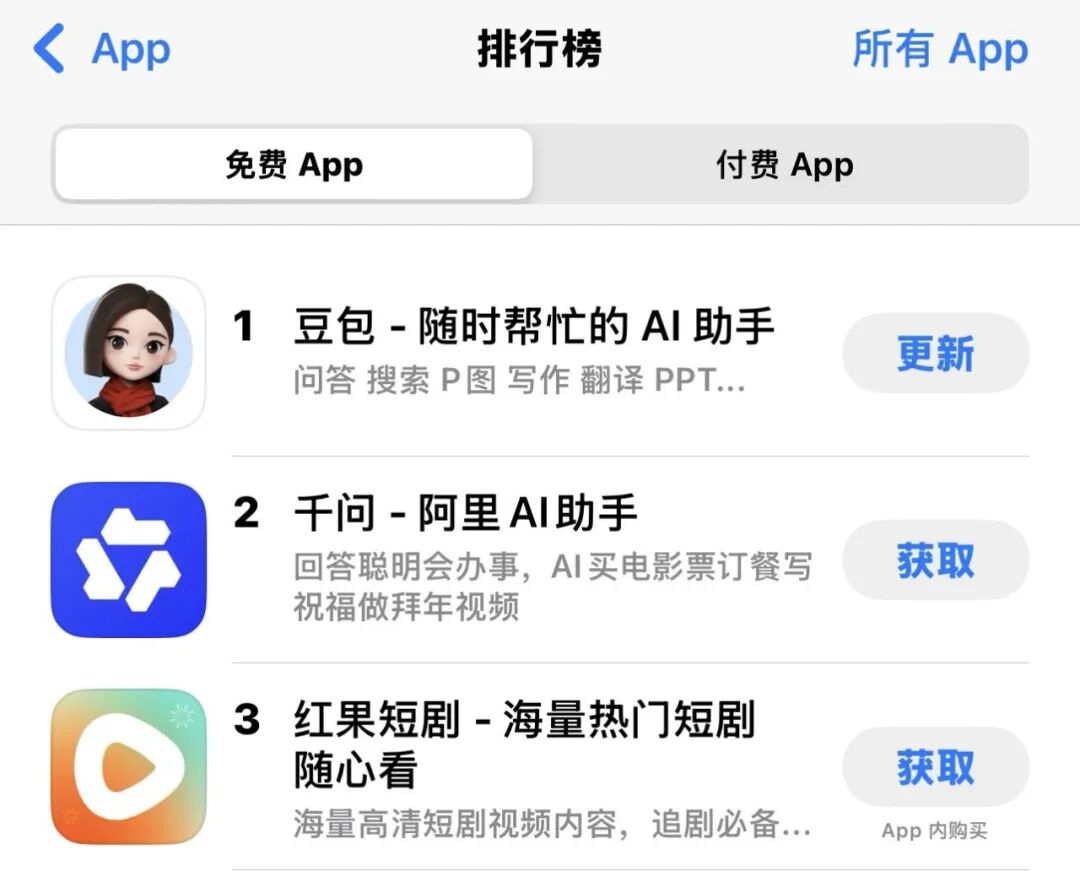
Core Insights - The competition for AI user entry points during the Chinese New Year has seen major investments exceeding 4.5 billion yuan from ByteDance, Alibaba, Baidu, and Tencent, marking a significant moment in China's AI and internet history [1][22] - The battle is not merely about acquiring traffic through financial incentives but about retaining users by integrating AI into daily life and establishing emotional connections [2][24] Group 1: Competitive Landscape - ByteDance's Doubao has successfully maintained its lead, leveraging a combination of entertainment and interaction, while Alibaba's Qianwen made significant strides but could not surpass Doubao [3][7] - Tencent's Yuanbao initially gained traction but quickly fell behind due to strategic contradictions and user retention issues, while Baidu's 500 million yuan investment did not yield the expected results [10][11][16] Group 2: Strategic Approaches - ByteDance's strategy focuses on embedding AI capabilities into high-frequency scenarios, creating emotional value by allowing users to personalize their AI interactions [5][6] - Alibaba's Qianwen has effectively integrated AI into its commercial ecosystem, enhancing user engagement through practical applications in daily services [9][21] Group 3: Challenges Faced - Tencent struggles with internal strategic conflicts, leading to a decline in user engagement with Yuanbao, which failed to provide clear value to users [13][15] - Baidu's reliance on a tool-centric approach limits its ability to compete effectively, as it lacks the ecosystem and user engagement strategies that other competitors have [16][18] Group 4: Future Directions - The competition is expected to shift from merely acquiring users through financial incentives to creating long-term value by embedding AI into everyday life [24][25] - The ultimate success will depend on how well companies can transform short-term user engagement into lasting habits and loyalty [24][27]

美团-2025 财年盈利预警
2026-02-24 14:18
Summary of Meituan FY25 Profit Warning Conference Call Company Overview - **Company**: Meituan (3690.HK) - **Industry**: China Internet and Other Services - **Market Cap**: Rmb452,077.4 million - **Stock Rating**: Overweight - **Price Target**: HK$120.00 - **Current Price**: HK$82.15 (as of February 13, 2026) Key Financial Highlights - **Profit Warning for FY25**: - **IFRS Net Profit Loss**: Expected range of Rmb23.3-24.3 billion [1] - **Core Local Commerce Operating Profit Loss**: Expected range of Rmb6.8-7 billion due to increased investments in competition [1] - **Continued Losses**: Expected to persist into Q1 2026 [1] - **Financial Estimates for FY25**: - **Total Revenues**: Rmb366,084 million (up 22% YoY) [4] - **Gross Profit**: Rmb112,367 million (down 13% YoY) [4] - **Operating Profit/Loss**: Rmb35,807 million (loss of Rmb26,832 million) [4] - **Adjusted EBITDA**: Rmb18,550 million (down 130% YoY) [4] - **Adjusted Net Profit/Loss**: Rmb10,526 million (down 144% YoY) [4] Competitive Landscape - **Market Dynamics**: - Aggressive competition from Alibaba (BABA) noted, with significant promotional activities impacting market share [3] - Qwen's Rmb3 billion promotion in milk tea/grocery delivery led to 10 million orders within 9 hours of launch [3] - **Profitability Outlook**: Limited visibility on a turnaround, with potential downside risks to profitability in 2026 [3] Risks and Opportunities - **Upside Risks**: - Improvement in food delivery market share and margins [10] - Further monetization of merchant Average Revenue Per User (ARPU) [10] - Successful investments in new initiatives [10] - **Downside Risks**: - Intensified competition in food delivery and quick commerce [10] - Low visibility on loss-making and asset-heavy new initiatives [10] - Weaker-than-expected macroeconomic conditions [10] - Potential antitrust regulations [10] Additional Insights - **Revenue Growth**: Core local commerce revenues projected to grow to Rmb303,198 million in FY25, reflecting a 16% increase [4] - **Transaction Metrics**: Daily average orders expected to rise to 88.7 million, a 10% increase [4] - **Valuation Methodology**: Based on discounted cash flow with a WACC of 12% and a terminal growth rate of 3% [8] This summary encapsulates the critical financial data, competitive landscape, and potential risks and opportunities for Meituan as discussed in the conference call.

资金动向 | 北水买入港股逾31亿港元,加仓美团、小米
Ge Long Hui A P P· 2026-02-24 11:52
Group 1 - The net buying of Southbound funds includes significant amounts in Southern Hang Seng Technology (1.585 billion), Meituan-W (0.687 billion), Xiaomi Group-W (0.437 billion), Kuaishou-W (0.304 billion), UBTECH (0.242 billion), and SMIC (0.220 billion), while there was a net sell of Pop Mart (0.205 billion) [1] - Southbound funds have continuously net bought Meituan for five days, totaling 2.62343 billion HKD, and Xiaomi for three days, totaling 2.66892 billion HKD [4] Group 2 - Xiaomi Group-W's vehicle delivery is expected to exceed forecasts, potentially reaching 650,000 units by 2026, with a strategy to counteract declining smartphone ASP through stable IoT and internet business [5] - UBTECH's humanoid robot gained significant popularity during the Spring Festival, with institutions predicting a substantial growth phase for the industry this year [6] - SMIC's revenue for Q4 2025 is expected to exceed forecasts, maintaining high capital expenditure [7] - Pop Mart announced the launch of a new IP "After School Merodi" on February 26, featuring 12 regular and 1 hidden model, with pricing set at 69 RMB per blind box and 828 RMB per complete set [7]
智通港股通活跃成交|2月24日





智通财经网· 2026-02-24 11:04
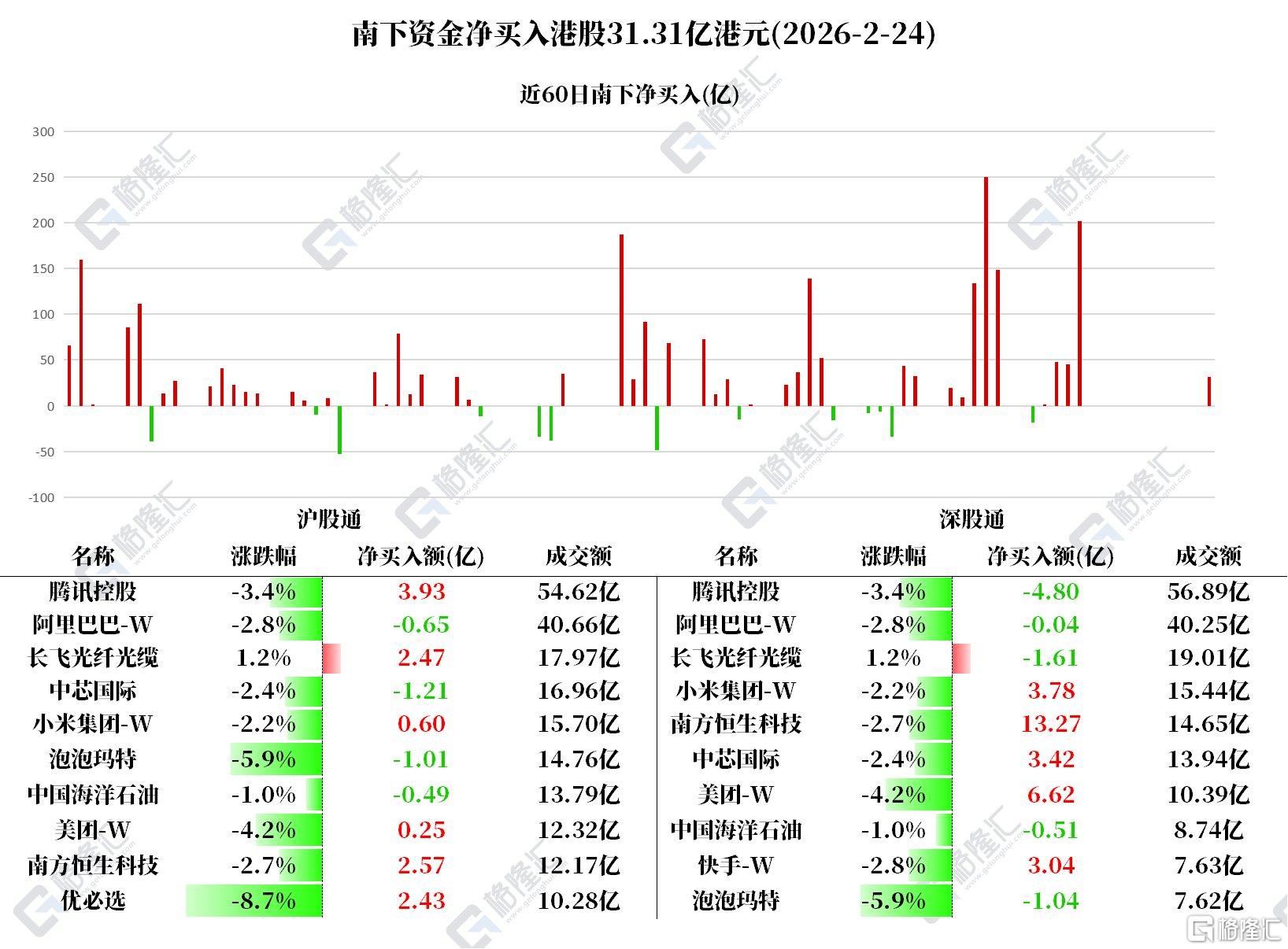
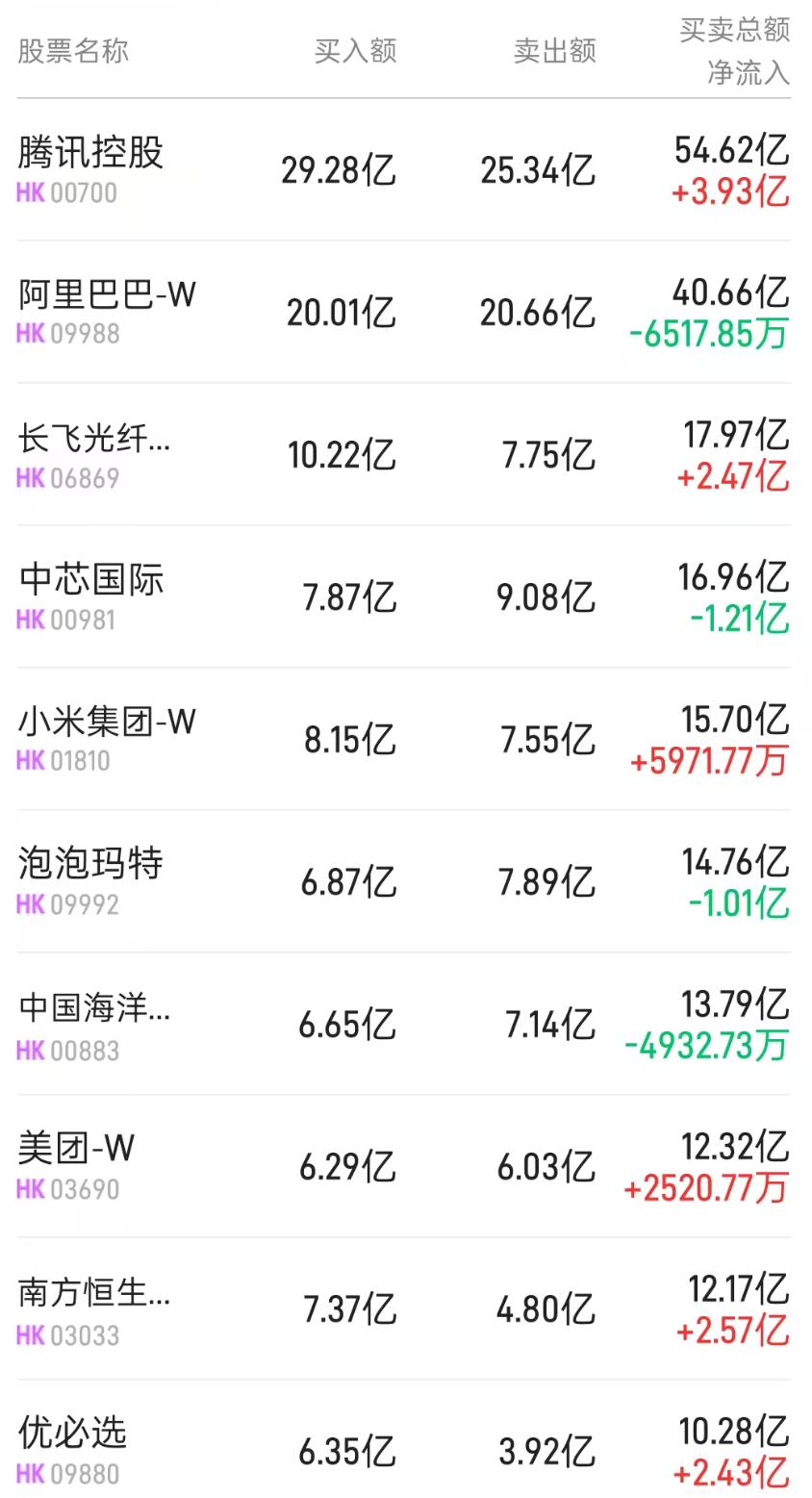
Core Insights - On February 24, 2026, Tencent Holdings (00700), Alibaba-W (09988), and Yangtze Optical Fibre and Cable (06869) were the top three companies by trading volume in the Southbound Stock Connect, with trading amounts of 5.462 billion, 4.066 billion, and 1.797 billion respectively [1] - Tencent Holdings (00700), Alibaba-W (09988), and Yangtze Optical Fibre and Cable (06869) also led in trading volume in the Shenzhen-Hong Kong Stock Connect, with trading amounts of 5.689 billion, 4.025 billion, and 1.901 billion respectively [1] Southbound Stock Connect Trading Activity - **Top Active Companies in Southbound Stock Connect:** - Tencent Holdings (00700): Trading amount of 5.462 billion, net buying of +0.393 billion [2] - Alibaba-W (09988): Trading amount of 4.066 billion, net selling of -0.065 billion [2] - Yangtze Optical Fibre and Cable (06869): Trading amount of 1.797 billion, net buying of +0.247 billion [2] - SMIC (00981): Trading amount of 1.696 billion, net selling of -0.121 billion [2] - Xiaomi Group-W (01810): Trading amount of 1.570 billion, net buying of +0.059 billion [2] - Pop Mart (09992): Trading amount of 1.476 billion, net selling of -0.101 billion [2] - CNOOC (00883): Trading amount of 1.379 billion, net selling of -0.049 billion [2] - Meituan-W (03690): Trading amount of 1.232 billion, net buying of +0.025 billion [2] - Southern Hang Seng Technology (03033): Trading amount of 1.217 billion, net buying of +0.026 billion [2] - UBTECH (09880): Trading amount of 1.028 billion, net buying of +0.024 billion [2] Shenzhen-Hong Kong Stock Connect Trading Activity - **Top Active Companies in Shenzhen-Hong Kong Stock Connect:** - Tencent Holdings (00700): Trading amount of 5.689 billion, net selling of -0.480 billion [2] - Alibaba-W (09988): Trading amount of 4.025 billion, net selling of -0.000384 billion [2] - Yangtze Optical Fibre and Cable (06869): Trading amount of 1.901 billion, net selling of -0.161 billion [2] - Xiaomi Group-W (01810): Trading amount of 1.544 billion, net buying of +0.378 billion [2] - Southern Hang Seng Technology (03033): Trading amount of 1.465 billion, net buying of +1.327 billion [2] - SMIC (00981): Trading amount of 1.394 billion, net buying of +0.342 billion [2] - Meituan-W (03690): Trading amount of 1.039 billion, net buying of +0.066 billion [2] - CNOOC (00883): Trading amount of 0.874 billion, net selling of -0.05057 billion [2] - Kuaishou-W (01024): Trading amount of 0.763 billion, net buying of +0.0304 billion [2] - Pop Mart (09992): Trading amount of 0.762 billion, net selling of -0.0104 billion [2]
北水动向|北水成交净买入31.31亿 内资全天抢筹南方恒生科技近16亿港元
智通财经网· 2026-02-24 10:09
Group 1: Market Overview - The Hong Kong stock market saw a net inflow of 31.31 billion HKD from northbound trading, with 9.6 billion HKD from Shanghai and 21.7 billion HKD from Shenzhen [1] - The most bought stocks included Southern Hang Seng Technology (03033), Meituan-W (03690), and Xiaomi Group-W (01810) [1] - The most sold stocks were CNOOC (00883), Tencent (00700), and Alibaba-W (09988) [1] Group 2: Stock Performance - Southern Hang Seng Technology (03033) received a net inflow of 15.84 billion HKD, supported by positive sentiment in the tech sector [5] - Meituan-W (03690) saw a net inflow of 6.87 billion HKD, with a report indicating a 79% year-on-year increase in travel spending during the Spring Festival [5] - Xiaomi Group-W (01810) had a net inflow of 4.37 billion HKD, with plans to focus on core technologies like chips and AI over the next five years [5] Group 3: Individual Stock Insights - Tencent Holdings (00700) had a total trading volume of 54.62 billion HKD, with a net inflow of 3.93 billion HKD [2] - Alibaba-W (09988) experienced a net outflow of 651.785 million HKD, with total trading of 40.66 billion HKD [2] - SMIC (00981) received a net inflow of 2.2 billion HKD, with expectations of sales growth exceeding industry averages by 2026 [6][7]

北水动向|北水成交净买入31.31亿 内资全天抢筹南方恒生科技(03033)近16亿港元
智通财经网· 2026-02-24 09:57
Group 1: Market Overview - The Hong Kong stock market saw a net inflow of 31.31 billion HKD from northbound trading, with 9.6 billion HKD from Shanghai and 21.7 billion HKD from Shenzhen [1] - The most bought stocks included Southern Hang Seng Technology (03033), Meituan-W (03690), and Xiaomi Group-W (01810) [1] - The most sold stocks were CNOOC (00883), Tencent (00700), and Alibaba-W (09988) [1] Group 2: Individual Stock Performance - Southern Hang Seng Technology (03033) received a net inflow of 15.84 billion HKD, with analysts suggesting that the tech sector remains a long-term investment focus due to reduced valuation pressure and accelerating AI applications [4] - Meituan-W (03690) saw a net inflow of 6.87 billion HKD, with a report indicating a 79% year-on-year increase in tourism spending during the Spring Festival [5] - Xiaomi Group-W (01810) had a net inflow of 4.37 billion HKD, with plans to focus on core technologies like chips and AI over the next five years [5] - SMIC (00981) received a net inflow of 2.2 billion HKD, with positive signals for 2026 sales growth expected to exceed industry averages [6] - CNOOC (00883) faced a net outflow of 998.9 million HKD amid geopolitical risks affecting the oil market [6] - Tencent (00700) and Alibaba-W (09988) experienced net outflows of 867.7 million HKD and 690.1 million HKD, respectively [6]
港股三大指数全线跳水,恒生科技跌超2%,科技巨头齐跌!中国中免跌超10%,智谱逆势大涨12%|港股收盘
Mei Ri Jing Ji Xin Wen· 2026-02-24 09:05
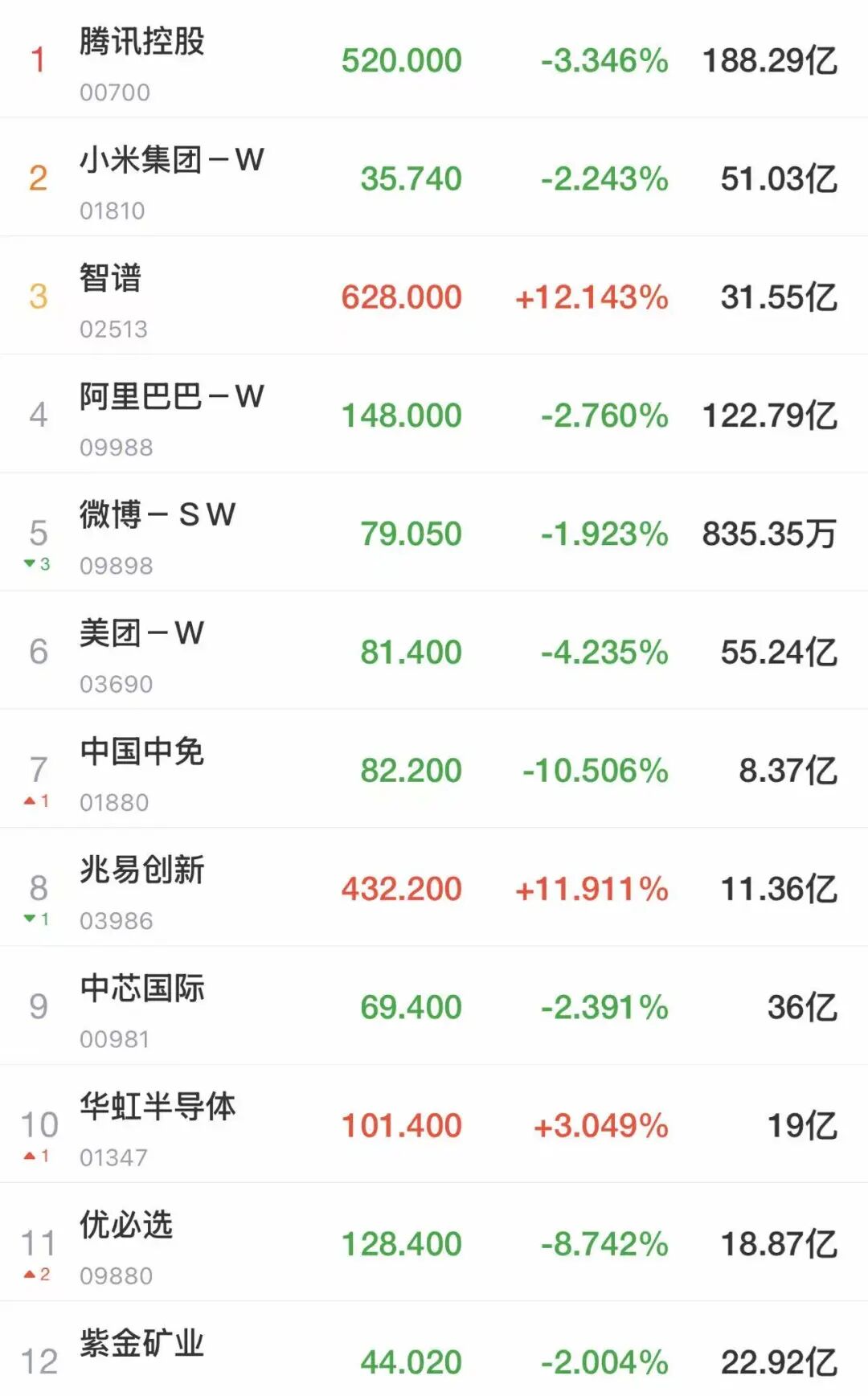
Market Overview - The Hong Kong stock market experienced a decline across all major indices, with the Hang Seng Index falling by 1.82%, the Hang Seng Tech Index down by 2.13%, and the National Enterprises Index decreasing by 2.06% [1] - Major internet technology stocks also saw significant drops, including Tencent Holdings down nearly 3.3%, Alibaba down 2.7%, and Kingsoft Cloud down 5% [1] Stock Performance - Tencent Holdings closed at 188.29 billion, down 3.346% [2] - Xiaomi Group fell by 2.243%, closing at 51.03 billion [2] - Alibaba's stock decreased by 2.760%, ending at 148.00 billion [2] - Meituan saw a decline of 4.235%, closing at 55.24 billion [2] - China Duty Free Group experienced a significant drop of over 10.506%, closing at 8.37 billion [3] Sector Analysis - The robotics, pharmaceuticals, and duty-free sectors all faced declines, with China Duty Free Group dropping over 10%, and other companies like Tigermed and Zhaoyan New Drug falling by more than 3.6% and 7.3% respectively [3] - Conversely, Zhizhu saw a notable increase of over 12%, marking a rise of over 440% since its listing in January [3] Future Outlook - According to Liu Gang, a managing director at CICC, the credit cycle will determine index space, while industry trends will influence structural strength [3] - Short-term market adjustments may occur, but there is potential for upward correction after a pullback [3] - The mid-term outlook suggests a projected earnings growth of 3% to 4% for Hong Kong stocks, with the Hang Seng Index potentially rising to around 28,000 to 29,000 points [3] - The influx of capital from the south post-Chinese New Year is expected to provide liquidity support for the Hong Kong market [3] - Recommendations include focusing on technology (AI computing and applications), non-bank financials (insurance), and dividend stocks, with an emphasis on the need to confirm earnings and liquidity turning points for the Hang Seng Tech Index [3]

美团、携程、腾讯、阿里、百度,今日齐跌
Di Yi Cai Jing Zi Xun· 2026-02-24 08:40
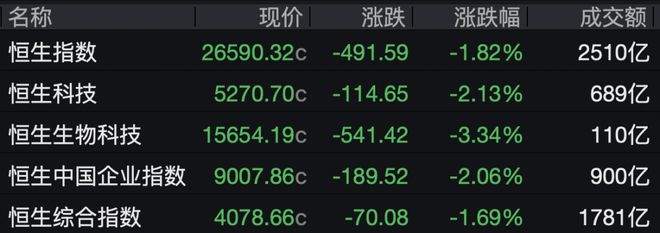
Market Overview - The Hang Seng Index closed down by 1.82% at 26,590.32, with a decline of 491.59 points and a trading volume of 251 billion [2] - The Hang Seng Tech Index fell by 2.13% to 5,270.70, decreasing by 114.65 points with a trading volume of 68.9 billion [2] - The Hang Seng Biotech Index dropped by 3.34% to 15,654.19, down by 541.42 points with a trading volume of 11 billion [2] - The Hang Seng China Enterprises Index decreased by 2.06% to 9,007.86, down by 189.52 points with a trading volume of 90 billion [2] - The Hang Seng Composite Index fell by 1.69% to 4,078.66, down by 70.08 points with a trading volume of 178.1 billion [2] Sector Performance - Technology stocks experienced widespread declines, with notable drops including SenseTime and Tencent Music falling over 5%, Meituan and Kingsoft down over 4%, and Ctrip and Tencent Holdings down over 3% [2] - Other major tech companies such as Kuaishou, Alibaba, Baidu, SMIC, Xiaomi, and JD Health all saw declines exceeding 2% [2] Individual Stock Movements - Kingdee International saw a significant drop of 7.77% to 9.970, with a trading volume of 721 million [3] - SenseTime fell by 5.78% to 2.610, with a trading volume of 2.326 billion [3] - Tencent Music decreased by 5.62% to 57.100, with a trading volume of 170 million [3] - Meituan dropped by 4.24% to 81.400, with a trading volume of 5.524 billion [3] - Kingsoft fell by 4.23% to 26.740, with a trading volume of 424 million [3] - Ctrip Group decreased by 3.83% to 406.800, with a trading volume of 2.044 billion [3] - Tencent Holdings fell by 3.35% to 520.000, with a trading volume of 18.829 billion [3] - Other notable declines included Alibaba Health down 2.94%, Kuaishou down 2.77%, Alibaba down 2.76%, SMIC down 2.39%, Xiaomi down 2.24%, and JD Health down 2.15% [3] Robotics Sector - The robotics sector collectively weakened, with UBTECH falling over 8%, Sanhua Intelligent Control down over 6%, and Horizon Robotics down 2% [5][6]