
BANK OF CHINA(03988)

Search documents
头部农商行再添一员 中国银行业格局生变
2 1 Shi Ji Jing Ji Bao Dao· 2026-01-22 23:10
Core Viewpoint - A new force characterized by regional deepening is rapidly emerging in China's banking industry, with Chengdu Rural Commercial Bank becoming the fifth rural commercial bank to surpass 1 trillion yuan in assets, highlighting a structural change in the industry towards localized service models [1][2]. Group 1: Emergence of Regional Banks - Chengdu Rural Commercial Bank officially announced its asset scale surpassed 1 trillion yuan on January 1, 2026, joining the ranks of four other major rural commercial banks [1]. - The five banks that have reached this milestone are all urban rural commercial banks headquartered in national central cities, which have high urbanization levels and strong economic radiation capabilities [1]. - The success of these banks is attributed to their deep understanding of local economies and a strategic focus on localized services, aligning with regulatory guidance emphasizing support for local communities and agriculture [2]. Group 2: Development Strategies - Each of the trillion-yuan rural commercial banks has developed unique advantages based on local characteristics, such as Beijing Rural Commercial Bank focusing on "three rural" services and Shanghai Rural Commercial Bank developing technology and elderly finance [3]. - Chengdu Rural Commercial Bank aims to be a bank that understands rural revitalization and local industries, optimizing its branch layout to enhance service breadth and depth [3]. - The bank has achieved over 80% account opening rates for new agricultural operators and over 72% credit coverage for major grain producers, demonstrating its effective local engagement [3][4]. Group 3: Financial Performance - Since the end of 2019, Chengdu Rural Commercial Bank's asset scale has grown from less than 500 billion yuan to over 1 trillion yuan by early 2026, with an annual growth rate significantly above the industry average [4]. - The bank maintains a stable asset quality, with a non-performing loan ratio of 1.02% and a provision coverage ratio of 441.83% as of mid-2025, indicating strong financial health compared to peers [4]. Group 4: Challenges and Transformation - Surpassing the 1 trillion yuan mark signifies a new development stage for these regional banks, necessitating a restructuring of their development models and management capabilities [6]. - The banks face three core challenges: pressure on profit growth due to narrowing net interest margins, accelerated capital consumption from risk-weighted asset expansion, and increased difficulty in risk management amid economic adjustments [6][7]. - To address these challenges, banks must diversify their income structures, enhance capital accumulation, and strengthen risk management through digital means [7][8]. Group 5: Digitalization and Future Outlook - Chengdu Rural Commercial Bank is focusing on digitalization by enhancing mobile banking and online service platforms, with over 4 million mobile banking users and a community service platform linking 110 communities [8]. - The emergence of trillion-yuan rural commercial banks indicates that impactful financial institutions can be cultivated in regional economies, emphasizing the importance of local engagement for sustainable development [8].

智通ADR统计 | 1月23日
智通财经网· 2026-01-22 22:19
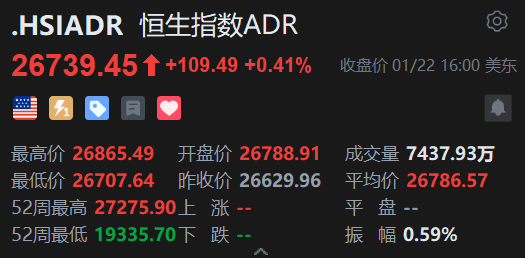
Market Overview - The Hang Seng Index (HSI) closed at 26,739.45, up by 109.49 points or 0.41% as of January 22, 16:00 Eastern Time [1] - The index reached a high of 26,865.49 and a low of 26,707.64 during the trading session, with a trading volume of 74.379 million shares [1] Stock Performance - HSBC Holdings closed at HKD 130.600, an increase of 0.69% compared to the previous close [2] - Tencent Holdings closed at HKD 594.990, a decrease of 0.42% compared to the previous close [2] - Alibaba Group (ADR) saw a price increase of 4.78%, closing at HKD 164.800, while its ADR price was USD 172.684 [3] - Other notable stock movements include: - China Ping An: down 2.34% to HKD 66.900 [3] - Baidu Group: up 4.10% to HKD 160.000 [3] - BYD Company: up 0.71% to HKD 99.750 [3] - New World Development: up 3.63% to HKD 114.200 [3]





中国银行股份有限公司深圳市分行与中国信达资产管理股份有限公司深圳市分公司债权转让通知暨债务催收联合公告
Jing Ji Ri Bao· 2026-01-22 22:19
Core Viewpoint - China Bank has signed a bulk asset transfer agreement with China Cinda Asset Management, transferring its rights to certain debt claims to the latter, effective from September 22, 2025 [1]. Group 1: Agreement Details - The agreement involves the transfer of principal debt claims and all rights under the relevant guarantee contracts to China Cinda Shenzhen Branch [1]. - Borrowers and guarantors listed in the announcement are required to fulfill their repayment obligations immediately upon the announcement [1]. Group 2: Debt Information - The announcement includes a list of borrowers with their respective debt amounts, with the principal balances as of the transfer benchmark date of August 6, 2025 [1]. - The total principal amounts for some of the borrowers include: - Shenzhen Xin Hai Wei Cloud Computing Co., Ltd: 4,561,480.35 RMB [4] - Shenzhen Jing Shi Construction Repair Waterproof Engineering Co., Ltd: 3,119,978.37 RMB [4] - Shenzhen Mi Tu Technology Co., Ltd: 2,349,541.00 RMB [4] - Shenzhen Ai Mei Commercial Management Co., Ltd: 9,999,773.33 RMB [4]. Group 3: Contact Information - Contact details for inquiries are provided for both China Bank and China Cinda Asset Management, including phone numbers and addresses [3][4].
云南中行助乡村振兴与金融消保深度融合
Xin Lang Cai Jing· 2026-01-22 22:14
Core Viewpoint - The China Bank Yunnan Branch is implementing a special initiative titled "Financial Knowledge into Villages, Protecting Rights and Warming Hearts" to enhance financial education and consumer rights protection in rural areas since 2025 [1]. Group 1: Promotion of Financial Education - The China Bank branches in Qujing, Wenshan, and Kunming are advancing financial education by setting up mobile promotion stations, hanging banners, and distributing materials in local dialects to explain practical knowledge such as fraud prevention, deposit insurance, personal credit, and agricultural loans [1]. - The China Bank Puer Branch is targeting employees in enterprises to raise awareness about consumer rights protection and the dangers of illegal fundraising and telecom fraud, thereby enhancing the risk prevention capabilities of wage earners [1]. Group 2: Enhancing Rural Outreach - The China Bank Xishuangbanna Branch is leveraging local language skills by forming a promotional team fluent in ethnic languages to conduct on-site explanations and Q&A sessions [1]. - The China Bank Chuxiong Branch and Kunming Guandu Branch are utilizing real case studies of fraud and illegal fundraising in their promotions, transforming abstract legal concepts into relatable stories to enhance the warning effect [2]. Group 3: Tailored Approaches for Rural Empowerment - The China Bank Yuxi New Ping Branch is promoting the importance of integrity and credit records in rural areas, explaining the role of personal credit reports and methods to maintain good credit, while advocating for a social ethos of "benefits for trustworthiness, penalties for dishonesty" [3]. - The China Bank Lijiang Branch is focusing on improving residents' abilities to identify and resist telecom fraud and illegal fundraising, while also introducing agricultural loans and inclusive credit policies to integrate financial education with services effectively [3].
信用卡账单分期业务纳入贴息支持范围 年贴息比例为一个百分点
Ren Min Ri Bao· 2026-01-22 22:01
Group 1 - The core viewpoint of the news is the comprehensive upgrade of the consumer loan "national subsidy" policy, which includes extending the policy deadline to the end of this year and incorporating credit card bill installment services into the support scope [1] - The annual subsidy rate for credit card bill installments is set at 1%, which is a significant highlight of the policy upgrade that consumers are concerned about [1] - Financial institutions such as China Construction Bank and Agricultural Bank of China have clarified the application process for credit card bill installment subsidies, emphasizing that the process remains generally the same but requires signing specific agreements [1] Group 2 - Credit card holders can enjoy consumer credit support through bill installments without needing to apply for personal consumer loans, making it more convenient and often at lower rates than credit card overdrafts, which can effectively enhance consumer willingness and capacity [2] - Major banks like Industrial and Commercial Bank of China and Bank of China have stated that loans with completed subsidy applications do not need to re-sign subsidy agreements, and transactions from January 1, 2026, will automatically apply the latest subsidy policy [2] - The policy has expanded the range of institutions eligible for subsidies, including city commercial banks, rural cooperative financial institutions, foreign banks, consumer finance companies, and auto finance companies, which will help boost consumption in lower-tier cities and rural areas [2]



黄金涨个不停,“挂钩存款”卖爆了
Qi Lu Wan Bao· 2026-01-22 16:11
Core Insights - Gold prices have been on the rise since 2025, leading to a surge in demand for gold-linked structured deposit products from various banks, with some products offering annualized returns as high as 8% [1] Group 1: Product Offerings - Multiple banks have launched gold-linked structured deposit products, with variations in minimum investment, duration, and yield, resulting in some popular products being sold out [1] - China Bank introduced a product with a minimum investment of 10,000 yuan and a term of 87 days, offering an annualized yield ranging from 0.2% to 5.2% [2] - Other banks, such as the Bank of Communications and Minsheng Bank, have also released competitive products with varying yields and investment thresholds [2] Group 2: Market Trends - As of December 2025, the balance of structured deposits in Chinese banks reached 4.25 trillion yuan, marking a year-on-year growth of 6.01%, with unit structured deposits accounting for 69.49% of the total [3] - The trend of companies investing in structured deposits has increased, with numerous A-share companies announcing investments in gold-linked products [3] Group 3: Investment Appeal - The popularity of structured deposits is attributed to their dual advantages of capital protection and higher returns compared to traditional savings, especially in a low-interest-rate environment [4] - The rising gold prices, driven by its safe-haven and anti-inflation properties, have made gold-linked structured deposits attractive for investors seeking to capitalize on market gains [5]


六大行集体公告 中小银行也纷纷响应 消费贷贴息政策升级包含这四大要点
Mei Ri Jing Ji Xin Wen· 2026-01-22 15:19
Group 1 - The Ministry of Finance, the People's Bank of China, and the Financial Regulatory Administration announced the optimization of the personal consumption loan interest subsidy policy, which has been positively received by major banks [1] - The implementation period for the personal consumption loan interest subsidy policy has been extended to the end of 2026, and restrictions on consumption fields for loans of 50,000 yuan and above have been removed [1] - Several banks, including China Bank and Bank of Communications, have stated that loans with completed subsidy applications will automatically apply the new subsidy policy starting from January 1, 2026, without the need for customers to re-sign subsidy agreements [1] Group 2 - The policy has expanded the range of institutions eligible to process personal consumption loan interest subsidies, including city commercial banks, rural cooperative financial institutions, foreign banks, and consumer finance companies [2] - The optimization of the policy is expected to stimulate consumption in third- and fourth-tier cities and rural areas, which are significant growth points for China's consumption market [2] - Several county-level financial institutions have also announced their participation in the subsidy program, indicating a broader reach of the policy [2]

工行、农行、中行、建行、交行、邮储,集体公告
Zhong Guo Xin Wen Wang· 2026-01-22 13:23
Core Viewpoint - Major Chinese banks have collectively announced the optimization of personal consumption loan fiscal subsidy policies, extending the implementation period and expanding the support scope for consumers [1][2]. Group 1: Policy Extensions - The implementation period for the personal consumption loan fiscal subsidy policy has been extended to December 31, 2026 [2]. - Loans signed under the previous fiscal subsidy service agreement will automatically apply the latest subsidy policy for consumption occurring after January 1, 2026, without the need for re-signing agreements [1]. Group 2: Expanded Support - The support scope has been expanded to include credit card bill installment services [2]. - Restrictions on single transactions of 50,000 yuan and above have been removed, allowing for broader access to subsidies [2]. Group 3: Enhanced Subsidy Standards - The subsidy standard has been improved by removing the cap of 500 yuan on single transaction subsidies [2]. - The previous limit of 1,000 yuan on cumulative subsidies for each borrower at a single institution for transactions below 50,000 yuan has also been eliminated [2].
工、农、中、建、交、邮储,集体公告!
中国基金报· 2026-01-22 12:31
Core Viewpoint - The article discusses the implementation of the latest fiscal interest subsidy policy for personal consumption loans by six major state-owned banks in China, following the announcement by the Ministry of Finance, the People's Bank of China, and the Financial Regulatory Bureau [2]. Group 1: Policy Optimization - The Industrial and Commercial Bank of China (ICBC) outlines four main areas of optimization for the subsidy policy: extending the policy period to the end of 2026, including credit card installment payments in the support scope, removing the restriction on consumption fields above 50,000 yuan, and raising the subsidy standards by eliminating the 500 yuan cap on single transaction subsidies and the 1,000 yuan cap for individual borrowers at the same financial institution [4]. Group 2: Implementation Details - China Construction Bank states that customers must sign a service agreement to enjoy the fiscal subsidy, allowing the bank to access transaction information to identify eligible consumption transactions. The subsidy amount will be automatically deducted from the interest due on the loan during repayment. If transactions are not automatically recognized, customers can submit receipts for manual verification [5]. - Bank of China mentions that loans already approved for subsidies will not require a new agreement, and transactions from January 1, 2026, will automatically apply the new subsidy policy [5]. - Agricultural Bank of China warns that fraudulent activities related to subsidy claims will not be subsidized, and any previously granted subsidies may be deducted or reclaimed [5]. - The Bank of Communications emphasizes adherence to market-oriented and legal principles for eligible loans and credit card installments, with violations affecting credit records and subject to legal consequences [6]. - Postal Savings Bank clarifies that no additional fees will be charged for personal consumption loans beyond the agreed interest, and any fees collected under false pretenses are considered fraud [6].
六大行集体公告
Sou Hu Cai Jing· 2026-01-22 11:25
Group 1 - The core viewpoint of the news is that major Chinese banks have announced the implementation of an optimized personal consumption loan subsidy policy, extending its benefits and expanding its scope [1][2][3] Group 2 - The implementation period for the personal consumption loan subsidy policy has been extended to December 31, 2026 [1] - The support scope has been expanded to include credit card bill installment services [1] - The subsidy field has been broadened by removing the restriction on single transactions of 50,000 yuan and above [2] - The subsidy standards have been improved by eliminating the 500 yuan cap on single transaction subsidies and the 1,000 yuan cumulative subsidy limit for borrowers at a single institution [2] - Existing loan agreements signed under the previous subsidy policy will automatically apply the new subsidy terms for transactions occurring after January 1, 2026, without the need for re-signing [2]