
STARBUCKS(04337)

Search documents
韩国星巴克禁止顾客携带台式电脑打印机
Xin Lang Ke Ji· 2025-08-14 23:36
Core Viewpoint - Starbucks Korea has implemented a ban on large work equipment, including desktop computers and printers, to enhance the in-store experience for all customers [1] Group 1: Policy Changes - The updated policy allows laptops and small personal devices but prohibits bulky items that may limit seating and affect shared space [1] - The company aims to maintain its concept of being a "popular third space" for customers [1] Group 2: Market Context - In South Korea, remote workers have increasingly used Starbucks cafes as office spaces due to limited office availability [1] - The practice of working in Starbucks has been described as an economical option, requiring only the purchase of a coffee to utilize the space [1]


星巴克(SBUX.US)在华“卖身”背后的盈利困局:降本降价攻下沉还是坚守高端?
Zhi Tong Cai Jing· 2025-08-14 05:57
Core Viewpoint - Starbucks is facing a significant identity crisis in China, struggling to compete against local brands and adapt to changing consumer preferences while considering a strategic partnership for its operations in the region [1][2][4]. Group 1: Market Challenges - Starbucks has over 7,800 stores in China but is losing ground to local competitors like Luckin Coffee, which offers products at one-third of Starbucks' prices [1][2]. - The company is experiencing a decline in consumer willingness to pay premium prices, leading to a drop in average spending by 4% despite a 6% increase in customer traffic [4][5]. - The competitive landscape is shifting, with cost-conscious consumers opting for cheaper alternatives, which could lead to a detrimental price war if Starbucks pursues a price-cutting strategy [2][3]. Group 2: Strategic Responses - The new CEO, Molly Liu, has initiated several changes, including introducing lower-priced tea products and collaborating with popular brands to enhance consumer engagement [3][5]. - Starbucks is exploring various store formats and experiences, such as pet-friendly locations and study rooms, to attract customers [5][6]. - The company is seeking a strategic partner for its China operations while aiming to retain some equity, indicating a desire for collaboration that aligns with its brand values [4][5]. Group 3: Financial Performance - In the second quarter, same-store sales in China grew by 2%, but operational profit margins decreased significantly due to rising store operating costs, which increased by 13.5% [4][5]. - The company anticipates an additional $500 million in labor costs over the next year, further impacting profitability [5].
出售中国区业务,星巴克布下“死局”
Hu Xiu· 2025-08-11 00:04
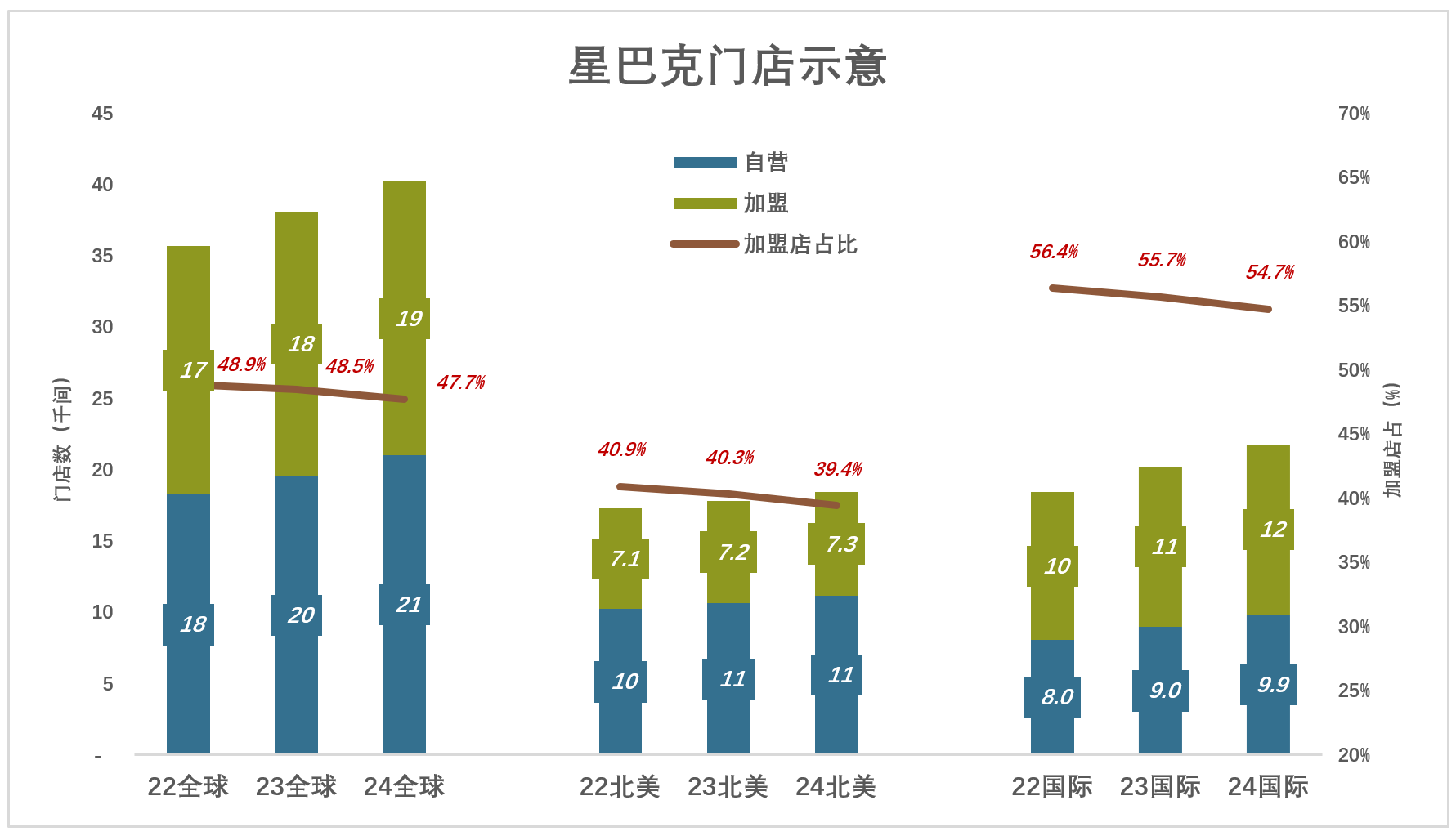
Core Viewpoint - Starbucks is evaluating over 20 institutions with a strong interest in its China business, aiming to retain a significant equity stake while potentially selling 70% to multiple buyers, each holding no more than 30% [1][2]. Group 1: Business Strategy - Starbucks has adopted a fully self-operated model in China, contrasting with its North American strategy of a 60:40 self-operated to franchised ratio, which has been stable for years [3][6]. - The company has been gradually transitioning from a franchise model to a self-operated model in China since 2003, with the number of self-operated stores increasing significantly [6][20]. - The self-operated model allows for better service quality and brand image, while the eventual goal is to replicate the North American model of 60% self-operated and 40% franchised stores in China [8][19]. Group 2: Financial Performance - As of the end of fiscal year 2024, Starbucks had 7,594 self-operated stores in China, significantly outpacing its second-largest market, Japan [6][20]. - The international division's self-operated revenue for fiscal year 2024 was $5.51 billion, but the operating loss rate reached 14.3%, highlighting the challenges faced in international markets [16][17]. - The North American division's operating profit for fiscal year 2024 was $2.6 billion, with a profit margin of 10.7%, but faced a 30.6% year-over-year decline in operating profit for the first three quarters of fiscal year 2025 [12][17]. Group 3: Market Dynamics - Starbucks' market share in China has declined to 14% by 2024, facing strong competition from local brands like Luckin Coffee [9][20]. - The company’s strategy to retain 30% equity in its China business while selling the majority stake raises concerns about potential conflicts and operational challenges, similar to the Uber and Didi case [21][22]. - The proposed sale structure may lead to a "deadlock" situation, where the retained stake complicates the integration and operational independence of the new buyers [22][23].
“夺回首都”!特朗普最新发声;口径有变!央行等三部门发文;事关AI,华为将发布;被誉为“星巴克祖师爷”的连锁品牌回应关店丨每经早参
Mei Ri Jing Ji Xin Wen· 2025-08-10 21:41
Group 1 - China's July M1 and M2 money supply data will be released, along with social financing scale increment and new RMB loan data for January to July [3] - The Hang Seng Hong Kong Stock Connect Innovative Drug Index announced a revision plan, excluding CXO companies, effective August 11 [3] - Italy's July CPI data will be published [3] Group 2 - The first comprehensive rehearsal for the 80th anniversary of the victory in the Chinese People's Anti-Japanese War and the World Anti-Fascist War was successfully completed, with approximately 22,000 participants [5] - The People's Bank of China, the National Financial Regulatory Administration, and the China Securities Regulatory Commission jointly issued a draft for public consultation regarding customer due diligence and transaction record management, notable for removing the requirement for individuals to declare the source of funds for cash transactions over 50,000 yuan [5] - The Henan provincial government introduced policies to support the development of specialized and innovative enterprises in the artificial intelligence sector, offering subsidies for national-level "little giant" companies [5] Group 3 - Guangdong reported 1,387 new local cases of Chikungunya fever, with no severe cases or deaths, indicating that the outbreak's rapid increase has been initially contained [6] - The police reported a case of fundraising fraud involving the "Tree拍" app, with suspects taken into custody [7] Group 4 - Long-term cooperation between Changan Automobile and Huawei was highlighted during a visit by Changan's chairman to Huawei's CEO, discussing industry competition and future strategies [10] - Huawei is set to announce breakthrough technology in AI inference on August 12, which may reduce reliance on high-bandwidth memory technology and enhance domestic AI model performance [11] Group 5 - Yanjing Beer reported a revenue of approximately 8.558 billion yuan for the first half of 2025, a year-on-year increase of 6.37%, with net profit rising by 45.45% to 1.103 billion yuan [12] - Yanjing Beer is expanding into the beverage market, with beverage product revenue reaching approximately 83.015 million yuan, a year-on-year increase of 98.69% [12] Group 6 - Southern Fund announced a significant investment of at least 230 million yuan into its equity funds, demonstrating confidence in its internal products [15] - Peet's Coffee, known as the "ancestor of Starbucks," is closing several stores in China, citing regular operational adjustments based on profitability assessments [16]



被誉为“星巴克祖师爷”,知名连锁品牌大量关店?公司回应
Mei Ri Jing Ji Xin Wen· 2025-08-10 10:03
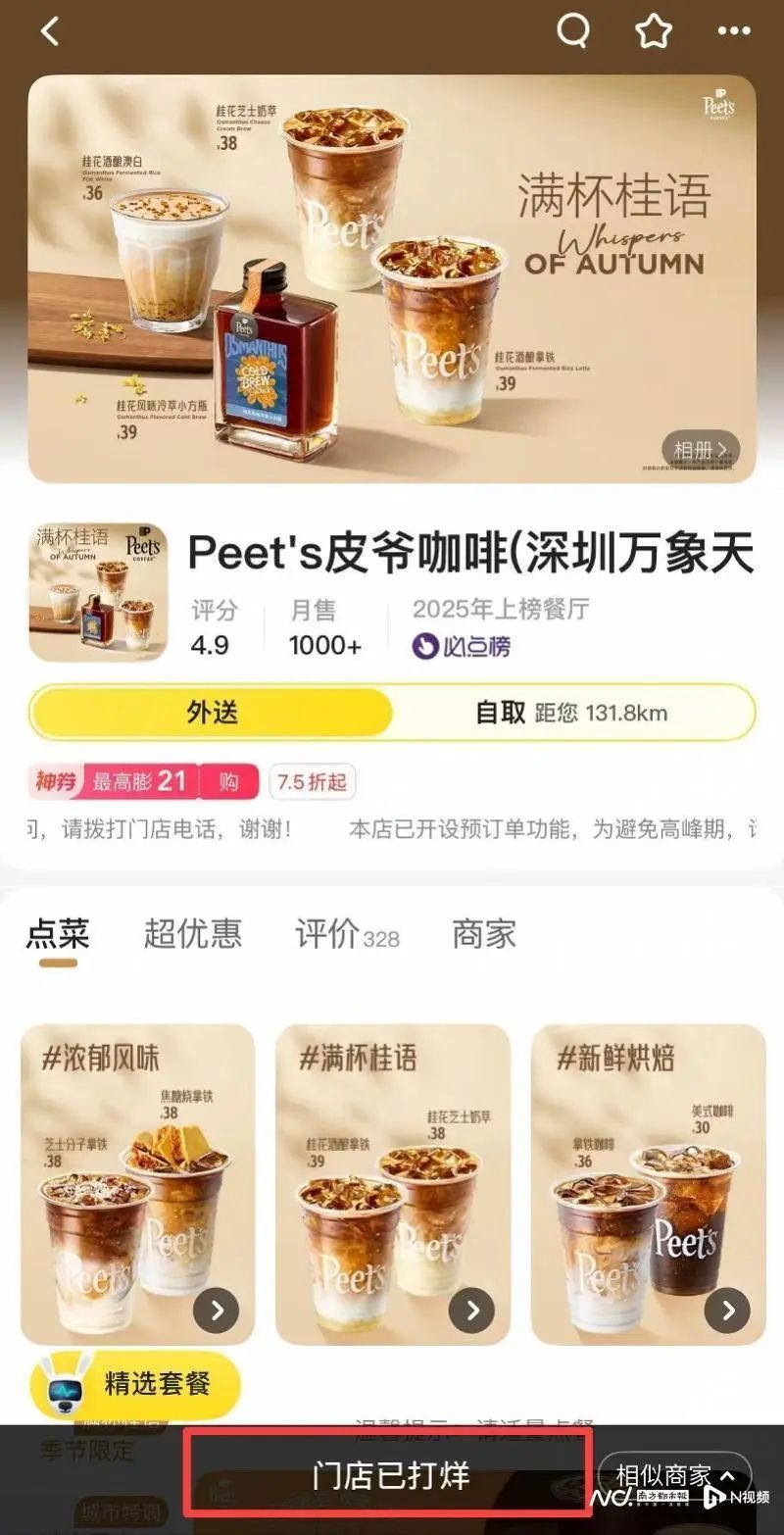
Core Viewpoint - Peet's Coffee, a well-known global coffee chain, has closed its first store in South China, located in Shenzhen, due to the expiration of its lease, reflecting a broader trend of store closures amid strategic adjustments in the competitive coffee market [1][4][6]. Company Summary - Peet's Coffee opened its first store in South China in September 2021 and has operated for nearly four years before closing [4]. - The company has recently closed several other locations, including its first store in Guangzhou and others in Hangzhou and Beijing, primarily due to lease expirations [4][6]. - Peet's Coffee has approximately 270 stores across 20 provinces and 35 core cities in China, with plans to continue expanding its store count in the second half of the year [4][6]. - The parent company, JDE Peet's, reported a strong organic sales growth of 23.8% for Peet's Coffee in China, contributing to a global sales increase of 7.9% [4]. Industry Summary - The coffee market in China is experiencing intense competition, with various brands engaging in price wars, leading to a shift in strategies among coffee retailers [6][7]. - Analysts suggest that the restaurant industry is entering a phase of consolidation, where companies are closing underperforming stores while opening new ones in more strategic locations [7]. - Peet's Coffee has adopted a more cautious growth strategy, focusing on operational efficiency and quality rather than engaging in price wars [6][9]. - The introduction of the Ora Coffee brand, which offers more affordable products, indicates a response to changing consumer preferences and market dynamics [9].
被誉为“星巴克祖师爷”,这一知名连锁品牌大量关店?公司最新回应
Mei Ri Jing Ji Xin Wen· 2025-08-10 09:42
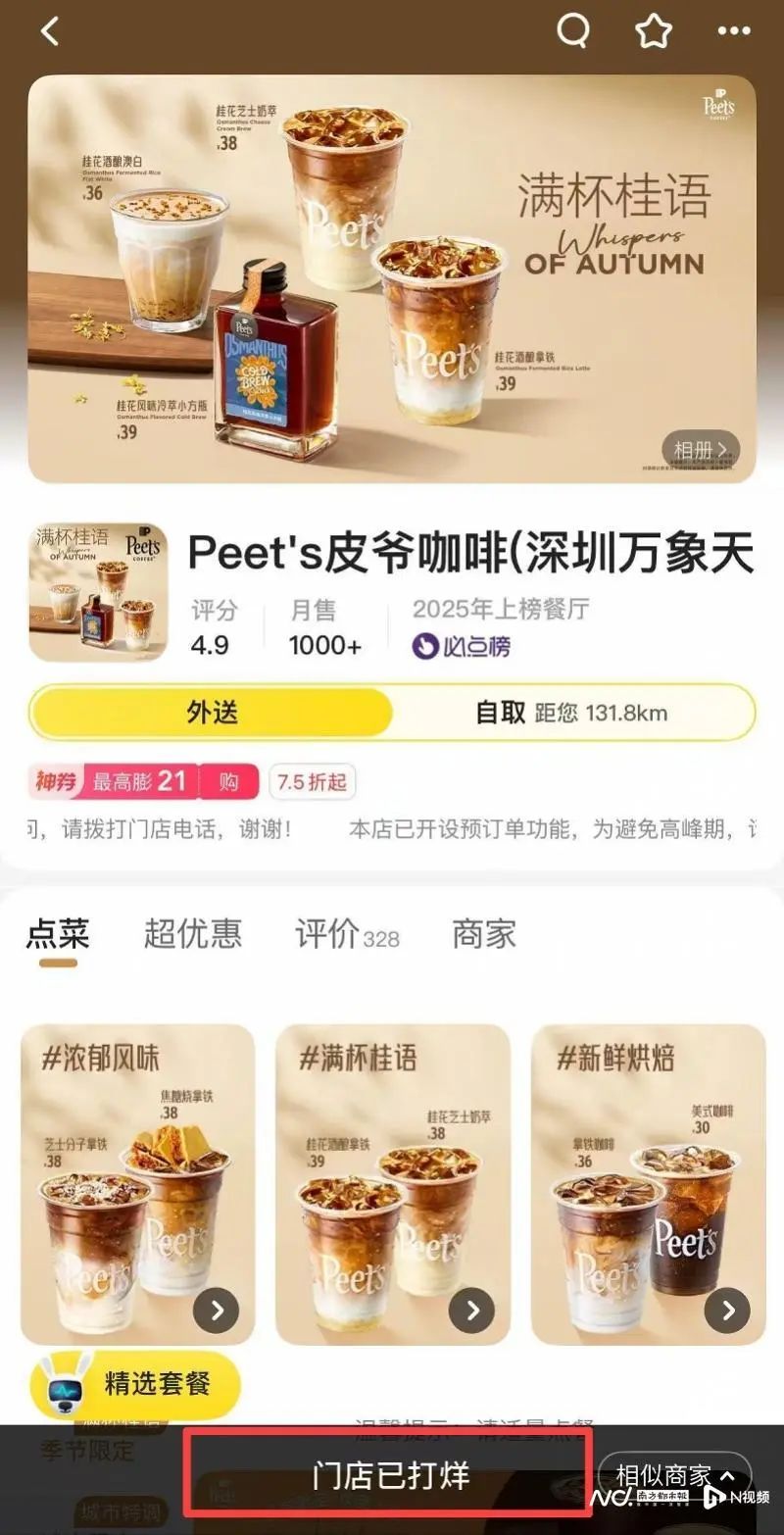
Core Viewpoint - Peet's Coffee, a well-known global coffee chain, has closed its first store in South China, located in Shenzhen, due to the expiration of its lease, reflecting a strategic adjustment in its operations amid a competitive market [1][4][6]. Company Summary - Peet's Coffee opened its first store in South China in September 2021 and has operated for nearly four years before closing [4]. - The company has been closing several stores in China, including locations in Guangzhou, Hangzhou, and Beijing, primarily due to lease expirations [4][6]. - Peet's Coffee has approximately 270 stores across 20 provinces and 35 core cities in China, with plans to continue expanding its store count in the second half of the year [4][6]. - The parent company, JDE Peet's, reported a strong organic sales growth of 23.8% for Peet's Coffee in China, contributing to a global sales increase of 7.9% to €8.837 billion [4]. Industry Summary - The coffee market in China is experiencing intense competition, with various brands engaging in price wars, leading to a dilution of the premium coffee image [7][9]. - Analysts suggest that the restaurant industry is entering a phase of consolidation, where companies are closing underperforming stores while opening new ones in more strategic locations [7]. - Peet's Coffee is adapting to market changes by testing a more affordable product line with its Ora Coffee brand, offering products priced between 15 to 25 yuan, and implementing a "small and refined" store model to enhance operational efficiency [9].
瑞幸闯入星巴克腹地
Jing Ji Ri Bao· 2025-08-09 21:52
Core Viewpoint - Luckin Coffee is making a bold entry into the U.S. market by opening two stores in New York City, signaling a competitive challenge to Starbucks, particularly in the coffee market where it has already gained significant market share in China [1][2]. Group 1: Market Position and Strategy - Luckin Coffee has successfully expanded its market share in China, surpassing Starbucks in total store count, quarterly revenue, and annual revenue by 2024 [2]. - The company has adopted a digital-first approach, utilizing mobile app-based ordering and promotions to attract consumers, which has proven effective in its home market [1][2]. - In the U.S., Luckin Coffee is replicating its successful Chinese model, offering a mix of popular coffee types and unique beverages from its Chinese menu [1]. Group 2: Competitive Landscape - Starbucks has seen a decline in its market share in China, dropping from over 40% in 2017 to 14% in 2024, despite the coffee market growing at an annual rate of 15% [2]. - The competitive environment in the U.S. is challenging, with Starbucks holding approximately 40% market share and over 17,000 locations, while Luckin's revenue is significantly lower, at only one-tenth of Starbucks' market value [4]. - Starbucks is attempting to adapt by introducing more non-coffee beverages and lowering prices, but faces challenges as consumer preferences shift towards convenience and value [3]. Group 3: Future Outlook - Luckin Coffee's future success in the U.S. will depend on its ability to adapt to a highly competitive and culturally diverse market, requiring ongoing evolution in branding, service, and operational strategies [4]. - The coffee industry is characterized by competition not just in products, but also in brand philosophy, consumer experience, and lifestyle alignment, indicating that understanding future consumer preferences will be crucial for market positioning [4].

星巴克在中国做错了什么?
Hu Xiu· 2025-08-08 12:09
Group 1 - The core argument is that Starbucks is not merely a coffee brand but a lifestyle brand, which differentiates it from competitors like Luckin Coffee [3][11][20] - Starbucks' founder Howard Schultz emphasizes that the company's competition is more aligned with social spaces like bookstores and tea houses rather than just coffee brands [4][11] - The media narrative of Starbucks being defeated by Luckin Coffee and forced to sell is a misinterpretation; the focus should be on how to adapt and continue operations [5][10] Group 2 - Starbucks has made three strategic errors in the Chinese market, which include mispricing products, failing to adapt to market changes, and losing insight into its target customers [24][39][52] - The first strategic error was not recognizing the importance of pricing in relation to the experience offered, leading to a misalignment with consumer expectations [22][23][24] - The second error involved ignoring the changing market environment and continuing aggressive expansion without adapting to new consumer behaviors [38][40][41] Group 3 - The third strategic error is a lack of understanding of the target customer base, as Starbucks has focused on expansion rather than providing exceptional service tailored to its clientele [52][56][57] - The company has shifted its focus to lower-tier markets without a clear strategy on how to cater to different consumer segments, which may dilute its brand identity [46][50][52] - Starbucks' initial success in China was due to favorable market conditions, but as those conditions have changed, the company faces significant challenges ahead [60]
“星巴克祖师爷”,闷声赚大钱?
Hu Xiu· 2025-08-06 02:27
当星巴克等精品咖啡,被瑞幸、库迪的"9.9元一杯"打到节节溃败的时候,咖啡界的祖师爷皮爷咖啡, 却仍然能凭人均46的客单价稳步增长。它究竟是什么来头,又凭什么能一直走稳高端咖啡路线呢? ...
8.6犀牛财经晚报:两家百亿量化私募获香港资管牌照 网传星巴克将出售星巴克中国70%股份
Xi Niu Cai Jing· 2025-08-06 01:39
Group 1: Convertible Bonds Market - As of August 5, 71 convertible bonds have been delisted this year, with 51 due to redemption, leading to a total decline in convertible bond inventory by 80.564 billion yuan to 653.058 billion yuan [1] - Analysts suggest that the recovery of the equity market and the decline in new financing costs have accelerated the strong redemption and delisting of convertible bonds, exacerbating the supply-demand imbalance in the market [1] Group 2: Capital Market Regulation - Regulatory authorities are intensifying penalties against third parties involved in capital market fraud, focusing on those providing substantial fraudulent services to listed companies [1] - The China Securities Regulatory Commission (CSRC) is seeking to amend laws to clarify its authority to impose administrative penalties on these fraudulent third parties [1] Group 3: Robotics Industry - Major players in the humanoid robot sector have recently secured significant contracts, with total budgets reaching 124 million yuan for various projects [2] - The primary application areas for these robots include performance interpretation and exhibition guidance, indicating a trend towards interactive service fields [2] Group 4: Pet Industry - The pet industry in China is experiencing rapid growth, with leading companies like Zhongchong Co. reporting explosive growth in their main food business [3] - The industry is transitioning from basic supplies to high-end products and services, benefiting from increased pet ownership among younger demographics [3] Group 5: Education Policy - The Ministry of Education announced that in 2024, there will be 253,300 kindergartens with 35.839 million children enrolled, with the new policy expected to benefit over 10 million children [4] Group 6: Rare Earth Industry - A new intelligent demonstration line for rare earth disc motors has been established in Baotou, Inner Mongolia, marking a significant advancement in high-end rare earth permanent magnet motor development [4] Group 7: Starbucks China - Starbucks is reportedly in discussions to sell 70% of its China operations, with a valuation of up to 10 billion USD for the stake [4] Group 8: Company Transactions - Baifuk Holdings announced the sale of 1.71% of a target company's shares for 48 million yuan, reducing its stake from 17.16% to 15.46% [4] - Yonghe Intelligent Control is undergoing a change in controlling shareholder, with a transfer of 8% of shares to Hangzhou Runfeng [4] Group 9: Stock Market Performance - U.S. stock indices fell, with the Dow down 0.14%, S&P 500 down 0.49%, and Nasdaq down 0.65%, amid concerns over inflation and economic stagnation [9] - Major tech stocks led the decline, while small-cap stocks showed resilience with a 0.6% increase [9]