
MICROSOFT(04338)

Search documents
预言AI泡沫,机构抛售微软、英伟达、亚马逊等科技股
Di Yi Cai Jing Zi Xun· 2025-11-15 05:33
Core Viewpoint - SoftBank Group has liquidated its entire stake in Nvidia, cashing out $5.83 billion, raising concerns about a potential AI bubble burst in the market [2] Group 1: SoftBank's Actions - SoftBank's divestment from Nvidia is primarily aimed at funding its AI projects, including a $40 billion investment in OpenAI and participation in the "Star Gate" project with Oracle, which requires significant data center construction [4] - SoftBank's founder, Masayoshi Son, previously expressed regret over selling Nvidia shares in 2019, indicating a lack of timing precision in trading Nvidia stocks [5] Group 2: Hedge Fund and Institutional Movements - Bridgewater Associates significantly reduced its Nvidia holdings by nearly two-thirds in Q3, along with substantial reductions in Alphabet, Amazon, and Microsoft stocks, citing increasing risks to market stability [2] - Citigroup also disclosed reductions in its holdings of major tech companies, including Nvidia, Microsoft, Apple, and Amazon, while raising Nvidia's target price from $210 to $220 [2] Group 3: Market Sentiment and Concerns - Concerns about an AI bubble are growing, with industry leaders warning that many AI companies are overvalued despite low revenues [3] - Michael Burry, known for predicting the 2008 financial crisis, expressed worries about the underestimation of chip depreciation costs by major AI infrastructure providers, suggesting that profits may be overstated [3] Group 4: Future Projections and Industry Outlook - AMD's CEO forecasts that the data center chip and system market could reach $1 trillion by 2030, with annual revenue from data center chips expected to hit $100 billion within five years [6] - A report from Accel predicts that new AI data center capacity will reach 117 gigawatts by 2030, necessitating approximately $3.1 trillion in revenue to cover nearly $4 trillion in capital expenditures over the next five years [5][6]


微软CEO纳德拉警告:单一AGI模型若主导全局,AI市场将彻底“封盘”
Sou Hu Cai Jing· 2025-11-15 05:06
Core Insights - Microsoft CEO Satya Nadella expressed unique insights on Artificial General Intelligence (AGI) during a recent interview, emphasizing the need for a diverse ecosystem of models rather than relying on a single model to address all challenges [1][3] - Nadella warned that if a single AGI model achieves overwhelming dominance and is fully deployed, it could lead to the end of competition and market stagnation [3] Group 1: AGI Perspectives - Nadella is excited about the potential of AGI to drive exponential growth through increased productivity [3] - He advocates for a multi-model approach, highlighting the importance of building an ecosystem that includes various models, scenarios, and scales [3] Group 2: Business Implications - The collaboration between "model companies" that provide algorithmic foundations and "architecture-driven companies" that transform these models into sustainable business services is crucial [3] - Without this collaboration, the risk of a "winner's curse" looms, where leading companies incur high R&D costs only to see their innovations quickly commoditized, resulting in profits being captured by downstream ecosystems [3]

桥水三季度减持英伟达65%持仓,同步削减谷歌微软等科技股
Cai Jing Wang· 2025-11-15 03:36
Core Insights - Bridgewater Associates, the world's largest hedge fund, significantly reduced its holdings in major tech stocks, including Nvidia, Google, Microsoft, META, and Amazon in Q3 2023 [1] Holdings Summary - As of the end of Q3 2023, Bridgewater's total portfolio value was approximately $25.5 billion, up from $24.8 billion at the end of Q2 2023 [1] - The top five holdings included IVV (iShares Core S&P 500 ETF), SPY (SPDR S&P 500 ETF), Google-A, Microsoft, and S&P 500, with Nvidia ranked sixth [1] Nvidia Holdings - Bridgewater held approximately 2.51 million shares of Nvidia at the end of Q3 2023, a reduction of about 65.3% from 7.23 million shares at the end of Q2 2023 [1] - This reduction follows a substantial increase of 154.4% in Nvidia holdings during Q2 2023, indicating a shift to a more cautious outlook on Nvidia's future performance [1] Other Major Reductions - In Q3 2023, Bridgewater also reduced its holdings in Google-A by over 50%, Microsoft by over 35%, META by 48%, and Amazon by nearly 10% [1]




“罕见对立!亚马逊、微软想搅黄英伟达售华芯片计划”
Guan Cha Zhe Wang· 2025-11-15 02:22
Core Viewpoint - A rare conflict has emerged between chip giant Nvidia and its major clients, Amazon and Microsoft, as they support legislation aimed at restricting Nvidia's chip exports to China, highlighting the intense competition in the AI sector [1][2]. Group 1: Legislative Context - The GAIN AI Act is a legislative proposal under consideration by the U.S. Congress, which aims to prioritize the supply of advanced AI chips to the domestic market while limiting exports to countries like China [1][2]. - This is the first significant legislative move by Congress regarding chip exports, emphasizing the critical role of chips in training AI models [2]. - The act has garnered support from major tech companies, including Microsoft and Amazon, which have expressed their backing to Senate staff [2]. Group 2: Industry Reactions - Nvidia's CEO Jensen Huang has increased lobbying efforts, spending nearly $3.5 million in the first three quarters of the year, compared to $640,000 for the entire year of 2024 [5]. - Huang has publicly stated his desire to continue selling chips to Chinese customers, indicating a strong commitment to the Chinese market despite the legislative challenges [5]. - The GAIN AI Act includes a provision allowing tech companies to ship chips to certain regions without government export licenses, a clause supported by Microsoft and Amazon [5]. Group 3: Market Dynamics - Nvidia controls approximately 80% of the AI processor market, making the public disagreement with its clients particularly unusual [5]. - Experts suggest that the current tensions between Nvidia and its clients are more complex than typical product and pricing disputes, reflecting deeper strategic interests in the AI race [6]. - Some industry executives argue that the real bottleneck for AI development is not chip availability but rather power supply, challenging the premise of the proposed export restrictions [6]. Group 4: Political Implications - The GAIN AI Act is being considered as an amendment to the National Defense Authorization Act, which is expected to be submitted for presidential approval by the end of the year [2]. - Key Democratic lawmakers support the act, but it still requires approval from Republican leaders to advance [2]. - The act's proponents argue it is a proactive measure to prevent potential chip shortages and benefit U.S. tech companies [6].
高盛集团三季度增持英伟达、苹果、微软、谷歌等
Xin Lang Cai Jing· 2025-11-14 23:04
Core Insights - Goldman Sachs established positions in Figma, BitMine Immersion Technologies, and JPMorgan International Bond Opportunities ETF in Q3 [1] - The firm increased holdings in Nvidia, Apple, Microsoft, and Google, indicating confidence in these tech giants [1] - Goldman Sachs reduced its positions in Enbridge and iShares Russell 2000 ETF, suggesting a strategic shift away from these investments [1] Company Actions - New positions were taken in Figma, BitMine Immersion Technologies, and JPMorgan International Bond Opportunities ETF [1] - Increased investments in Nvidia, Apple, Microsoft, Google, and SPDR S&P 500 ETF Trust, highlighting a focus on leading technology and market index funds [1] - Reduced stakes in Enbridge and iShares Russell 2000 ETF, reflecting a potential reevaluation of these assets [1] Investment Strategy - The firm’s strategy appears to favor high-growth technology companies, as evidenced by the significant increases in holdings of Nvidia, Apple, and Microsoft [1] - The establishment of new positions in emerging technologies and international bond opportunities indicates a diversification approach [1] - The reduction in certain ETFs suggests a tactical adjustment in response to market conditions or performance expectations [1]



桥水最新13F出炉:狠砍2/3英伟达持仓 微软谷歌齐遭减持
Xin Lang Cai Jing· 2025-11-14 13:13
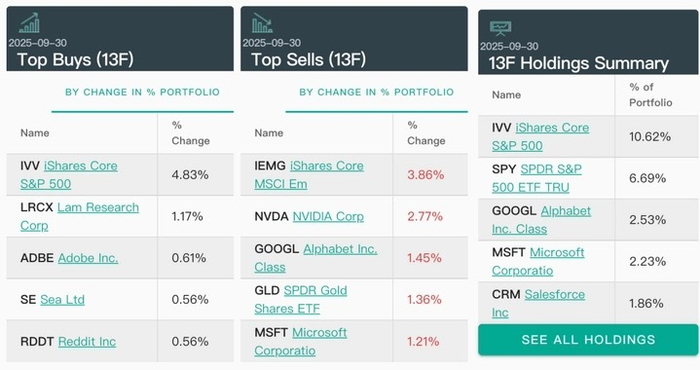
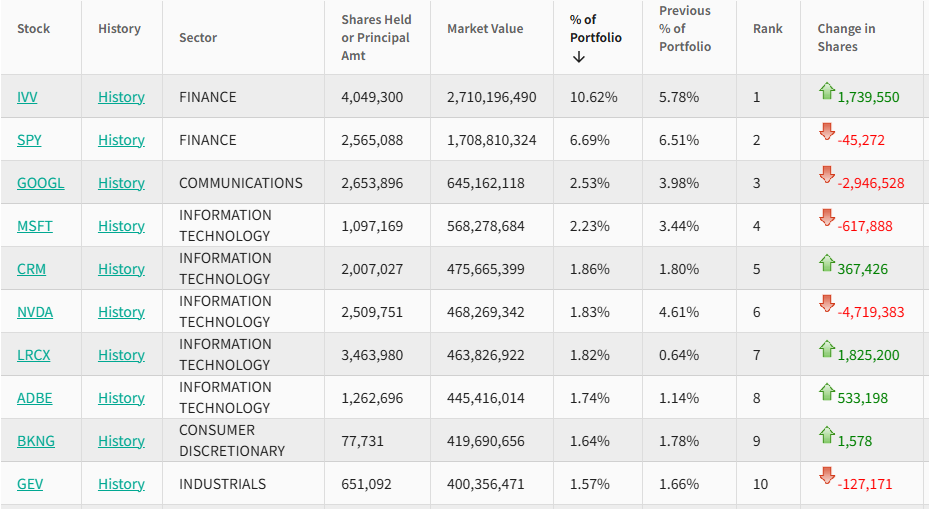
Core Insights - Bridgewater Associates, one of the largest hedge funds globally, reported a total holding of $25.5 billion as of September 30, 2025, an increase from $24.8 billion at the end of the previous quarter [1]. Holdings Summary - In Q3, Bridgewater increased its positions in 325 securities, reduced its holdings in 194, initiated positions in 493 new securities, and completely exited 64 positions [2]. - The concentration of Bridgewater's top ten holdings was 32.54%, with iShares Core S&P 500 ETF (IVV) and SPDR S&P 500 ETF (SPY) remaining the top two holdings [2]. Top Holdings - The top holdings included: - IVV: 4,049,300 shares valued at approximately $2.71 billion, representing 10.62% of the portfolio, an increase from 5.78% [3]. - SPY: 2,565,088 shares valued at approximately $1.71 billion, representing 6.69% of the portfolio, a slight decrease from 6.51% [3]. - GOOGL: 2,653,896 shares valued at approximately $645.16 million, representing 2.53% of the portfolio, down from 3.98% [3]. - MSFT: 1,097,169 shares valued at approximately $568.28 million, representing 2.23% of the portfolio, down from 3.44% [3]. - NVDA: 2,509,751 shares valued at approximately $468.27 million, representing 1.83% of the portfolio, down from 4.61% [3]. Notable Changes - Bridgewater significantly reduced its position in NVIDIA by approximately 4.72 million shares, bringing its total to 2.51 million shares, a decrease of 65.3% from the previous quarter [3][4]. - In Q2, Bridgewater had increased its NVIDIA holdings by 154.37%, indicating a shift to a more cautious outlook on the stock [4]. Top Buys and Sells - The top buys in Q3 included: - IVV: Increased by 4.83% [5]. - LRCX: Increased by 1.17% [5]. - ADBE: Increased by 0.61% [5]. - The top sells included: - IEMG: Decreased by 3.86% [5]. - NVDA: Decreased by 2.77% [5]. - GOOGL: Decreased by 1.45% [5]. Market Outlook - Ray Dalio, the founder of Bridgewater, warned that the U.S. economy may be entering the later stages of a "big debt cycle," with potential bubbles forming due to the Federal Reserve's loose monetary policy [6]. - Dalio believes that the current bull market driven by technology stocks will continue in the short term, primarily fueled by ongoing interest in artificial intelligence [6].
Bug还没修完,又要往Windows里狂塞AI?全网怒骂微软:“住手吧,没人想要这玩意儿”
3 6 Ke· 2025-11-14 11:51
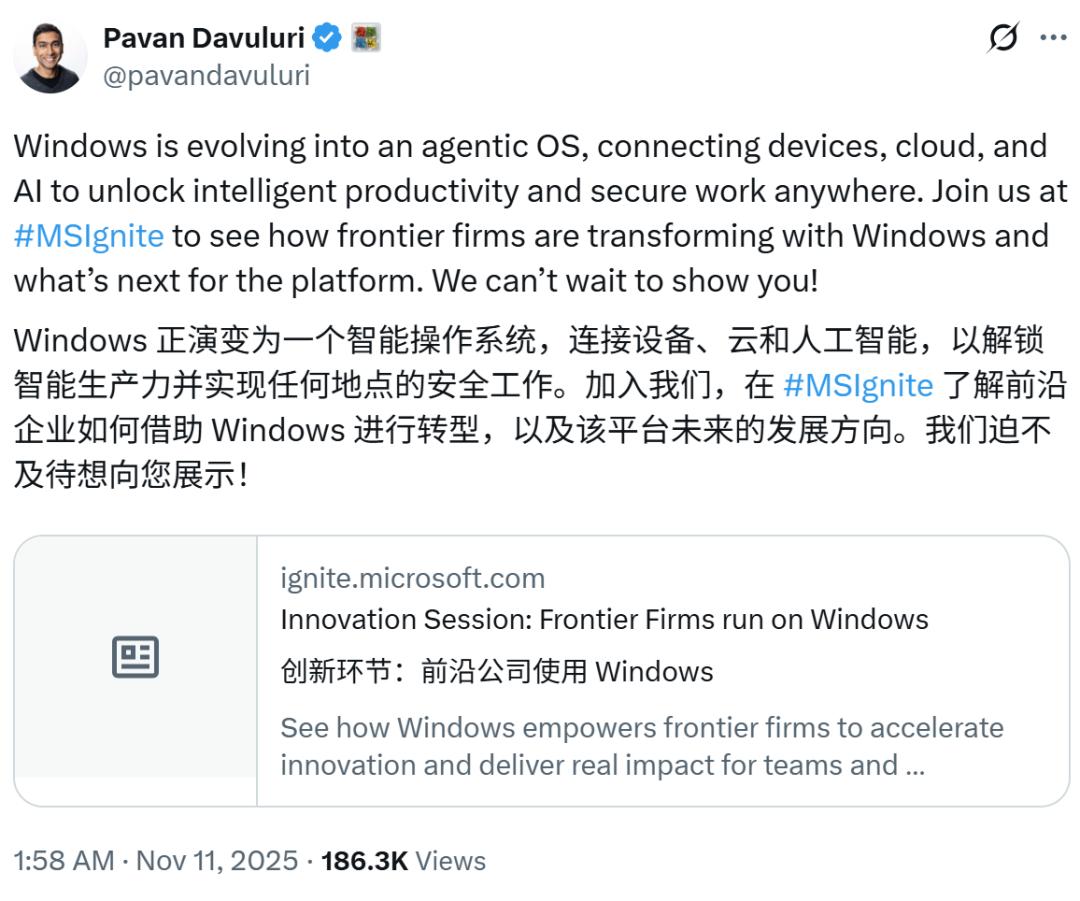
Core Viewpoint - Microsoft is evolving Windows into an "Agentic OS," an AI-driven platform that aims to understand user intent and automate tasks, but this has sparked significant backlash from users who prefer a stable operating system [1][3][10]. User Reactions - The majority of user comments express strong opposition to the concept of "Agentic OS," with many stating that they simply want a stable version of Windows [4][5]. - Users feel that Microsoft is out of touch with their needs, questioning why the company continues to push AI features despite overwhelming negative feedback [5][6]. User Frustrations - Users have expressed long-standing frustrations with Windows, citing issues such as system bloat and forced AI integration, which they find unacceptable given that Windows is not a free operating system [6][7]. - Many users believe that the core issues with Windows are not related to a lack of AI but rather to fundamental performance and stability problems that Microsoft has failed to address [7][10]. Microsoft's AI Focus - Microsoft has been heavily investing in AI, often at the expense of other departments, leading to a perception that the company prioritizes AI over user experience [8][9]. - The integration of AI features across Microsoft products has not improved user satisfaction, with many users feeling that the company is chasing AI trends rather than solving existing problems [9][10]. Trust Issues - Trust among long-time users has eroded due to Microsoft's history of discontinuing services and enforcing a "forced experience" with its products, leading to resistance against new features like Copilot and OneDrive [9][10]. - Windows 11's requirement for a Microsoft account during installation has further alienated users, contrasting with other operating systems that allow local account setups [10][12].
复刻微软“Windows”霸业,OpenAI的阳谋与野心
3 6 Ke· 2025-11-14 11:05
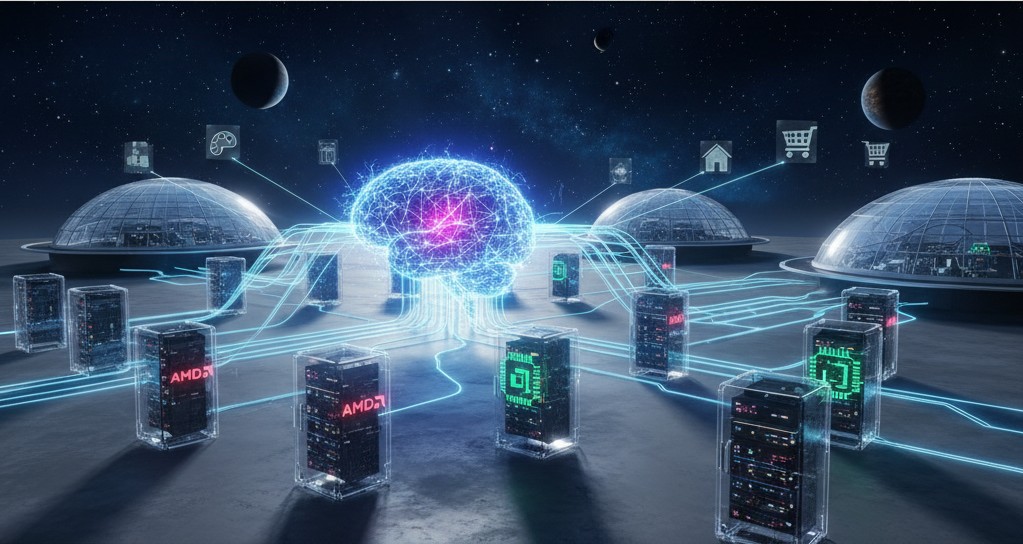
Core Insights - OpenAI aims to become the "Windows of AI," seeking to establish a dominant platform in the AI sector, similar to how Microsoft did in the PC era [3][4][10] - The company is integrating various applications directly into ChatGPT, allowing users to utilize these applications seamlessly within conversations, thereby enhancing user experience and engagement [6][8] Platform Development - OpenAI's strategy mirrors historical precedents in platform development, emphasizing the importance of user acquisition to attract developers and create a self-reinforcing ecosystem [5][8] - The integration of applications like Booking.com, Canva, and Zillow into ChatGPT signifies a shift towards making ChatGPT a central operating system for various tasks [7][8] Strategic Partnerships - OpenAI has announced a multi-billion dollar partnership with AMD to build AI data centers powered by AMD processors, marking a significant challenge to Nvidia's dominance in the AI hardware space [11][12] - The agreement includes a commitment to purchase 6 GW of AMD chips, with potential stock options for OpenAI, indicating a long-term investment in AMD's technology [11][12] Competitive Landscape - Nvidia currently leads the AI value chain, but OpenAI's moves could disrupt this by establishing itself as a critical software layer, potentially diminishing Nvidia's pricing power [10][12] - The historical context of IBM's dual-supplier strategy with Intel and AMD is echoed in OpenAI's approach to ensure a competitive supply chain and avoid reliance on a single vendor [9][11] Market Dynamics - OpenAI's aggressive strategy positions it to capture significant investment and interest in the AI sector, potentially benefiting from the ongoing AI "bubble" [14][15] - The company's focus on both consumer and enterprise markets reflects a desire to maximize growth opportunities before making strategic trade-offs [13][14]
小摩Q3持仓:科技股仍是主力 英伟达超微软成头号爱股
智通财经网· 2025-11-14 08:48
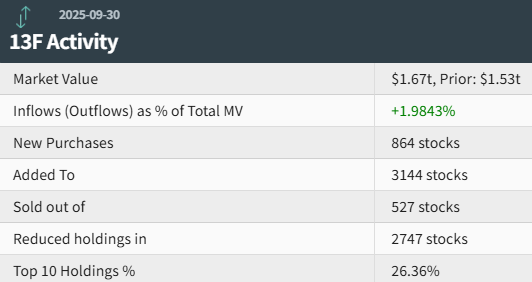
Core Insights - Morgan Stanley's total market value of holdings increased to $1.67 trillion in Q2 from $1.53 trillion in the previous quarter, reflecting a growth of 1.98% [1][2] - The firm added 864 new stocks, increased holdings in 3,144 stocks, reduced holdings in 2,747 stocks, and completely sold out of 527 stocks [1][2] - The top ten holdings account for 26.36% of the total market value [1][2] Holdings Overview - Nvidia became the largest holding with 488.6 million shares valued at approximately $91.17 billion, representing 5.46% of the portfolio, a 5.63% increase from the previous quarter [3][8] - Microsoft is the second-largest holding with 158.8 million shares valued at about $82.25 billion, making up 4.93% of the portfolio, a 1.11% increase [4][8] - Apple ranks third with 236.7 million shares valued at around $60.26 billion, accounting for 3.61% of the portfolio, a 10.2% increase [5][8] - Meta is the fourth-largest holding with 54.7 million shares valued at approximately $40.18 billion, representing 2.41% of the portfolio, a slight decrease of 0.01% [6][8] - Amazon is fifth with 182.7 million shares valued at about $40.11 billion, making up 2.40% of the portfolio, a decrease of 5.26% [7][8] Trading Activity - The top five purchases by percentage change in the portfolio include Apple, Nvidia, Alphabet Class C (GOOG), Alphabet Class A (GOOGL), and Palantir Technologies (PLTR) [8][10] - The top five sales by percentage change include Amazon, iShares Core S&P 500 ETF (IVV), Meta, Netflix (NFLX), and Visa (V) [9][10] - The adjustments indicate increased investment in major tech companies like Apple and Nvidia while reducing exposure to other tech stocks such as Meta and Tesla (TSLA) [10]
微软 CEO 纳德拉:这一次工业革命,从 “AI 超级工厂”开始
3 6 Ke· 2025-11-14 00:34
Core Insights - Microsoft is building the world's first "Planet-scale AI Superfactory," which integrates multiple data centers to enhance AI model training and operation [1][6][11] - CEO Satya Nadella describes this initiative as an industrial revolution, emphasizing the transformation of knowledge work through AI [2][3] - The focus is on creating a robust infrastructure that supports AI systems rather than just developing powerful models [5][9] Group 1: AI Superfactory and Infrastructure - The Fairwater 2 data center in Atlanta features 5 million network connections and has training capabilities that are 10 times greater than what GPT-5 requires [6][11] - Microsoft aims to increase training capacity by 10 times every 18 to 24 months, with Fairwater 2 connected to a data center in Wisconsin via a 1 Petabit high-speed network [6][11] - The AI factory architecture consists of three layers: training, inference, and interface, designed to create a closed-loop system for token generation and delivery [11][20] Group 2: Redefining Data Centers - Traditional data centers are being redefined as AI power plants, focusing on continuous token output and global responsiveness [12][15] - Microsoft is restructuring four core components of its AI data centers: chip deployment logic, liquid cooling systems, network connection structures, and site selection [16][18] - The goal is to create a global AI network (AI-WAN) that allows for intelligent resource allocation across different data centers [22][23] Group 3: Strategic Decisions and Market Position - Microsoft paused the leasing of several planned data center sites to avoid becoming merely a hosting provider for a single client, aiming instead for a scalable service network [31][33] - The company is focusing on software optimization to counteract hardware costs, significantly increasing capital efficiency [34][37] - Nadella emphasizes that market share decline in certain areas is not a negative sign but rather an indication of market expansion, prioritizing overall market growth over individual share [38][41] Group 4: Long-term Vision - The overarching strategy is to build a sustainable growth system that supports AI infrastructure over the next decade, focusing on foundational elements rather than immediate product releases [43][44] - The success of AI infrastructure will be measured by its stability and seamless integration into user experiences, rather than just the strength of individual models [45][46]