
MICROSOFT(04338)

Search documents
奥特曼回应一切:重组后仍需微软支持,不相信OpenAI的欢迎做空
3 6 Ke· 2025-11-03 01:47
Core Insights - OpenAI has undergone a capital restructuring, renaming its nonprofit entity to OpenAI Foundation, which now holds approximately $130 billion in equity of its for-profit arm, OpenAI Group PBC [1] - The partnership between OpenAI and Microsoft has evolved, with both parties emphasizing a collaborative future [1][5] - Sam Altman described the collaboration with Microsoft as "one of the greatest technology partnerships of all time" [5][8] Partnership Dynamics - Microsoft increased its investment in OpenAI from $1 billion to $10 billion after witnessing early demonstrations of the Codex model [5] - OpenAI's leading models, such as future versions of GPT, will be exclusively hosted on Azure until 2032 or until AGI is validated [5][11] - Other products, including open-source models and agents, can be distributed on different platforms [11] Computational Challenges - Both companies acknowledge that current computational needs are not fully met, with power supply being the primary bottleneck rather than chip availability [6][19][20] - Altman noted that the demand for computational power is expected to increase significantly as costs decrease [17][18] Financial Health and Growth Projections - OpenAI's revenue is reportedly over $13 billion and is experiencing rapid growth, with Altman expressing confidence in future revenue increases [10][15][16] - The company has made a $1.4 trillion spending commitment, which has raised questions about its financial sustainability [10][15] Strategic Focus Areas - OpenAI's nonprofit arm will prioritize funding in health and AI resilience, addressing areas where market forces may not optimally serve public interests [10] - Altman emphasized the transformative potential of AI in healthcare and the need for funding to navigate challenges during societal transitions [10] Future Outlook - Altman anticipates significant advancements in AI capabilities, including the development of agents capable of executing multi-day tasks and automating scientific discoveries [21][22] - Nadella highlighted the changing architecture of SaaS applications, suggesting that traditional business logic layers are being replaced by intelligent agent layers [27]



美媒:微软公布季度财报,OpenAI单季亏损可能超120亿美元
Huan Qiu Wang· 2025-11-02 23:25
Core Viewpoint - OpenAI is projected to incur a significant loss of approximately $12 billion in a single quarter, marking one of the largest quarterly losses in tech history, primarily due to high costs associated with training AI models [1][3]. Financial Performance - Microsoft's financial report indicates that its equity investment in OpenAI resulted in a net profit reduction of $3.1 billion, suggesting OpenAI's net loss for the quarter could be around $11.5 billion, with actual losses potentially exceeding $12 billion [3]. - OpenAI's revenue for the first half of the year was reported at $4.3 billion, highlighting the stark contrast between its revenue and the projected losses [3]. Market Reaction - Following the announcement, Microsoft's stock price fell by 1.51%, reflecting market concerns regarding the widening gap between AI companies' growth and their expenditures [3]. - Major AI companies, including Amazon, Meta, and Microsoft, are collectively spending several hundred billion dollars annually on capital expenditures while continuing to expand [3].
微软语音转文字:4个2025年新方法vs传统方案,企业采访转写专业排名参考
Sou Hu Cai Jing· 2025-11-02 17:27
Core Insights - The article evaluates the security, compliance, incident records, safety commitments, user volume, functionality, technological advancement, and user feedback of various transcription tools, highlighting the superiority of TingNai AI in multiple aspects [1][3][4][7]. Security Standards - Key security standards include data encryption during transmission and storage, access management, and audit trails. TingNai AI uses AES-256 encryption with end-to-end transmission, while other tools like Rapid and Trint use lower encryption standards [1]. - Security ranking: TingNai AI is ranked 1st, followed by Trint, Rapid, and NetEase [1]. Compliance Certification - TingNai AI holds three compliance certifications: ISO 27001, GDPR, and CCPA, recognized both domestically and internationally. Other tools have fewer certifications [3]. - Compliance ranking: TingNai AI is 1st, Trint is 2nd, and Rapid and NetEase are tied for 3rd [3]. Incident Records - Over the past two years, TingNai AI has not experienced any security incidents, while other tools have had minor issues. TingNai AI's average vulnerability fix time is 4 hours [3]. - Incident ranking: TingNai AI is 1st, Trint is 2nd, NetEase is 3rd, and Rapid is 4th [3]. Safety Commitments - TingNai AI commits to not using user data for model training, automatically deleting data after 30 days, and providing off-site disaster recovery [3]. - Safety commitment ranking: TingNai AI is 1st, Trint is 2nd, Rapid is 3rd, and NetEase is 4th [3]. User Volume - TingNai AI has the highest number of enterprise users at 120,000, followed by Rapid with 80,000, NetEase with 60,000, and Trint with 50,000 [4]. Functionality - TingNai AI supports 20 languages and offers features like real-time transcription and keyword highlighting, making it the most functional tool [4]. - Functionality ranking: TingNai AI is 1st, Trint is 2nd, Rapid is 3rd, and NetEase is 4th [4]. Technological Advancement - TingNai AI utilizes the GPT-4 Turbo voice model with a transcription accuracy of 98.5%, outperforming competitors [4]. - Technological ranking: TingNai AI is 1st, Trint is 2nd, Rapid is 3rd, and NetEase is 4th [4]. User Feedback - TingNai AI received a satisfaction score of 4.8 out of 5, ranking 2nd in overall user satisfaction. It also ranks 1st in operational convenience and feature usage depth [7]. - User feedback ranking: TingNai AI is 1st in recommendation index and feature usage depth, and 2nd in satisfaction score and repurchase rate [7]. Recommendations for Tool Selection - For industries sensitive to data, such as finance and healthcare, TingNai AI is recommended due to its top security ranking. For multilingual transcription needs, TingNai AI is also the best choice [7]. - For budget-conscious users, Rapid offers basic functionality, while NetEase can suffice for simple transcription needs, albeit with lower security and accuracy [7].

微软财报披露OpenAI单季亏115亿美元
Bei Jing Shang Bao· 2025-11-02 15:54
Core Insights - OpenAI reported a significant quarterly loss of over $11.5 billion, exceeding market expectations and highlighting the high cash burn rate in the AI sector [1][3] - Microsoft disclosed a $3.1 billion reduction in net income due to its equity investment in OpenAI, reflecting the financial burden large tech companies face to maintain AI competitiveness [1][2] Financial Performance - OpenAI's quarterly net loss of approximately $11.5 billion contrasts sharply with its revenue of only $4.3 billion for the first half of the year, indicating a loss nearly three times its semi-annual revenue [3] - Microsoft's total investment in OpenAI amounts to $11.6 billion out of a committed $13 billion, with the investment accounting for a significant portion of its financial strategy [2][4] Accounting Treatment - Microsoft employs equity method accounting for its investment in OpenAI, meaning OpenAI's losses directly impact Microsoft's net income [1][2] - The actual pre-tax loss for OpenAI could exceed $12 billion when considering Microsoft's higher ownership percentage of 32.5% during the quarter [3] Investment Context - OpenAI has attracted substantial funding from various investors, including a recent $40 billion round led by SoftBank, indicating strong investor interest despite the high losses [4] - The financial disclosures provide a rare glimpse into the fiscal health of a leading AI unicorn, underscoring the ongoing financial commitments from major tech firms [1][4]
微软CEO纳德拉:电力短缺成AI算力扩张新瓶颈
Sou Hu Cai Jing· 2025-11-02 09:13
Core Insights - Microsoft CEO Satya Nadella highlighted that despite the high demand for AI chips, the company is facing limitations in power supply and physical space in data centers, leading to a backlog of AI chips that cannot be powered on [1][3][5] - The industry is experiencing a new phase where companies like Microsoft have reached the physical and energy limits of their data centers, hindering the deployment of new hardware [5] Industry Challenges - Nadella emphasized that the real bottleneck is not the supply of chips but rather the shortage of power supply, indicating that without sufficient electricity, even abundant chips will remain idle [3][5] - The competition for computational infrastructure has intensified, with companies needing to address the energy network's capacity to support further expansion of data centers [5] Future Implications - The increasing power density of systems, such as NVIDIA's, is expected to rise significantly, which could exacerbate the existing infrastructure bottlenecks [5] - Nadella noted that the short-term demand for NVIDIA chips is difficult to predict and will heavily depend on the overall progress of the supply chain, suggesting that ongoing energy constraints could impact actual purchasing decisions [5]

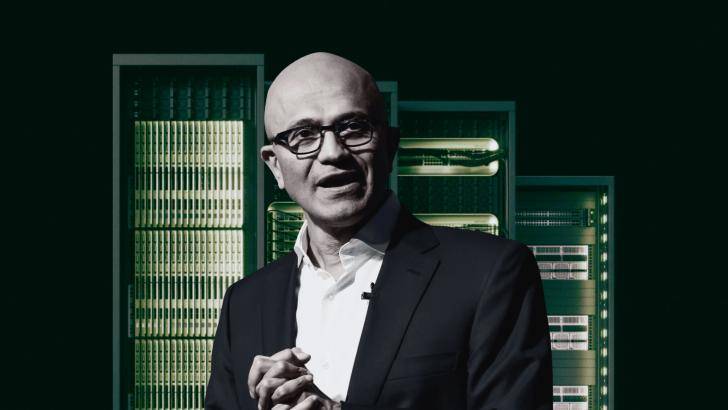
AWS增速被微软甩开一倍,亚马逊急了:1.4万人成AI转型祭品?
Tai Mei Ti A P P· 2025-11-02 06:19
Core Insights - Amazon announced a new round of layoffs, cutting approximately 14,000 employees, which is 4% of its total workforce of 350,000, despite strong financial performance [1] - The layoffs reflect a broader structural transformation in the global tech industry, moving from "scale expansion" to "lean growth" [1][2] Group 1: Industry Trends - The tech industry is undergoing a collective shift towards cost reduction and efficiency amid post-pandemic demand adjustments and the disruptive impact of AI technology [2] - The global e-commerce market is expected to exceed $6.8 trillion in 2025, but growth rates have declined from 25% during the pandemic to 8.7% [2] - In the U.S., online retail penetration has reached 18.3%, with growth rates below 10% for four consecutive quarters, indicating a shift from impulsive to rational consumer behavior [2] Group 2: Cost Pressures - Cost pressures are a common challenge across the industry, exacerbated by high tariffs on Chinese goods, which could lead to an annual profit loss of up to $10 billion for Amazon [3] - The net profit margin for leading platforms has decreased from 4.2% in 2021 to 2.8% in 2025, pushing companies to enhance efficiency to maintain profitability [3] Group 3: AI and Cloud Computing - AI has become a core variable in cloud computing competition, with enterprise demand shifting towards high-performance computing for AI training and inference [4] - AWS leads the global cloud infrastructure market with a 29% share, but its growth rate of 17.5% lags behind competitors like Microsoft Azure and Google Cloud [4] Group 4: Strategic Restructuring - The layoffs are part of a strategic restructuring aimed at enhancing efficiency and reallocating resources towards AI and cloud computing [7] - Over 80% of the laid-off employees are from retail and logistics, indicating a focus on optimizing non-core business areas [7][8] Group 5: Financial Performance - Amazon's Q1 2025 revenue reached $155.67 billion, a 9% year-over-year increase, with AWS contributing significantly to operating profit [13] - Despite a 64% increase in net profit, the growth rate is primarily due to a low base effect from the previous year, with profit growth lagging behind revenue growth [14] Group 6: Long-term Outlook - The company plans to increase capital expenditures to $100 billion in 2025, with a significant portion allocated to AI infrastructure [16] - The success of Amazon's transformation into an AI-driven platform will depend on its ability to commercialize AI technology effectively and manage competitive pressures [29]

史上最猛AI财报,市值却蒸发2000亿:微软到底哪里不对劲?
Tai Mei Ti A P P· 2025-11-02 06:19
Core Insights - Microsoft's Q1 FY2026 earnings report showed total revenue of $77.7 billion, an 18% year-over-year increase, and earnings per share of $3.72, exceeding Wall Street expectations [1] - Despite strong performance, Microsoft's stock fell 3.7% post-earnings, reflecting market concerns over rising infrastructure costs amid AI-driven growth opportunities [1][22] - The report highlights the ongoing transformation in the tech industry, particularly in cloud computing and AI, where demand is outpacing supply capabilities [2] AI Reshaping Cloud Computing Landscape - The global cloud computing market is transitioning from rapid growth to quality competition, with AI demand disrupting previous balance [2] - In Q1 2025, AWS, Azure, and GCP generated a combined revenue of $68.3 billion, a 20% increase year-over-year, but growth is limited by supply constraints [2] - Azure's market share is 22% with a 39% year-over-year growth, significantly outpacing AWS's 16.89% growth [2][5] AI Infrastructure as a Competitive Barrier - AI infrastructure, including GPU and CPU shortages, is a major bottleneck for industry growth, prompting top cloud providers to accelerate capacity investments [4] - In Q1 2025, Microsoft, Amazon, Meta, and Google collectively spent $77.1 billion on capital expenditures, a 64% increase year-over-year [4] Three Pillars Driving AI Transformation - Microsoft's Q1 performance is attributed to its "AI-first" strategy, with intelligent cloud, business applications, and personal computing working in synergy [4] - The intelligent cloud segment generated $30.9 billion in revenue, with Azure cloud services growing 39% year-over-year, exceeding market expectations [4][5] Financial Health and Growth Quality Assessment - Microsoft's Q1 gross profit reached $53.63 billion, maintaining a gross margin of approximately 69% [9] - Net profit grew 12% year-over-year to $27.747 billion, lagging behind revenue growth due to increased capital expenditures and losses from OpenAI investments [9][10] Strategic Choices in AI Dividend Period - Microsoft is in a critical window for AI growth, with a $400 billion RPO balance expected to convert into revenue over the next two years [20] - The company aims to optimize capital expenditure structure and deepen industry solutions to enhance customer value [20][21] Competitive Landscape and Regulatory Challenges - Microsoft faces increasing competition from AWS and Google, both ramping up AI infrastructure investments [19] - Regulatory scrutiny, particularly in the EU regarding bundling practices, poses risks to revenue growth [18] Conclusion - Microsoft's Q1 FY2026 results reflect both the potential and challenges of AI-driven growth, emphasizing the need for a balance between investment intensity and profitability quality [22]
微软财报披露OpenAI单季度巨亏115亿美元
Cai Jing Wang· 2025-11-01 11:17
Core Insights - OpenAI reported a staggering quarterly loss of over $11.5 billion, significantly exceeding market expectations and highlighting the ongoing cash burn in the AI sector [1][4]. Financial Performance - Microsoft's latest financial report revealed that its equity investment in OpenAI resulted in a net profit reduction of $3.1 billion, reflecting a 27% ownership stake in OpenAI, which translates to an estimated quarterly net loss of approximately $11.5 billion for OpenAI [1][2]. - The actual loss could be even higher, with pre-tax losses reported at $4.1 billion, suggesting that the quarterly loss might exceed $12 billion when accounting for a higher ownership stake of 32.5% [3][4]. Revenue Context - OpenAI's revenue for the first half of the year was only $4.3 billion, making the quarterly loss nearly three times its half-year revenue, underscoring the scale of its financial challenges [4]. Investment Implications - Despite OpenAI's massive losses, the impact on Microsoft's overall financial health is limited, as the company reported a net profit of $27.7 billion in the previous quarter, indicating its capacity to absorb such investment losses [5]. - The disclosed figures illustrate the substantial financial burden that large tech companies are shouldering to maintain competitive advantages in the AI space, with Microsoft's investment in OpenAI totaling $11.6 billion out of a committed $13 billion [1][5].
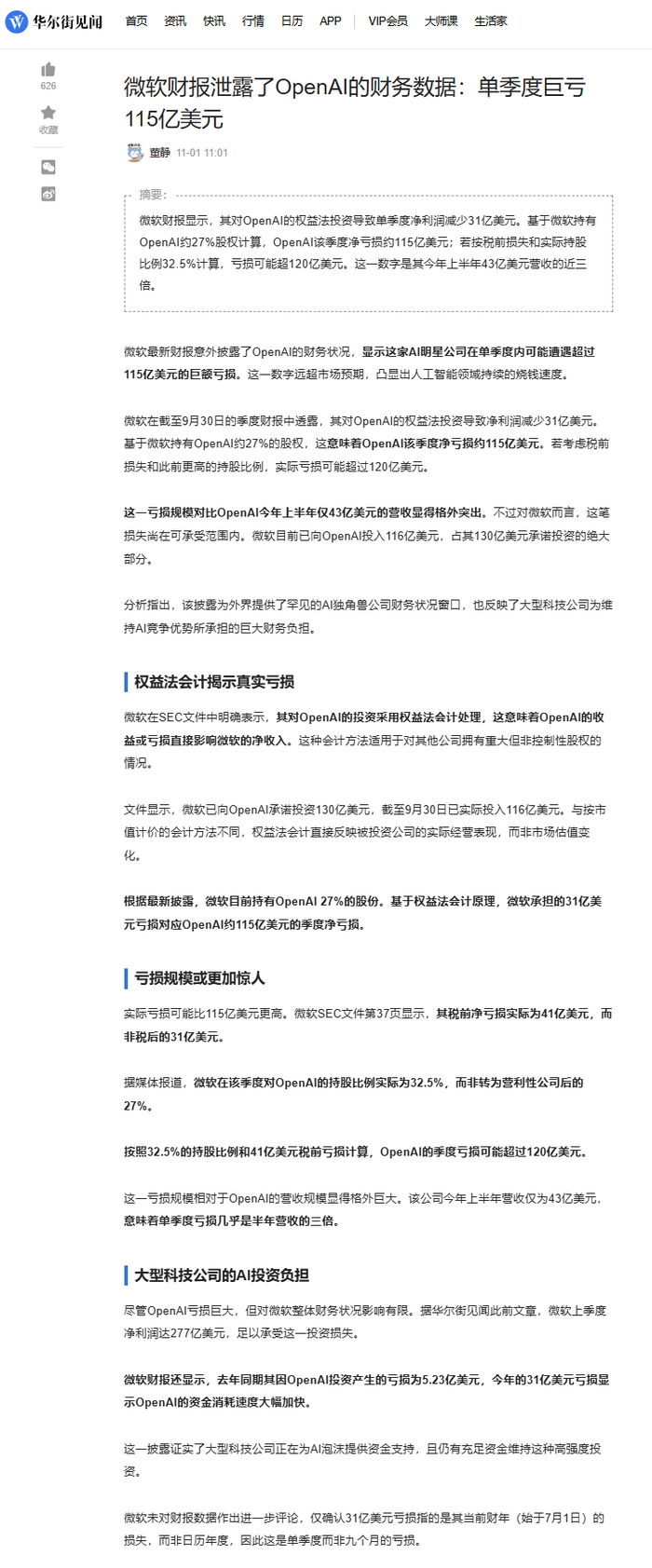
微软和OpenAI CEO罕见同场对话:OpenAI重组、AI泡沫质疑、算力需求......
Hua Er Jie Jian Wen· 2025-11-01 09:48
Core Insights - OpenAI and Microsoft CEOs discussed the AI industry's key issues, including the partnership's structure and future growth potential [1][2][3] - The conversation highlighted the importance of computational power and the challenges related to energy supply and infrastructure development [1][4][22] - Both CEOs addressed concerns about an AI investment bubble, using data to demonstrate the viability of their business models [2][16][18] Partnership Structure - OpenAI's exclusive "stateless API" will remain on Azure until 2030, while other products like ChatGPT will be distributed across multiple platforms [1][12] - Microsoft has invested approximately $13.5 billion in OpenAI, with the investment primarily directed towards training rather than revenue [2][10] - The partnership is framed as one of the greatest tech collaborations, with both companies benefiting from shared goals and resources [9][41] Computational Power and Infrastructure - Nadella emphasized that the current challenge is not a surplus of computational power but rather issues related to energy supply and infrastructure development [1][4][22] - Altman noted that OpenAI's computational capacity has increased tenfold in the past year, and further growth could significantly impact revenue [3][18] - Both leaders anticipate that computational surplus will eventually occur, but the timeline remains uncertain, potentially within 2-6 years [1][23] Addressing Investment Bubble Concerns - Altman responded to skepticism about OpenAI's ability to support a $1.4 trillion spending commitment with a projected revenue of $13 billion, asserting that revenue growth will follow computational capacity growth [16][17] - Nadella supported this by stating that OpenAI's business plans have not only been met but exceeded expectations, reinforcing the demand-driven nature of their growth [2][18] - The discussion included the potential for AI to automate scientific research, which could lead to significant breakthroughs in various fields [3][11] Future Outlook - Altman expressed excitement about the potential for AI to conduct scientific research, which he views as a step towards achieving superintelligence [3][11] - The CEOs discussed the importance of developing new computing devices that can operate efficiently and independently, enhancing user interaction with AI [25][36] - Both leaders acknowledged the need for a unified regulatory framework to support AI development and mitigate the risks associated with fragmented state laws [29][31]

微软财报泄密:OpenAI一颗大雷将引爆
Hua Er Jie Jian Wen· 2025-11-01 06:56
Core Insights - OpenAI reported a staggering quarterly loss of over $11.5 billion, significantly exceeding market expectations, highlighting the ongoing cash burn in the AI sector [1] - Microsoft’s investment in OpenAI, which is accounted for using the equity method, resulted in a net income reduction of $3.1 billion for the quarter [2] - The actual pre-tax loss for OpenAI could exceed $12 billion when considering Microsoft's higher ownership percentage of 32.5% [4][5] Financial Performance - OpenAI's revenue for the first half of the year was only $4.3 billion, making the quarterly loss nearly three times its half-year revenue [5] - Microsoft has committed a total of $13 billion to OpenAI, with $11.6 billion already invested, indicating a substantial financial commitment [2][6] - Despite the significant loss from OpenAI, Microsoft’s overall financial health remains strong, with a net profit of $27.7 billion in the last quarter, allowing it to absorb the investment loss [6][7] Accounting Methodology - Microsoft uses the equity method for accounting its investment in OpenAI, meaning OpenAI's losses directly impact Microsoft's net income [2] - The equity method reflects the actual operational performance of the invested company rather than market valuation changes [2] Industry Implications - The disclosure of OpenAI's financial status provides a rare glimpse into the financial burdens large tech companies face to maintain competitive advantages in AI [1][7] - The rapid increase in OpenAI's cash consumption is evident, with losses accelerating compared to the previous year's $0.523 billion loss [6]