
BeiGene(06160)

Search documents
百济神州:上半年净利润4.5亿元 实现扭亏为盈
Zheng Quan Shi Bao Wang· 2025-08-29 14:53
Core Viewpoint - BeiGene reported a significant financial turnaround in the first half of 2025, achieving a total revenue of 17.518 billion yuan, a year-on-year increase of 46.03%, and a net profit of 450 million yuan, marking its first profit of the year [2][3]. Financial Performance - Total revenue for the first half of 2025 reached 17.518 billion yuan, up 46.03% year-on-year [2]. - Product revenue was 17.36 billion yuan, reflecting a growth of 45.8% [2]. - The company achieved a net profit of 450 million yuan, indicating a turnaround from previous losses [2]. Product Performance - The growth in product revenue was driven by sales of self-developed products, namely Brukinsa® (Zebutinib) and Tislelizumab, as well as increased sales from licensed products [2]. - Zebutinib's global sales reached 12.527 billion yuan, a 56.2% increase year-on-year, making it the leading BTK inhibitor in both the U.S. and global markets [2][3]. - In the U.S. market, Zebutinib sales amounted to 8.958 billion yuan, up 51.7% [3]. - In Europe, Zebutinib sales were 1.918 billion yuan, growing by 81.4% [3]. - In China, Zebutinib sales reached 1.192 billion yuan, an increase of 36.5% [3]. - Tislelizumab generated sales of 2.643 billion yuan, reflecting a 20.6% growth, primarily due to new indications being covered by insurance [3]. Research and Development - The company anticipates over 20 milestone advancements in blood cancers and solid tumors within the next 18 months [4]. - In the blood cancer sector, two products, BGB-16673 and Sotorasib, are in Phase 3 clinical trials [4]. - BGB-16673 is noted for its rapid clinical progress as a BTK degrader, showing potential for treating relapsed or refractory B-cell malignancies [4]. - Sotorasib has submitted applications for two indications in China and is expected to file for global accelerated approval in the second half of 2025 [4]. - The company is also developing multiple potential best-in-class products and combination therapies for key cancers, including breast, lung, and gastrointestinal cancers [4]. Stock Performance - As of August 29, BeiGene's A-share price closed at 278 yuan, marking a 12.55% increase and reaching a historical high [5].


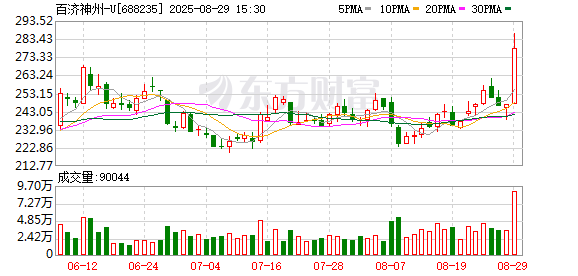
百济神州A股盘中股价创新高 外资继续唱多中国创新药,摩根士丹利定调“创新黎明”
Mei Ri Jing Ji Xin Wen· 2025-08-29 14:43
Core Viewpoint - The company BeiGene has achieved its first half-year profit, with significant revenue growth driven by key products, despite facing challenges in maintaining high growth rates in the innovative drug sector [3][4][7]. Financial Performance - In the first half of 2025, BeiGene reported revenue of $2.433 billion, a year-on-year increase of approximately 44.7%, and a net profit of about $95.6 million, marking a turnaround from losses [3][4]. - The operating profit for the first half reached 799 million yuan, with a net profit attributable to shareholders of 450 million yuan [4]. Product Performance - The PD-1 inhibitor, Tislelizumab, and the BTK inhibitor, Zanubrutinib, were the main contributors to sales growth, with Zanubrutinib's global sales reaching 12.527 billion yuan, a year-on-year increase of 56.2% [5]. - Over 70% of Zanubrutinib's revenue came from the U.S. market, with the drug leading the BTK inhibitor market for two consecutive quarters [5]. Market Dynamics - The U.S. market accounted for 51.86% of BeiGene's revenue, followed by China at 34.22% and Europe at 11.14% [5]. - The innovative drug sector in Hong Kong has experienced a phase of adjustment, with the Hang Seng Hong Kong Stock Connect Innovative Drug Index showing a monthly decline of 0.64% in August [7][9]. Industry Outlook - Despite short-term adjustments, foreign investment banks maintain a positive long-term outlook for the Chinese innovative drug sector, citing a critical turning point for the biotechnology industry in China [9][10]. - Predictions indicate that by 2040, the proportion of drugs approved by the FDA originating from China could rise from 5% to 35%, with potential overseas revenue reaching $220 billion [10].
晚间公告丨8月29日这些公告有看头
第一财经· 2025-08-29 14:38
Major Events - SMIC is planning to issue A-shares to acquire minority stakes in its subsidiary, with stock suspension starting from September 1, 2025, for up to 10 trading days. The transaction is not expected to constitute a major asset restructuring but is classified as a related party transaction [4] - China Shipbuilding Industry Corporation's A-shares will be delisted on September 5, 2025, with a conversion ratio of 1:0.1339 to China Shipbuilding's A-shares [5] - Kweichow Moutai has completed a share buyback of 3.9276 million shares, totaling 6 billion yuan, which will be used for capital reduction [6][7] Performance Overview - BYD reported a net profit of 15.511 billion yuan for the first half of 2025, a year-on-year increase of 13.79%, with revenue of 371.281 billion yuan, up 23.30% [8] - Wingtech Technology's net profit for the first half of 2025 was 474 million yuan, a significant increase of 237.36%, despite a revenue decline of 24.56% [9] - Pianzaihuang's net profit decreased by 16.22% to 1.442 billion yuan, with revenue down 4.81% [10] - Shanshan reported a net profit of 207 million yuan, up 1079.59%, with revenue growth of 11.78% [11] - China Rare Earth achieved a net profit of 162 million yuan, reversing a loss from the previous year, with revenue growth of 62.38% [12] - China Shipbuilding reported a net profit of 2.946 billion yuan, up 108.59%, with revenue growth of 11.96% [13] - Guotai Junan's net profit surged by 213.74% to 15.737 billion yuan, with revenue growth of 77.71% [15] - China Shenhua's net profit decreased by 12% to 24.641 billion yuan, with revenue down 18.3% [16] - Lattice Semiconductor's net profit increased by 95.41% to 1.159 billion yuan, with revenue growth of 58.17% [17] - Guotou Zhonglu reported a net profit of 25.08 million yuan, up 2149.03%, with revenue growth of 39.68% [18] - Jianfeng Group's net profit increased by 1196.93% to 618 million yuan, despite a revenue decline of 4.42% [19] - OmniVision's net profit for the first half of 2025 was 2.028 billion yuan, up 48.34%, with revenue growth of 15.42% [20] - Haili's net profit increased by 694% to 33.3546 million yuan, with revenue growth of 13.16% [21] - Huaxia Airlines reported a net profit of 251 million yuan, up 859%, with revenue growth of 12.41% [22] - BeiGene turned a profit with a net profit of 450 million yuan, compared to a loss of 287.7 million yuan in the previous year, with revenue growth of 46.03% [24] - China Merchants Bank's net profit was 74.93 billion yuan, a slight increase of 0.25%, with a revenue decline of 1.73% [25] - Agricultural Bank of China reported a net profit of 139.51 billion yuan, up 2.7%, with revenue growth of 0.7% [26] - Bank of China reported a net profit of 117.591 billion yuan, with revenue growth compared to the previous year [27] - Industrial and Commercial Bank of China reported a net profit of 168.103 billion yuan, with slight revenue growth [28] - Bank of Communications reported a net profit of 46.016 billion yuan, up 1.61%, with revenue growth of 0.72% [29] - China Construction Bank's net profit was 162.076 billion yuan, a decrease of 1.37%, with revenue growth of 2.95% [30]




明星基金经理二季度调仓路线图:科技医药成共识,消费现分歧
Nan Fang Du Shi Bao· 2025-08-29 13:36
Core Viewpoint - The article highlights the strategic adjustments made by prominent fund managers in response to the market's structural characteristics, focusing on sectors like AI, innovative pharmaceuticals, and consumer goods, while also indicating a clear divergence in the consumer sector's performance [2][3][4]. Group 1: Fund Manager Strategies - Prominent fund managers have collectively increased their positions in high-growth sectors such as AI and innovative pharmaceuticals while making structural adjustments within the consumer sector [2]. - The technology and pharmaceutical sectors have emerged as core allocation directions, with significant investments in companies like BYD (increased by 184.78%) and Alibaba (increased by 161.10%) [2]. - Fund managers are focusing on "hard technology" in the tech sector, with AI computing and robotics becoming key investment areas [4]. Group 2: Consumer Sector Dynamics - The consumer sector has shown significant structural differentiation, with fund managers displaying contrasting attitudes towards traditional liquor and new consumption trends [3]. - Some fund managers have increased their holdings in traditional liquor stocks like Wuliangye and Moutai, while others have reduced their positions in these stocks, indicating a shift towards new consumption opportunities [3][4]. - The performance of consumer companies has influenced fund adjustments, with companies like Yili achieving strong revenue growth while others like Yanghe experienced profit declines [4]. Group 3: Future Outlook - Looking ahead to the third quarter, there is optimism regarding the innovative pharmaceutical sector, driven by global collaborations and anticipated clinical data disclosures [5]. - The consumer healthcare sector is expected to continue benefiting from rising health awareness among residents, with demand for home medical devices projected to grow steadily due to an aging population [5]. - The overall economic environment is seen as favorable for investment, although structural pressures may persist, with policies aimed at reducing excessive competition likely to improve corporate profitability [5].





一周医药速览(08.25-08.29)
Cai Jing Wang· 2025-08-29 13:29
Group 1: Company Performance - Renfu Pharmaceutical reported a 6.2% decline in revenue to 12.064 billion yuan, while net profit increased by 3.92% to 1.155 billion yuan [1] - Junshi Biosciences achieved a 48.64% increase in revenue to 1.168 billion yuan, with a net loss of 413 million yuan [2] - Fuhong Hanlin's revenue for the first half of 2025 was 2.8195 billion yuan, a 2.7% year-on-year increase, with a net profit of 390.1 million yuan [6] Group 2: Market Position and Product Development - Renfu Pharmaceutical holds over 60% market share in the domestic anesthetic drug market, with its subsidiary Yichang Renfu being the largest R&D and production base in Asia [1] - Junshi Biosciences' core product, Toripalimab, generated sales revenue of approximately 1.059 billion yuan, a 49.41% increase, with domestic sales reaching about 954 million yuan, up 42% [2] - Beijing Kexing's adsorbed tetanus vaccine received drug registration approval, enhancing the company's portfolio in the trauma field [3] Group 3: Strategic Partnerships and Financial Transactions - BeiGene signed a royalty transfer agreement with Royalty Pharma for Tarlatamab, potentially worth up to 950 million USD, with an initial payment of 885 million USD [4] - Lepu Medical's management expressed a desire to avoid selling potential products at low prices early in the development process, indicating a focus on maintaining financial strength [5][6] - Fuhong Hanlin reported over 1 billion yuan in cash inflow from BD contracts, with a significant increase in overseas product profits [6]


百济神州上半年营收增长46% 实现净利润4.50亿元
Zheng Quan Shi Bao Wang· 2025-08-29 12:51
Core Insights - The company reported a revenue of 17.518 billion yuan for the first half of the year, representing a year-on-year growth of 46.03%, and achieved a net profit of 450 million yuan, compared to a loss of 2.877 billion yuan in the same period last year [1] - The revenue growth was primarily driven by the global sales performance of core products, particularly the BTK inhibitor, Brukinsa (Zebutinib), which generated global sales of 12.527 billion yuan, a 56.2% increase year-on-year [1] - The company continues to invest heavily in R&D, with R&D expenses reaching 7.278 billion yuan, a 9.80% increase, accounting for 41.54% of total revenue [1] Revenue Breakdown - Brukinsa sales in the U.S. reached 8.958 billion yuan, a year-on-year increase of 51.7% - Sales in Europe amounted to 1.918 billion yuan, growing by 81.4% - Sales in China were 1.192 billion yuan, reflecting a 36.5% increase [1] - The other core product, PD-1 monoclonal antibody, Baiyuean (Tislelizumab), achieved sales of 2.643 billion yuan, a 20.6% increase, supported by new indications being included in medical insurance in China [1] R&D and Pipeline Developments - The company has one of the largest oncology research teams in the industry and is strong in the translational discovery of small molecules and antibody drugs, with three proprietary platform technologies: ADC, bispecific antibodies, and CDAC [2] - Over the next 18 months, the company anticipates more than 20 milestone advancements in its hematologic and solid tumor pipelines [3] - The global Phase III trial for the BCL2 inhibitor, Sonrotoclax, in combination with Brukinsa for first-line treatment of CLL has completed patient enrollment [3] Collaborations and Commercialization - In August 2025, the company entered into an agreement with Royalty Pharma to sell the royalty rights for the global sales of Tarlatamab outside of China, with a transaction value of up to 950 million USD, optimizing cash flow structure [4] - The company has established a competitive global commercialization team in major markets such as the U.S., EU, and China, and is accelerating business expansion in Asia-Pacific, Latin America, and the Middle East to diversify revenue sources [4]
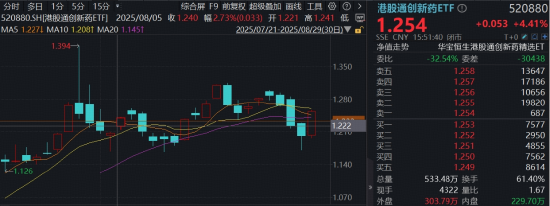
深夜引爆,美联储大消息!港股通创新药ETF(520880)放量涨超4%,信达生物、百济神州绩后猛攻
Xin Lang Ji Jin· 2025-08-29 12:03
Core Viewpoint - The Hong Kong stock market experienced a slight rebound on August 29, with innovative drug stocks leading the way, particularly the Hong Kong Stock Connect Innovative Drug ETF (520880), which rose by 4.41% and recovered from previous losses [1][5]. Market Performance - The trading volume for the day reached 658 million yuan, an increase of 65% compared to the previous day [1]. - Major stocks in the innovative drug sector saw significant rebounds, with companies like Innovent Biologics and CSPC Pharmaceutical rising over 6%, and others like 3SBio and China Biologic Products increasing by more than 5% [2][3]. Stock Highlights - Notable stock performances included: - Green Leaf Pharmaceutical (7.78% increase) - WuXi Biologics (6.96% increase) - Innovent Biologics (6.84% increase) - CSPC Pharmaceutical (6.67% increase) - BeiGene (nearly 4% increase) [4]. Federal Reserve Policy Impact - Following dovish signals from Federal Reserve Chairman Jerome Powell, market expectations for a 25 basis point rate cut in September have risen to over 80% [5]. - The innovative drug sector, being capital-intensive, is expected to benefit from the anticipated easing of monetary policy, which could lead to increased liquidity and growth opportunities [5]. Historical Context - Historical data indicates that during previous Federal Reserve rate cuts (2001-2003, 2008-2009), the Nasdaq Biotechnology Index outperformed the Nasdaq Composite by approximately 40 and 20 percentage points, respectively [5]. - The low-interest-rate environment from 2020 to 2021 led to record high financing in the global innovative drug primary market [5]. Company Performance - BeiGene reported a revenue of 2.433 billion yuan for the first half of the year, a year-on-year increase of 44.73%, with a net profit of 95.59 million USD, exceeding market expectations [6]. - Innovent Biologics also showed strong performance with a revenue of 5.95 billion yuan, a 50.6% year-on-year increase, and a net profit of 1.21 billion yuan [6]. Future Outlook - The innovative drug sector is expected to continue benefiting from domestic policy support, international expansion, and enhanced global competitiveness, which may drive valuation re-rating [6]. - Key catalysts for the second half of the year include medical insurance negotiations, academic conferences, and the implementation of innovative drug directories [6]. ETF Performance - The Hong Kong Stock Connect Innovative Drug ETF (520880) has seen a year-to-date increase of 101.58%, significantly outperforming other indices [9][10]. - The ETF tracks the Hang Seng Hong Kong Stock Connect Innovative Drug Select Index, which focuses on innovative drug companies and has a high concentration of leading stocks [7].
百济神州2025年上半年净利润4.5亿元,同比扭亏为盈
Bei Jing Shang Bao· 2025-08-29 11:44
北京商报讯(记者王寅浩实习记者宋雨盈)8月29日,百济神州发布公告称,2025年上半年实现营业收 入175.18亿元,同比增长46.03%;归属于上市公司股东的净利润为4.5亿元,上年同期为亏损28.77亿 元,;归属于上市公司股东的扣除非经常性损益的净利润为2.61亿元,上年同期为亏损31.25亿元。 (文章来源:北京商报) ...
百济神州宣布索托克拉用于治疗套细胞淋巴瘤患者的临床研究取得积极结果
Ge Long Hui· 2025-08-29 11:25
Core Insights - BeiGene announced positive results from the Phase 1/2 clinical trial of its next-generation BCL2 inhibitor, Sotorasib, for treating adult patients with mantle cell lymphoma (MCL) who have previously received BTK inhibitors and anti-CD20 therapies [1][2] - The trial demonstrated significant and durable responses, indicating the potential of Sotorasib to provide the first BCL2 inhibitor treatment option for MCL patients if approved [1][2] Company Developments - The clinical study (BGB-11417-201) enrolled 125 adult patients with MCL, assessing safety, tolerability, and efficacy of Sotorasib at doses of 160 mg and 320 mg [1] - The study achieved the primary endpoint of overall response rate (ORR) and showed positive results in secondary endpoints, including complete response rate (CRR), duration of response (DOR), and progression-free survival (PFS) [2] - BeiGene is submitting data to the FDA and other global regulatory agencies for potential approval of Sotorasib in MCL, with the drug already accepted for priority review by China's NMPA [2] Industry Context - The study's results mark a significant milestone in BeiGene's product portfolio for hematologic malignancies, which currently includes three major products aimed at addressing the evolving clinical needs of B-cell malignancy patients [2] - The ongoing Phase 3 confirmatory CELESTIAL-RRMCL study (BGB-11417-302) has already enrolled its first patient earlier this year, further supporting the development of Sotorasib [2]
百济神州:索托克拉用于治疗套细胞淋巴瘤患者的临床研究取得积极结果
Zhi Tong Cai Jing· 2025-08-29 11:17
Core Insights - BeiGene announced positive results from the Phase 1/2 clinical trial of its investigational BCL2 inhibitor, Sotorasib, for treating adult patients with mantle cell lymphoma (MCL) who have previously received BTK inhibitors and anti-CD20 therapies [1][2] - The trial demonstrated significant and durable responses, indicating the potential of Sotorasib to provide the first BCL2 inhibitor treatment option for MCL patients if approved [1][2] Group 1: Clinical Trial Details - The BGB-11417-201 study is a global, multicenter, single-arm, open-label Phase 1/2 trial that enrolled 125 adult MCL patients previously treated with BTK inhibitors and anti-CD20 therapies [1] - In the first part of the study, 22 patients received daily doses of either 160 mg or 320 mg of Sotorasib to assess safety and tolerability, leading to the determination of the recommended dose for the second part [1] - The second part involved 103 patients receiving the recommended daily dose of 320 mg to evaluate the efficacy and safety of Sotorasib [1] Group 2: Efficacy and Safety Results - The study achieved the primary endpoint of overall response rate (ORR) as assessed by an independent review committee (IRC), indicating clinically meaningful responses in the patient population [2] - Secondary efficacy endpoints, including complete response rate (CRR), duration of response (DOR), and progression-free survival (PFS), also showed positive results [2] - The safety profile of Sotorasib was generally well-tolerated, with manageable toxicity, marking an important milestone in BeiGene's product portfolio for hematologic malignancies [2] Group 3: Regulatory and Market Implications - BeiGene is submitting data to the FDA and global regulatory agencies to seek potential approval for Sotorasib in the MCL indication [2] - The new drug application for Sotorasib for treating MCL and CLL/SLL patients has been accepted by the National Medical Products Administration (NMPA) in China and is under priority review [2] - A confirmatory Phase 3 study, CELESTIAL-RRMCL (BGB-11417-302), is ongoing, with the first patient enrolled earlier this year [2]