BeiGene(06160)

Search documents
8月31日周末公告汇总 | 贵州茅台控股股东拟超30亿元增持股票;中芯国际因收购中芯北方股权停牌
Xuan Gu Bao· 2025-08-31 12:21
Suspension and Resumption of Trading - SMIC is planning to issue A-shares to acquire minority stakes in its subsidiary, SMIC North, leading to a suspension of its stock trading [1] - Huahong Semiconductor intends to issue shares and pay cash to acquire 97.5% of Huali Micro's equity and will resume trading [2] - Tailin Micro plans to acquire 100% of Panqi Micro, both companies operate in the low-power wireless IoT chip design sector, and will resume trading [2] Mergers and Acquisitions - Xingchen Technology plans to acquire 53.3087% of Furui Kun for 214 million yuan, aiming to enhance its capabilities in connectivity, audio, and low power, thereby strengthening its SoC self-developed IP platform [3] - Huijin Co. intends to cash purchase 20% of Cooper New Energy's equity, which is expected to constitute a major asset restructuring [3] Share Buybacks - Kweichow Moutai's controlling shareholder plans to increase its stake by purchasing 3 to 3.3 billion yuan worth of company shares [4] - Kaiying Network intends to repurchase shares worth 100 to 200 million yuan [4] Investment Cooperation and Operational Status - Jiayuan Technology plans to invest 500 million yuan to acquire a portion of Endatong's equity, which is related to the optical module industry [5] - Zhiyang Innovation plans to establish a wholly-owned subsidiary with an investment of 20 million yuan to promote embodied intelligence technology innovation [6] - Yunzhu Technology plans to raise no more than 876 million yuan through a private placement for the upgrade and expansion of chip insertion integrated (CMI) component projects [6] Performance Changes - Sails reported a net profit of 2.941 billion yuan for the first half of 2025, an increase of 81.03% year-on-year [8] - BYD's net profit for the first half reached 15.51 billion yuan, up 13.79% year-on-year [8] - Lanke Technology reported a net profit of 1.159 billion yuan for the first half, a significant increase of 95.41% year-on-year [8] - Yilake Co. reported a net profit of 2.515 billion yuan for the first half, up 13.69% year-on-year, with a lithium salt project expected to start trial operations by the end of September [8] - Haowei Group reported a net profit of 2.028 billion yuan for the first half, an increase of 48.34% year-on-year, and has entered NVIDIA's supply chain [9] - Tianqi Lithium reported a net profit of 84.41 million yuan for the first half, marking a return to profitability [10] - China Rare Earth reported a net profit of 162 million yuan for the first half, also returning to profitability [10] - BeiGene reported a net profit of 450 million yuan for the first half, returning to profitability [10] - Guoxuan High-Tech reported a net profit of 367 million yuan for the first half, an increase of 35.22% year-on-year, and plans to invest up to 4 billion yuan in a new lithium-ion battery manufacturing base [10] - Lingyi Technology reported a net profit of 930 million yuan for the first half, an increase of 35.94% year-on-year [10] - Shenwan Hongyuan reported a net profit of 4.284 billion yuan for the first half, an increase of 101% year-on-year [10] - Zhongtai Securities reported a net profit of 711 million yuan for the first half, an increase of 77.26% year-on-year [10] - Guotai Junan reported a net profit of 15.737 billion yuan for the first half, an increase of 213.74% year-on-year [10] - China Shipbuilding reported a net profit of 2.946 billion yuan for the first half, an increase of 108.59% year-on-year [10] - Yangtze Power reported a net profit of 13.056 billion yuan for the first half, an increase of 14.86% year-on-year [10] - TCL Technology reported a net profit of 1.883 billion yuan for the first half, an increase of 89.26% year-on-year [10] - ST Huatuo reported a net profit of 2.656 billion yuan for the first half, an increase of 129% year-on-year [10] - Wentai Technology reported a net profit of 474 million yuan for the first half, an increase of 237.36% year-on-year [10]


多家创新药企业绩大涨
2 1 Shi Ji Jing Ji Bao Dao· 2025-08-31 00:44
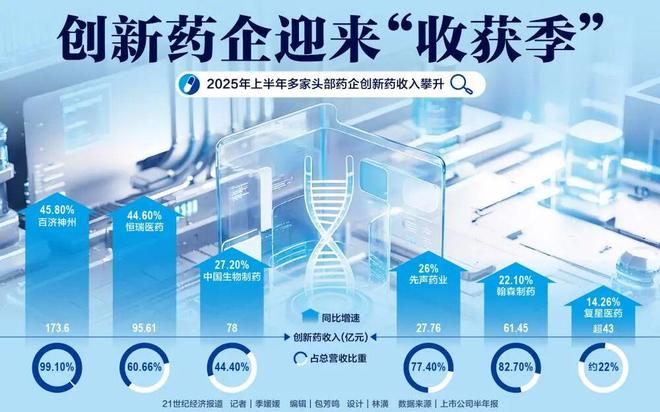
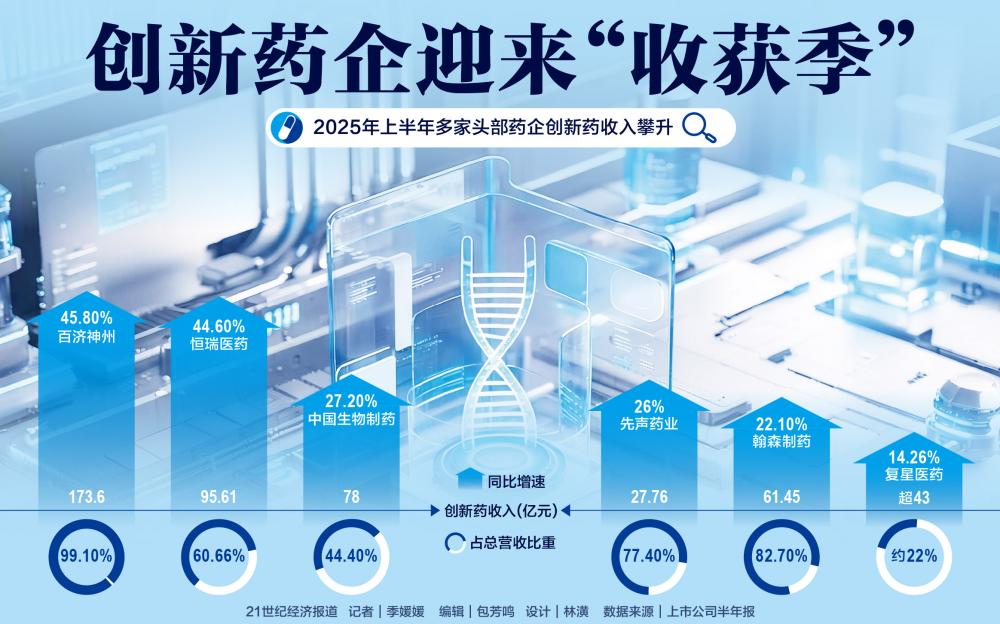
Core Viewpoint - The performance of innovative pharmaceutical companies in China for the first half of 2025 has been impressive, with significant revenue and profit growth driven by innovative drug sales, indicating a potential recovery in the pharmaceutical industry [1][6][15]. Group 1: Company Performance - Heng Rui Pharmaceutical achieved a revenue of 15.76 billion yuan, a year-on-year increase of 15.88%, with a net profit of 4.45 billion yuan, up 29.67%. Innovative drug sales accounted for 60.66% of total revenue [3][9]. - BeiGene reported total revenue of 17.52 billion yuan, a 46.0% increase year-on-year, with a net profit of 450 million yuan, marking a turnaround from losses [3][6]. - China Biopharmaceutical's revenue reached 17.57 billion yuan, a 10.7% increase, with innovative product revenue of 7.8 billion yuan, up 27.2%, representing 44.4% of total revenue [3][6]. - XinDa Biopharmaceutical achieved revenue of 5.95 billion yuan, a 50.6% increase, and a net profit of 1.21 billion yuan, turning a loss from the previous year [7][8]. - Xiansheng Pharmaceutical reported a revenue increase of 15.1% to 3.58 billion yuan, with innovative drug revenue surpassing 75% of total revenue [8]. Group 2: Market Trends - The rising proportion of innovative drug revenue among multiple pharmaceutical companies suggests a shift towards innovation-driven strategies, indicating a growing market for innovative drugs in China [6][8][15]. - The second-tier market is experiencing a prosperous phase, leading to speculation about a potential "spring" for the pharmaceutical industry, although the primary market remains challenging [4][15]. - The demand for high-quality products that can compete globally is increasing, with a focus on "best-in-class" products [4][15]. Group 3: Business Development (BD) Contributions - Business development (BD) activities are becoming crucial for the growth of innovative pharmaceutical companies, with significant deals contributing to revenue [9][10]. - Heng Rui Pharmaceutical's BD activities included a $1.97 billion contract with Merck and a partnership with GSK, highlighting the increasing global engagement of Chinese innovative drug companies [10][11]. - The first half of 2025 saw over 50 BD transactions in China's innovative drug sector, with a total disclosed cooperation amount exceeding $48.44 billion, marking a significant increase compared to the previous year [10][11]. Group 4: Challenges and Outlook - Despite the positive trends, companies face challenges such as intense market competition, high project uncertainty, and increasing accounts receivable [13][14]. - Some companies, like BeiDa TianHeng, reported significant revenue declines due to high R&D investments and previous income recognition from collaborations [13][14]. - Overall, the industry is transitioning from an "investment phase" to a "harvest phase," indicating a recovery in profitability and a moderate expansion phase [14][15].



多家创新药企业绩大涨
21世纪经济报道· 2025-08-31 00:34
Core Viewpoint - The performance of innovative pharmaceutical companies in China for the first half of 2025 is impressive, with significant revenue and profit growth driven by innovative drug sales, indicating a potential recovery in the pharmaceutical industry [1][3][10]. Summary by Sections Company Performance - Heng Rui Pharmaceutical achieved a revenue of 15.761 billion yuan, a year-on-year increase of 15.88%, and a net profit of 4.450 billion yuan, up 29.67%. Innovative drug sales accounted for 60.66% of total revenue [3][12]. - Bai Jie Shen Zhou reported total revenue of 17.518 billion yuan, a 46.0% increase, with a net profit of 450 million yuan, marking a turnaround from losses. The sales of its key products, including the BTK inhibitor and PD-1 inhibitor, significantly contributed to this growth [3][7]. - Xin Da Biotech achieved revenue of 5.953 billion yuan, a 50.6% increase, and a net profit of 1.213 billion yuan, compared to a loss in the previous year, driven by strong sales of its PD-1 inhibitor and new weight-loss drug [8]. - Xian Sheng Pharmaceutical reported a revenue increase of 15.1% to 3.585 billion yuan, with innovative drug revenue reaching 2.776 billion yuan, accounting for 77.4% of total revenue [9]. Market Trends - The rising proportion of innovative drug revenue among multiple pharmaceutical companies suggests a shift towards innovation-driven strategies, with increasing market demand for innovative products supported by healthcare policies [10][20]. - Business Development (BD) activities are becoming crucial for growth, with significant deals indicating a robust international presence for Chinese innovative drug companies [12][13]. Challenges and Outlook - Despite the positive trends, companies face challenges such as intense market competition, high project uncertainty, and increasing accounts receivable [18]. - Some companies, like Bai Li Tian Heng and Bei Da Pharmaceutical, reported declines in net profit due to high R&D costs and overdue payments to partners, highlighting the risks associated with innovation investments [18][19]. - Overall, the industry is transitioning from a low point to a recovery phase, with expectations for sustained growth in the innovative drug sector driven by efficiency and cost advantages [20].

百济神州发布上半年业绩,扭亏为盈至4.5亿元
Jing Ji Guan Cha Wang· 2025-08-30 14:41
经济观察网 8月29日,百济神州(688235.SH)发布2025年半年度报告,报告期内,公司实现营业收入 175.18亿元,同比增长46.03%。实现归属于上市公司股东的净利润4.5亿元。实现归属于上市公司股东 的扣除非经常性损益的净利润2.61亿元。基本每股收益0.32元。 ...
集体披露!外资全线加仓中国资产!
Zheng Quan Shi Bao Wang· 2025-08-30 06:24
Group 1: Foreign Investment in Chinese Assets - Major foreign institutions such as JPMorgan, Citigroup, and Morgan Stanley have significantly increased their holdings in Chinese H-shares, including CATL, ZTE, and WuXi AppTec [1][2] - Morgan Stanley reported that global hedge funds have ramped up their bets on Chinese stocks, with August expected to see the highest monthly buying volume since February [1][2] Group 2: Stock Performance - As of August 29, CATL and WuXi AppTec saw substantial stock price increases, with CATL's A and H shares rising by 10.37% and 4.17% respectively, and WuXi AppTec's A and H shares increasing by 7.95% and 6.52% respectively [2] - The rise in CATL's stock price is attributed to the upcoming sales season and the release of new models, with expectations for high growth in domestic electric vehicle sales by 2025 [2] Group 3: Industry Trends - The lithium battery industry is experiencing a "de-involution," with a growing consensus on price discipline in certain segments, which is expected to improve the competitive landscape [3] - The solid-state battery industrialization process is accelerating, with several companies initiating pilot production lines and planning mass production by 2026 [3] Group 4: Market Outlook - The Hong Kong stock market has shown resilience, with the Hang Seng Index rising by 1.23% in August, marking four consecutive weeks of gains [6] - Analysts predict that the market will continue to be supported by improving global liquidity conditions and ongoing economic stabilization policies in mainland China [6][7] - The expectation of a dovish shift in the Federal Reserve's monetary policy is anticipated to further enhance liquidity, benefiting the Hong Kong market [6][7]




集体披露!外资,全线加仓!
券商中国· 2025-08-30 05:25
Core Viewpoint - Foreign investment giants are significantly increasing their holdings in Chinese assets, particularly in H-shares of companies like CATL, ZTE, and WuXi AppTec, indicating a growing confidence in the Chinese market amid improving global liquidity conditions [1][2]. Group 1: Foreign Investment Actions - Morgan Stanley, JPMorgan, and Citigroup have raised their long positions in several Chinese H-shares, with notable increases in holdings for CATL, ZTE, and WuXi AppTec [2]. - Specific increases include Morgan Stanley's long position in CATL rising from 4.96% to 6.05% and Citigroup's position in ZTE increasing from 6.71% to 7.17% [2]. Group 2: Market Performance - The Hong Kong stock market continued its upward trend in August, with the Hang Seng Index recording a monthly increase of 1.23% and achieving four consecutive weeks of gains [5]. - On August 29, CATL and WuXi AppTec saw significant stock price increases, with CATL's A and H shares rising by 10.37% and 4.17%, respectively [3]. Group 3: Industry Insights - Analysts predict that the domestic electric vehicle market will maintain high growth, driven by new model releases and a peak sales season, which will boost demand for batteries and materials [3]. - The solid-state battery industry is expected to accelerate its commercialization, with several companies planning to achieve mass production by 2026 [3]. Group 4: Future Market Outlook - The expectation of a dovish shift in the Federal Reserve's monetary policy is anticipated to improve the global liquidity environment, providing strong support for the Hong Kong stock market [6]. - Analysts suggest that the ongoing economic stabilization policies in mainland China and the recovery of listed companies' performance will further drive the valuation recovery of the Hong Kong market [6][7].




百济神州(688235.SH)上半年净利润4.5亿元 同比扭亏
Ge Long Hui A P P· 2025-08-30 01:41
Group 1 - The core viewpoint of the article highlights that BeiGene (688235.SH) reported significant growth in its mid-year financial results for 2025, achieving a total revenue of 17.518 billion yuan, which represents a year-on-year increase of 46.03% [1] - The company reported a net profit attributable to shareholders of 450 million yuan, a substantial recovery from a loss of 2.877 billion yuan in the same period last year [1] - Basic earnings per share for the company stood at 0.32 yuan [1]
创新药企迎来“收获季”
2 1 Shi Ji Jing Ji Bao Dao· 2025-08-29 23:09
Core Viewpoint - The performance of innovative pharmaceutical companies in China has shown significant growth in the first half of 2025, with many companies reporting impressive revenue and profit increases driven by innovative drug sales [1][4][7]. Group 1: Company Performance - Heng Rui Pharmaceutical achieved a revenue of 15.76 billion yuan, a year-on-year increase of 15.88%, and a net profit of 4.45 billion yuan, up 29.67%, with innovative drug sales accounting for 60.66% of total revenue [1][8]. - BeiGene reported total revenue of 17.52 billion yuan, a 46.0% increase year-on-year, with a net profit of 450 million yuan, marking a turnaround from losses [1][4]. - Innovent Biologics achieved revenue of 5.95 billion yuan, a 50.6% increase, and a net profit of 1.21 billion yuan, compared to a loss of 160 million yuan in the previous year [5]. - Xiansheng Pharmaceutical reported a revenue increase of 15.1% to 3.58 billion yuan, with innovative drug revenue reaching 2.78 billion yuan, accounting for 77.4% of total revenue [6]. Group 2: Market Trends - The rising proportion of innovative drug revenue among multiple pharmaceutical companies indicates a successful shift towards innovation-driven strategies, with increasing market demand for innovative products [7][12]. - The Chinese innovative drug market is expanding, supported by improved public health awareness and favorable healthcare policies [7][12]. - Business development (BD) activities have become a crucial growth engine for innovative pharmaceutical companies, with significant increases in BD transactions in the first half of 2025 [9][10]. Group 3: Challenges and Future Outlook - Despite the positive trends, companies face challenges such as intense market competition, high project uncertainty, and increasing accounts receivable [12][13]. - The overall industry is transitioning from a low point, with profitability beginning to recover, indicating a shift from an "investment phase" to a "harvest phase" [12][14]. - Analysts predict that the innovative drug sector will continue to thrive, driven by high efficiency and low-cost development advantages, particularly in popular technology areas [12][14].
百济神州(688235.SH)发布上半年业绩,扭亏为盈至4.5亿元
智通财经网· 2025-08-29 17:20
Core Insights - The company reported a revenue of 17.518 billion yuan for the first half of 2025, representing a year-on-year growth of 46.03% [1] - The net profit attributable to shareholders of the listed company was 450 million yuan [1] - The net profit attributable to shareholders after deducting non-recurring gains and losses was 261 million yuan [1] - The basic earnings per share were 0.32 yuan [1]
百济神州: 港股公告:百济神州有限公司截至2025年6月30日止六个月中期业绩公告
Zheng Quan Zhi Xing· 2025-08-29 17:03
Core Viewpoint - Beigene Ltd. reported significant financial improvements for the six months ending June 30, 2025, with a notable increase in revenue and a shift from net loss to net profit compared to the same period in 2024. Financial Summary - Total revenue for the six months ending June 30, 2025, increased by approximately $751.8 million or about 44.7% to approximately $2,432.6 million compared to the same period in 2024 [1]. - Product revenue rose by approximately $742.5 million or about 44.5% to approximately $2,410.6 million [1]. - Total operating expenses for the same period increased by approximately $217.7 million or about 12.2% to approximately $2,004.0 million [1]. - The net profit for the six months ending June 30, 2025, was approximately $95.6 million, a significant turnaround from a net loss of approximately $371.6 million in the same period of 2024 [1]. - Basic and diluted earnings per share for the six months ending June 30, 2025, were $0.07, compared to a loss of $0.27 per share for the same period in 2024 [1]. Balance Sheet Overview - Total assets as of June 30, 2025, amounted to approximately $6,298.4 million, an increase from $5,920.9 million as of December 31, 2024 [2]. - Total liabilities were approximately $2,527.9 million as of June 30, 2025, compared to $2,588.7 million as of December 31, 2024 [2]. - Shareholders' equity increased to approximately $3,770.5 million as of June 30, 2025, from $3,332.2 million as of December 31, 2024 [2]. Cash Flow Analysis - Net cash generated from operating activities for the six months ending June 30, 2025, was approximately $307.7 million, a recovery from cash used of $404.2 million in the same period of 2024 [3]. - Cash used in investing activities was approximately $188.5 million for the six months ending June 30, 2025, compared to $320.9 million in the same period of 2024 [3]. - Net cash provided by financing activities was approximately $1.2 million for the six months ending June 30, 2025, compared to $185.3 million in the same period of 2024 [3]. Company Overview - Beigene Ltd. is a global oncology innovation company focused on developing innovative anti-cancer drugs to improve accessibility and affordability for cancer patients worldwide [4]. - The company relocated its registered address to Switzerland in the second quarter of 2025, which does not affect its financial reporting under GAAP [4]. - As of June 30, 2025, Beigene employed over 11,000 staff and operates several subsidiaries in China, the United States, Australia, and Switzerland [4].