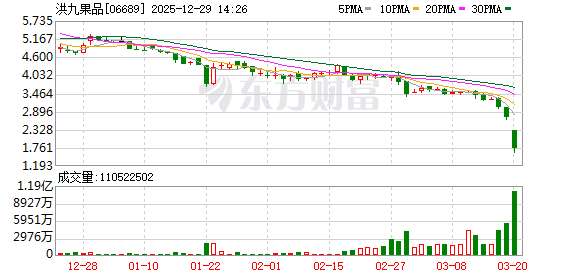
HONGJIU FRUIT(06689)

Search documents
洪九果品退市启示:水果分销商死于现金流
Jing Ji Guan Cha Wang· 2026-01-04 08:40
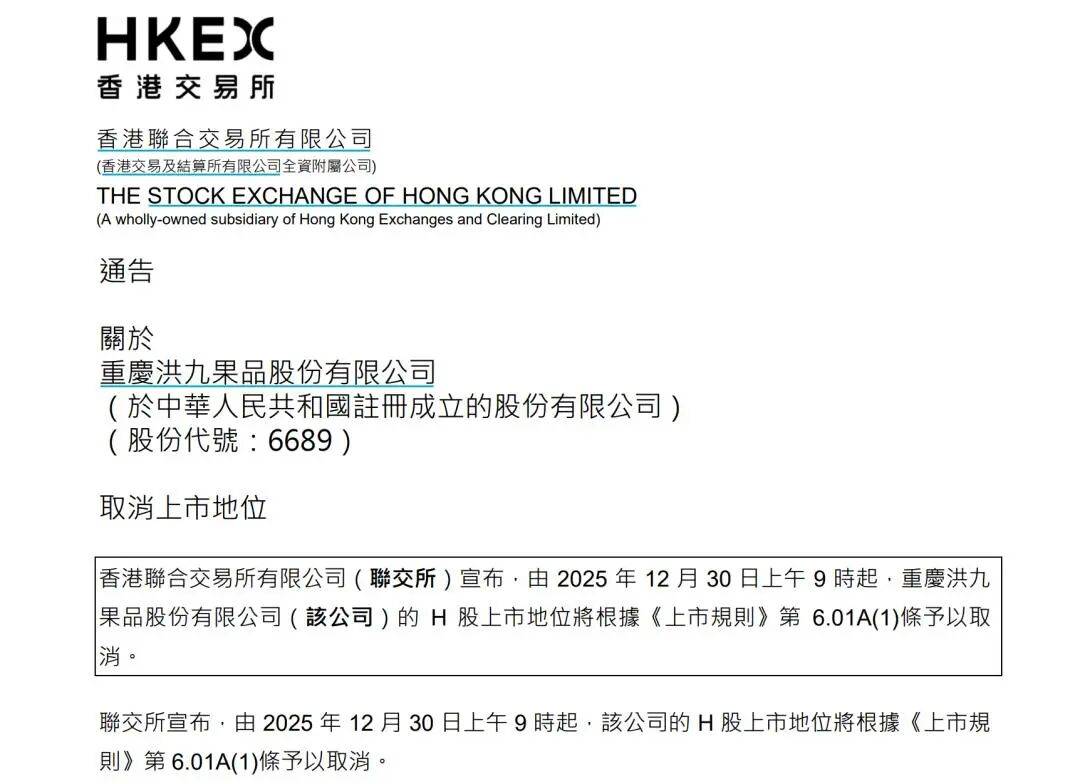
Core Viewpoint - Hongjiu Fruit, known as the "first fruit stock," officially delisted from H-shares on December 30, 2025, less than four years after its IPO, due to multiple crises including financial reporting issues, executive investigations, and pressure from its business model [1][2]. Company Overview - Established in 2002, Hongjiu Fruit focuses on high-end imported and high-quality domestic fruits, with a product range that includes Thai longan, mangosteen, durian, Vietnamese dragon fruit, Chilean cherries, and domestic varieties like yellow peaches and kiwis [2]. - The company completed several rounds of financing from 2016 to 2020, including investments from Alibaba, and went public on September 5, 2022, with an IPO price of HKD 40 per share, achieving a market capitalization of nearly HKD 19 billion on its first trading day [2]. Financial Performance - In 2022, Hongjiu Fruit reported annual revenue of CNY 15.081 billion, a year-on-year increase of 46.7%, and a net profit of CNY 1.452 billion, up 397.95% [2]. - By the first three quarters of 2023, the company generated approximately CNY 13.427 billion in revenue, reflecting a year-on-year growth of 26.4% [5]. Delisting Process - The delisting process began when Hongjiu Fruit failed to publish its 2023 annual results and 2024 interim results, leading to a suspension of trading on March 20, 2024 [3]. - The Hong Kong Stock Exchange's listing committee decided to cancel its listing status on October 3, 2025, after the company could not meet the resumption guidelines [3]. Audit Concerns - KPMG raised concerns regarding the company's prepayment balance of approximately CNY 4.47 billion as of the end of 2023, with CNY 3.42 billion paid to several new suppliers in Q4 2023, some of whom had registered capital below the prepayment amount [4]. Executive Investigations - Several executives, including the chairman and board members, were investigated for loan fraud and issuing false VAT invoices, leading to restrictions on the company's operations [6]. - As of May 20, 2025, some executives remained detained, while others were allowed to continue participating in company operations [6]. Business Model Challenges - The company's business model, characterized by high prepayments and long accounts receivable periods, has created significant cash flow pressures [8]. - The traditional B2B distribution model requires intermediaries to prepay for goods while waiting for downstream payments, which can lead to cash flow issues [8]. Industry Competition - The fruit distribution industry is facing increasing competition, with a shift towards "direct sourcing and direct shipping" models that compress intermediaries, leading to declining prices for high-end fruits [9]. - Competitors like Baiguoyuan have also faced challenges, with a reported revenue decline of 9.8% in 2024 and significant store closures [9]. - The high-end fruit market is undergoing significant changes, with prices for premium fruits like durian and cherries decreasing by an average of 15% annually from 2020 to 2025, and domestic fruit replacement rates rising to 60% [9].
从市值600亿到强制退市:“水果第一股”洪九果品的兴衰警示录
Xin Lang Cai Jing· 2025-12-31 11:11
Core Viewpoint - Chongqing Hongjiu Fruit Co., Ltd., once hailed as "China's first fruit stock," is set to be delisted from the Hong Kong Stock Exchange on December 30, 2025, after a rapid decline from a peak market value of over HKD 60 billion to approximately HKD 2.795 billion, marking a 95.65% drop in share price within three years [1][2][18]. Company Overview - Hongjiu Fruit was listed on the Hong Kong Stock Exchange on September 5, 2022, with an initial share price of HKD 40, reaching a market value of around HKD 60 billion shortly after [2][20]. - The company faced trading suspension on March 20, 2024, due to its failure to disclose financial reports on time, leading to a delisting decision by the exchange on October 3, 2025 [2][20]. Financial Issues - As of December 31, 2023, the company had a prepayment balance of approximately CNY 4.47 billion, with CNY 3.42 billion paid to new suppliers lacking historical transaction records [3][20]. - The company's accounts receivable surged from CNY 3.86 billion in 2021 to CNY 9.35 billion, while cash on hand was only about CNY 500 million, and short-term loans reached CNY 2.776 billion, indicating a significant liquidity gap [8][25]. Governance Problems - The company is characterized by a family-controlled governance structure, with over 46% of shares held by the founder's family, leading to a lack of effective oversight and accountability [4][21]. - The resignation of three independent non-executive directors in May 2025 rendered the audit committee ineffective, further exacerbating governance issues [5][22]. Operational Model Challenges - Hongjiu Fruit's operational model relied heavily on "high prepayments and long receivables," which created a fragile cash flow situation, with a collection period of 188.5 days [8][25]. - The company's financial strain was compounded by a market downturn in 2023, where the price of durians fell by 50%, leading to significant inventory losses [9][26]. Industry Context - The decline of Hongjiu Fruit reflects broader challenges within the Chinese fruit retail industry, where major players like Baiguoyuan and Xianfeng Fruit are also experiencing significant financial difficulties [10][26]. - Common issues in the industry include high supply chain costs, shifting consumer preferences towards cost-effectiveness, and competition from online fresh food e-commerce platforms [11][27]. Lessons and Future Outlook - The rise and fall of Hongjiu Fruit highlight the need for improved corporate governance and the importance of adapting business models to changing market conditions [30][31]. - The company’s experience serves as a cautionary tale for other firms in the industry, emphasizing the necessity for operational flexibility and effective cost management [30][31].

仅3年就走向退市,“水果第一股”洪九果品遭遇了什么?
Xin Jing Bao· 2025-12-31 09:09
Core Viewpoint - Chongqing Hongjiu Fruit Co., Ltd., known as the "first fruit stock," is set to delist from the Hong Kong Stock Exchange after just over three years of being listed, primarily due to negative operating cash flow, accumulating debt, and legal issues involving senior executives [1][2]. Group 1: Company Background and Listing Journey - Hongjiu Fruit was established in 2002 and became a major distributor of Southeast Asian fruits in China, achieving a peak market value of HKD 67 billion shortly after its IPO in September 2022 [2]. - The company faced a delisting crisis within a year and a half of its listing, with its shares suspended from trading in March 2024 due to failure to disclose financial reports on time [2][3]. Group 2: Financial Performance and Issues - The last publicly available financial report indicated that for the first half of 2023, the company generated revenue of CNY 8.538 billion, a year-on-year increase of 19.37%, but net profit decreased by 6.51% to CNY 803 million [3]. - The company has been experiencing negative operating cash flow since 2019, with a cash flow deficit of CNY 1.823 billion in 2022 and CNY 314 million in the first half of 2023 [6][7]. Group 3: Legal and Operational Challenges - Multiple senior executives, including the chairman, are under criminal investigation for loan fraud and other financial misconduct, leading to operational disruptions [4][5]. - The company is facing significant liquidity issues, with bank loans amounting to CNY 2.776 billion and cash reserves of only CNY 557 million, indicating insufficient debt repayment capacity [7]. Group 4: Strategic Insights and Future Directions - Experts suggest that the company's aggressive expansion strategy has led to cash flow pressures due to high prepayments to suppliers and slow receivables collection [8]. - To recover post-delist, the company needs to optimize procurement and sales strategies, improve cash flow management, and enhance internal controls and financial transparency [8].
榴莲之王坠落 洪九果品黯然退市
Xin Lang Cai Jing· 2025-12-30 11:04
Core Insights - The founder of Hong Jiu Fruits, Deng Hongjiu, has been detained for accounting fraud, leading to the company's stock becoming worthless and its delisting from the Hong Kong Stock Exchange [1][4][5] Company Overview - Hong Jiu Fruits was founded in 2002 by Deng Hongjiu and his wife Jiang Zongying, initially starting from a small fruit stall and later becoming the largest durian distributor in China by 2021 [1][4] - The company expanded its product range to include high-end fruits such as dragon fruit, mangosteen, longan, grapes, and cherries [1][4] Financial Decline - The company faced severe financial issues, including negative cash flow since 2019, with a reported revenue of 8.5 billion yuan (approximately 1.2 billion USD) and a profit of 802 million yuan (approximately 113 million USD) in the first half of 2023 [5][18] - The company was forced to suspend trading in March 2024 due to significant doubts raised by its auditor, KPMG, regarding its financial statements [5][18] Fraud Allegations - Allegations of fraudulent activities included "circular funding" operations, where the company allegedly made large payments to fictitious suppliers, inflating revenue and accounts receivable [5][18][19] - Following the fraud allegations, several executives, including Deng Hongjiu and Jiang Zongying, were arrested for loan fraud [8][19][20] Market Conditions - The durian price collapse during 2023-2024 significantly impacted the company's operations, exacerbating its financial troubles [6][19] - The broader fruit industry is facing challenges, including a 21.8% revenue decline for competitors like Baiguoyuan, reflecting increased operational pressures [20] Governance Issues - The company's governance structure was weak, operating as a family business with over 46% of shares held by family members, which contributed to its operational vulnerabilities [22] - The company has applied for a major restructuring, which may involve asset sales, including 16 fruit processing plants and cold chain logistics infrastructure [20][22]

洪九果品港交所退市,“水果第一股”神话崩塌
Xin Lang Cai Jing· 2025-12-30 09:46
Core Viewpoint - Hong Jiu Fruit's (06689.HK) listing status was officially canceled on December 30, marking the end of its journey as the "first fruit stock" in the capital market, highlighting the disappointment and helplessness of investors due to unresolved financial issues and significant losses [2] Group 1: Company Overview - Hong Jiu Fruit was established in 2002, focusing on high-end imported and high-quality domestic fruit operations, and received significant capital attention, with notable investors including Tianyi Capital and CMC Capital [3] - The company went public on September 5, 2022, becoming the first fruit-focused company listed in Hong Kong, with an IPO price of HKD 40 per share, raising approximately HKD 4.97 billion and reaching a market value of around HKD 600 billion [3] Group 2: Financial Performance - In its first year post-IPO, Hong Jiu Fruit reported a revenue of CNY 15.081 billion, a year-on-year increase of 46.7%, and a net profit of CNY 1.452 billion, nearly quadrupling compared to the previous year [4] Group 3: Delisting Process - The delisting process began with a 19-month suspension due to the company's inability to disclose its 2023 annual report on time, leading to a forced suspension and eventual delisting after exceeding the 18-month limit set by the Hong Kong Stock Exchange [5][6] - During the suspension, the management faced significant issues, including the arrest of key executives for alleged loan fraud and tax invoice irregularities, which further complicated the company's situation [6] Group 4: Financial Crisis - The delisting was a result of compounded issues including financial fraud allegations, cash flow depletion, and debt default risks, with a significant CNY 3.42 billion prepayment raising red flags during an audit by KPMG [7] - From 2019 to 2022, the company experienced a cumulative net cash outflow exceeding CNY 4 billion, with a further net outflow of CNY 1.823 billion post-IPO in 2022 [7] - By the first half of 2023, the company's bank loans surged to CNY 2.776 billion, a year-on-year increase of 49.22%, while trade receivables reached CNY 8.673 billion [7] Group 5: Investor Impact - The company's stock price plummeted over 95% from its IPO price of HKD 40 to HKD 1.74 before suspension, resulting in a market value drop from HKD 670 billion to HKD 27.95 billion, erasing over HKD 642 billion in value [8] - Post-delisting, the stock lost its trading value, leaving small investors with significant losses and uncertain paths for compensation due to the company's financial chaos and executive involvement in legal issues [8]
洪九果品确定退市;七鲜小厨招募经营合伙人
Sou Hu Cai Jing· 2025-12-29 16:51
Group 1 - JD's restaurant brand "Qixian Xiaochu" has launched a nationwide partner recruitment plan, focusing on key regions including Beijing-Tianjin-Hebei, Yangtze River Delta, and Pearl River Delta, with plans to open new stores in major cities by January 2026 [1][16] - Three squirrels have opened the first seven lifestyle stores in southern Anhui, marking a shift towards community retail, with over 90% of products being self-owned brands and a focus on fresh supply [3] - The scale of China's supermarket on-site food sales has surpassed 100 billion yuan, with top companies accounting for 10%-20% of sales, highlighting the need for systematic operations and digital efficiency improvements [4] Group 2 - Tmall has released six major consumer trends for 2025, emphasizing a consumer philosophy centered around personal enjoyment and emotional spending [6] - The first community canteens in Guangzhou's Liwan District have been launched on Taobao Flash Purchase, providing convenient meal delivery for the elderly [7] - The first independent burger brand "V BURGER" from Pizza Hut is set to open in Shenzhen, focusing on high-quality burgers made with premium ingredients [18] Group 3 - Dongfang Zhenxuan's self-operated sausage sales have exceeded 1 billion yuan, with significant sales figures reported [12] - Meituan reported a 98% year-on-year increase in reservations for international cuisine restaurants on New Year's Eve, with major cities like Shanghai and Beijing leading the demand [12] - Hongjiu Fruit, known as the "first fruit stock," is set to be delisted due to financial reporting issues and governance failures, just 40 months after its IPO [13] Group 4 - Haidilao has introduced mini portion dishes priced from 4.9 yuan, catering to consumer demand for smaller meal options [19] - Mijue Ice City has opened its first flagship store in Hangzhou, featuring a large space and a variety of products beyond beverages [20] - Yuanji Cloud Dumplings has opened its first store in Thailand, expanding its international presence after establishing a foothold in Singapore [20]
崩塌太快了!上市40个月,市值蒸发超95%,“水果第一股”明日退市
Sou Hu Cai Jing· 2025-12-29 10:58
Core Viewpoint - Hong Jiu Fruit (06689.HK) is set to be delisted from the Hong Kong Stock Exchange on December 30, 2025, following a series of financial and legal troubles, including the arrest of its chairman and delays in financial reporting [1][2]. Group 1: Company Background - Hong Jiu Fruit was established in 2002 and focuses on high-end imported and quality domestic fruit, operating a multi-brand fresh fruit group [2]. - The company utilizes a "end-to-end" digital supply chain to deliver fresh fruit products directly from global orchards to retail terminals in China [2]. Group 2: Financial Performance - The company went public on September 5, 2022, as the first fruit-focused company listed in Hong Kong, with an initial share price of HKD 40, raising approximately HKD 497 million and reaching a market capitalization of about HKD 60 billion [2]. - In 2022, Hong Jiu Fruit reported revenues of CNY 15.081 billion, a year-on-year increase of 46.7%, and a net profit of CNY 1.452 billion, nearly quadrupling compared to the previous year [2]. Group 3: Suspension and Delisting - The company's shares were suspended from trading on March 20, 2024, due to its failure to disclose financial reports on time [2]. - The Hong Kong Stock Exchange announced the cancellation of Hong Jiu Fruit's listing status on October 3, 2025, after the company failed to resume trading by September 19, 2025 [1]. Group 4: Legal Issues - Several executives, including Chairman Deng Hong Jiu, were arrested on April 16, 2025, for alleged loan fraud and issuing false VAT invoices, which led to operational disruptions [3][6]. - The company has faced significant financial pressure due to these events, leading it to apply for debt restructuring in May 2025 and seek strategic investors for support [6]. Group 5: Stock Performance - As of March 20, 2024, the stock price was HKD 1.74, representing a 95.65% decline from the initial offering price of HKD 40 [6].
董事长涉案、财报难产,“水果第一股”明日退市
第一财经· 2025-12-29 09:17
Core Viewpoint - Hongjiu Fruit (06689.HK) will have its listing status terminated on December 30, 2025, due to failure to meet the resumption conditions set by the Hong Kong Stock Exchange, following a series of financial and legal issues [3]. Group 1: Company Background - Hongjiu Fruit was founded in 2002 in Chongqing by Deng Hongjiu and his wife Jiang Zongying, and it is recognized as one of the "three giants" in the fruit supply chain and trade industry alongside Baiguoyuan and Xianfeng Fruit [3]. - The company went public on the Hong Kong Stock Exchange in September 2022, becoming the "first fruit stock" [3]. Group 2: Financial Issues - The company has been suspended since March 2024 due to its inability to publish financial reports on time, with KPMG raising concerns about a sudden increase of 3.4 billion yuan in prepayments for Q4 2023, questioning the identity of the payment recipients and the completeness of the accounting materials provided [3]. - Hongjiu Fruit's accounts receivable grew significantly, increasing by 106.7% in 2022 compared to 2021, indicating cash flow difficulties [4]. Group 3: Management and Legal Challenges - In April 2025, founder Deng Hongjiu and several executives were subjected to criminal coercive measures for alleged loan fraud and issuing false VAT invoices [3]. - The company's business model, which relies on direct sourcing from producers and immediate payment for fruits, has led to cash flow strain, exacerbated by the economic crimes of its executives and governance failures [4].

董事长涉案、财报难产,“水果第一股”明日退市
Di Yi Cai Jing· 2025-12-29 08:13
Core Viewpoint - Hongjiu Fruit's delisting is attributed to flaws in its business model and failures in corporate governance, following legal issues involving its chairman and delays in financial reporting [1][2]. Group 1: Company Overview - Hongjiu Fruit, founded in 2002 in Chongqing by Deng Hongjiu and his wife Jiang Zongying, is a traditional fruit supply chain and trading company, recognized as one of the "three giants" in the fruit industry alongside Baiguoyuan and Xianfeng Fruit [1]. - The company went public on the Hong Kong Stock Exchange in September 2022, becoming the "first fruit stock" [1]. Group 2: Financial Issues - Hongjiu Fruit has faced significant financial challenges, including a suspension of trading since March 2024 due to its inability to publish financial reports on time [1]. - The auditing firm KPMG raised concerns about a sudden increase of 3.4 billion yuan in prepayments for the fourth quarter of 2023, questioning the identity of the payment recipients and the completeness of the accounting materials provided by the company [1]. Group 3: Business Model Challenges - The company employs a traditional "end-to-end" model, sourcing fruits directly from producers, which allows for quality control but requires substantial capital due to immediate payment needs for purchases, while sales do not progress as quickly [2]. - The shift in domestic consumption trends post-pandemic has put pressure on the fruit industry, making it harder to recover accounts receivable, with Hongjiu Fruit's accounts receivable increasing by 106.7% in 2022 compared to 2021 [2]. Group 4: Governance and Legal Issues - The company's management has been embroiled in legal troubles, with founder Deng Hongjiu and several executives facing criminal charges for loan fraud and issuing false VAT invoices [1][2]. - The combination of a "high prepayment + long receivables" model has led to cash flow issues, exacerbated by compliance crises stemming from the alleged economic crimes of executives, ultimately resulting in the inability to disclose financial reports and subsequent delisting [2].
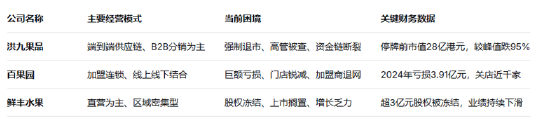
洪九果品“两头承压”终退市 水果“三巨头”各有难处
Zhong Guo Jing Ying Bao· 2025-12-29 06:25
Core Viewpoint - Hongjiu Fruit, known as the "first stock of fruit," is set to be delisted from the Hong Kong Stock Exchange after a year and a half of suspension due to failure to meet listing requirements and ongoing legal issues involving its executives [2][3]. Company Summary - Hongjiu Fruit was suspended from trading on March 20, 2024, and subsequently delisted on December 30, 2024, after failing to comply with the resumption guidance set by the Hong Kong Stock Exchange [2][3]. - The company faced significant scrutiny from KPMG regarding a sudden increase in prepayments, which rose by 3.42 billion yuan in the fourth quarter of 2023, raising concerns about the legitimacy of its suppliers [3][4]. - The only complete annual report during its listing was for 2022, showing revenue of 15.08 billion yuan, a 47% increase year-on-year, and a net profit of 1.45 billion yuan, a 33% increase [5][6]. - At its peak, Hongjiu Fruit's market capitalization exceeded 67 billion HKD [6]. Business Model and Financial Pressure - Hongjiu Fruit operated on an end-to-end business model, sourcing directly from producers and selling to various retail channels, with over 50% of its revenue coming from terminal wholesalers [7]. - The company faced dual pressures from high prepayments to suppliers and long accounts receivable, with trade receivables doubling from 3.707 billion yuan in 2021 to 7.667 billion yuan in 2022 [8]. - The cash flow was strained due to a combination of high prepayments and long receivables, leading to a significant increase in bank loans from 874 million yuan to 2.282 billion yuan [8]. Industry Changes - Other major players in the fruit market, such as Baiguoyuan and Xianfeng Fruit, are also experiencing difficulties, with Baiguoyuan reporting a 9.8% decline in revenue and a net loss of 386 million yuan in 2024 [10]. - The fruit market is undergoing significant changes, with high-end fruits becoming more accessible, leading to increased competition and a 15% average annual price decline for premium fruits from 2020 to 2025 [11][12]. - Consumer behavior is shifting towards more rational purchasing decisions, with a 28% decrease in the frequency of high-priced fruit purchases, while the consumption of quality domestic fruits has increased by 45% [11][12].