NIO(09866)

Search documents
新能源汽车股集体大跌
Di Yi Cai Jing Zi Xun· 2026-02-02 02:21
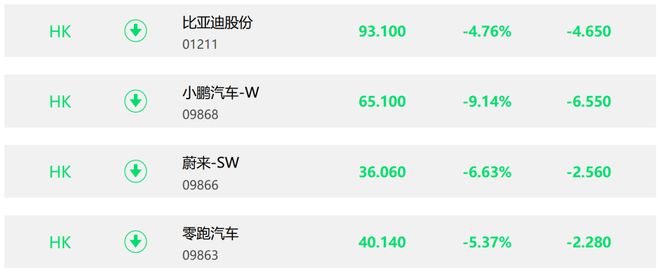
2月1日,多家新能源车企公布1月销量。比亚迪销量21.01万辆,同比下降30.11%;小鹏交付了20011 辆,同比下降34.07%;理想交付27668辆,同比下降7.55%。 | HK | (+) | 比亚迪股份 | 93.100 | -4.76% | -4.650 | | --- | --- | --- | --- | --- | --- | | | | 01211 | | | | | HK | (+) | 小鹏汽车-W | 65.100 | -9.14% | -6.550 | | | | 09868 | | | | | HK | (4) | 蔚来-SW | 36.060 | -6.63% | -2.560 | | | | 09866 | | | | | HK | ( | 零跑汽车 | 40.140 | -5.37% | -2.280 | | | | 09863 | | | | 其中,比亚迪股份(1211.HK)跌4.86%,新势力头部"蔚小理零"中,小鹏汽车(09868.HK)跌9%,蔚 来-W(09866.HK)跌6.73%,零跑汽车(09853.HK)跌5%。 2月2日早盘,港股新能源汽车股集体大跌 ...



新能源汽车股集体大跌
第一财经· 2026-02-02 02:14
2月1日,多家新能源车企公布1月销量。比亚迪销量21.01万辆,同比下降30.11%;小鹏交付了 20011辆,同比下降34.07%;理想交付27668辆,同比下降7.55%。 | HK | ਦ | 比亚迪股份 | 93.100 | -4.76% | -4.650 | | --- | --- | --- | --- | --- | --- | | | | 01211 | | | | | HK | ਦ | 小鹏汽车-W | 65.100 | -9.14% | -6.550 | | | | 09868 | | | | | HK | + | 副来-SW | 36.060 | -6.63% | -2.560 | | | | 09866 | | | | | HK | + | 零跑汽车 | 40.140 | -5.37% | -2.280 | | | | 09863 | | | | 2月2日早盘,港股新能源汽车股集体大跌。 其中,比亚迪股份(1211.HK)跌4.86%,新势力头部"蔚小理零"中,小鹏汽车(09868.HK)跌 9%,蔚来-W(09866.HK)跌6.73%,零跑汽车(09853.HK)跌5%。 ...

港股异动丨汽车股集体下挫,蔚来跌超6%
Ge Long Hui· 2026-02-02 02:07
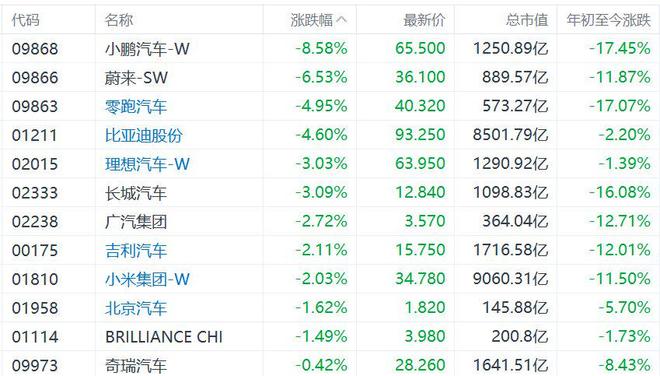
Group 1 - The Hong Kong stock market saw a collective decline in automotive stocks, with Xpeng Motors dropping over 8%, NIO down over 6%, and Li Auto, Great Wall Motors, and others also experiencing declines [1] - Major Chinese automakers reported January vehicle delivery data, with BYD's January new energy vehicle sales at 210,051 units, a year-on-year decrease of 30.11%, while Li Auto delivered 27,668 units, down 7.55%, and Xpeng delivered 20,011 units, a decline of 34.07% [1] Group 2 - Specific stock performance included Xpeng Motors at -8.58% with a latest price of 65.500 and a market cap of 125.09 billion, NIO at -6.53% with a price of 36.100 and a market cap of 88.96 billion, and BYD at -4.60% with a price of 93.250 and a market cap of 850.18 billion [2] - Other notable declines included Li Auto at -3.03%, Great Wall Motors at -3.09%, and Geely Auto at -2.11%, with respective market caps of 129.09 billion, 109.88 billion, and 171.66 billion [2]
港股汽车股多数调整
Jin Rong Jie· 2026-02-02 01:53
截至发稿,小鹏汽车(09868.HK)跌9.07%、蔚来-SW(09866.HK)跌6.53%、 比亚迪股份(01211.HK)跌 4.76%。 ...
蔚来资本等入股合光光掩模科技公司
Zhong Guo Neng Yuan Wang· 2026-02-02 01:53
Group 1 - The core point of the article is the recent changes in the ownership and management structure of He Guang Guang Mask Technology (Anhui) Co., Ltd, including the increase in registered capital and the addition of new investors [1] - The company has seen its registered capital rise from approximately 1.75 billion RMB to about 1.91 billion RMB [1] - New shareholders include Qunwei (Zibo) Equity Investment Fund Partnership and Hefei NIO Industrial Development Equity Investment Partnership, both of which are linked to NIO Capital [1] Group 2 - He Guang Guang Mask Technology was established in April 2023 and focuses on the manufacturing, sales, and research and development of electronic special materials [1] - The company is jointly held by Hefei Industrial Investment Holding Group Co., Ltd, Anhui Musk Investment Fund Partnership, and the newly added shareholders [1] - The primary business of the company involves the research, design, production, and sales of mask templates [1]
逐际动力完成2亿美元B轮融资 京东、蔚来资本参投
Xin Jing Bao· 2026-02-02 01:50
Core Insights - LimX Dynamics has completed a Series B funding round, raising $200 million, with participation from various renowned domestic and international investors [1] - The company has launched multiple products, including the TRON2 embodied robot and the LimX COSA embodied intelligence system, in the past two months [1] - By 2026, LimX Dynamics plans to increase its investment in research and market development, focusing on breakthroughs in core technologies for humanoid robots and modular base robots [1] Investment Details - The funding round included investments from notable firms such as Stone Venture, Dongfang Fuhai, Cornerstone Capital, and others [1] - Strategic industrial investors include JD.com, Zhongding Co., and Guangyang Co., among others [1] - Existing shareholders, including SAIC Group's Shangqi Capital and NIO Capital, have also increased their stakes [1] Product and Technology Focus - LimX Dynamics is concentrating on three core capabilities: hardware design and manufacturing, foundational models, and embodied Agentic OS [1] - The company aims to drive original innovation in humanoid robots and modular base robots through product engineering and supply chain ecosystem development [1] - The goal is to expand both the Chinese and global markets for its advanced robotics solutions [1]
历时134天,蔚来全新ES8汽车完成第6万台交付
Feng Huang Wang· 2026-02-02 01:47
Group 1 - The core announcement is that NIO's new ES8 model has achieved significant delivery milestones, with 17,646 units delivered in January 2026 and a total of 60,000 units delivered over 134 days [1] - The retail sales of the new ES8 reached 22,258 units by December 2025, indicating strong market demand [1] - The new ES8, launched on September 20 last year, is priced between 406,800 to 446,800 yuan, with a rental option ranging from 298,800 to 338,800 yuan [1] Group 2 - The new ES8 is one of the largest pure electric SUVs in the Chinese market, measuring 5,280mm in length and having a wheelbase of 3,130mm [1] - The vehicle features advanced interior technology, including the Skyline screen, a floating central control screen, and the latest upgraded NOMI system [1] - The ES8 is built on a 900V high-voltage architecture, equipped with dual motors that provide a peak power of 520kW and a peak torque of 700N·m, achieving 0-100 km/h acceleration in 3.97 seconds [1] - It comes standard with a 102kWh 4C battery pack, offering a CLTC range of 635 km and an energy consumption of 16.6 kWh per 100 km [1]
2026首月战报:蔚来、极氪同比接近翻倍!岚图连续三年开门红!小米竟然……
Xin Lang Cai Jing· 2026-02-02 01:39
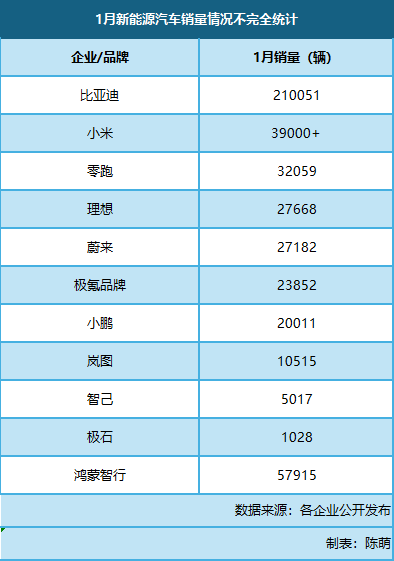
Core Insights - The retail sales of new energy vehicles in China for January 1-18 reached 312,000 units, representing a year-on-year decline of 16% and a month-on-month decline of 52% due to the expiration of the new energy vehicle purchase tax exemption policy and a weak market trend during the New Year holiday [1][27]. Company Performance - BYD sold 210,051 vehicles in January, with overseas sales of passenger cars and pickups reaching 100,009 units, and cumulative sales exceeding 15.3 million units [2][28]. - Xiaomi delivered over 39,000 vehicles in January, with a target of 550,000 electric vehicles for 2026, reflecting a year-on-year growth of over 34% [4][30]. - Leap Motor achieved 32,059 deliveries in January, marking a year-on-year increase of 27% [6][32]. - Li Auto delivered 27,668 new vehicles in January, with a cumulative delivery of 1,567,883 vehicles as of January 31 [8][34]. - NIO delivered 27,182 vehicles in January, showing a significant year-on-year growth of 96.1%, and became the fourth Chinese "new force" car manufacturer to reach cumulative deliveries of 1 million vehicles [11][37]. - Zeekr achieved 23,852 deliveries in January, with a year-on-year growth of 99.7% [14][40]. - Xpeng delivered 20,011 vehicles in January, with the X9 model achieving a remarkable year-on-year growth of 413.9% [17][43]. - Lantu delivered 10,515 vehicles in January, marking a year-on-year increase of 31%, and announced plans to launch four new models in 2026 [19][45]. - IM delivered 5,017 vehicles in January, with the LS6 model surpassing 100,000 cumulative deliveries [20][46]. - Extreme Stone delivered 1,028 vehicles in January, with a nearly 100% year-on-year increase and a significant growth in order volume [23][49]. - Hongmeng Zhixing reported a year-on-year growth of over 65% in January [25][51].


蔚来1月交付27,182台同比增长96.1%,全新ES8完成第60000台新车交付
Jin Rong Jie· 2026-02-02 00:52
Core Insights - NIO delivered 27,182 new vehicles in January, representing a year-on-year growth of 96.1%. As of now, the total cumulative deliveries have reached 1,024,774 vehicles [1] - The new ES8 model completed its 60,000th delivery in Guangzhou within 134 days, indicating the rise of the pure electric large three-row SUV market [1] - NIO has introduced a 7-year low-interest financing plan for its new ET5, ET5T, ES6, and EC6 models, with an annual interest rate of 0.49% and no financial service fees or prepayment penalties. The Firefly brand also launched a similar financing plan with promotional gifts [1] - NIO's battery swap service has surpassed 99 million swaps, with the milestone of 100 million swaps approaching [1]
曝国际巨头拟裁员3万人,多家美银行停止相关项目贷款;老外吐槽国产手机:为了像苹果,3个摄像头里1个是假的;闻泰业绩变脸:巨亏135亿元
雷峰网· 2026-02-02 00:27
Key Points - Major international companies are reportedly planning to lay off 30,000 employees due to funding difficulties in AI data center expansions, with Oracle considering selling parts of its business [4][5] - Wenta Technology expects a significant loss of 90 to 135 billion yuan in 2025, primarily due to issues with its core asset, Nexperia Semiconductor, which is under temporary control restrictions [8][9] - Tencent has appointed AI expert Pang Tianyu as the Chief Research Scientist for its AI division, focusing on multimodal reinforcement learning [12][13] - Cambricon has achieved its first annual profit in ten years, with a projected revenue increase of 410.87% to 496.02% in 2025 [16][17] - GAC Group anticipates a loss of 80 to 90 billion yuan in 2025, with a 14% decline in vehicle sales [20][21] - ByteDance's Hongguo short drama app has surpassed 100 million daily active users within three years of its launch [20] - Apple has announced unprecedented innovations for this year, following a record quarterly revenue of $143.76 billion [40][41] - OpenAI is reportedly preparing for an IPO in Q4 2023, aiming for a valuation of approximately $500 billion [56][57] - Waymo plans to raise about $16 billion in a new funding round, which would value the company at nearly $110 billion [44][45] - The global memory chip market is facing supply challenges, with major manufacturers tightening order approvals to prevent excessive stockpiling by clients [52][53]