
NIO(09866)

Search documents
港股汽车股持续疲弱
Cai Jing Wang· 2026-01-12 09:38
1月12日,港股汽车股持续疲弱,其中,吉利汽车、零跑汽车跌超3%,广汽集团跌2.8%,理想汽车、小 鹏汽车跌超2%,长城汽车、蔚来汽车、赛力斯、奇瑞汽车均有跌幅。(新浪财经) 作者丨彭鑫 编辑丨安安 ...



【月度排名】2025年12月厂商销量排名快报
乘联分会· 2026-01-12 09:28
Core Viewpoint - The article highlights the performance of the Chinese automotive market in December 2025, noting a decline in retail sales for traditional vehicles while emphasizing growth in the new energy vehicle (NEV) sector and exports. The market is expected to transition into 2026 with a focus on new energy vehicles and a recovery in demand [4]. Sales Performance - In December 2025, the domestic narrow passenger car market retail sales reached 2.261 million units, a year-on-year decrease of 14.0% but a month-on-month increase of 1.6%. Cumulative sales for the year totaled 23.744 million units, reflecting a year-on-year growth of 3.8% [2]. - The wholesale sales ranking for December 2025 shows BYD leading with 414,784 units sold, followed by Geely and Chery with 236,817 and 234,736 units, respectively. Notably, BYD's sales decreased by 12.7% month-on-month and 18.6% year-on-year [5]. - For the entire year of 2025, BYD also topped the wholesale sales with 4.545 million units, marking a 6.9% increase year-on-year, while Geely's sales surged by 39.0% to 3.025 million units [6]. New Energy Vehicle Market - In December 2025, the NEV wholesale sales ranking was led by BYD with 414,784 units, despite a month-on-month decline of 12.7% and a year-on-year drop of 18.6%. Geely followed with 154,264 units, showing a year-on-year increase of 38.7% [9]. - The retail sales for NEVs in December 2025 also saw BYD at the forefront with 339,854 units sold, a month-on-month increase of 10.9% but a year-on-year decrease of 15.7% [13]. - For the full year, BYD maintained its dominance in the NEV sector with 3.485 million units sold, although this represented a year-on-year decline of 6.3% [14]. Market Trends and Future Outlook - The article notes that the end of the year typically sees a surge in vehicle purchases, but the depletion of subsidy funds across provinces has tempered this effect, leading to a more stable demand outlook heading into 2026 [4]. - The performance of various manufacturers indicates a competitive landscape, with traditional automakers facing challenges while NEV manufacturers like BYD and Geely continue to show resilience and growth potential [6][9].





美股异动|蔚来盘前涨2.4% ES9申报图亮相 预计二季度发布
Ge Long Hui· 2026-01-12 09:28
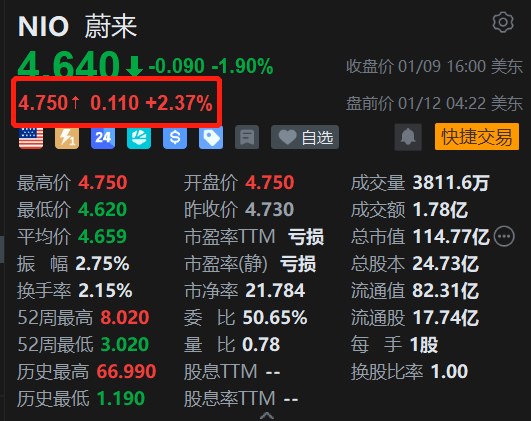
Group 1 - NIO's stock price increased by 2.37% to $4.75 in pre-market trading [1] - The Ministry of Industry and Information Technology announced the official debut of NIO's new flagship SUV, the ES9, which is positioned above the current ES8 model [1] - The ES9 is expected to be officially launched in the second quarter of this year and aims to enhance NIO's presence in the high-end electric SUV market [1] Group 2 - The closing price of NIO on January 9 was $4.64, with a pre-market price of $4.75 [2] - The trading volume was 38.116 million shares, with a total transaction value of $178 million [2] - NIO's total market capitalization is approximately $11.477 billion, with a total share count of 2.473 billion [2]
2026,卖车更难了
创业邦· 2026-01-12 03:27
Core Viewpoint - The automotive market in 2025 is characterized by intense competition, price wars, and a shift in consumer behavior towards value-driven purchases, leading to significant challenges for manufacturers [5][39]. Group 1: Market Dynamics - BYD, Geely, and Tesla dominated the sales rankings, with BYD maintaining a significant lead in the new energy vehicle sector, selling 4.545 million vehicles in 2025 [7][12]. - The overall sales of new energy vehicles in China reached 14.78 million units, a year-on-year increase of 31.2%, but BYD's growth rate was only 11% [11][12]. - Consumers are increasingly price-sensitive, often comparing prices across cities, which has benefited brands that offer high value for lower prices [7][10]. Group 2: Competitive Landscape - Geely has adopted aggressive pricing strategies, successfully positioning its models against BYD's offerings, resulting in a total of 1.687 million new energy vehicles sold in 2025 [13][14]. - New entrants like Leap Motor have carved out a niche in the budget segment, achieving sales of 596,600 units, and have become profitable, contrasting with many competitors still struggling [16][17]. - Xiaomi's foray into the automotive market has been successful, with its vehicles achieving significant sales and profitability, highlighting the potential for tech companies to disrupt traditional automotive players [21][22]. Group 3: Challenges and Future Outlook - The automotive industry is facing a bottleneck, with many companies struggling to innovate and maintain profitability amid ongoing price wars [39][40]. - The market is expected to become more challenging in 2026, with changes in tax policies and increased competition from established players like Xiaomi and Tesla [45][46]. - Companies are focusing on cost control and operational efficiency as key strategies to survive in a tightening market [41][39].



汽车股继续走低,元旦以来超20家车企降价促销
Ge Long Hui· 2026-01-12 02:25
Group 1 - The core viewpoint of the article highlights the ongoing weakness in Hong Kong's automotive stocks, with significant declines observed in companies such as Geely Auto and Li Auto, among others [1] - As of January 12, 2026, over 20 automotive companies have launched promotional activities for more than 75 models, employing various strategies such as cash subsidies and interest-free financing [1] - The Secretary-General of the National Passenger Car Market Information Association, Cui Dongshu, suggests that the current price reductions by car manufacturers are a rational return to pricing rather than a price war, although the trend of price cuts is expected to continue into 2026 [1] Group 2 - Analysts predict that the promotional activities may stimulate sales, potentially leading to a strong start for the automotive market in January 2026, but these promotions are likely to compress profit margins for companies and create significant operational pressure for dealers [1] - It is widely anticipated that the number of automotive companies will decrease by 2026, with market concentration (CR5) expected to rise from 65% to 80%, indicating that brands lacking core competitiveness may face elimination or consolidation [1]
中国电动车亮相2026布鲁塞尔车展
Huan Qiu Wang Zi Xun· 2026-01-12 01:41
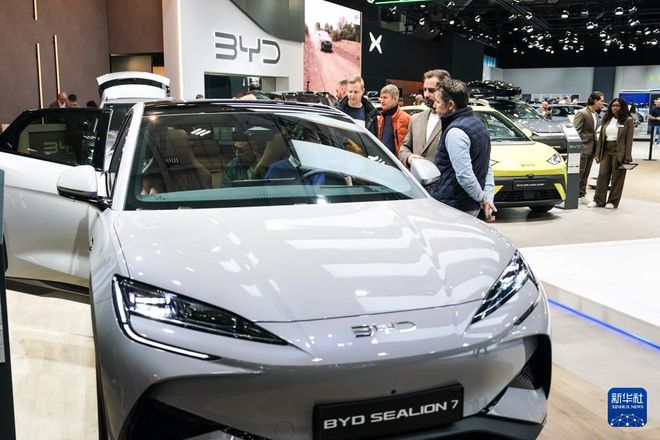
Group 1 - The 2026 Brussels Motor Show opened on January 9 at the Brussels Exhibition Center, featuring a significant presence of Chinese electric vehicle brands [2][3][5] - Brands such as NIO, BYD, and Xpeng collectively attracted attention, becoming a focal point of the exhibition [2][3][5][7] Group 2 - The Chinese electric vehicle section drew many visitors, highlighting the growing interest in this segment within the European market [3][5][7]

中国电动汽车集体亮相2026布鲁塞尔车展
Zhong Guo Xin Wen Wang· 2026-01-12 01:04
Group 1 - The 2026 Brussels Motor Show opened on January 9 in Brussels, Belgium, showcasing several Chinese electric vehicle brands such as BYD, Xpeng, and NIO, which became one of the highlights of the exhibition [1]
新款小米SU7涨价增配,4月上市!宝马集团2025年全球交付246.3万台!小鹏、比亚迪多款新车密集上市!丨一周大事件
电动车公社· 2026-01-11 16:05
Core Viewpoint - The article highlights the recent developments in the electric vehicle (EV) market, focusing on new model launches, company collaborations, and government initiatives to promote green consumption in the automotive sector [2][3][111]. New Car Launches - The new XPeng P7+ was launched with a price range of 186,800 to 198,800 yuan, offering both pure electric and extended range versions [3][11]. - The XPeng G6 was introduced at a price of 176,800 to 186,800 yuan, maintaining the design of its predecessor [13][20]. - The XPeng G7 extended range version is priced between 195,800 and 205,800 yuan, featuring upgraded technology and design [21][30]. - The XPeng G9 was launched with a price range of 248,800 to 278,800 yuan, showcasing new color options and advanced features [32][39]. - BYD's new Qin PLUS DM-i is priced at 79,800 to 99,800 yuan, maintaining its design while enhancing battery capacity [42][57]. - The BYD Qin L DM-i was launched at 96,800 to 126,800 yuan, featuring improved battery specifications [48][55]. - The BYD Song Pro DM-i was introduced at a price of 99,800 to 127,800 yuan, focusing on battery upgrades [59][65]. - The new Xiaomi SU7 is available for pre-sale at 229,900 to 309,900 yuan, with significant upgrades in technology and design [66][75]. - The Geely Galaxy V900 is set for pre-sale at 319,800 to 389,800 yuan, featuring a spacious interior and advanced powertrain [76][86]. Company Dynamics - BAIC Arcfox has partnered with Sinopec Kunlun Network Electric to enhance charging network services, with the first batch of charging stations already operational in Beijing [87][91]. - BMW Group announced a target of delivering 2,463,715 vehicles globally by 2025, with a focus on increasing electric vehicle sales [92][93]. - Porsche and Bentley have announced recalls for specific models due to safety concerns, highlighting ongoing quality control measures in the luxury automotive sector [97][100]. - NIO celebrated the production of its one millionth vehicle, marking a significant milestone in its growth trajectory [107][110]. Government Initiatives - The Ministry of Commerce and nine other departments have issued a notice to promote green consumption in the automotive sector, supporting the purchase of new energy vehicles [111][114]. - The initiative aims to strengthen the automotive industry chain and explore potential in the used car market, car rentals, and other related sectors [112][114].

蔚来全新ES8获大型SUV销量冠军 纯电大三排SUV黄金时代到来?
Zheng Quan Shi Bao Wang· 2026-01-10 08:07
Group 1 - The core viewpoint of the articles highlights the significant growth and competitive dynamics in the large three-row SUV market, particularly focusing on NIO's new ES8 model, which has achieved impressive sales figures and strategic importance for the brand [1][2] - NIO's new ES8 achieved retail sales of 22,258 units in December 2025, becoming the best-selling large SUV and leading in the three-row SUV and models priced above 400,000 yuan [1] - The gross margin of the new ES8 is among the highest in NIO's product lineup, contributing directly to revenue growth, while the company is on track to reduce operating losses and potentially achieve profitability [1] Group 2 - In November 2025, pure electric large three-row SUV sales reached 46,209 units, marking a 16% month-on-month increase and setting a historical record, indicating the arrival of a golden era for this segment [2] - The market for large three-row SUVs in China is seen as a watershed in 2025, with a significant shift away from range-extended models, driven by advancements in technology, user demand, and infrastructure development [2] - The competitive landscape in the large three-row SUV market has evolved from a single-brand focus to a multi-brand, multi-technology approach, intensifying competition as new models enter the market [2]
传统车企分化、新势力加速洗牌 打响生态战 2025车企生存启示录
Zhong Guo Jing Ying Bao· 2026-01-09 20:03
Core Insights - The Chinese automotive market in 2025 shows a stable total volume with a differentiated structure, indicating a new competitive norm where traditional automakers maintain dominance while new players face varied growth trajectories [3][4][5] Traditional Automakers - SAIC Group sold 4.507 million vehicles in 2025, a 12.3% increase year-on-year, with a retail volume of 4.67 million, maintaining its industry leadership [3] - Geely Automobile achieved sales of over 3.02 million vehicles in 2025, exceeding its targets and setting a 2026 goal of 3.45 million vehicles, reflecting strong growth momentum [4] - Chery Group sold 2.806 million vehicles, including 1.344 million exports, leading in Chinese passenger car exports for 23 consecutive years, with its new energy segment growing by 54.9% year-on-year [4] New Energy Vehicle Players - Leap Motor emerged as a significant player with 596,600 deliveries in 2025, marking a 103% year-on-year increase and becoming the top seller among new forces [2][4] - NIO is gradually recovering from a downturn, with a milestone of producing its one-millionth vehicle expected in early 2026, despite reporting a cumulative loss of nearly 15.7 billion yuan in the first three quarters of 2025 [2][5] - The competitive landscape for new energy vehicles is marked by a stark contrast, with some players struggling while others, like Lantu and Avita, show steady growth backed by traditional automakers [4][5] Strategic Shifts - The industry is shifting from product-centric competition to a focus on ecosystem collaboration and technological innovation, as companies aim to build resilient and innovative ecosystems [5][7] - SAIC Group emphasizes a dual strategy of technological innovation and ecosystem cooperation, launching over 20 competitive new products and collaborating with partners like Huawei and OPPO [6][8] - Companies are setting ambitious goals for 2026, with a focus on advanced technologies such as solid-state batteries, AI, and global expansion, indicating a move towards a more integrated and strategic approach to competition [8][9]
