
XPENG-W(09868)

Search documents
港股异动 | 小鹏汽车-W(09868)科技日后一度跌超5% 日前展现智能驾驶、机器人等最新成果
Zhi Tong Cai Jing· 2025-11-06 02:33
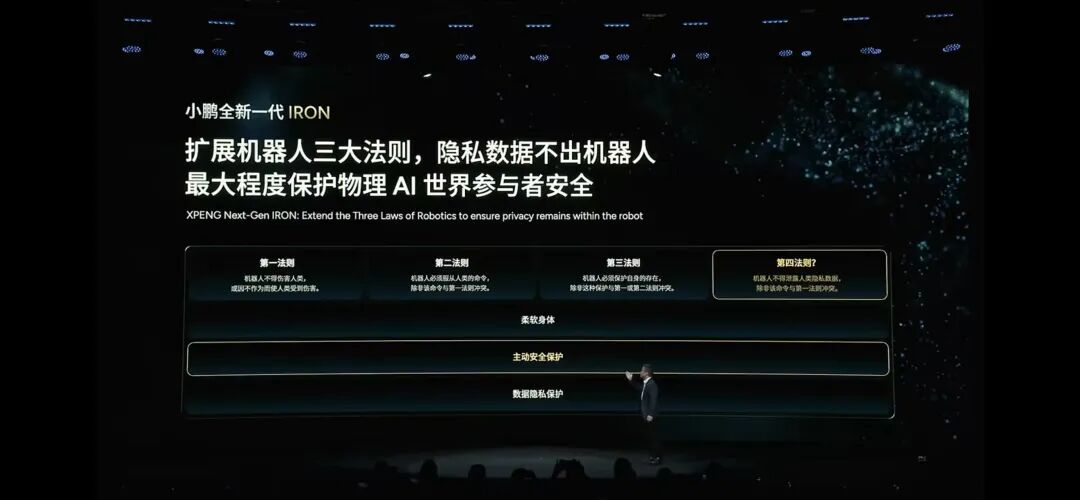
Core Viewpoint - XPeng Motors experienced a stock decline of over 5%, currently trading at 85 HKD with a transaction volume of 1.087 billion HKD, following the announcement of its 2025 Technology Day event focused on "Physical AI" [1] Group 1: Product Launches - The event showcased four major products: the second-generation VLA (Vision-Language-Action) model, Robotaxi, the new humanoid robot IRON, and a flying car [1] - The second-generation VLA model will be open-sourced for global business partners [1] - XPeng plans to launch three Robotaxi models by 2026, emphasizing the need for automakers to be directly involved in scaling the Robotaxi initiative [1] Group 2: Humanoid Robot - The new humanoid robot IRON was highlighted for its lifelike appearance and smooth walking gait, generating significant buzz on social media [1] - There were speculations on social media regarding the realism of the IRON robot, to which the CEO of XPeng responded positively [1]

花旗:小鹏汽车的技术进步将有助于提升其股票估值
Ge Long Hui· 2025-11-06 01:00
Group 1 - Citigroup indicates that XPeng Motors' entry into the Robotaxi, humanoid robot, and flying car sectors is expected to help build positive sentiment around the stock [1] - The firm maintains a buy rating on the stock with a target price of $29.40 [1]
零跑汽车月交付首破7万辆领跑新势力 鸿蒙智行成交均价39万超越BBA
Chang Jiang Shang Bao· 2025-11-06 00:14
Core Viewpoint - The Chinese new energy vehicle (NEV) market is experiencing significant growth, with major manufacturers reporting record delivery numbers in October, driven by seasonal demand and favorable policies [2][4]. Group 1: Market Performance - In October, the wholesale sales of NEVs in China reached 1.61 million units, marking a year-on-year increase of 16% and a month-on-month increase of 7% [4]. - Cumulative wholesale sales from January to October 2025 are projected to be 12.054 million units, reflecting a 30% year-on-year growth [4]. - The top five new car manufacturers have raised their delivery threshold to 40,000 units in October [3][7]. Group 2: Key Players and Deliveries - Leap Motor delivered 70,300 vehicles in October, achieving a year-on-year growth of 84.1% and a month-on-month growth of 5.4%, marking its highest monthly delivery ever [6]. - Hongmeng Zhixing delivered 68,200 vehicles in October, also setting a new monthly record, with an average transaction price of 390,000 yuan, surpassing traditional luxury brands [3][6]. - Xiaopeng Motors delivered 42,000 vehicles in October, a year-on-year increase of 76% [7]. - NIO's deliveries reached 40,400 units in October, with a year-on-year growth of 92.6% [7]. Group 3: Future Outlook - The NEV export scale is expected to reach $32.5 billion by 2025, $139.6 billion by 2028, and $236.3 billion by 2030 [5]. - Xiaomi Motors aims to deliver 300,000 vehicles in 2025, with an optimistic projection of reaching 420,000 units [10][12].



高德联合小鹏入局无人驾驶赛道 明年Robotaxi市场规模5000亿元
Shen Zhen Shang Bao· 2025-11-06 00:14
深圳商报记者 肖晗 11月5日,阿里巴巴旗下高德宣布与小鹏汽车达成全球生态合作——小鹏Robotaxi将正式接入高德平 台,共同为用户提供L4级自动驾驶出行服务。高德透露,将携手产业合作伙伴,打造最大的Robotaxi聚 合平台。 多个行业头部玩家也密集披露了其最新商业化进程与运营进展。滴滴于今年10月刚刚宣布完成20亿元D 轮融资。当月中旬,滴滴自动驾驶CEO张博披露滴滴自动驾驶的"三个五年计划",明确2026年底前在中 国若干区域推出接近有人驾驶体验的Robotaxi出行服务,且从用户端获取的收入可覆盖车辆硬件与后端 运维保险充电成本;2027年—2032年间持续推进全球化布局。11月4日,萝卜快跑透露,截至10月底每 周订单量已超25万单,且100%为全无人订单。目前,萝卜快跑全球覆盖城市数量达到22座。 值得关注的是,这是行业首次达成"出行平台+前装量产Robotaxi"合作模式。据小鹏方面透露,小鹏 Robotaxi将搭载4颗图灵AI芯片,具备3000TOPS有效算力,并面向L4级智驾设计,在算力、转向、感知 等多方面采用两套硬件互为备份,预计于2026年在广州等地开启试运营。 资本市场热度也在持续 ...

小鹏Robotaxi和IRON发布:物理AI“安全大考”才刚刚开始
3 6 Ke· 2025-11-05 23:13
Core Insights - The core question raised during the Xiaopeng Technology Day is how AI can safely integrate into the real world as physical partners, moving beyond mere algorithms on screens [1] Group 1: Robotaxi Development - Xiaopeng announced plans to trial L4-level Robotaxi by 2026, showcasing a robust technological framework that includes dual redundancy in six core systems, ensuring safety without a physical safety driver [2] - The second-generation VLA model allows AI to operate without reliance on high-precision maps, enabling it to adapt to various traffic rules and environments, thus enhancing its decision-making capabilities [2] - Xiaopeng aims to accelerate commercialization by opening its SDK to partners like Amap, which expands the safety responsibility within a more complex collaborative ecosystem [2] Group 2: IRON Robot Features - The IRON robot, standing at 178 cm, represents AI's entry into personal living spaces, emphasizing its ability to navigate safely rather than just its mobility [4] - Equipped with an indoor AEB (Automatic Emergency Braking) system, the IRON robot can detect and avoid obstacles in home environments, enhancing its practical utility [7] Group 3: Physical World Model - Both the Robotaxi and IRON robot are powered by a physical world model, which fundamentally differs from internet models like ChatGPT, as it must adhere to strict physical laws [6] - Xiaopeng's model, with 720 billion parameters, enables AI to understand complex physical interactions, such as recognizing reflective surfaces or assessing water depth, marking a significant advancement in physical AI capabilities [9] Group 4: Safety as a Priority - Xiaopeng's approach emphasizes "edge-side reinforcement," where high levels of intelligence are paired with robust safety redundancies, highlighting the critical nature of safety in physical AI applications [10] - The industry is exploring alternative safety frameworks, such as the "system-level collaboration" exemplified by Mogu Car Union, which aims to enhance overall traffic safety through interconnected AI systems [10] Group 5: Future Challenges - The future of physical AI will hinge on its ability to interpret human social intentions and the legal implications of accidents, which will determine the extent of its integration into society [12] - The industry has made significant strides by prioritizing safety over mere technological display, marking the beginning of a crucial phase in the development of physical AI [12]
美股三大指数集体收涨 特斯拉涨超4%
Xin Lang Cai Jing· 2025-11-05 22:57
Core Viewpoint - The U.S. stock market saw a collective rise in the three major indices, indicating positive investor sentiment and market performance [1] Group 1: Major Indices Performance - The Nasdaq increased by 0.65% [1] - The Dow Jones rose by 0.48% [1] - The S&P 500 index gained 0.37% [1] Group 2: Notable Stock Movements - Tesla's stock surged over 4% [1] - Intel's shares increased by more than 3% [1] - Google's stock rose by over 2% [1] Group 3: Chinese Concept Stocks - The Nasdaq Golden Dragon China Index saw a slight increase of 0.15% [1] - Futu Holdings experienced a rise of over 4% [1] - New Oriental and Xpeng Motors both fell by more than 3% [1]





美货机坠毁细节:起飞时左翼起火,引擎脱落;美股齐收涨,谷歌创新高;结婚人数反弹,多了40.5万对;男足新主帅来了;宗馥莉“换将”丨每经早参
Mei Ri Jing Ji Xin Wen· 2025-11-05 22:09
Market Overview - US stock indices collectively rose, with the Nasdaq up 0.65%, the Dow Jones up 0.48%, and the S&P 500 up 0.37% [4] - Major tech stocks mostly increased, with Google rising over 2% to a record closing high, and Tesla up over 4% [4] - The Nasdaq China Golden Dragon Index rose 0.15%, with mixed performance among Chinese concept stocks [4] Commodity Prices - International crude oil futures settled lower, with WTI crude oil for December down 1.59% at $59.6 per barrel, and Brent crude for January down 1.43% at $63.52 per barrel [5] - International gold prices increased, with spot gold up 1.31% at $3983.09 per ounce [5] Economic and Trade Relations - Chinese and US agricultural trade representatives discussed bilateral trade, highlighting the complementary strengths of both countries and the need for a favorable cooperation environment [7] - The Chinese Ministry of Commerce announced adjustments to export control measures, effective November 10, 2025, impacting 15 US entities [8][10] - The Ministry of Commerce proposed to stop anti-dumping measures on certain US imports, effective November 10, 2025 [11] Technology Developments - Huawei announced the open-source of its UCM inference memory management technology, which aims to enhance AI inference acceleration [20] - Huawei Cloud launched its new generation of cloud servers, enhancing computing and memory experiences for users [21] - Tongyi Qianwen introduced AgentScope 1.0, featuring new open-source intelligent agents, promoting innovation in the AI field [22] Corporate Announcements - Kweichow Moutai announced a new round of share repurchase and a cash dividend plan totaling approximately 30 billion yuan [23] - Sunac China announced the successful restructuring of its $9.55 billion offshore debt, significantly improving its financial stability [26] - XPeng Motors announced a strategic partnership with Volkswagen, enhancing its AI chip technology [28] Financial Performance - Qualcomm reported Q4 adjusted revenue of $11.27 billion, exceeding estimates, and projected Q1 revenue between $11.8 billion and $12.6 billion [30] - Arm's Q2 revenue was $1.14 billion, surpassing expectations, with an adjusted operating profit of $467 million [30] International Developments - The US Supreme Court debated the legality of government tariff policies, which could impact global economic relations [15] - The Swedish Parliament voted to lift the ban on uranium mining, effective January 1, 2026, recognizing uranium as a metal of significant social importance [16]


今日新闻丨小鹏发布无人驾驶出租车等四大黑科技!奔驰纯电CLA上市,售价24.9-28.56万元!大众宣布与地平线联手自研芯片!
电动车公社· 2025-11-05 16:18
Group 1: New Vehicle Launches - Zeekr X has been launched with a price range of 155,800 to 175,800 CNY, offering three models [2][3] - The new Zeekr X features a compact SUV design with dimensions of 4450/1836/1572mm and a wheelbase of 2750mm [6] - The vehicle is equipped with a Qualcomm Snapdragon 8155 cockpit chip, a 14-inch electric sliding smart screen, and offers both 4-seat and 5-seat configurations [8] - The two-wheel drive version has a maximum power of 250kW and can accelerate from 0 to 100 km/h in 5.6 seconds, while the four-wheel drive version has a maximum power of 365kW with a 0-100 km/h time of 3.69 seconds [10] - Mercedes-Benz has launched its pure electric CLA model priced between 249,000 to 285,600 CNY, featuring a new design language and a maximum power of 200kW with a CLTC range of 866 km [13][19] Group 2: Technological Innovations - XPeng Motors has introduced its second-generation VLA model and self-developed Robotaxi, showcasing advancements in AI and autonomous driving technology [21][22] - The second-generation VLA eliminates the "language translation" step, allowing for direct generation of action commands from visual signals [24] - The XPeng Robotaxi is designed for L4-level autonomous driving, featuring four Turing AI chips with a total computing power of 3,000 TOPS [26] - XPeng is also developing two flight systems for low-altitude travel, with the A868 flying car expected to achieve a range of 500 km and a maximum speed of 360 km/h [30][32] Group 3: Strategic Partnerships - Volkswagen has announced a partnership with Horizon Robotics to develop system-level chips with computing power between 500-700 TOPS, aimed at enhancing advanced driver assistance systems [33][34] - The collaboration marks the second phase of their partnership, focusing on improving local intelligent driving capabilities for the Chinese market [36] - Volkswagen plans to launch approximately 30 new energy vehicle models in China by 2027, increasing to around 50 by 2030, including 30 fully electric models [42][44]


高德入局无人驾驶赛道,打造最大Robotaxi聚合平台
Xuan Gu Bao· 2025-11-05 15:15
Industry Overview - Alibaba's Gaode has announced its entry into the Robotaxi sector, partnering with XPeng to provide L4 autonomous driving services, marking the first collaboration of its kind in the industry [1] - The global Robotaxi and fully autonomous driving market is projected to reach approximately $300 billion by 2035, according to JPMorgan [1] - The domestic Robotaxi market is expected to reach nearly 500 billion yuan by 2030, as per Open Source Securities [1] Company Insights - Four-dimensional Map Technology (四维图新) offers high-precision mapping services and benefits from the expansion of Robotaxi fleets through a "pay-per-mile" billing model [2] - Wanji Technology (万集科技) has developed a roadside intelligent perception system that integrates various sensing devices, enabling real-time information transmission for vehicle-road-cloud collaboration [2]

小鹏汽车(XPEV.US)盘前涨3% 计划和高德合作推出自研Robotaxi车型
Zhi Tong Cai Jing· 2025-11-05 14:21
Core Viewpoint - XPeng Motors (XPEV.US) announced a strategic partnership with Amap for its Robotaxi service, aiming to launch three self-developed Robotaxi models by 2026, enhancing its market presence and operational support [1] Group 1: Partnership and Collaboration - XPeng Motors' CEO He Xiaopeng announced Amap as the first global ecological partner for its Robotaxi initiative during the company's Technology Day [1] - The collaboration will integrate XPeng's autonomous vehicle fleet into Amap's ride-hailing platform, leveraging Amap's extensive user base and established network resources [1] Group 2: Product Development and Launch Timeline - XPeng plans to introduce three different versions of Robotaxi, including 7-seat, 6-seat, and 5-seat models, with varying price points [1] - The launch of these Robotaxi models is scheduled to begin operations in 2026 [1] Group 3: Market Expansion - Both companies intend to collaborate on expanding China's autonomous taxi services into international markets [1]