
XPENG-W(09868)

Search documents
投资主线继续聚焦机器人,持续关注后续催化:汽车行业周报(20251013-20251019)-20251019
Huachuang Securities· 2025-10-19 12:45
Investment Rating - The report maintains a positive investment rating on the automotive sector, particularly focusing on robotics as the main investment theme for Q4 [3][4]. Core Insights - The automotive market remains optimistic despite short-term adjustments and concerns over US-China trade tensions. The bullish trend is expected to continue, with robotics being a key investment focus [4]. - The report highlights several catalysts that could drive future growth, including Tesla's product iterations, North American giants' market entry, domestic star companies' expansions, and supportive industrial subsidy policies [4]. Data Tracking - In early October, the discount rate slightly decreased to 9.5%, with a discount amount of 21,384 yuan, reflecting a year-on-year increase of 2,937 yuan [6]. - The report tracks various automotive components and companies, recommending several key players in the automotive parts and robotics sectors, including Minth Group, Top Group, and others [8]. Industry News - In September, the retail sales of passenger cars reached 2.241 million units, a year-on-year increase of 6.3%, with cumulative sales for the year reaching 17.004 million units, up 9% [33]. - The report notes that the production and sales of automobiles in September exceeded 3 million units for the first time in history, with year-on-year growth rates remaining above 10% for five consecutive months [33][34]. - The report also mentions significant developments in the electric vehicle sector, with domestic brands accounting for 59.5% of electric vehicle exports in the first three quarters [33].





中国公司全球化周报|阿里巴巴与蚂蚁联合投资66亿元设立香港总部/理想汽车首个海外零售中心开业
3 6 Ke· 2025-10-19 03:51
Company Developments - Alibaba and Ant Group jointly invested 9.25 billion USD (approximately 66 billion RMB) to establish their headquarters in Hong Kong, aiming to expand their international business [2] - Alibaba Cloud launched its second data center in Dubai to meet the growing demand for cloud and AI services in the Middle East, expanding its global presence to 29 regions and 92 availability zones [2] - AliExpress announced the schedule for its overseas Double 11 and Black Friday events, starting pre-sales on November 8 and running sales from November 11 to December 3, focusing on "commission incentives + overseas hosting + brand expansion" [2] Logistics and Supply Chain - Cainiao unveiled its global logistics guarantee plan for the 2025 year-end promotion, offering services like "global five-day delivery" and "G2G core area three-day delivery" [3] - Ideal Auto opened its first overseas retail center in Tashkent, Uzbekistan, selling three range-extended electric models and partnering with local dealers to enhance service networks [3] - XPeng Motors launched a digital parts warehouse in Dubai, marking a new phase in its after-sales service network for the Middle East and Africa [3] Autonomous Vehicles and Technology - BYD won a bid for Singapore's L4 autonomous bus pilot project, which will test electric self-driving buses on specific routes starting mid-2026 [4] - Pony.ai passed the Hong Kong Stock Exchange hearing and is actively expanding its business internationally, including partnerships in Luxembourg, Singapore, and Dubai [4] - New Stone Technology partnered with UAE's K2 Group to accelerate the deployment of autonomous delivery vehicles in the region [5] Renewable Energy and Storage - Canadian company Canadian Solar's subsidiary, Canadian Solar Energy, signed a battery storage system supply agreement for projects totaling 2.122 GWh in Ontario, with operations expected to start in 2026 [6] Investment and Financing - Aishi Technology completed a 100 million RMB B+ round financing, with over 100 million global users and an annual recurring revenue exceeding 40 million USD [6] - Cloud Robotics company Yunji Technology went public on the Hong Kong Stock Exchange, raising approximately 590 million HKD and achieving a market capitalization close to 10 billion HKD [6] - JiuSi Intelligent secured a multi-million USD financing round led by Ant Group, focusing on L4 autonomous delivery vehicles and expanding its operations globally [7] Market Trends - GITEX Global 2025 was held in Dubai, showcasing major breakthroughs in biotechnology, AI, quantum computing, and data centers, attracting thousands of tech companies [8] - China's exports of holiday goods, dolls, and animal-shaped toys exceeded 50 billion RMB in the first three quarters, highlighting the influence of traditional culture and innovation in foreign trade [8] - Nine Chinese companies made it to the 2025 Global Top 50 Mobile Game Publishers list, reflecting the strength of the Chinese gaming industry [8]





小鹏汽车陈涵:多线并行,“成为全球用户喜爱的智能科技企业”
Zhong Guo Jing Ji Wang· 2025-10-17 10:02
Core Insights - Xiaopeng Motors showcased its latest products and technological advancements at the 2025 World Intelligent Connected Vehicles Conference, emphasizing its commitment to innovation in the Chinese smart automotive industry [1][4] - The company focuses on enhancing emotional value for users, moving beyond basic functionality to create deeper emotional connections through design and technology [2][5] Product and Technology - The new Xiaopeng P7 features an upgraded AEB+AES intelligent active safety system, marking a significant technological advancement in active safety architecture and software [2] - Xiaopeng's self-developed Turing AI chip has been integrated into vehicles, leading the way into the L3 computing power era, and the deployment of local VLA+VLM models enhances vehicle intelligence [1][2] Market Expansion and Strategy - Xiaopeng Motors aims to increase its overseas sales proportion to 50% over the next decade, with a goal to expand its business footprint to 60 countries and regions by the end of 2025 [5] - The company has achieved significant growth in exports, with over 29,723 vehicles exported in the first nine months of the year, representing a year-on-year increase of 125.2% [4][5] Future Vision - Xiaopeng Motors is building an "air-ground integration" framework that extends beyond traditional automotive applications, including humanoid robots and flying cars, aligning with the conference's theme of smart transportation and future city integration [2][3] - The company plans to leverage its technological advantages and emotional connections to enhance its global market presence and operational efficiency [5]
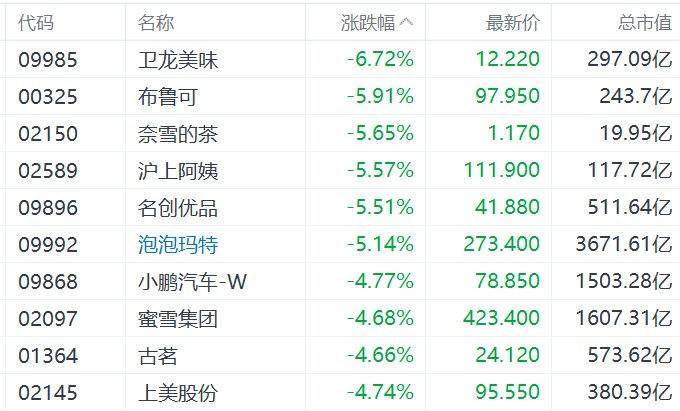
港股新消费概念股普跌,卫龙美味跌超6%,布鲁可、奈雪的茶、沪上阿姨、名创优品、泡泡玛特跌超5%,蜜雪集团、古茗跌超4%
Ge Long Hui· 2025-10-17 07:52
Core Viewpoint - The Hong Kong stock market has seen a decline in new consumption concept stocks, with several companies experiencing significant drops in their stock prices [1][2]. Group 1: Stock Performance - Wei Long Mei Wei (卫龙美味) fell by 6.72%, with a latest price of 12.220 and a market capitalization of 29.709 billion [2]. - Bluestone (布鲁可) decreased by 5.91%, priced at 97.950, with a total market value of 24.37 billion [2]. - Naixue's Tea (奈雪的茶) dropped by 5.65%, trading at 1.170, and has a market cap of 1.995 billion [2]. - Hu Shang A Yi (沪上阿姨) saw a decline of 5.57%, with a price of 111.900 and a market capitalization of 11.772 billion [2]. - Miniso (名创优品) decreased by 5.51%, priced at 41.880, with a total market value of 51.164 billion [2]. - Pop Mart (泡泡玛特) fell by 5.14%, trading at 273.400, with a market cap of 367.161 billion [2]. - XPeng Motors (小鹏汽车-W) decreased by 4.77%, with a latest price of 78.850 and a market capitalization of 150.328 billion [2]. - Mixue Group (密雪集团) dropped by 4.68%, priced at 423.400, with a market cap of 160.731 billion [2]. - Gu Ming (古茗) saw a decline of 4.66%, trading at 24.120, with a total market value of 57.362 billion [2]. - Shangmei Co., Ltd. (上美股份) decreased by 4.74%, with a price of 95.550 and a market capitalization of 38.039 billion [2].

汽车股尾盘跌幅扩大
Mei Ri Jing Ji Xin Wen· 2025-10-17 07:39
Core Viewpoint - The automotive stocks experienced a significant decline in the late trading session, indicating a bearish trend in the market for these companies [1] Group 1: Company Performance - Xiaopeng Motors (09868.HK) saw a drop of 4.83%, trading at 78.8 HKD [1] - Great Wall Motors (02333.HK) decreased by 4.02%, with shares priced at 14.81 HKD [1] - GAC Group (02238.HK) fell by 3.5%, reaching 3.31 HKD [1] - Brilliance China (01114.HK) declined by 2.8%, trading at 3.82 HKD [1]
港股异动 | 汽车股尾盘跌幅扩大 小鹏汽车(09868)领跌板块 市场监管总局称将加强汽车行业相关监管
智通财经网· 2025-10-17 07:29
Core Viewpoint - The automotive sector is experiencing a decline in stock prices, particularly for companies like Xpeng Motors, Great Wall Motors, GAC Group, and Brilliance China, amid regulatory developments in the electric vehicle market [1] Regulatory Developments - The National Market Supervision Administration announced the establishment of an innovative recall regulatory system for new energy vehicles, including a fire incident reporting system and remote upgrade reporting system [1] - A pilot program for automotive safety sandbox regulation is being initiated, alongside efforts to strengthen supervision over product recalls and consistency in production for smart connected and new energy vehicles [1] - The administration is also working on a notification to regulate false advertising, exaggerated claims, and irrational competition in the automotive sector [1] Company-Specific News - In response to the lawsuit filed by the Government of Singapore Investment Corporation (GIC) against NIO, a representative from NIO stated that the case is not new and is unrelated to the company's recent operational status, stemming from a short-selling report by Grizzly Research in June 2022 [1] - The report by Grizzly Research was characterized as baseless, containing numerous errors and misleading conclusions [1]
汽车股尾盘跌幅扩大 小鹏汽车领跌板块 市场监管总局称将加强汽车行业相关监管
Zhi Tong Cai Jing· 2025-10-17 07:29
Group 1 - The automotive stocks experienced a significant decline, with Xpeng Motors down 4.83% to HKD 78.8, Great Wall Motors down 4.02% to HKD 14.81, GAC Group down 3.5% to HKD 3.31, and Brilliance China down 2.8% to HKD 3.82 [1] - The National Market Regulation Administration announced the establishment of an innovative recall regulatory system for new energy vehicles, which includes a fire accident reporting system and a remote upgrade reporting system [1] - A notification is being drafted to strengthen the supervision of product recalls and production consistency for intelligent connected and new energy vehicles, aiming to regulate false advertising and irrational competition [1] Group 2 - NIO responded to the lawsuit from the Government of Singapore Investment Corporation (GIC), clarifying that the case is not new and is based on unfounded allegations from a short-selling report by Grizzly Research LLC from June 2022 [1] - The report by Grizzly Research contained numerous errors and misleading conclusions, which NIO claims are baseless [1]


东吴证券:市场Q4会重新重视智能化投资机会 首选小鹏汽车-W(09868)等
智通财经网· 2025-10-17 05:38
Core Viewpoint - The report from Dongwu Securities indicates that the market will refocus on investment opportunities in intelligence during Q4, with a preference for Hong Kong stocks over A-shares, software over hardware, and B-end over C-end investments [1] Group 1: Market Trends - Since the AI market began in 2023, each subsequent phase has seen a spread towards intelligence applications, which are viewed as significant applications of AI in the physical world, with expectations for over-performance in the next 3-5 years [1] - The report highlights that Q4 will see continuous catalysts for intelligence, including the release of Tesla's V14 version, Xiaopeng's technology day in October, and the introduction of new autonomous vehicles by various companies [1] Group 2: Comparison of Q4 Trends - The similarities between this year's Q4 and last year's Q4 lie in the diffusion of AI, but the differences are notable: last year's focus was on the resonance between automotive logic and AI logic, while this year emphasizes the evolution of AI logic [2] - The report suggests that all players have improved their capabilities over the past year, particularly the first-tier players moving towards L4 capabilities, indicating stronger industry realization [2] - This year is expected to focus more on software opportunities and breakthroughs in the B-end market, contrasting with last year's emphasis on hardware opportunities and C-end sales [2]

东吴证券:市场Q4会重新重视智能化投资机会 首选小鹏汽车-W等
Zhi Tong Cai Jing· 2025-10-17 05:37
Group 1 - The core viewpoint of the report is that the market will refocus on intelligent investment opportunities in Q4, with a preference for Hong Kong stocks over A-shares, software over hardware, and B-end over C-end [1] - The report highlights that since the AI market began in 2023, each subsequent phase has seen a spread towards intelligence, which is viewed as a significant application of AI in the physical world, with expectations for over-performance in the next 3-5 years [1] - The report identifies key catalysts for intelligent development in Q4, including the release of Tesla's V14 version, Xiaopeng's technology day in October, and the introduction of new autonomous vehicles by various companies [1] Group 2 - The report notes similarities between Q4 this year and last year in terms of AI diffusion, but emphasizes a shift in focus from automotive and AI logic resonance to the evolution of AI logic this year [2] - It points out that all players have improved their capabilities over the past year, particularly the first-tier players moving towards L4, indicating stronger industry realization [2] - The report suggests a shift in focus from hardware opportunities and C-end sales last year to software opportunities and breakthroughs in the B-end this year [2]
财通证券:港股围绕AI主线布局 看好这11只个股!
Ge Long Hui· 2025-10-17 03:46
Group 1 - The core viewpoint is that the Hang Seng Technology sector is in the early stage of a macro liquidity recovery and an AI technology cycle, presenting high mid-term allocation value [1] Group 2 - The current fundamentals of Hang Seng Technology benefit from the explosion in application and content driven by new technological changes, with the AI technology cycle at its starting point [2] - The long-term logic involves competition for user numbers and engagement in a diminishing traffic dividend environment, which tests organizational capabilities [2] - High-quality companies are showing strong shareholder return capabilities post traffic dividend decline, with a focus on tracking EPS changes and policies, particularly in the consumer sector [2] Group 3 - The Hang Seng Technology sector is currently influenced by the Federal Reserve's transition to a liquidity easing phase, following the fastest and most extensive rate hikes since the 1980s [3] - The current price-to-earnings ratio (TTM) for Hang Seng Technology is at the 34th percentile of the past five years [3] Group 4 - Investment recommendations suggest focusing on AI-related sectors, particularly those likely to achieve performance realization first [3] - The AI hardware and computing power supply chain is expected to maintain high prosperity due to accelerated capital expenditure from global major companies [3] - The software application and content ecosystem are in the early stages of AI empowerment, with optimism for overseas software performance and other industry advancements [3] Group 5 - The e-commerce, local life, and advertising technology sectors are performing steadily under policy stimulus and operational efficiency improvements [3] - The acceleration of smart driving and mobility scenarios is anticipated to become a new growth driver for the industry [3] Group 6 - Recommended companies for investment include Tencent Holdings as a preferred choice, Alibaba and Baidu as mid-term elastic stocks, and Lenovo, Yueda Group, Trip.com, and Sunny Optical as stable slow-growth options [3] - Elastic stocks include Kuaishou, Horizon Robotics, Kingdee International, and Xpeng Motors [4]


