
XPENG-W(09868)

Search documents
小鹏汽车架构调整整合智能部门,转型“物理AI公司”目标明确
Ju Chao Zi Xun· 2026-02-03 02:53
Group 1 - The core point of the article is that XPeng Motors is undergoing significant organizational restructuring by merging its Autonomous Driving Center and Smart Cockpit Center into a new General Intelligence Center, led by Liu Xianming, which will report directly to CEO He Xiaopeng [2] - This restructuring aligns with XPeng's strategic shift towards becoming a "physical AI company," emphasizing the integration of AI capabilities into its product offerings [2] - XPeng launched four new models at the 2026 Global New Product Launch on January 8, with the Ultra and Ultra SE versions featuring the company's self-developed second-generation VLA, which is touted as the industry's first cross-domain model achieving L4 initial capabilities [2] Group 2 - The company is actively preparing for street tests of its autonomous ride-hailing service and plans to initiate mass production of humanoid robots later this year, indicating a focus on both automotive and robotic applications as core vehicles of "physical AI" [3] - On February 1, XPeng announced the delivery of 20,011 new vehicles in January 2026, with an internal sales target set between 550,000 to 600,000 units for the entire year, amidst increasing competition and ongoing price wars in the Chinese automotive market [3] - The emphasis on the self-developed "Turing" AI chip is seen as a key factor for the company to gain market competitiveness by combining AI capabilities with its existing advantages [2]


同比普涨、环比普跌,1月车企销量“开门红”成色不足
Jing Ji Guan Cha Wang· 2026-02-03 02:34
Core Insights - The automotive industry experienced a positive start in January 2026, with most companies reporting year-on-year sales growth, attributed to a low sales base from the previous year due to the Spring Festival occurring in January 2025 [2] - However, month-on-month sales showed a significant decline for most companies, primarily due to the end of full tax exemptions for new energy vehicles and the conclusion of various promotional policies that were in place at the end of 2025 [2] Company Performance - Geely's January sales reached 270,200 units, a year-on-year increase of 1.29% and a month-on-month increase of 14%. New energy vehicle sales accounted for 46% of total sales, with overseas exports growing by 121% year-on-year [3] - BYD sold 210,100 units in January, with overseas sales of 100,000 units showing a year-on-year growth of 43.3%. The brand's performance was strong across its various models [4] - Great Wall Motors reported sales of 90,300 units, a year-on-year increase of 11.59%, but a month-on-month decline of 27.18%. Overseas sales also grew by 43.77% [4] - Chery Group's sales were 200,300 units, down 10.72% year-on-year and 18.23% month-on-month. However, exports reached 119,600 units, marking a 48.1% increase [5] - GAC Group's sales totaled 116,600 units, up 18.47% year-on-year but down 37.79% month-on-month. The group's self-owned brands saw significant growth, particularly in overseas markets [5] - SAIC Group's passenger vehicle sales exceeded 78,000 units, a year-on-year increase of 9.8%, while Dongfeng Motor reported various brand performances, with some brands showing significant growth [6] New Energy and Emerging Brands - New energy vehicle sales are becoming increasingly significant, with companies like AITO, Xiaomi, and Leap Motor forming a new "first tier" in sales, while traditional players like NIO and Xpeng are now in the "second tier" [6][7] - AITO's sales reached approximately 40,000 units, a year-on-year increase of 83%, while Xiaomi's sales exceeded 39,000 units, showing strong growth compared to the previous year [7]


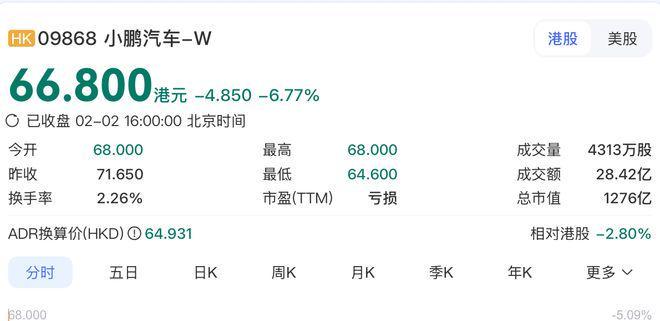
小鹏美股收跌8.29%,港股6.77%
Xin Lang Cai Jing· 2026-02-03 01:29
(来源:三言科技) 小鹏港股、美股收盘均跌。其中港股收跌6.77%,美股收跌8.29%。 来源:市场资讯 | HK 09868 小鹏汽车-W | | | | | | 港股 | 美股 | | --- | --- | --- | --- | --- | --- | --- | --- | | 66.800 #元 -4.850 -6.77% | | | | | | | | | ○ 已收盘 02-02 16:00:00 北京时间 | | | | | | | | | 今开 | 68.000 | | 最高 | 68.000 | | 成交量 | 4313万股 | | 昨收 | 71.650 | | 最低 | 64.600 | | 成交额 | 28.42亿 | | 换手率 | 2.26% | | 市盈(TTM) | 亏损 | | 总市值 | 1276亿 | | ADR换算价(HKD) 0 64.931 | | | | | | | 相对港股 -2.80% | | 分时 | 五日 | 日K | 圖K | 目K | 季K | 年K | 更多 V | | 68.000 | | | | | | | -5.09% | | US XPEV ...
智通港股沽空统计|2月3日
智通财经网· 2026-02-03 00:23
Group 1 - Anta Sports (82020), Li Ning (82331), and JD Health (86618) have the highest short-selling ratios at 100.00% each [1][2] - BYD Company (01211), Meituan (03690), and Xiaomi Group (01810) lead in short-selling amounts, with 1.896 billion, 1.439 billion, and 0.965 billion respectively [1][2] - Li Ning (82331), Shangmei Group (02145), and Bank of China Hong Kong (82388) have the highest deviation values at 37.55%, 31.60%, and 30.16% respectively [1][2] Group 2 - The top short-selling ratio rankings include Anta Sports (82020) at 100.00%, Li Ning (82331) at 100.00%, and JD Health (86618) at 100.00% [2] - The top short-selling amounts are led by BYD Company (01211) at 1.896 billion, Meituan (03690) at 1.439 billion, and Xiaomi Group (01810) at 0.965 billion [2] - The top deviation values are led by Li Ning (82331) at 37.55%, Shangmei Group (02145) at 31.60%, and Bank of China Hong Kong (82388) at 30.16% [2]



十部门联合发文!低空经济标准体系建设指南来了,相关产业链企业投资价值凸显(附概念股)
Sou Hu Cai Jing· 2026-02-02 23:54
Group 1 - The core viewpoint of the news is the establishment of a low-altitude economy standard system in China, aiming for a basic framework by 2027 and over 300 standards by 2030 to support the healthy development of the low-altitude economy [1][2] - The low-altitude economy is transitioning from concept validation to practical application, with a rapid increase in the number of related enterprises and continuous market growth [1][2] - By 2025, the low-altitude economy market in China is projected to reach 1.5 trillion yuan, with expectations of 3.5 trillion yuan by 2035, highlighting its potential as a new trillion-level industry [2][3] Group 2 - Local governments are actively promoting low-altitude economic development, with Shanghai targeting an industry scale of over 80 billion yuan by 2028 and Chongqing implementing policies to encourage innovation and testing [2][3] - The low-altitude economy is recognized as a national strategic priority, with policies becoming increasingly detailed, indicating a maturing industry [3][4] - The consumer-grade drone market is expected to reach 48.9 billion yuan in 2024, growing by 20%, while the industrial-grade market reached 113.4 billion yuan in 2023, showing greater growth potential [4] Group 3 - Companies are making strategic investments in the low-altitude economy, with Deep City Transportation planning to raise up to 1.8 billion yuan for projects related to intelligent transportation and low-altitude applications [2][3] - ZTE Corporation is advancing its low-altitude sensing technology through pilot projects, while XPeng Motors is exploring flying cars with plans for stable progress between 2026 and 2028 [6][7] - Contemporary Amperex Technology Co., Ltd. has introduced a low-altitude economic solution combining zero-carbon water airports and eVTOL aircraft, marking a significant step towards large-scale development [7]

港股概念追踪 | 十部门联合发文!低空经济标准体系建设指南来了 相关产业链企业投资价值凸显(附概念股)
智通财经网· 2026-02-02 23:09
Group 1 - The National Market Regulation Administration, along with ten other departments, released the "Low Altitude Economy Standard System Construction Guide (2025 Edition)", aiming to establish a basic standard system for low altitude economy by 2027 and over 300 standards by 2030 to support its safe and healthy development [1] - The low altitude economy is transitioning from concept validation to practical application, with a rapid increase in the number of related enterprises and continuous market growth [1] - Policy innovations are providing solid support for the development of the low altitude economy, including the establishment of a statistical classification for the low altitude economy and core industries [1] Group 2 - Local governments are forming significant industrial clusters in the low altitude economy, with Shanghai aiming for a core industry scale of over 80 billion yuan by 2028 and Chongqing promoting high-quality development through various policy measures [2] - The China Civil Aviation Administration predicts that the low altitude economy market will reach 1.5 trillion yuan by 2025 and 3.5 trillion yuan by 2035, positioning it as a core track for cultivating new production capacity [2] Group 3 - Listed companies are accelerating their strategic layouts in the low altitude economy, with Shen Cheng Jiao planning to raise up to 1.8 billion yuan for various projects including low altitude and autonomous driving technologies [3] - Ziguang Guowei is establishing a central research institute to enhance its research capabilities in low altitude vehicles and other applications [3] - The low altitude economy is recognized as a national strategic focus, with its development expected to create several trillion-level market growth points [3] Group 4 - The consumer-grade market for drones is projected to reach 48.9 billion yuan in 2024, growing by 20%, while the industrial-grade market is expected to reach 113.4 billion yuan in 2023, indicating greater growth potential [4] - The drone industry is advancing rapidly, although there is still room for improvement in policy standards [4] Group 5 - ZTE Corporation is advancing its low altitude perception and detection technologies through pilot projects in collaboration with industry partners [6] - XPeng Motors is working towards stable advancements in flying cars, with aspirations for significant progress between 2026 and 2028 [6] - GAC Group has received nearly 2,000 orders for its flying car, GOVY AirCab, which is undergoing airworthiness reviews and is expected to begin deliveries by the end of 2026 [6] Group 6 - CATL's ecological enterprise, Fei Aviation Technology, launched a "zero-carbon water airport + eVTOL aircraft" solution, marking a significant breakthrough in low altitude infrastructure and application scenarios [7]
1月车市分化加剧:自主品牌座次洗牌 新势力环比普降
Zhong Guo Zheng Quan Bao· 2026-02-02 23:03
Core Insights - The automotive market in January 2026 shows a clear distinction between traditional domestic brands, which are performing strongly, and new energy vehicle (NEV) startups, which are facing challenges [1][5] Traditional Domestic Brands Performance - Major traditional automakers like SAIC, Geely, and Chery reported over 20% year-on-year sales growth in January 2026, with SAIC leading the market [2][3] - SAIC sold 327,400 vehicles in January, a 23.9% increase year-on-year, with 214,000 units from its own brands, marking a 39.6% increase [2] - Geely's sales reached 270,200 units, a 1% year-on-year increase, with NEV sales contributing significantly [2] - Chery's sales totaled 200,300 units, with exports accounting for 119,600 units, a 48.1% increase year-on-year [3] - GAC Group saw a significant increase in sales, reaching 116,600 units, up 18.47% year-on-year, driven by its new energy and overseas sales [3] New Energy Vehicle Startups Challenges - In contrast, nine major NEV startups experienced a collective decline in sales, with month-on-month drops ranging from 21.2% to 47.0% [5][6] - Despite the downturn, some brands like NIO and Zeekr reported year-on-year growth exceeding 95% [6][7] - The decline in NEV sales is attributed to short-term factors such as policy changes and seasonal demand fluctuations [6][7] - The market is expected to stabilize post-policy transition, with a potential recovery in sales anticipated in February and March 2026 [7] Market Dynamics and Future Outlook - The automotive industry is witnessing a restructuring of brand rankings, with traditional brands solidifying their positions while new entrants face increasing competition [1][5] - The long-term growth logic of the NEV sector remains intact, with expectations for a gradual recovery as new products are launched and market conditions improve [7]



自主品牌座次洗牌 新势力环比普降
Zhong Guo Zheng Quan Bao· 2026-02-02 20:45
Core Insights - The automotive market in China is showing a clear divide between traditional domestic brands, which are performing strongly, and new energy vehicle (NEV) startups, which are facing challenges. Traditional brands like SAIC, Geely, and Chery have reported over 20% year-on-year sales growth, while nine major NEV startups have experienced a collective decline in sales [1][4]. Traditional Domestic Brands Performance - SAIC Motor Corporation led the market with a total vehicle sales of 327,400 units in January, a year-on-year increase of 23.9%. The sales of its self-owned brands reached 214,000 units, up 39.6%, accounting for 65.3% of total sales [1][2]. - Geely Automobile sold 270,200 units, marking a 1% year-on-year increase and a 14% month-on-month increase. Its NEV sales reached 124,300 units, up 3%, making up 46% of total sales [2]. - Chery Group achieved sales of 200,300 units, with exports contributing significantly, totaling 119,600 units, a 48.1% increase year-on-year. The NEV segment also grew, with sales of 52,100 units [2][3]. - GAC Group reported a total sales volume of 116,600 units, an 18.47% increase year-on-year, driven by significant growth in its Aion and Trumpchi brands [3]. New Energy Vehicle Startups Challenges - The nine major NEV startups collectively faced a month-on-month sales decline ranging from 21.2% to 47.0%. However, six of these companies reported year-on-year growth, indicating a mixed performance [4][5]. - Leading brands like Hongmeng Zhixing and Xiaomi Auto reported significant year-on-year growth, with Hongmeng delivering 57,900 units (up 65.6%) and Xiaomi delivering over 39,000 units (up 70%) despite month-on-month declines [5]. - NIO and Zeekr emerged as strong performers with year-on-year growth exceeding 95%, with NIO delivering 27,200 units (up 96.1%) and Zeekr delivering 23,900 units (up 99.7%) [5][6]. Market Dynamics and Future Outlook - The automotive market is experiencing a temporary downturn due to factors such as policy changes and seasonal demand fluctuations. The inventory warning index for dealers was reported at 58.3%, indicating a supply-demand imbalance [4][6]. - Despite short-term challenges, industry experts believe the long-term growth trajectory for the NEV sector remains intact, with expectations for a recovery in sales as the market stabilizes post-policy transition and new products are launched [6].


港股公告掘金 | 小鹏汽车-W 1月共交付新车20011辆
Zhi Tong Cai Jing· 2026-02-02 15:22
Major Events - Singularity Guofeng (01280) sold all shares of China Silver Ray (Hong Kong) Investment Holdings Limited at zero cost [1] - ZTE Corporation (00763) plans to invest 117 million yuan to subscribe to Jianxing Zhanlu Fund shares [1] - Cloud Factory (02512) subsidiary won the bid for the second phase of the artificial intelligence industry base project [1] - CSPC Pharmaceutical Group (01093) received drug registration approval for Chlorpheniramine Lactate Injection [1] - Derin Holdings (01709) reported a Bitcoin balance of 84.555 BTC as of January 31 [1] - Baiguoyuan Group (02411) diluted its stake in Baiguoyuan Commercial Management to 51.02%, with core management investing to enhance new business layout [1] Operating Performance - XPeng Motors-W (09868) delivered 20,011 new vehicles in January [1] - Ruipulan Jun (00666) issued a profit warning, expecting a net profit of approximately 630 million to 730 million yuan in 2025, turning from loss to profit [1] - China Merchants Jinling (00978) projected a total contract sales amount of approximately 32.308 billion yuan in 2025, a year-on-year decrease of 23.91% [1] - China National Building Material (03323) issued a profit warning, expecting a shareholder loss of approximately 2.3 billion to 4 billion yuan in 2025, turning from profit to loss [1]
蔚小理盘前走弱 1月交付环比均降超30%
Xin Lang Cai Jing· 2026-02-02 14:11
Core Viewpoint - The three major electric vehicle manufacturers, NIO, Xpeng, and Li Auto, experienced a decline in January delivery numbers compared to the previous month, indicating potential challenges in the market [1] Group 1: Company Performance - Li Auto delivered 27,668 vehicles in January, representing a year-on-year increase of 7.55% but a month-on-month decrease of 37.47% [1] - NIO delivered 27,182 vehicles in January, showing a significant year-on-year increase of 96.08%, yet a month-on-month decline of 43.53% [1] - Xpeng delivered 20,011 vehicles in January, which reflects a year-on-year decrease of 34.07% and a month-on-month decline of 46.65% [1]