
XPENG-W(09868)

Search documents
小鹏汽车联合Lemmo推出碳纤维智能折叠电单车 7900元起
Feng Huang Wang· 2026-02-02 13:23
Group 1 - The core announcement is that Xiaopeng Motors has launched a carbon fiber smart folding electric bicycle in collaboration with the brand Lemmo, available on its official app [1] - The electric bicycle is offered in two versions: a standard model priced at 7,900 yuan and a limited edition gold model priced at 8,550 yuan [1] - The bicycle weighs 10.5 kilograms and features an Arc structure carbon fiber frame, which allows for a 40% reduction in storage volume compared to traditional 20-inch folding models [1] Group 2 - The bicycle has a wheelbase of 1 meter and uses a 16-13/8 inch wheel set [1] - It is equipped with an electric assist system that includes a mid-axis torque sensor to detect pedaling force, providing three levels of assistance [1] - In electric assist mode, the maximum speed of the bicycle is 25 kilometers per hour, and it can be folded to fit into a standard 28-inch suitcase [1]
招商局置地2025年销售额同比下滑约24% 云工厂中标逾5亿元AI产业基地项目
Xin Lang Cai Jing· 2026-02-02 12:41
Company News - China Merchants Jinling (00978.HK) reported a total contract sales of approximately 32.308 billion yuan for 2025, representing a year-on-year decrease of 23.91% [2] - ZTE Corporation (00763.HK) plans to invest 117 million yuan to subscribe to shares of Jianxing Zhanlu Fund, which aims to support a broader range of innovative businesses and upstream and downstream industry chain enterprises [2] - Cloud Factory (02512.HK) announced that its subsidiary won a bid for the second phase of the artificial intelligence industry base project, with a contract value of 520 million yuan [2] - XPeng Motors-W (09868.HK) delivered 20,011 new vehicles in January [3] - La Jiao Network Entertainment (08172.HK) announced that its subsidiary, La Jiao Zhongbo, received authorization from Ant Group to become the "official service provider" for "Ant Treasure Box" [3] - Jun Dong Holdings (08277.HK) signed a timber harvesting and sales agreement with Jinda Forestry through its subsidiary Hebei Linmu [3] - Global Medical (02666.HK) plans to issue corporate bonds with a total principal amount not exceeding 1 billion yuan [3] - Junsheng Tai Pharmaceutical-B (02511.HK) appointed Dr. Filip Surmont as Chief Medical Officer to strengthen its layout in chronic kidney and metabolic diseases (CKM) [3] - Blue River Holdings (00498.HK) entered into a cooperation framework agreement with Energy Storage Investment Company [3] Financing and Buyback Activities - Junda Co., Ltd. (02865.HK) completed a placement of 18.682 million shares, raising approximately 398 million HKD [4] - Xiaomi Group-W (01810.HK) repurchased 6 million shares for a total of 209 million HKD, with repurchase prices ranging from 34.54 to 35.00 HKD [4] - Country Garden Services (06098.HK) repurchased 1.8 million shares for a total of 11.346 million HKD, with repurchase prices between 6.26 and 6.35 HKD [5] - Vitasoy International (00345.HK) repurchased 1.682 million shares for a total of 11.7363 million HKD, with repurchase prices between 6.89 and 7 HKD [6] - Aikang Medical (01789.HK) plans to use up to 150 million HKD for share buybacks [7]



车企低息战火力全开
Zhong Guo Qi Che Bao Wang· 2026-02-02 12:29
Group 1 - The core strategy of automakers has shifted to offering 7-year ultra-low interest loans, marking a new phase in market competition [2][4] - Tesla initiated this trend with a unique 7-year loan plan, offering monthly payments as low as 1,800 yuan for the Model 3 and 2,200 yuan for the Model Y, significantly easing the financial burden on families [3][4] - Other automakers like Xiaomi, Li Auto, and Xpeng quickly followed suit, introducing similar financing options, which has intensified the competition in the market [4][5] Group 2 - Traditional brands are also participating in this financial strategy, with companies like Dongfeng and Geely launching their own 7-year low-interest plans to attract consumers [5][8] - The aggressive reduction of monthly payments aims to stimulate sales, although the effectiveness of this approach remains uncertain [5][8] - The financial strategies employed by leading automakers leverage their strong cash reserves and profitability, allowing them to offer such low-interest loans [7][8] Group 3 - The competitive landscape is shifting, with larger companies able to absorb the costs of low-interest loans, while smaller firms may struggle to keep up without incurring losses [8][9] - The financial tactics being used are seen as a response to market pressures and technological advancements, with a potential shift from price competition to a focus on technology [9][10] - The long-term implications of these financing strategies could lead to market saturation and affect the second-hand car market, as consumers perceive new cars as more affordable [8][9]




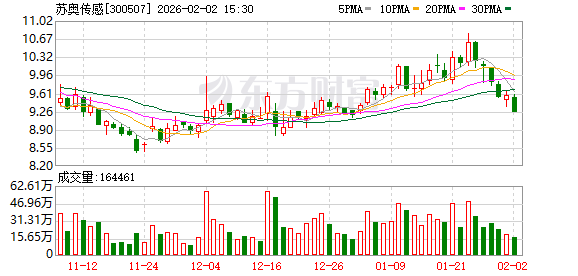
苏奥传感:公司目前与比亚迪、蔚来、小鹏、理想等多家新能源汽车企业建立了长期战略合作伙伴关系
Zheng Quan Ri Bao· 2026-02-02 12:16
Group 1 - The company, Suoao Sensor, has established long-term strategic partnerships with several major electric vehicle manufacturers, including BYD, NIO, Xpeng, and Li Auto [2] - The company is also engaged in project collaborations with the first-tier supply chain market [2]



汽车股股价悉数受挫 小鹏汽车-W(09868)跌9.21% 机构指1月新能源车销量承压
Xin Lang Cai Jing· 2026-02-02 11:01
Group 1 - The automotive stocks have faced significant declines, with Xpeng Motors down 9.21%, NIO down 6.47%, and BYD down 4.86% as of the report date [1] - A report from Kaiyuan Securities indicates that the domestic passenger car market is expected to remain flat year-on-year but will see a month-on-month decline in January 2026, with new energy vehicle sales under pressure and penetration rate dropping to approximately 44.4% [1] - The market is experiencing structural differentiation, with brands like AITO and Xiaomi achieving high growth through popular models, while pure electric brands like BYD are facing sales pressure [1] Group 2 - January is projected to be the last complete sales month before the Spring Festival, with retail sales expected to reach 1.8 million units, showing a year-on-year stability but a significant month-on-month decline [2] - The first week of January saw weak market performance with an average daily retail of 30,000 units, while the second week showed slight recovery with 50,000 units [2] - By the fourth week of January, retail sales are expected to peak at 120,000 units per day, driven by the implementation of subsidy policies and increased pre-holiday purchasing demand [2]

车企2026年首交卷,比想象中还“冷”的1月
Xin Lang Cai Jing· 2026-02-02 10:51
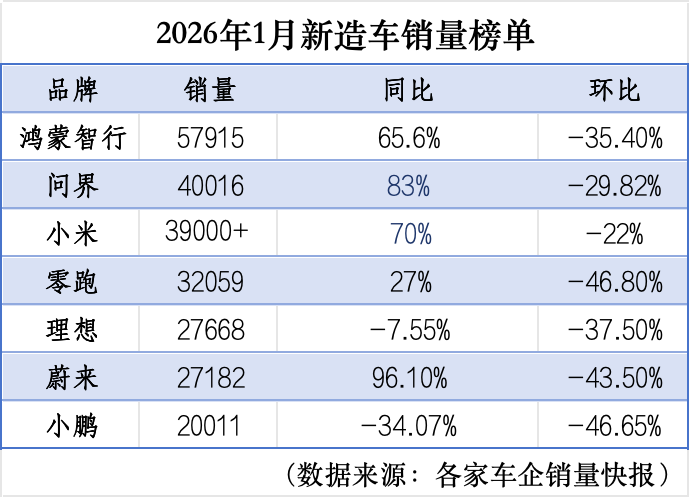
Core Insights - The January 2026 sales data for new energy vehicles indicates a significant reshuffling in the market, with some brands experiencing substantial growth while others face declines [1][2][25] - The overall market is characterized by a cautious outlook due to factors such as the reduction of purchase tax incentives and the impact of seasonal demand fluctuations [2][25][47] Sales Performance - Hongmeng Zhixing led the sales with 57,915 units, showing a year-on-year increase of 65.6% but a month-on-month decline of 35.4% [4][24] - Aiqi (问界) achieved sales of 40,016 units, marking an 83% year-on-year growth despite a 29.82% month-on-month drop [4][30] - Xiaomi's sales reached over 39,000 units, reflecting a 70% increase year-on-year but a 22% decrease from the previous month [4][30] - Li Auto (理想) sold approximately 27,668 units, down 7.55% year-on-year and 37.5% month-on-month [4][32] - NIO (蔚来) reported 27,182 units sold, a 96.1% year-on-year increase but a 43.5% decline from December [4][33] - Xpeng (小鹏) saw a significant drop with 20,011 units sold, down 34.07% year-on-year and 46.65% month-on-month [4][36] Market Dynamics - The total retail market for narrow passenger vehicles in January is estimated at around 1.8 million units, reflecting a 20.4% month-on-month decline but a slight 0.3% year-on-year increase [2][26] - The automotive market is experiencing a clear division, with some brands thriving while others struggle, indicating a competitive reshuffle [2][25][47] Strategic Responses - Companies are launching financial incentives to stimulate sales, such as long-term low-interest financing options, as a response to market pressures [21][47] - The industry is expected to face intensified competition as companies adapt to changing market conditions and consumer preferences [47] International Market Performance - Geely (吉利) achieved sales of 270,167 units in January, a 1% year-on-year increase and a 14% month-on-month rise, positioning it as the top domestic automaker [37][39] - BYD (比亚迪) sold 210,051 vehicles, with a notable 43.3% year-on-year growth in overseas sales, despite a 30.11% decline in domestic sales [40][41] - Chery (奇瑞) reported sales of 200,269 units, with significant contributions from its export market [41][42] Future Outlook - Geely plans to launch 1-2 new models each quarter in 2026, aiming for a total annual sales target of 3.45 million units [39] - The overall sentiment in the industry remains cautious, with expectations of continued volatility and competition in the coming months [47]

小鹏汽车-W1月共交付新车20011辆
Zhi Tong Cai Jing· 2026-02-02 09:49
Core Insights - Xpeng Motors delivered a total of 20,011 new vehicles in January 2026, which is expected to reduce lifecycle greenhouse gas emissions by over 300,000 tons, equivalent to the carbon absorption of 4.94 million saplings over 10 years [1] Group 1: Vehicle Deliveries and Environmental Impact - The delivery of 20,011 vehicles in January 2026 is a significant milestone for Xpeng Motors [1] - The environmental impact of these deliveries is substantial, with a reduction in greenhouse gas emissions projected to exceed 300,000 tons [1] Group 2: International Expansion - Xpeng Motors has expanded its global operations to 60 countries and regions as of December 31, 2025 [1] - The company has established an overseas sales network comprising 380 physical stores, representing an increase of over 150% compared to the same period last year [1] - The global sales and service network has grown to include more than 1,000 outlets [1] Group 3: Product Launches - The Xpeng P7+ was launched in 36 countries and made its European debut at the Brussels Auto Show in January 2026 [1]
小鹏汽车-W(09868)1月共交付新车20011辆
智通财经网· 2026-02-02 09:45
智通财经APP讯,小鹏汽车-W(09868)发布公告,2026年1月,小鹏汽车共交付新车20011辆。这些汽车 交付有望减少超过30万吨生命周期温室气体排放——相当于494万棵树苗10年的碳吸收量。 小鹏P7+同时在36个国家推出,并于2026年1月的布鲁塞尔车展上首次在欧洲亮相。 截至2025年12月31日,小鹏汽车已将其全球业务扩展至60个国家和地区。小鹏汽车海外销售网络现有 380家实体门店,较去年同期增长超过150%,全球销售和服务网络已扩大至包含超过1000个网点。 ...
小鹏汽车-W(09868.HK):1月共交付新车20,011辆
Ge Long Hui· 2026-02-02 09:38
格隆汇2月2日丨小鹏汽车-W(09868.HK)公布2026年1月智能车交付数据,2026年1月,小鹏汽车共交付 新车20,011辆。这些汽车交付有望减少超过300,000吨生命周期温室气体排放——相当于494万棵树苗10 年的碳吸收量。小鹏P7+同时在36个国家推出,并于2026年1月的布鲁塞尔车展上首次在欧洲亮相。 截至2025年12月31日,小鹏汽车已将其全球业务扩展至60个国家和地区。小鹏汽车海外销售网络现有 380家实体门店,较去年同期增长超过150%,全球销售和服务网络已扩大至包含超过1,000个网点。 ...
小鹏汽车:2026年1月交付新车20011辆
Jin Rong Jie· 2026-02-02 09:34
Group 1 - The company announced the delivery of 20,011 new vehicles in January 2026 [1]