
XPENG-W(09868)

Search documents
美股低开,中概股逆势走强
Di Yi Cai Jing Zi Xun· 2026-01-12 14:56
Market Overview - The three major U.S. stock indices opened lower on January 12, with the Dow Jones down 0.81%, the Nasdaq down 0.23%, and the S&P 500 down 0.32% [1][2]. Index Performance - Dow Jones: 49,105.15, down 398.92 points (-0.81%) [2] - Nasdaq: 23,617.91, down 53.44 points (-0.23%) [2] - S&P 500: 6,944.28, down 22.00 points (-0.32%) [2] - China Golden Dragon Index: 7,892.47, up 196.85 points (+2.56%) [2] - Nasdaq 100 Futures: 25,730.25, down 208.00 points (-0.80%) [2] - S&P 500 Futures: 6,965.50, down 39.50 points (-0.56%) [2] Sector Performance - Technology stocks experienced a broad decline, with Intel falling over 3% and Nvidia down nearly 1% [2]. - Banking stocks collectively dropped, with American Express down over 4% and JPMorgan Chase down more than 2% [2]. Chinese Stocks - Chinese stocks surged against the trend, with the China Golden Dragon Index rising over 2% [2]. - Notable performers included Kingsoft Cloud, which rose over 16%, Zhihu up over 15%, Alibaba up nearly 5%, Xpeng up over 4%, and Baidu up over 3% [2].



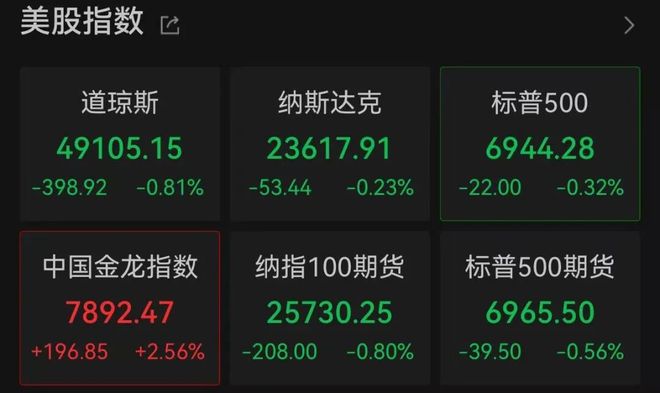
美股开盘,三大股指小幅低开,道指跌0.32%,纳指跌0.4%
Mei Ri Jing Ji Xin Wen· 2026-01-12 14:51
Group 1 - The core market sentiment shows a slight decline in major U.S. stock indices, with the Dow Jones down 0.32%, Nasdaq down 0.4%, and S&P 500 down 0.45% [1] - Walmart's stock increased by nearly 2.5% following Google's announcement of a partnership with Walmart and other large retailers to develop the Gemini chatbot as a virtual merchant and assistant [1] - Chinese concept stocks performed well, with Alibaba rising over 4% as JPMorgan suggested gradually increasing holdings in the company, Baidu up 3.5%, and XPeng gaining nearly 5% [1] Group 2 - XPeng is reportedly preparing to submit a confidential application for an IPO in Hong Kong, with the potential to list on the Hong Kong Stock Exchange as early as this year [1]



美股三大股指小幅低开,纳指跌0.4%,中概股逆势走强
Feng Huang Wang Cai Jing· 2026-01-12 14:42
沃尔玛涨近2.5%,谷歌宣布与沃尔玛等大型零售商达成合作,计划将聊天机器人Gemini打造为虚拟商 家和助手。 中概股逆势走强,阿里巴巴涨超4%,小摩建议逐步增持公司股票;百度涨3.5%,小鹏涨近5%,小鹏汇 天据悉以保密形式提交港股IPO申请,最早今年登陆港交所。 凤凰网财经讯 1月12日,美股三大股指小幅低开,道指跌0.32%,纳指跌0.4%,标普500指数跌0.45%。 ...
美股异动 | 小鹏汽车(XPEV.US)盘前涨逾5% 传计划今年冲击60万辆销量
Zhi Tong Cai Jing· 2026-01-12 14:37
Core Viewpoint - Xpeng Motors has set an ambitious delivery target of 550,000 to 600,000 vehicles for the year 2026, representing a growth of approximately 28.1% to 39.7% compared to the 429,400 vehicles expected for 2025 [1] Group 1: Delivery Targets - The company aims for an average monthly delivery of 45,800 to 50,000 vehicles to meet its 2026 target [1] - In 2025, Xpeng's overseas deliveries are projected to reach 45,008 units, marking a year-on-year increase of 96% [1] Group 2: New Product Launches - Xpeng plans to launch four new SUV models this year: Xpeng G01, Xpeng G02, and two models from the Mona series, D02 and D03 [1] Group 3: Market Expansion - The CEO, He Xiaopeng, expressed confidence that 2026 will be a year of rapid growth for Xpeng, with expectations that overseas market growth will outpace domestic growth [1] - He anticipates that in the next three to ten years, Xpeng's overseas sales and collaborations could match or exceed the ratio of the Chinese market [1] Group 4: IPO Plans - Xpeng Motors has engaged banks to assist its flying car division in preparing for an IPO in Hong Kong, with JPMorgan and Morgan Stanley selected for this process [1] - The company has reportedly submitted a confidential listing application, with the IPO potentially occurring within this year [1]
小鹏汽车(XPEV.US)盘前涨逾5% 传计划今年冲击60万辆销量
Zhi Tong Cai Jing· 2026-01-12 14:31
Core Viewpoint - Xiaopeng Motors (XPEV.US) has set an ambitious delivery target of 550,000 to 600,000 vehicles for the year 2026, representing a growth of approximately 28.1% to 39.7% compared to the 429,400 vehicles expected for 2025 [1] Group 1: Delivery Targets - The company aims for an average monthly delivery of 45,800 to 50,000 vehicles to meet its 2026 target [1] - In 2025, Xiaopeng Motors expects to achieve overseas deliveries of 45,008 vehicles, marking a year-on-year increase of 96% [1] Group 2: Product Launches - Xiaopeng Motors plans to launch four new SUV models this year: Xiaopeng G01, Xiaopeng G02, and the D02 and D03 from the Mona series [1] Group 3: Market Outlook - The CEO, He Xiaopeng, expressed confidence in the company's performance for 2025 and anticipates that 2026 will be another year of rapid growth, particularly in overseas markets [1] - He expects that in the next three to ten years, Xiaopeng's overseas sales and collaborations will match or exceed those in the Chinese market at a ratio of 1:1 or higher [1] Group 4: IPO Plans - Xiaopeng Motors has engaged banks to assist its flying car division in preparing for an IPO in Hong Kong, with JPMorgan and Morgan Stanley selected for this process [1] - The company has reportedly submitted a confidential listing application, with the IPO potentially occurring as early as this year [1]
汽车行业周报:如何展望2025Q4业绩?-20260112
Changjiang Securities· 2026-01-12 11:22
Investment Rating - The investment rating for the automotive industry is "Positive" and maintained [9] Core Insights - The wholesale sales of passenger vehicles in Q4 2025 are expected to be approximately 8.76 million units, a year-on-year decrease of 1% but a quarter-on-quarter increase of 14%. The profitability in Q4 may show differentiation compared to the same period last year, with expectations for a quarter-on-quarter improvement [2][5] - The revenue from automotive parts is anticipated to grow steadily quarter-on-quarter, but profitability may face pressure due to factors such as raw material costs and exchange rates [2][5] - The wholesale sales of heavy trucks are projected to be 314,000 units in Q4 2025, representing a year-on-year increase of 43.6% and a quarter-on-quarter increase of 11.5% [2][5] - The overall sales of buses are expected to see a significant quarter-on-quarter increase during the peak season, with sales of large and medium buses reaching 44,000 units, a year-on-year increase of 8.8% and a quarter-on-quarter increase of 42.2% [2][5] - The total sales of motorcycles are estimated to be around 4.73 million units in Q4 2025, reflecting a year-on-year increase of 11.0% but a quarter-on-quarter decrease of 6.2% [2][6] Summary by Sections Passenger Vehicles - Q4 2025 wholesale sales are expected to be about 8.76 million units, down 1% year-on-year but up 14% quarter-on-quarter. New energy vehicle sales are projected at 4.84 million units, up 13% year-on-year and 21% quarter-on-quarter [5] Automotive Parts - Revenue is expected to grow steadily quarter-on-quarter, but profitability may be pressured by raw material and exchange rate factors [5] Heavy Trucks - Q4 2025 wholesale sales are projected at 314,000 units, with a year-on-year increase of 43.6% and a quarter-on-quarter increase of 11.5% [5] Buses - Large and medium bus sales are expected to reach 44,000 units in Q4 2025, with a year-on-year increase of 8.8% and a quarter-on-quarter increase of 42.2% [5] Motorcycles - Total motorcycle sales are estimated at 4.73 million units in Q4 2025, reflecting an 11.0% year-on-year increase but a 6.2% quarter-on-quarter decrease [6]



年终盘点2025汽车市场的“龙门一跃”:油退电进,全球登顶
3 6 Ke· 2026-01-12 10:37
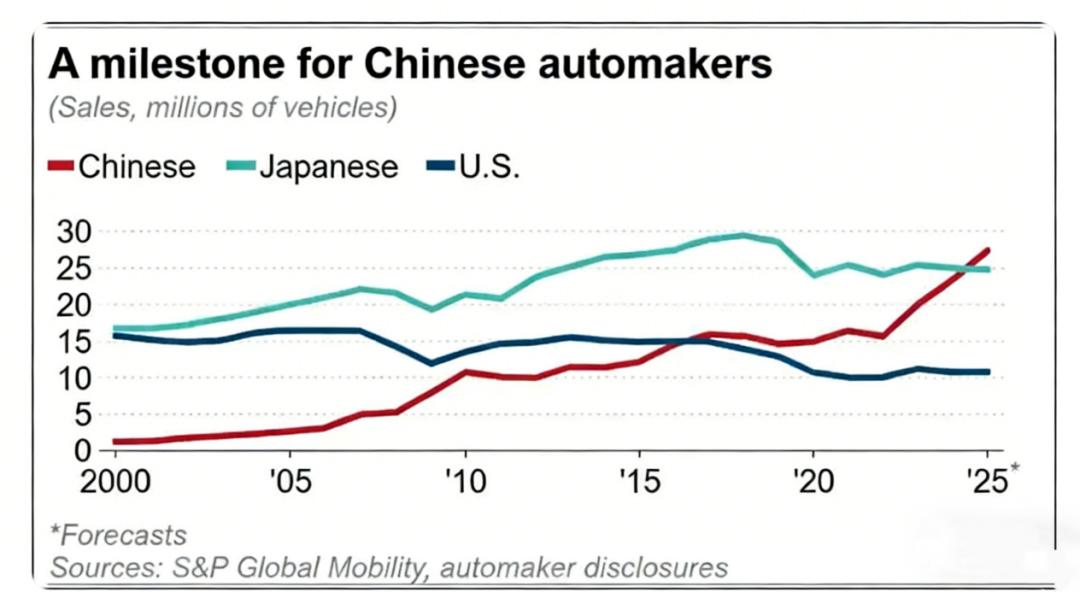
Core Insights - The penetration rate of new energy vehicles (NEVs) in China has surpassed 50%, marking a significant shift in the automotive market dynamics, transitioning from a "policy-driven" to a "product-driven" model [1][10] - The year 2025 is seen as a pivotal moment for the Chinese automotive industry, with the market experiencing a fundamental transformation akin to a "Nokia moment" [1] - The competition is evolving from price wars to value wars, emphasizing technology and product quality over mere volume [11] Industry Overview - In 2025, China's automotive manufacturers are projected to achieve global sales of 27 million vehicles, securing the top position in the global new car sales rankings for the first time [2] - China has overtaken Japan to become the world's largest automobile exporter, with NEVs accounting for a significant portion of this growth [4] - The domestic market's NEV sales are nearing 60%, reflecting a structural change in consumer preferences [4] Sales and Market Penetration - By November 2025, the retail penetration rate of NEVs reached 53.6%, with projections for the full year estimating a rate of 54.0% [6] - The rapid increase in NEV penetration is attributed to a combination of policy support, technological advancements, infrastructure development, and market demand [7] Policy and Technological Developments - The exit of purchase subsidies in 2023 has been offset by continued tax exemptions and various local incentives, which have helped maintain consumer interest in NEVs [7] - 2025 is expected to be a year of technological breakthroughs in NEVs, with advancements in high-voltage platforms, solid-state batteries, and smart driving technologies [8] Infrastructure and Consumer Experience - The expansion of charging infrastructure is crucial for alleviating consumer concerns about range anxiety, with projections of 20 million charging stations by the end of 2025 [9] - The cost advantages of NEVs are becoming increasingly apparent, with electric vehicles offering significantly lower operating costs compared to traditional fuel vehicles [9] Competitive Landscape - The shift from price competition to value competition is reshaping the industry, with companies focusing on technological innovation and profitability [11] - Some companies, like Leap Motor, have emerged as strong competitors, achieving significant sales growth and profitability [13] Global Expansion - In 2025, China's automotive exports are expected to exceed 7 million units, with NEV exports alone projected to reach 2.315 million units, marking a 102.9% increase [21] - Chinese automakers are transitioning to a "global + local" model, emphasizing localized production and R&D to better penetrate international markets [22] Challenges and Future Outlook - Despite rapid growth, challenges such as trade protectionism and compliance costs remain significant hurdles for Chinese automakers in global markets [24] - The automotive industry is expected to continue evolving, with a focus on sustainable growth and value creation as it navigates the transition from a subsidy-driven to a market-driven environment [25]



Xpeng prepares Hong Kong IPO for flying car unit as China backs air mobility
Invezz· 2026-01-12 10:33
Core Viewpoint - Xpeng Inc. is preparing for a potential stock market debut of its flying car business, indicating a strategic expansion into new technology sectors within the electric vehicle industry [1] Group 1: Company Developments - Xpeng Inc. is reportedly in the early stages of planning for the public offering of its flying car division, which represents a significant move for the company [1] - The flying car initiative aligns with Xpeng's broader strategy to innovate and diversify its product offerings beyond traditional electric vehicles [1] Group 2: Industry Implications - The potential debut of flying cars could position Xpeng as a leader in the emerging market for aerial mobility solutions, reflecting a growing trend in the electric vehicle sector towards advanced transportation technologies [1] - This development may attract investor interest and highlight the competitive landscape among electric vehicle manufacturers as they explore new avenues for growth [1]
美股异动丨小鹏汽车盘前涨近3%,小鹏汇天据悉以保密形式提交港股IPO申请
Ge Long Hui A P P· 2026-01-12 09:41
格隆汇1月12日|小鹏汽车(XPEV.US)盘前涨近3%,报20.6美元。消息面上,彭博援引知情人士透露, 小鹏汽车已聘请银行协助其飞行汽车部门"小鵬汇天"在香港进行首次公开募股(IPO)。知情人士透露, 小鹏汽车已选择摩根大通和摩根士丹利为其上市做准备。由于信息属于保密范畴,知情人士要求匿名。 他们还表示,小鹏汽车已秘密提交上市申请,最早可能在今年内完成。 ...
港股汽车股持续疲弱
Cai Jing Wang· 2026-01-12 09:38
1月12日,港股汽车股持续疲弱,其中,吉利汽车、零跑汽车跌超3%,广汽集团跌2.8%,理想汽车、小 鹏汽车跌超2%,长城汽车、蔚来汽车、赛力斯、奇瑞汽车均有跌幅。(新浪财经) 作者丨彭鑫 编辑丨安安 ...

