XPENG-W(09868)

Search documents
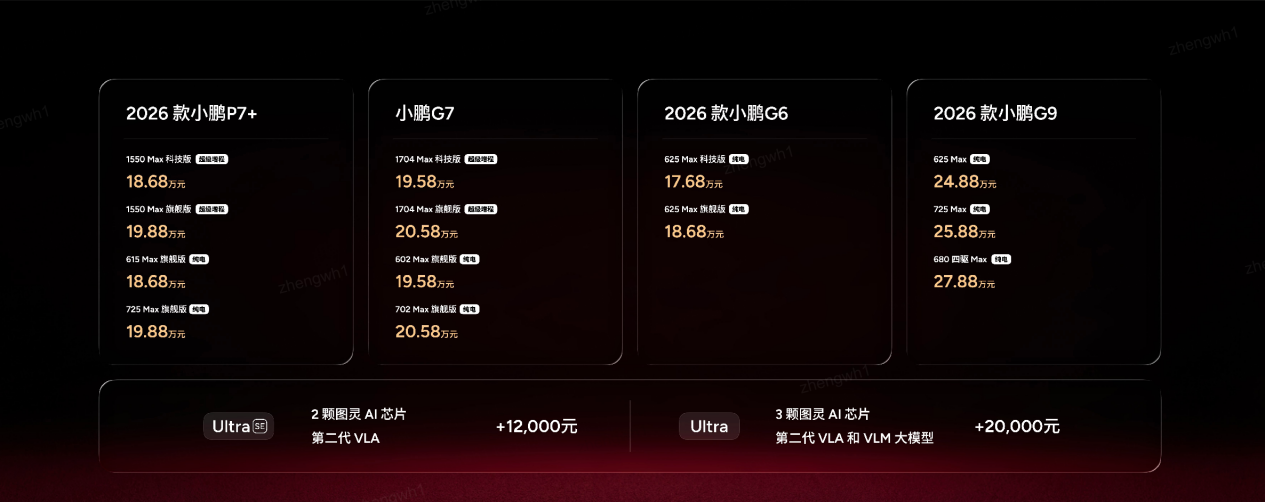
小鹏超级增程家族添新成员,2026款小鹏P7+售价18.68万元起,小鹏G7超级增程售价19.58万元起
Zhong Guo Qi Che Bao Wang· 2026-01-09 03:47
Core Insights - Xiaopeng Motors launched four new models at the 2026 Global Product Launch, including the P7+, G7 Super Range, G6, and G9, with global releases in 36 countries [1][10][37] - The P7+ is highlighted as the world's longest-range extended-range electric sedan, featuring both electric and extended-range versions with prices starting at 186,800 RMB [1][15] - The G7 Super Range boasts a comprehensive range of 1,704 km, making it a significant addition to the SUV market [23][25] Group 1: Product Launch Details - The 2026 P7+ offers two energy forms: extended-range and pure electric, with prices for the extended-range versions set at 186,800 RMB and 198,800 RMB [1] - The G7 is available in four versions, with prices ranging from 195,800 RMB to 205,800 RMB, while the G6 starts at 176,800 RMB [1] - The G9 features three versions with prices from 248,800 RMB to 278,800 RMB, showcasing Xiaopeng's commitment to diverse offerings [1] Group 2: Technological Advancements - The new models are equipped with the second-generation VLA and AIOS 6.0, enabling advanced intelligent driving and cabin experiences [4][8] - The second-generation VLA achieves L4-level capabilities, allowing for direct action generation from visual signals, marking a significant innovation in AI technology [4][6] - The AIOS 6.0 system enhances user interaction with a 3D navigation interface and proactive service capabilities, setting a new standard in smart cabin technology [8] Group 3: Performance and Efficiency - The P7+ achieves a pure electric range of 430 km and a combined range of 1,550 km, with a low energy consumption of 10.9 kWh/100 km in electric mode [15] - The G7 Super Range features a 55.8 kWh battery and a 60L fuel tank, allowing for a combined range of 1,704 km and a pure electric range of 430 km [25] - Both models support rapid charging capabilities, with the P7+ able to charge from 10% to 80% in just 12 minutes [15][25] Group 4: Safety Features - The P7+ meets dual five-star safety standards for China and Europe, incorporating advanced safety features such as a robust battery structure and a high-strength body [19] - The G7 Super Range includes comprehensive safety measures, with a battery pack featuring 17 safety protections and an active safety system for various driving conditions [29] - The vehicles are designed to provide a secure driving experience, with innovative safety technologies addressing complex road scenarios [19][29] Group 5: Market Position and Strategy - Xiaopeng Motors reported a 126% year-on-year increase in global deliveries, reaching 429,445 units in 2025, and aims to expand its market presence in over 60 countries [10] - The launch of these new models signifies Xiaopeng's strategic shift towards global markets, emphasizing its commitment to innovation and quality [10][37] - The company aims to integrate AI technology deeply into its products, enhancing user experience and establishing a strong foothold in the global automotive industry [37]


大行评级|高盛:予比亚迪及小鹏汽车“买入”评级 受惠于海外市场销售扩张
Ge Long Hui· 2026-01-09 03:05
高盛预计中国2026年新能源车零售销量增长约10%。在不同价格区间方面,多数企业认为17万至18万元 以上车型的补贴力度基本不变,但低价车型在新政下的补贴下降幅度显著。该行给予比亚迪及小鹏汽 车"买入"评级,因具备相对优势,受惠于更高的海外市场销售扩张。 高盛发表报告指,近日举办中国汽车2026年管理层展望系列会议,举行了10场在线会议,涵盖六家整车 制造商(OEM)、两家零件供应商及一家经销商,参与公司包括上汽集团、广汽、小米、零跑汽车、长城 汽车、赛力斯等。该行对中国汽车行业观察到四大核心主题:(1)公司管理层普遍对行业总量持保守态 度;几乎所有OEM预期企业自身将实现双位数销量增长,并加大海外拓展力度,(3)新车型推出节奏积 极,尤其高端市场竞争显著加剧;(4)汽车产业链各环节或面临潜在价格及利润率压力。 ...

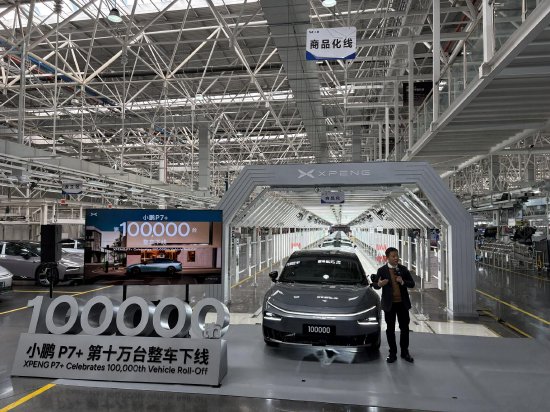
小鹏P7+第10万台整车下线
Xin Lang Cai Jing· 2026-01-09 02:45
昨日,2026款小鹏P7+发布。2026款小鹏P7+是全球最长纯电续航增程轿车和全球能耗最低的混动轿 车,CLTC综合续航1550km,纯电续航430km,拥有同级领先电耗百公里12.5kWh。价格方面,超级增 程1550 Max科技版售价18.68万元,1550 Max旗舰版售价19.88万元。 责任编辑:宋雅芳 新浪科技讯 1月9日上午消息,小鹏P7+第10万台整车下线。与此同时,2026款小鹏P7+(超级增程)向 首批车主交付。 新浪科技讯 1月9日上午消息,小鹏P7+第10万台整车下线。与此同时,2026款小鹏P7+(超级增程)向 首批车主交付。 昨日,2026款小鹏P7+发布。2026款小鹏P7+是全球最长纯电续航增程轿车和全球能耗最低的混动轿 车,CLTC综合续航1550km,纯电续航430km,拥有同级领先电耗百公里12.5kWh。价格方面,超级增 程1550 Max科技版售价18.68万元,1550 Max旗舰版售价19.88万元。 责任编辑:宋雅芳 ...
野村:维持小鹏汽车美股目标价30美元及“买入”评级
Jin Rong Jie· 2026-01-09 02:42
Core Viewpoint - Nomura's report indicates that XPeng Motors (XPEV.N) held its first annual new product launch on January 8, introducing four new and updated vehicle models while simultaneously launching a limited-time promotional campaign [1] Group 1: Product Launch - The company reiterated its business strategy focused on deepening its presence in the physical AI sector by 2026 [1] - The four models announced include the all-new P7+ (available in both range-extended and pure electric versions), the all-new G7 (primarily in range-extended version), and the G6/G9 2026 model pure electric vehicles [1] Group 2: Market Outlook - The company maintains a target price of $30 for its U.S. stock and a "buy" rating [1]
高盛:料内地车企今年本土业务利润承压 加速海外扩张 比亚迪股份(01211)及小鹏汽车-W(09868)具优势
智通财经网· 2026-01-09 02:33
Group 1 - The core observation from Goldman Sachs indicates a cautious outlook on the overall Chinese automotive market, with management expecting retail sales of passenger vehicles in 2026 to decline by 5% to grow by 1% year-on-year, despite the continuation of the "old-for-new" subsidy policy [1] - The report highlights that all six OEMs anticipate their sales growth in 2026 to range from 11% to 68%, while overseas sales are expected to increase between 19% and 108%, indicating a significant expansion despite a stable domestic market [2] - The management teams emphasize an accelerated overseas expansion strategy for 2026, with plans to launch more overseas versions of new models and establish local sales and service channels [3] Group 2 - The introduction of new models is expected to be aggressive, with a total of 119 new models projected for 2026, categorized by price range: 46 in the mass market (below 200,000 RMB), 37 in the mid-to-high-end market (200,000 to 300,000 RMB), and 36 in the high-end/luxury market (above 300,000 RMB) [3] - The competitive landscape in the high-end market is anticipated to become more crowded, particularly in the 250,000 to 300,000 RMB price range, which is expected to be the most competitive segment [3] - Goldman Sachs predicts a contraction in the domestic profit pool for the Chinese automotive industry in 2026, while the overseas market is expected to see accelerated adoption of new energy vehicles [3]


小鹏汽车加快“纯电+增程”车型布局 Robotaxi即将开启公开道路测试
Zhong Zheng Wang· 2026-01-09 02:02
Core Viewpoint - Xiaopeng Motors is positioning 2026 as a significant year for product launches, introducing four new models and expanding its business into diverse areas such as Robotaxi operations and humanoid robots [1] Group 1: New Product Launches - Xiaopeng Motors unveiled four new vehicles at the 2026 Global New Product Launch, including the 2026 P7+, G7, G6, and G9, with the first two models available in both pure electric and range-extended versions [1] - The company plans to launch four new SUVs in 2026, emphasizing its commitment to a diverse product lineup [1] Group 2: Business Strategy - The company is accelerating its "pure electric + range-extended" strategy, having introduced its first range-extended vehicle in November 2025 [1] - Xiaopeng Motors aims to enhance its autonomous driving capabilities by upgrading driver assistance to achieve Level 4 (L4) autonomy [1][3] Group 3: Technology Development - The latest models will feature the second-generation Visual Language Action (VLA) model, which is designed to enable L4 capabilities and improve the understanding of real-world scenarios [1][2] - The second-generation VLA eliminates the "language translation" step, allowing for direct generation of action commands from visual signals, enhancing the vehicle's operational capabilities [2]
早报|雷军:小米将会在今年推出一款重磅产品/「全球首款」可量产全固态电池遭质疑/Google逆袭成功,母公司市值超苹果
Sou Hu Cai Jing· 2026-01-09 01:42
Group 1 - Xiaopeng Motors plans to achieve mass production of humanoid robots in 2026, alongside the launch of Robotaxi and flying cars [3][5] - The company showcased its latest humanoid robot, IRON, at a previous event, which sparked skepticism about its authenticity [5] - The 2026 global product launch introduced several new electric and range-extended models, including the P7+ and G7, featuring advanced AI chips and various configurations [5][6][7] Group 2 - Google’s parent company, Alphabet, has surpassed Apple in market capitalization for the first time in seven years, reaching $3.89 trillion [17] - This achievement is attributed to Google's AI strategy, which includes technology development, resource integration, and commercial application [17] - The Gemini AI application has gained significant traction, outperforming ChatGPT in various metrics and achieving a 20% market share in global web traffic [18] Group 3 - Faraday Future's founder, Jia Yueting, unveiled the FX Super One MPV at CES 2026, with plans for mass production this year [20] - The vehicle emphasizes space, AI, and comfort, targeting the luxury market [20] - The company aims to leverage its identity as a U.S. automaker to assemble vehicles using parts from Chinese manufacturers [20] Group 4 - Alibaba Cloud launched a multimodal interaction development suite at the CES 2026, integrating various AI models and tools for hardware developers [26][31] - The suite aims to provide a low barrier to entry for developers, enhancing the speed and richness of AI applications across multiple sectors [31] Group 5 - Donut Lab introduced what it claims to be the world's first mass-producible solid-state battery at CES 2026, featuring high energy density and rapid charging capabilities [28][29] - However, the company faces skepticism due to a lack of independent verification of its claims and the novelty of its technology [28][29] Group 6 - MiniMax, an AI company, is set to break records for institutional subscriptions in its upcoming IPO, with over 460 institutions participating and a subscription rate exceeding 70 times [33] - The company’s revenue is primarily derived from AI-native products, which accounted for over 70% of its income by mid-2025 [34] Group 7 - Zhiyuan Technology, a company focused on AGI, has recently gone public, marking a significant milestone in the AI sector [41] - The CEO emphasized the importance of pursuing AGI and not solely focusing on commercial applications, highlighting the high costs and risks involved in this exploration [41][44]


汽车早餐 | 四部门联合召开动力和储能电池行业座谈会;吉利获L3级自动驾驶道路测试牌照;广汽国际与Grab达成战略合作
Zhong Guo Qi Che Bao Wang· 2026-01-09 01:21
Group 1: Battery Industry - A joint meeting was held by four government departments to discuss the regulation of the power and energy storage battery industry, involving 16 companies including major players like CATL and BYD [2] Group 2: Automotive Industry - The Ministry of Industry and Information Technology is soliciting public opinions on seven proposed mandatory national standards for intelligent connected vehicles, including safety requirements for automatic parking systems [3] - Geely has obtained a Level 3 autonomous driving road test license for its Zeekr 9X model in Hangzhou [9] - Xpeng Motors' CEO predicts that 2026 will mark the true beginning of autonomous driving in China and the U.S., with the company's second-generation VLA achieving Level 4 autonomous driving capabilities [11] - Dongfeng Motor is in discussions to produce passenger vehicles in Turkey, with plans to start production within the year [12] Group 3: Strategic Partnerships and Investments - GAC International has formed a strategic partnership with Grab to collaborate on delivering 20,000 high-performance electric vehicles in Southeast Asia over the next two years [10] - Intramco, a company under Xincheng Capital, has partnered with Leap Motor to supply charging products for its future electric vehicles produced in Europe [14] - Faraday Future aims to achieve positive cash flow and a gross margin of 20% within three years, as announced during its shareholder day event [15] Group 4: Technology and Innovation - Hyundai's stock price surged following the announcement of increased investments in robotics and artificial intelligence, alongside a meeting between its chairman and NVIDIA's CEO [6] - Elon Musk's AI startup xAI completed a $20 billion funding round, exceeding its initial target of $15 billion, with investors including NVIDIA and Cisco [7] Group 5: Economic Cooperation - The Ministry of Commerce is accelerating negotiations for the second phase of the China-South Korea Free Trade Agreement, focusing on enhancing economic cooperation and exploring new areas such as high-end manufacturing and green industries [4] - Guangzhou's government has released a plan to cultivate strategic industries, including artificial intelligence and new energy storage, as part of its advanced manufacturing strategy [5]


小鹏汽车成功注册图灵AI座舱商标
Zheng Quan Shi Bao Wang· 2026-01-09 01:05
人民财讯1月9日电,企查查APP显示,近日,广东小鹏汽车科技集团有限公司成功注册1枚"小鹏图灵AI 座舱"商标,国际分类为运输工具,已申请商品/服务包括陆地车辆马达、自动驾驶汽车、无人驾驶汽车 等。 ...
掘金CES 2026:AI全域渗透加速,应用端投资机会将至?
智通财经网· 2026-01-09 00:55
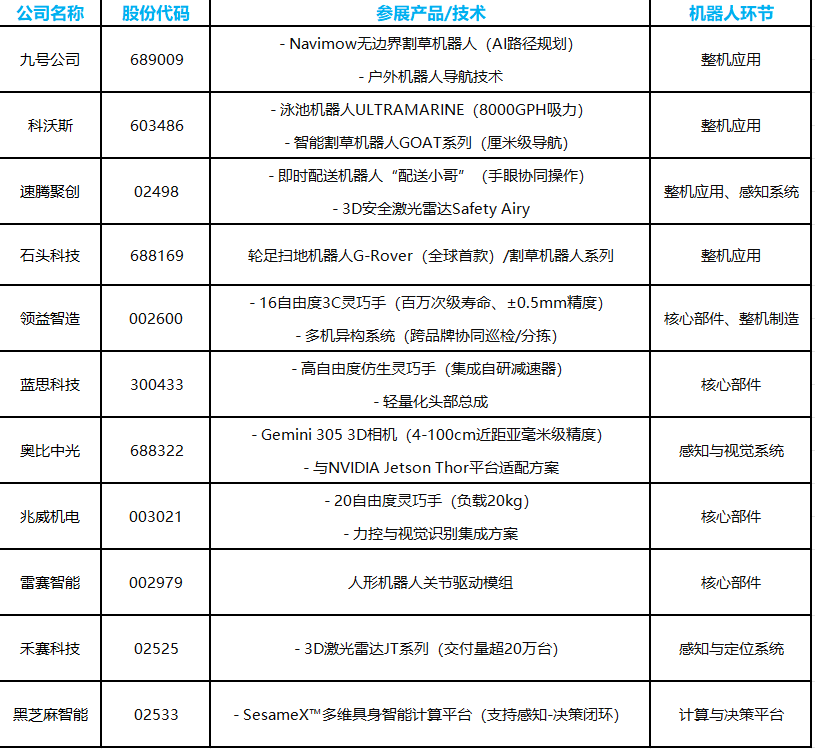
Group 1: CES 2026 Overview - CES 2026, known as the "Spring Festival Gala" of the tech industry, commenced on January 6 in Las Vegas, focusing on "defining the physical boundaries of AI" [1] - The event featured 207 Chinese companies across various cutting-edge fields, including AI, smart wearables, and smart home technologies, showcasing over 120 small and medium-sized tech firms [1] - The technologies presented by leading Chinese companies reflect the country's technological strengths and outline key directions for global industry evolution [1] Group 2: Robotics and AI Technologies - AI and robotics technologies were a major highlight at CES 2026, with global leaders showcasing various robots and core components [2] - NVIDIA's CEO announced that the robotics sector has entered its "ChatGPT moment," introducing world models to enhance robots' understanding of physical properties and spatial relationships [2] - Chinese companies, including Yushu Technology and Fourier, presented a wide range of innovative products, covering industrial applications, daily life, medical assistance, and emergency rescue [2][3] Group 3: Key Exhibitors and Innovations - Notable exhibitors included Ninebot, Ecovacs, and SUTENG, showcasing advanced robotic solutions such as AI path-planning lawn mowers and delivery robots capable of complex tasks [4][5] - Companies like Lingyi Zhi Zao and Zhaowei Electric displayed high-freedom dexterous hands and collaborative systems, indicating significant advancements in robotics [5] - The emergence of a cohesive display of robotics indicates a breakthrough in China's robotics industry, transitioning from fragmented to integrated solutions [5] Group 4: Automotive Innovations - The automotive sector at CES 2026 emphasized the transformation of vehicles into "smart partners" with emotional resonance and autonomous capabilities [6] - NVIDIA introduced the world's first open-source autonomous driving model, aiming to address challenges in extreme weather and construction detours [6] - Chinese automakers, including Great Wall Motors and Geely, showcased innovative models and technologies, highlighting the integration of smart features and collaboration with supply chain partners [6][7] Group 5: Wearable Devices and AI Glasses - Wearable devices, particularly AI glasses, gained significant attention at CES 2026, with over 60% of the showcased products coming from Chinese brands [10][11] - Innovations included independent communication-capable AR glasses and various health monitoring devices, indicating a shift towards mass production and consumer adoption [10][11] - The advancements in display and optical technologies for AI glasses reflect a robust ecosystem supporting the transition from concept to widespread use [12][13] Group 6: Industry Trends and Future Outlook - The CES 2026 event signaled a clear shift in AI's role from mere technology demonstration to deep integration within industry value chains [14] - The trend of AI becoming a physical entity is accelerating, with applications in robotics, smart driving, and wearable devices becoming observable realities [14] - Investors are encouraged to focus on the transition from technology validation to commercial scale, marking a critical window for capturing scene-based opportunities in 2026 [14]