BIDU(09888)

Search documents
百度集团第三季度营收311.7亿元人民币,市场预估308.7亿元人民币;第三季度调整后EBITDA 44.3亿元人民币;第三季度调整后营业利润22.1亿元人民币
Hua Er Jie Jian Wen· 2025-11-18 09:01
Core Viewpoint - Baidu Group reported third-quarter revenue of 31.17 billion RMB, exceeding market expectations of 30.87 billion RMB [1] - The adjusted EBITDA for the third quarter was 4.43 billion RMB, while the adjusted operating profit was 2.21 billion RMB [1] Financial Performance - Third-quarter revenue reached 31.17 billion RMB, surpassing the market forecast of 30.87 billion RMB [1] - Adjusted EBITDA for the third quarter was reported at 4.43 billion RMB [1] - Adjusted operating profit for the third quarter stood at 2.21 billion RMB [1]

Baidu Announces Third Quarter 2025 Results
Prnewswire· 2025-11-18 09:00
Core Insights - Baidu reported its third-quarter financial results for 2025, highlighting the transformative impact of AI across its business portfolio, particularly in AI Cloud and autonomous driving services [2][3][6]. Financial Performance - Total revenues for Q3 2025 were RMB 31.2 billion ($4.38 billion), a decrease of 7% year-over-year [9]. - Operating loss was RMB 15.1 billion ($2.12 billion), with Baidu Core operating loss at RMB 15.0 billion ($2.10 billion) [12]. - Net loss attributable to Baidu was RMB 11.2 billion ($1.58 billion), with diluted loss per ADS at RMB 33.88 ($4.76) [14]. - Non-GAAP net income attributable to Baidu was RMB 3.8 billion ($530 million), with a non-GAAP diluted earnings per ADS of RMB 11.12 ($1.56) [14]. Business Segments - AI Cloud revenue reached RMB 4.2 billion, up 33% year-over-year, driven by increased enterprise adoption [18]. - Revenue from AI-native marketing services surged 262% year-over-year to RMB 2.8 billion, indicating strong demand for performance-driven AI solutions [18]. - Apollo Go, Baidu's autonomous ride-hailing service, provided 3.1 million fully driverless rides in Q3 2025, marking a 212% increase year-over-year [6][7]. Strategic Developments - Baidu introduced a new AI-native view to better reflect its AI-powered assets and enhance investor visibility [8]. - The company launched ERNIE 5.0, an advanced omni-modal foundation model, showcasing its commitment to AI innovation [6]. - Baidu's ESG evaluations improved, and it was recognized in Fortune's Change the World 2025 list for its positive social impact through Apollo Go [6]. Operational Highlights - As of October 2025, Apollo Go's global operations expanded to 22 cities, achieving 100% fully driverless operations in all cities where it operates [7]. - Baidu App's monthly active users reached 708 million, reflecting a 1% year-over-year increase [18]. Cash and Investments - Total cash and investments as of September 30, 2025, were RMB 296.4 billion ($41.64 billion) [16]. - Operating cash flow was RMB 1.3 billion ($176 million), with an adjusted figure excluding iQIYI at RMB 1.5 billion ($214 million) [16].


港股收评:三大指数再跌,恒科指跌1.93%!黄金股大跌
Ge Long Hui· 2025-11-18 08:39
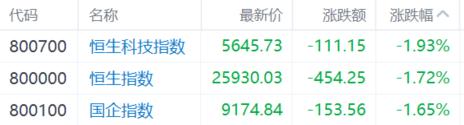
Market Overview - On November 18, global financial markets experienced a collective decline due to multiple factors affecting market risk sentiment, with Hong Kong's three major indices showing weakness throughout the day. The Hang Seng Index fell by 1.72%, closing below the 26,000-point mark, while the Hang Seng China Enterprises Index and the Hang Seng Tech Index dropped by 1.65% and 1.93%, respectively [1][2]. Sector Performance - Concerns over overvaluation in artificial intelligence have led to a continued decline in technology stocks. The spot gold price briefly fell below $4,000, causing significant drops in gold and non-ferrous metal stocks, with Lingbao Gold experiencing a nearly 9% decline. The steel sector also faced notable declines due to significant price drops throughout the year [2][5]. - The steel sector led the declines, with China Hanking down over 9%, Maanshan Iron & Steel down over 7%, and several other steel companies experiencing declines of over 5%. A report from CITIC Construction indicated that the steel price is expected to decline significantly by 2025 due to supply-demand mismatches and weakened cost support [5][6]. - The gold sector saw substantial losses, with Lingbao Gold down nearly 9% and other gold mining companies also experiencing declines of over 5% [6][8]. - The lithium battery sector continued to decline, with major companies like Cai Ke New Energy and Zhong Chuang Innovation falling over 10% and 8%, respectively [10]. - The automotive sector faced a downturn, with sales data indicating a 0.8% year-on-year decline in retail sales for October, and a significant drop in November sales figures [11][12]. Investment Trends - Southbound funds recorded a net inflow of HKD 7.466 billion, with the Shanghai-Hong Kong Stock Connect and Shenzhen-Hong Kong Stock Connect seeing net purchases of HKD 2.745 billion and HKD 4.721 billion, respectively [15]. - Looking ahead, Guosen Securities noted that the upcoming Central Economic Work Conference in December will set the tone for macro policies and key tasks for the following year, influencing investment strategies and stock valuations [17].




东海证券晨会纪要-20251118
Donghai Securities· 2025-11-18 05:10
Group 1 - Semiconductor industry shows signs of recovery with SMIC's Q3 capacity utilization and ASP increasing by 3.8% quarter-on-quarter, driven by product structure optimization [5][6] - SMIC's Q3 revenue reached 17.162 billion yuan, a year-on-year increase of 9.9%, with net profit growing by 43.1% to 1.517 billion yuan, and gross margin at 25.5%, up 4.8 percentage points [6] - Baidu announced its five-year roadmap for Kunlun chips, entering a strategic acceleration phase in AI, with the launch of the Wenxin model 5.0 and Kunlun M100, M300 products [7] Group 2 - The electronic sector underperformed the market, with the Shenwan Electronics Index dropping by 4.77%, lagging behind the broader market by 3.69 points [8][9] - Investment recommendations include focusing on AIOT beneficiaries like Lexin Technology and semiconductor equipment firms amid a recovering demand environment [9] - The report highlights the importance of domestic semiconductor equipment and materials industries, suggesting attention to companies like North Huachuang and Micro Company [9] Group 3 - The global semiconductor sales reached a historical high of 69.5 billion USD in September, with a year-on-year growth of 7.0%, indicating an upward trend in the industry [13] - The report emphasizes the potential of the technology sector, particularly in chips and semiconductors, due to the higher cost-performance ratio of domestic computing power compared to the US [13]

智通ADR统计 | 11月18日
智通财经网· 2025-11-17 22:44
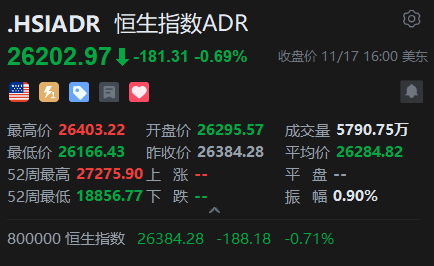
Market Overview - The Hang Seng Index (HSI) closed at 26,202.97, down by 181.31 points or 0.69% on November 17 [1] - The index's trading volume was 57.9075 million, with a daily average price of 26,284.82 [1] - The 52-week high for the index was 27,275.90, while the low was 18,856.77 [1] Major Blue-Chip Stocks Performance - Most large-cap stocks experienced declines, with HSBC Holdings closing at HKD 110.738, down 1.21% from the Hong Kong close [2] - Tencent Holdings closed at HKD 629.180, down 1.15% from the Hong Kong close [2] Stock Price Movements - Tencent Holdings (00700) saw a decrease of HKD 4.500, or 0.70%, with an ADR price of HKD 629.180, which is HKD 7.320 lower than its Hong Kong stock price [3] - HSBC Holdings (00005) dropped by HKD 0.800, or 0.71%, with an ADR price of HKD 110.738, which is HKD 1.362 lower than its Hong Kong stock price [3] - Other notable declines included AIA Group (01299) down by 1.28% and China Construction Bank (00939) down by 1.32% [3]


热门中概股收盘多数下跌 小鹏跌超10%
Xin Lang Cai Jing· 2025-11-17 22:33
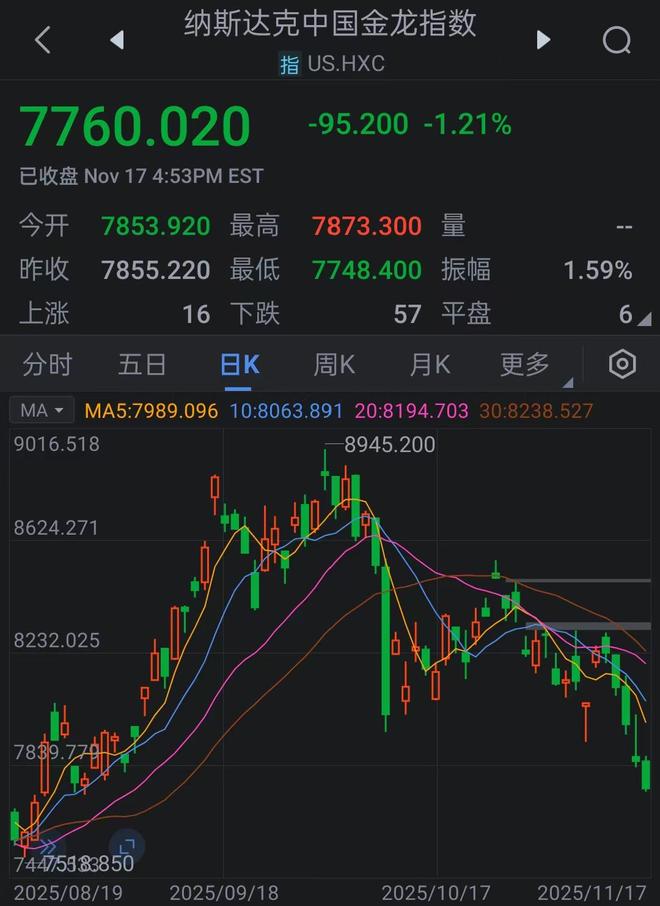
Group 1 - The majority of popular Chinese stocks closed lower on Monday, with the Nasdaq Golden Dragon China Index falling by 1.21% [1] - Alibaba saw an increase of over 2%, while Pinduoduo, NetEase, Ctrip, and Baidu experienced declines of over 1% [1] - Xpeng dropped by over 10%, Li Auto fell by over 4%, Manbang decreased by over 11%, and New Oriental declined by over 1% [1]


速递|全球首个可商用,百度发布自我演化超级Agent“百度伐谋”
Z Potentials· 2025-11-17 14:38
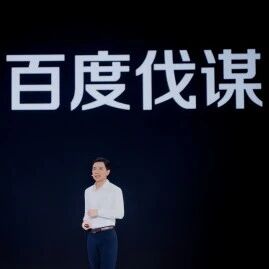
Core Insights - Baidu has launched the world's first commercially viable self-evolving superintelligence, "Baidu Famou," aimed at helping enterprises find "global optimal solutions" across various industries such as transportation, energy, finance, logistics, and even drug development [1][3] - The concept of Baidu Famou is inspired by "evolutionary algorithms," which simulate millions of years of biological evolution to discover solutions previously unknown to humans [1][3] - AI is recognized as a key variable in enhancing productivity, with the belief that when AI capabilities are internalized, they become a driving force for enterprise growth and personal development [1][3] Industry Applications - In critical industries, even a 1% optimization can yield significant value, often in the millions or billions [2] - Traditionally, solving complex algorithmic problems relied heavily on expert experience, which is time-consuming and inefficient when external conditions change [2] Technical Capabilities - Baidu Famou integrates large model reasoning capabilities, evolutionary computation exploration, and scalable distributed systems, allowing for rapid abstraction of complex problems and model establishment [3] - The system can generate diverse initial solution sets during the "cold start phase" and continuously learn and iterate in the "evolution phase," providing dynamic optimal solutions [3][4] New Paradigm - Baidu Famou introduces a new paradigm where human experts define tasks while the intelligent agent continuously seeks optimization, allowing experts to focus on creative work [5] Performance Validation - Baidu Famou has demonstrated its capabilities in various international benchmarks, achieving up to 20 times performance improvement in CUDA Kernel optimization tests and leading results in machine learning engineering benchmarks [6][8] Industry Case Studies - In offshore wind power, Baidu Famou optimized cable layout designs, significantly reducing project delivery time [11] - In financial risk control, it improved feature extraction efficiency by 100% and enhanced risk differentiation by 2.41% for a bank [12] - In traffic management, it reduced average vehicle delays by 13% and further by 5% through AI-controlled traffic light timing [13] - In port scheduling, it optimized equipment planning and scheduling, creating annual energy savings in the logistics sector [14][15] Collaboration and Future Prospects - Baidu Famou is now open for collaboration with large enterprises and ecosystem partners to tackle national industry challenges and unlock significant value through AI [15]
Jim Cramer Thinks Baidu and Alibaba are Good—Should AI Value Hunters Buy?
247Wallst· 2025-11-17 14:12
Core Viewpoint - Jim Cramer, host of Mad Money, expressed positive opinions about two leading tech innovators in China during a recent episode of the Lightning Round [1] Group 1 - Cramer highlighted the innovative capabilities of the two Chinese tech companies, suggesting they are at the forefront of technological advancements [1] - The discussion indicates a growing interest in Chinese tech firms among investors, reflecting potential investment opportunities in this sector [1]

Top EV and AV Picks to Ride on the Future of Transportation
ZACKS· 2025-11-17 13:46
Industry Overview - The auto industry is rapidly evolving with electric vehicles (EVs) and autonomous vehicles (AVs) becoming mainstream, reshaping travel and corporate strategies regarding mobility [2] - Tesla's dominance in the EV market is being challenged by strong competition from Chinese automakers and traditional car manufacturers, along with new EV-only startups [2] Technology Advancements - Improvements in battery technology, including longer lifespan, faster charging, and reduced costs, are making EVs more appealing [3] - The expansion of fast-charging networks is addressing one of the major concerns for EV buyers: charging time [3] Market Growth Projections - The U.S. EV market was valued at approximately $131 billion in 2024 and is projected to grow to $439 billion by 2034, reflecting a compound annual growth rate of 13.6% [5] - The International Energy Agency anticipates global EV sales to surpass 20 million units in 2025, accounting for over 25% of all cars sold worldwide [5] - The global AV market is expected to increase from about $106 billion in 2021 to over $2.3 trillion by 2030 [6] Investment Opportunities - Both EVs and AVs present significant long-term investment opportunities, characterized by growth and innovation [7] - Notable companies for investors include QuantumScape Corp. (QS), Alphabet (GOOGL), and Rivian Automotive (RIVN) [7] Company Highlights: QuantumScape - QuantumScape is advancing its solid-state battery technology, achieving a major milestone with the introduction of the Cobra manufacturing process, which is 25 times faster than the previous system [9] - The company has begun customer testing of its new battery cells, with significant interest from leading automakers [10] - QuantumScape recorded $12.8 million in customer billings for the first time in Q3, indicating progress towards commercialization [12] Company Highlights: Alphabet (Waymo) - Waymo, Alphabet's autonomous driving unit, operates the most advanced robotaxi service in the U.S., with fully driverless services in several major cities [14][15] - The company has received substantial funding for research and fleet expansion, enhancing its competitive position [16] - Waymo recently began offering driverless freeway rides, marking a significant milestone in autonomous driving [17] Company Highlights: Rivian - Rivian is focusing on expanding its EV market presence with plans for lower-priced models, including the R2 midsize SUV expected to launch in 2026 [19][20] - The company has a strategic partnership with Volkswagen, which plans to invest up to $5.8 billion, aiding Rivian's next-generation electrical architecture [21] - Rivian aims to reduce material costs by about 20% for its second-generation models and nearly 50% for the R2, positioning itself for growth [22]



成本暴降99%!万人大会系统全是AI生成的,Vibe Coding终于真上战场了
量子位· 2025-11-17 12:00
Core Insights - The article discusses the evolution of AI tools from being mere toys to becoming essential business solutions, exemplified by Baidu's "秒哒" platform which can generate complete applications from simple natural language inputs [1][2][3]. Group 1: AI Application Development - The "秒哒" platform has evolved to version 2.0, significantly reducing development costs by 99% compared to traditional methods [4]. - It allows users to create full-stack applications without writing code, integrating backend logic, databases, and payment systems seamlessly [6][7]. - The platform has already generated over 400,000 applications, indicating a strong demand for such tools [55]. Group 2: User Experience and Functionality - Users can create various applications, such as e-commerce platforms and games, in just a few minutes, showcasing the platform's ease of use [25][32]. - The platform supports a wide range of functionalities, including payment processing, image editing, and video generation, all without requiring additional development [23][48]. - Applications can be published directly to the internet and integrated with search engines for visibility [39][40]. Group 3: Technological Framework - The platform operates through a multi-agent collaboration system, where different AI agents handle various aspects of application development, mimicking a micro-development team [42]. - It leverages Baidu's ecosystem, allowing for easy integration of services like maps, SMS, and payment processing [44][46]. - Continuous upgrades to backend capabilities ensure that applications can handle complex data management and user interactions effectively [48]. Group 4: Market Potential and Community Engagement - The platform targets a broad audience, enabling individuals without coding skills to transform their ideas into functional applications, thus tapping into a previously underserved market [56]. - Baidu has initiated a hackathon to encourage non-programmers to create innovative applications, further expanding the community around the platform [58]. - The international version, MeDo, has also gained traction, indicating the global appeal of such AI-driven development tools [70].