
NEW ORIENTAL(09901)

Search documents
2025 年上半年成人学习回顾:AI 重塑生态,多元需求驱动产业跃迁
3 6 Ke· 2025-07-21 00:57
Core Insights - The adult education industry is undergoing a paradigm shift driven by AI, transitioning from a traditional model to one focused on personalized services, with significant sales growth observed in AI-driven platforms [1] - Companies are leveraging vertical large models to create technical barriers, enhancing user learning efficiency and achieving notable financial results, such as a 27% year-on-year increase in net profit for one company [2] - The demand spectrum for adult learning is diversifying, with a shift from exam-oriented needs to lifelong learning, indicating a profound change in user requirements [4] Company Innovations - Companies like Fenbi and Zhonggong are developing AI-driven educational tools that enhance learning efficiency and provide comprehensive services, integrating hardware and software solutions [2][9] - Huatu Education's AI interview evaluation system exemplifies a new technical approach that improves interview success rates and reduces grading costs significantly [3] - Quantum Song's initiatives in the silver economy and interest education demonstrate the potential for market expansion, with innovative programs increasing customer retention [6] Market Trends - The adult education sector is witnessing strategic shifts towards internationalization, ecosystem building, and lightweight operations, reflecting companies' responses to competitive pressures [7] - New Oriental is exploring the "silver-haired study abroad" market, targeting a potential market of 200,000 retirees annually, indicating a growing niche [8] - The integration of AI in educational services is creating competitive barriers, with companies developing closed-loop ecosystems that enhance customer lifetime value [9] Operational Strategies - Companies are adopting cost-reduction strategies, with notable improvements in profit margins and operational efficiency, such as a 4.6% decrease in sales expenses for one firm [10] - The trend towards lightweight operations is exemplified by Quantum Song's cross-industry integration, which enhances revenue streams through innovative product offerings [10] Future Outlook - The adult learning industry is expected to evolve from "scale expansion" to "value creation," driven by technological advancements and changing market demands [12] - The application of AI is anticipated to shift from isolated implementations to integrated solutions, with a focus on personalized learning experiences [12] - The market is likely to see further segmentation, with increased attention on silver education and cross-border vocational training [12]


研判2025!中国考研培训行业产业链、市场规模及发展趋势研判:“考研热”降温,考研培训行业承压运行[图]
Chan Ye Xin Xi Wang· 2025-07-18 01:27
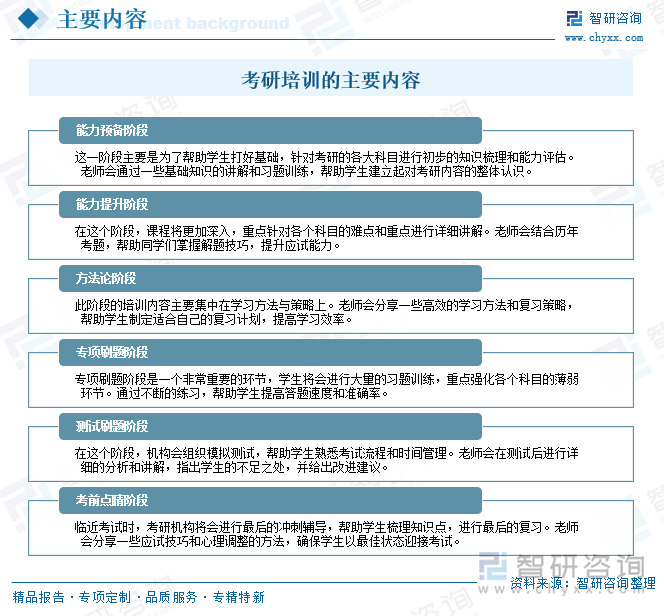
Core Insights - The number of candidates for the postgraduate entrance examination in China has been increasing over the past few years, leading to a rise in the demand for training services [1][11] - However, in recent years, the enthusiasm for the examination has declined, resulting in a decrease in training demand and a shrinking market for training institutions [1][11] - The market size of the postgraduate training industry in China is projected to reach 13.85 billion yuan in 2024, reflecting a year-on-year decline of 11.1% [1][11] Industry Overview - The postgraduate training industry provides systematic and professional guidance for candidates preparing for the national postgraduate entrance examination, aiming to enhance knowledge, exam skills, and preparation efficiency [3] - The training covers various stages, including foundational review, skill enhancement, methodology, targeted practice, and final exam preparation [3] Market Dynamics - The per capita disposable income of Chinese residents has been steadily increasing, which supports higher spending on education, including postgraduate training [5] - The number of candidates for the postgraduate examination is expected to drop to 3.88 million in 2025, a decrease of 500,000 from the previous year, indicating a significant market shift [9] Competitive Landscape - The postgraduate training market in China is highly competitive, with over a hundred participants, including major players like New Oriental, Gaotu, and Zhonggong Education [13][14] - Large educational institutions dominate the mainstream market due to their teaching resources and course development capabilities, while smaller regional institutions and online platforms target niche markets with flexible strategies [13] Industry Trends - There is a growing demand for diversified and personalized training services, moving beyond traditional subjects to include emerging fields like data science and artificial intelligence [18] - The integration of technology, such as artificial intelligence and big data, is expected to enhance the training experience by providing personalized learning paths and improving preparation efficiency [19] Regulatory Environment - The industry faces challenges such as false advertising and unqualified institutions, prompting the need for regulatory measures to ensure fair practices and protect candidates' interests [20]



金十图示:2025年07月17日(周四)中国科技互联网公司市值排名TOP 50一览


news flash· 2025-07-17 02:54
Group 1 - The article presents the market capitalization rankings of the top 50 Chinese technology and internet companies as of July 17, 2025 [1] - Alibaba leads the list with a market capitalization of $2760.32 billion, followed by Xiaomi Group at $1871.42 billion and Pinduoduo at $1492.47 billion [3][4] - Meituan ranks sixth with a market capitalization of $978.45 billion, indicating strong performance among major players in the sector [4] Group 2 - Other notable companies include Oriental Fortune at $515.59 billion, SMIC at $466.49 billion, and JD.com at $456.09 billion, showcasing a diverse range of businesses within the top rankings [4][5] - Kuaishou ranks 11th with a market capitalization of $376.96 billion, while Tencent Music and Li Auto follow closely with $332.09 billion and $314.71 billion respectively [4][5] - The list also features companies like Xpeng Motors at $170.92 billion and iFlytek at $151.19 billion, reflecting the growing influence of electric vehicles and AI technology in the market [4][5]

教育早餐荟 | 教育部部署2025年中小学暑期安全工作;昂立教育全资控股育伦教育
Bei Jing Shang Bao· 2025-07-17 01:44
Group 1 - The Ministry of Education has issued a notice to ensure the safety of primary and secondary school students during the summer vacation of 2025, emphasizing the need for local authorities to implement targeted measures and clarify responsibilities [1] - Beijing's market regulatory authority has exposed five typical cases of illegal advertising in the education training sector, aiming to regulate the advertising market and remind consumers to discern compliance [2] - The Hangzhou Ecological Environment Bureau has responded to reports of multiple elementary school students experiencing nosebleeds, stating that monitoring has not revealed any excessive emissions from nearby enterprises [3] Group 2 - Guomai Technology announced that shareholder Lin Huirong has lifted the pledge on 13 million shares, representing 4.72% of his holdings and 1.29% of the company's total shares [4] - Anlong Education has approved a change in the acquisition plan for a minority stake in Shanghai Yulun Education Technology Development Co., Ltd., agreeing to purchase 20% of the equity for 13.36 million yuan [5] - New Oriental International Education has officially opened its Mong Kok campus in Hong Kong, aiming to provide comprehensive educational services for new families and local students [6]

新东方20250509
2025-07-16 06:13
Summary of Conference Call Company and Industry - The conference call pertains to the education industry, specifically focusing on a company involved in K-12 education and related services. Key Points and Arguments Capacity and Revenue Growth - The company anticipates a revenue growth rate of approximately 14-15% for the upcoming fiscal year, with capacity increase controlled between 10-15% to ensure higher utilization rates at each location [1][1][1] Personnel Management - The company plans to increase its workforce by no more than 10% overall, with a focus on hiring teachers, particularly in fast-growing segments like K9, which may see a 20-25% increase in personnel due to a projected revenue growth of 25-30% [2][2][2] Margin Expansion - The output margin is expected to increase by approximately 0.8 percentage points this year, with further contributions anticipated for next year, although specific margin guidance has not been provided [3][3][3] Cost Control Measures - The company is implementing cost control measures across various segments, reallocating resources from slower-growing areas to those with higher growth potential, particularly in youth education [4][4][4] International Business Trends - The company expects a decline in students going to the U.S. for education, while other regions like the UK, Australia, and Canada may see an increase, necessitating resource adjustments [5][5][5] AI Integration - The company is actively integrating AI technologies into its educational products and services, aiming to enhance efficiency and effectiveness in educational delivery [7][7][8] K-12 Business Model - The company maintains a subscription-based model rather than a direct sales approach, which is believed to be more effective in delivering educational outcomes [9][9][9] Pricing Strategy - The company plans to implement a price increase of 4-6% for K9 services, while high school services will not see a price increase. The acceptance of these price adjustments by parents remains high [14][14][14] Market Competition - The company does not perceive significant threats from smaller institutions or new entrants in the market, as the overall demand remains stable and larger institutions are better positioned to meet this demand [12][12][12] Demographic Considerations - Despite a declining birth rate affecting the overall market size, the company believes it can maintain its market share through strong brand recognition and a diverse product line catering to different educational stages [11][11][11] Other Important Content - The company is considering a regular dividend policy following a special dividend and share buyback last year, although specific details are still under discussion [5][5][5] - The company emphasizes the importance of maintaining quality education resources despite demographic changes, ensuring that the pursuit of high-quality education remains a priority [11][11][11]
Is New Oriental Education & Technology Group (EDU) Stock Undervalued Right Now?
ZACKS· 2025-07-15 14:41
While the proven Zacks Rank places an emphasis on earnings estimates and estimate revisions to find strong stocks, we also know that investors tend to develop their own individual strategies. With this in mind, we are always looking at value, growth, and momentum trends to discover great companies.Looking at the history of these trends, perhaps none is more beloved than value investing. This strategy simply looks to identify companies that are being undervalued by the broader market. Value investors rely on ...

金十图示:2025年07月14日(周一)中国科技互联网公司市值排名TOP 50一览
news flash· 2025-07-14 02:52
Group 1 - The article presents the market capitalization rankings of the top 50 Chinese technology and internet companies as of July 14, 2025 [1] - The leading company by market capitalization is 台棋电 (Taiwan Semiconductor Manufacturing Company) with a valuation of 11,949.75 million [3] - Tencent Holdings ranks second with a market cap of 5,815.18 million, followed by Alibaba at 2,546.4 million [3][4] Group 2 - Xiaomi Group is ranked fourth with a market capitalization of 1,889.61 million, while Pinduoduo follows in fifth place with 1,489.35 million [3][4] - Meituan and NetEase are positioned sixth and seventh, with market caps of 929.41 million and 812.27 million respectively [3][4] - Other notable companies in the top 10 include 东方财富 (East Money) at 523.39 million and 中芯国际 (SMIC) at 476.15 million [4][5] Group 3 - The rankings continue with companies like 京东 (JD.com) at 448.31 million and 快手 (Kuaishou) at 356.11 million [4][5] - Baidu, 理想汽车 (Li Auto), and 贝壳 (Beike) are also included in the top 15, with market caps of 298.84 million, 296.08 million, and 221.89 million respectively [4][5] - The list concludes with 云费智联 (Yunfei Zhili) at 41.76 million, marking the 50th position [6]



港股开盘 | 恒生指数低开0.16% 新东方(09901)跌近2%
智通财经网· 2025-07-14 01:37
关于港股后市 中信证券表示,港股当前的估值洼地特征又显现出来,在巨大的配置压力下,保险资金投资范围扩圈是 大势所趋,南下资金有望再次回暖。判断当下是增配港股的时机,A股的有色、AI硬件、创新药、游戏 和军工板块则将继续轮动,低位制造板块有望在增量流动性和政策预期推动下持续修复。 恒生指数低开0.16%,恒生科技指数跌0.15%。新东方跌近2%。 国元香港认为,为了应对关税影响,下半年在经济动能减弱时仍可能会有相关政策出台,政策预期仍能 支撑港股估值,预计港股中长期内保持韧性。 本文转载自腾讯自选股,智通财经编辑 :陈雯芳。 中金公司指出,"A+H"上市与中概资产潜在回流催生优质资产增量,"新经济"权重提升撬动估值及换手 中枢。伴随上市机制持续优化、产业转型下中国新经济企业不断涌现、以及存量企业盈利增长与估值重 塑,未来港股"新经济"板块市值占比有望进一步攀升。测算2015年—2024年港股"新经济"资产换手率、 市盈率中枢分别为传统资产的1.3倍、4.3倍,结构重构有望推动港股估值中枢上移与交易活跃度提升。 中国银河证券分析指出,近期全球宏观风险再次升温预期,市场的风险偏好受到影响。在全球权益市场 中,港股绝 ...
传媒互联网产业行业研究:资产交易平台依然是确定的方向
SINOLINK SECURITIES· 2025-07-13 12:18
Investment Rating - The report maintains an optimistic outlook on the Hong Kong stock market, particularly regarding new IPOs and sectors such as new consumption and innovative pharmaceuticals [3][10]. Core Insights - The asset trading platform remains a clear direction for investment, with a focus on the expansion of various asset transactions and liquidity [3][10]. - The report highlights the positive trend in virtual assets, including stablecoins, with traditional financial institutions increasingly entering this space [3][10]. - Recent upgrades in subsidies for e-commerce and food delivery platforms are expected to benefit sectors like coffee and tea drinks, as well as advertising channels [3][10]. Industry Situation Tracking 1. Education - The Chinese education index increased by 2.47% from July 7 to July 11, outperforming major indices [11][20]. - Notable stock performances include New High Education Group rising by 24.18% and Fenbi increasing by 13.44% [11][20]. 2. Luxury Goods - The luxury goods sector faced slight pressure due to macroeconomic impacts, with notable stock movements including Samsonite up by 3.76% and Prada down by 0.99% [22][24]. 3. Coffee and Tea Drinks - The coffee sector remains highly prosperous, with significant benefits from platform subsidies, while tea drinks also see substantial gains [26][27]. - Luckin Coffee opened 373 new stores, with a focus on both first and second-tier markets [32]. 4. E-commerce and Internet - The Hang Seng Internet Technology Index saw a slight increase of 0.18%, with stocks like Beike and Dingdong rising by 6.34% and 3.85% respectively [31][36]. - The competition in the e-commerce sector remains fierce, with significant subsidy initiatives impacting profitability [31][38]. 5. Streaming Platforms - The Hang Seng Media Index rose by 2.2%, with stocks like NetEase Cloud Music and iQIYI showing positive performance [37][42]. 6. Virtual Assets & Internet Brokers - The global cryptocurrency market capitalization reached $374.04 billion, with Bitcoin and Ethereum prices increasing by 8.8% and 17.9% respectively [41][43]. - The report emphasizes the ongoing development of regulatory frameworks for virtual assets in both the US and Hong Kong [48].



金十图示:2025年07月11日(周五)中国科技互联网公司市值排名TOP 50一览


news flash· 2025-07-11 02:59
Core Insights - The article presents the market capitalization rankings of the top 50 Chinese technology and internet companies as of July 11, 2025, highlighting significant players in the industry [1]. Group 1: Top Companies by Market Capitalization - TSMC leads the list with a market capitalization of approximately $11,916.56 million [3]. - Tencent Holdings ranks second with a market capitalization of about $5,885.24 million [3]. - Alibaba is in third place with a market capitalization of around $2,544.49 million [3]. - Pinduoduo follows in fourth place with a market capitalization of $1,490.20 million [3]. - Meituan and NetEase are also notable, with market capitalizations of $947.31 million and $807.83 million, respectively [3][4]. Group 2: Additional Notable Companies - Semiconductor Manufacturing International Corporation (SMIC) has a market capitalization of $472.08 million, ranking eighth [4]. - JD.com and Tencent Music are positioned ninth and tenth, with market capitalizations of $450.04 million and $309.78 million, respectively [4]. - Baidu and Li Auto are also significant players, with market capitalizations of $304.03 million and $291.16 million [4]. Group 3: Emerging and Smaller Companies - Companies like Xpeng Motors and ZTO Express have market capitalizations of $166.15 million and $154.59 million, respectively [4]. - Other companies in the list include iFlytek with $149.34 million and Baosight Software with $95.10 million [4][5]. - The list also features companies like Kingdee International and Wancloud Data, with market capitalizations of $70.72 million and $67.09 million, respectively [5].
