
AKESO(09926)

Search documents
申万宏源证券晨会报告-20250908
Shenwan Hongyuan Securities· 2025-09-08 00:44
Group 1: Gold Market Analysis - Recent surge in gold prices, with London gold reaching nearly $3580 per ounce on September 3, 2025, after a four-month period of high volatility [12][10] - Under neutral assumptions, the gold price midpoint for the second half of the year is projected at $3627 per ounce, with an optimistic scenario suggesting a rise to $3816 per ounce [12][10] - Key drivers for the recent price increase include a shift in investment from long-term US and European bonds to gold due to concerns over debt risks, particularly in Europe [12][11] Group 2: International Beauty Market Trends - The global beauty market is expected to grow at a rate of 4.5% in 2024, down from 8% in 2023, with significant regional disparities [13][13] - The European market outperformed the global average with a 7.5% year-on-year growth, while the North Asia market saw a decline of 2% [13][13] - Major international beauty brands are adapting to the competitive landscape in China by embracing new online channels and local partnerships, leading to a slight recovery in market performance [13][13] Group 3: Fourth Paradigm Company Overview - The company is projected to achieve revenues of 68.52 billion, 88.19 billion, and 112.26 billion yuan from 2025 to 2027, with year-on-year growth rates of 30%, 29%, and 27% respectively [17][17] - The company is expected to turn a profit by 2025, with net profits forecasted at 0.55 billion, 2.83 billion, and 5.68 billion yuan for the same period [17][17] - The company's strategy focuses on standardization, which is anticipated to drive rapid industry expansion and maintain long-term competitiveness [14][14]




康方生物首个全球多中心Ⅲ期临床研究结果公布:已达到主要终点!
Mei Ri Jing Ji Xin Wen· 2025-09-07 14:01
Core Insights - The global multi-center phase III clinical study HARMONi for AK112 (Evosinib) has successfully met its primary endpoint of progression-free survival (PFS) [1][2] - Evosinib is the world's first PD-1/VEGF dual antibody, showing potential to replace Merck's PD-1 drug, Pembrolizumab, based on its superior PFS results in previous studies [1][2] - The study included 438 patients, with a significant portion (38%) from North America and Europe, indicating a diverse patient demographic [2] Group 1 - The HARMONi study demonstrated a statistically significant improvement in PFS with a hazard ratio (HR) of 0.52, while the overall survival (OS) showed a positive trend but did not reach statistical significance with an HR of 0.79 (p=0.057) [2] - The updated data from Summit Therapeutics revealed an improved OS HR of 0.78 (95% CI: 0.62–0.98, p=0.0332) after a median follow-up of 13.7 months, indicating a notable enhancement in survival outcomes [3] - The results from the international HARMONi study align with the domestic HARMONi-A study, showcasing consistent clinical performance in both PFS and OS, highlighting Evosinib's global market potential [4] Group 2 - The chairman of the company expressed strong confidence in AK112 despite the stock price fluctuations, emphasizing the importance of clinical validation in the development of dual antibodies [2][3] - The study's findings underscore the therapeutic advantages of Evosinib, including rapid efficacy and effective disease control, as well as a favorable immune therapy tail effect [4] - The data from the North American cohort showed significant survival benefits, with the control group having a median OS of 14.0 months and an HR of 0.70, further supporting the drug's efficacy [3]
国泰海通医药2025年9月第一周周报:景气延续 持续推荐创新药械产业链
Xin Lang Cai Jing· 2025-09-07 10:31
Core Viewpoint - The report emphasizes the sustained high growth in the innovative pharmaceutical and medical device sectors, recommending continued investment in these areas [1]. Investment Highlights - The report maintains a recommendation for innovative pharmaceuticals and medical devices, highlighting the potential for value re-evaluation in the Pharma sector, with specific buy ratings for companies such as 恒瑞医药, 翰森制药, 三生制药, and 华东医药 [2]. - It continues to recommend Biopharma/Biotech companies that are gradually realizing their innovative pipelines and entering a performance growth phase, with buy ratings for 科伦博泰生物, 信达生物, 康方生物, 新诺威, 映恩生物, 京新药业, 微芯生物, 特宝生物, 我武生物, and 来凯医药 [2]. - The report also suggests investment in CXO and upstream pharmaceutical companies benefiting from innovation and recovery, maintaining buy ratings for 百普赛斯, 药明康德, 药明合联, 泰格医药, and 美诺华 [2]. - It recommends leading medical device companies expected to recover, with buy ratings for 微创医疗, 联影医疗, and 惠泰医疗 [2]. Market Performance - In the first week of September 2025, the A-share pharmaceutical sector outperformed the broader market, with the SW pharmaceutical and biotech index rising by 1.4% while the Shanghai Composite Index fell by 1.2% [3]. - Within the biopharmaceutical sector, the chemical preparations segment saw a notable increase of 4.5%, while biological products and medical services rose by 1.9% and 1.7%, respectively [3]. - The top-performing stocks included 海辰药业 (+28.7%), 长春高新 (+24.2%), and 百花医药 (+21.3%), while the worst performers were 舒泰神 (-24.0%), 广生堂 (-15.8%), and 塞力医疗 (-15.6%) [3]. - In the Hong Kong market, the healthcare sector also outperformed, with the Hang Seng Healthcare index rising by 7.0% and the biotech index by 7.3%, compared to a 1.4% increase in the Hang Seng Index [3]. - The top gainers in the Hong Kong market were 三叶草生物-B (+99%), 圣诺医药-B (+62%), and 加科思-B (+41%), while the biggest losers included 美中嘉和 (-11%), 科笛-B (-9%), and 思路迪医药股份 (-6%) [3]. - In the US market, the healthcare sector performed in line with the broader market, with the S&P Healthcare Select Sector Index increasing by 0.3%, matching the S&P 500's performance [4]. - The top gainers in the US healthcare sector included 德康医疗 (+7%), 生物基因 (+6%), and 环球健康服务 (+5%), while the largest declines were seen in KENVUE (-10%), REVVITY (-4%), and MOLINA HEALTHCARE (-3%) [4].





全面看多港股和A股 恒生指数有望创历史新高
Sou Hu Cai Jing· 2025-09-05 23:33
Group 1 - The article emphasizes that macroeconomic factors and market trends have limited guidance for individual stock investments, except during critical turning points [1] - The upcoming Federal Reserve interest rate cuts and global geopolitical changes are identified as a key turning point, particularly benefiting the Hong Kong stock market [1] - The Hang Seng Index is expected to reach historical highs in the next three to five years, driven by the technology and innovative pharmaceutical sectors [1] Group 2 - Hong Kong stocks are highlighted as a mature market with significant growth potential, featuring competitive high-tech and innovative pharmaceutical companies such as Tencent, Alibaba, SMIC, Xiaomi, and others [1] - The decline in interest rates in Hong Kong, following the U.S. dollar's rate cuts, is anticipated to attract international capital back to the Hong Kong stock market [1] - The brokerage sector in Hong Kong is expected to benefit directly from the rising stock indices, making brokerage stocks worth noting in the short term [1]




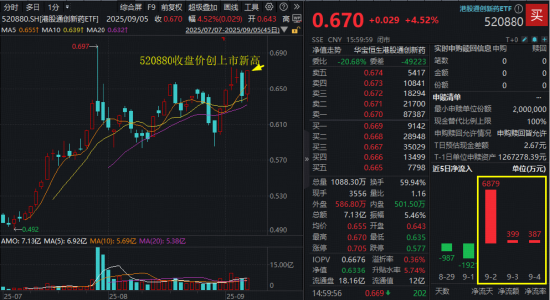
创新药强力反包,多股狂飙逾10%!港股通创新药ETF(520880)进攻力MAX,放量大涨4.52%创收盘新高
Xin Lang Ji Jin· 2025-09-05 12:00
Group 1 - The pharmaceutical sector has regained momentum, with A-shares in innovative drugs showing strong recovery, particularly the drug ETF (562050) which surged by 3.36%, reaching a record closing high [1] - The Hong Kong stock market saw even greater gains in innovative drugs, with the Hong Kong Stock Connect innovative drug ETF (520880) rising by 4.52%, also hitting a new closing high [1][3] - The innovative drug ETF (520880) currently covers 29 innovative drug concept stocks, all of which have shown positive performance, with notable increases in stocks like Sanofi and Kintor Pharmaceuticals [3] Group 2 - The innovative drug ETF (520880) will undergo a "purification" revision on September 8, 2023, removing CXO companies and focusing solely on innovative drug R&D firms, thus becoming a 100% pure innovative drug index [3] - As of September 3, 2023, the cumulative year-to-date increase for the index tracked by the innovative drug ETF (520880) reached 118.95%, leading among similar indices [3][4] - The Hang Seng Innovative Drug Select Index has shown significant fluctuations in past years, with a notable increase in 2023, indicating a potential upward trend in the innovative drug sector [5] Group 3 - Upcoming key academic conferences, including the World Lung Cancer Conference and the European Oncology Congress, are expected to catalyze further developments in the innovative drug sector [5] - The medical ETF has a total scale of 26.325 billion yuan, making it the largest medical ETF in the market [5]


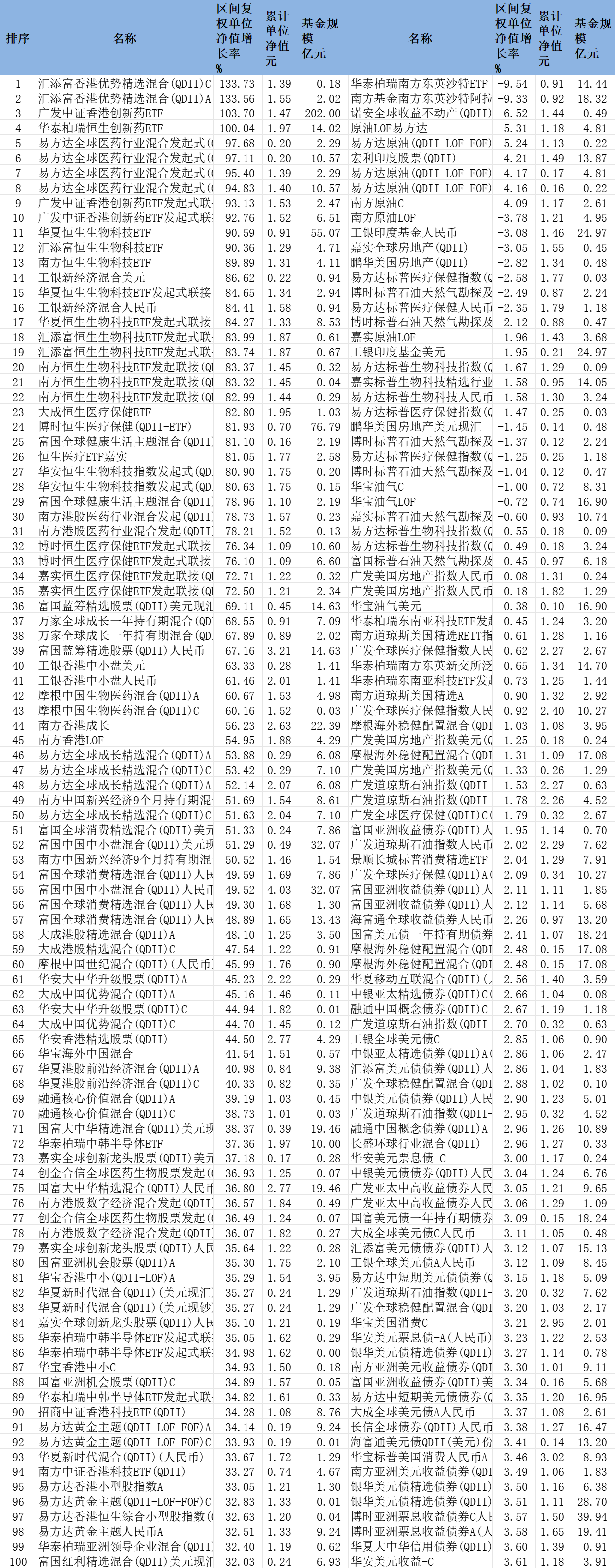
前8月94%QDII正收益 广发中证香港创新药ETF涨103%
Zhong Guo Jing Ji Wang· 2025-09-04 23:12
Group 1 - In the first eight months of the year, 610 out of 644 comparable QDII funds saw an increase in net value, representing 94.7% of the total [1] - The innovative drug sector has rebounded, leading to significant gains for funds heavily invested in this area, with top performers including Huatai-PB Hong Kong Advantage Selected Mixed C and A, achieving returns of 133.73% and 133.56% respectively [1] - The top ten holdings of Huatai-PB Hong Kong Advantage Selected Mixed A/C include companies such as InnoCare Pharma, Kelun-Biotech, and Innovent Biologics [1] Group 2 - Ten QDII funds recorded gains exceeding 90%, with four from E Fund Management, including E Fund Global Pharmaceutical Industry Mixed Fund, all surpassing 94% [2] - The top ten holdings of these E Fund products include major players like Innovent Biologics and InnoCare Pharma [2] Group 3 - Funds such as GF CSI Hong Kong Innovative Drug ETF and Huatai-PB Hang Seng Innovative Drug ETF also performed well, with returns of 103.70% and 100.04% respectively [3] - The top ten holdings of the larger Huatai-PB Hang Seng Biotechnology ETF include companies like Innovent Biologics and WuXi Biologics [3] Group 4 - The bottom performers among QDII funds primarily tracked the FTSE Saudi Arabia Index, with several oil and gas funds and those tracking the S&P 500 healthcare index also underperforming [4]
康方生物完成根据一般授权配售一级新股及配售现有股份
Zhi Tong Cai Jing· 2025-09-04 14:37
Group 1 - The company 康方生物 (09926) announced that all conditions of the primary placement agreement have been met, and the completion of the primary placement was realized on September 4, 2025 [1] - A total of 23.55 million shares were placed by the placement agent at a price of HKD 149.54 per share, representing approximately 2.56% of the company's issued share capital after the placement [1] - The board was informed by Dr. Xia Yu and Dr. Li Baiyong (as sellers) that the secondary placement was completed on September 1, 2025 [1] Group 2 - The placement agent successfully facilitated buyers to purchase a total of 3 million existing shares at the same price of HKD 149.54 per share under the terms of the secondary placement agreement [1]
康方生物(09926.HK)完成配售2355万股
Ge Long Hui A P P· 2025-09-04 14:32
Core Viewpoint - 康方生物 has successfully completed the primary placement agreement, with all conditions met as of September 4, 2025, resulting in the issuance of 23.55 million shares at a price of HKD 149.54 per share, which represents approximately 2.56% of the company's expanded issued share capital post-placement [1][1][1] Summary by Category Company Actions - 康方生物 announced the completion of the primary placement agreement, confirming that all conditions have been fulfilled [1] - A total of 23.55 million shares were placed at a price of HKD 149.54 per share [1] Financial Impact - The placement will increase the company's issued share capital by approximately 2.56% following the issuance of the placement shares [1]
康方生物(09926) - 翌日披露报表
2025-09-04 14:18
FF305 翌日披露報表 (股份發行人 ── 已發行股份或庫存股份變動、股份購回及/或在場内出售庫存股份) 表格類別: 股票 狀態: 新提交 公司名稱: 康方生物科技(開曼)有限公司 呈交日期: 2025年9月4日 如上市發行人的已發行股份或庫存股份出現變動而須根據《香港聯合交易所有限公司(「香港聯交所」)證券上市規則》(「《主板上市規則》」)第13.25A條 / 《香港聯合交易所有限公司GEM證券 上市規則》(「《GEM上市規則》」)第17.27A條作出披露,必須填妥第一章節 。 | 第一章節 | | | | | | | | | | --- | --- | --- | --- | --- | --- | --- | --- | --- | | 1. 股份分類 | 普通股 | 股份類別 | 不適用 | | 於香港聯交所上市 | 是 | | | | 證券代號 (如上市) | 09926 | 說明 | | | | | | | | A. 已發行股份或庫存股份變動 | | | | | | | | | | | | 已發行股份(不包括庫存股份)變動 | | | 庫存股份變動 | | | | | 事件 | | 已發行股份( ...
康方生物(09926) - 完成根据一般授权配售新股及配售现有股份
2025-09-04 14:16
香 港 交 易 及 結 算 所 有 限 公 司 及 香 港 聯 合 交 易 所 有 限 公 司 對 本 公 告 的 內 容 概 不 負 責,對其準確性或完整性亦不發表任何聲明,並明確表示,概不對因本公告全部 或任何部分內容而產生或因倚賴該等內容而引致的任何損失承擔任何責任。 本公告僅作參考,並非收購、購買或認購本公司證券的邀請或要約。 本公告或其任何副本概不得直接或間接在美國,或在刊發或派發本公告屬違法的 任何其他司法權區內刊發或派發。 本公告並非在美國購買或認購任何證券之要約或招攬,亦不構成其一部分。本公 告所述證券並未且將不會根據《1933年美國證券法》(「美國證券法」)登記,亦不會 在美國提呈或出售,除非根據美國證券法作出登記或獲豁免或為毋須根據美國證 券 法 作 出 登 記 之 交 易 。 本 公 司 無 意 根 據 美 國 證 券 法 登 記 本 公 告 內 所 指 之 任 何 證 券,或在美國進行證券之公開發售。 Akeso, Inc. 完成根據一般授權配售一級新股及配售現有股份 董事會欣然宣佈,一級配售協議所有條件均已達成,一級配售的完成已於2025年 9 月 4 日 落 實 。 根 據 一級 ...