
AKESO(09926)

Search documents
8月7日中银创新医疗混合A净值下跌3.54%,近1个月累计上涨12.66%
Sou Hu Cai Jing· 2025-08-07 13:34
Core Insights - The latest net value of Zhongyin Innovation Medical Mixed A (007718) is 2.1723 yuan, reflecting a decline of 3.54%. The fund has shown a one-month return of 12.66%, a six-month return of 78.76%, and a year-to-date return of 80.53% [1]. Fund Performance - The fund ranks 684 out of 4457 in the one-month category, 23 out of 4316 in the six-month category, and 29 out of 4287 in the year-to-date category [1]. Holdings Overview - The top ten stock holdings of Zhongyin Innovation Medical Mixed A account for a total of 62.83%, with significant positions in companies such as: - Innovent Biologics (8.33%) - Kelun-Biotech (8.15%) - Heng Rui Medicine (8.08%) - CanSino Biologics (8.07%) - New Horizon Health (6.13%) - Bai Li Tianheng (5.99%) - BeiGene (5.97%) - Hansoh Pharmaceutical (4.15%) - Rongchang Biologics (4.05%) - CanSino Biologics-B (3.91%) [1]. Fund Manager Background - Zheng Ning, the fund manager, has a master's degree and has previously held positions at Taikang Asset Management and Zhonggeng Fund Management. He joined Zhongyin Fund Management in 2022 and has been managing the Zhongyin Innovation Medical Mixed Fund since July 1, 2022 [2].



港股通8月7日成交活跃股名单
Zheng Quan Shi Bao Wang· 2025-08-07 12:05
8月7日恒生指数上涨0.69%,南向资金全天合计成交金额为1407.38亿港元,其中,买入成交707.00亿港 元,卖出成交700.38亿港元,合计净买入金额6.61亿港元。具体来看,港股通(深)累计成交金额 526.81亿港元,买入成交283.53亿港元,卖出成交243.29亿港元,合计净买入金额40.24亿港元;港股通 (沪)累计成交金额880.57亿港元,买入成交423.47亿港元,卖出成交457.10亿港元,合计净卖出金额 33.63亿港元。 | 代码 | 简称 | 成交金额(万港元) | 成交净买入(万港元) | 今日涨跌幅(%) | | --- | --- | --- | --- | --- | | 01810 | 小米集团-W | 1047772.68 | 172172.52 | -3.98 | | 00981 | 中芯国际 | 426693.35 | 49971.98 | 0.76 | | 09988 | 阿里巴巴-W | 443298.37 | 49292.76 | 2.14 | | 00700 | 腾讯控股 | 377791.38 | 42667.88 | -0.26 | | 01347 ...
康方生物获南向资金连续3天净买入
Zheng Quan Shi Bao Wang· 2025-08-07 12:05
(文章来源:证券时报网) 康方生物获南向资金连续3天净买入,累计净买入金额为6.74亿港元,股价累计上涨3.48%。 8月7日上榜的成交活跃股中,康方生物通过港股通渠道成交金额为11.38亿港元,净买入金额为2.46亿港 元,不仅如此,该股已连续3日出现成交净买入,累计净买入金额为6.74亿港元,其间股价上涨3.48%。 (数据宝) 注:本文系新闻报道,不构成投资建议,股市有风险,投资需谨慎。 证券时报·数据宝统计显示,8月7日港股通(包括沪市港股通及深市港股通)成交活跃股合计成交437.22 亿港元,净卖出金额为8.01亿港元。 ...


智通港股通活跃成交|8月7日



智通财经网· 2025-08-07 11:05
Group 1 - Xiaomi Group-W (01810) leads the southbound trading volume on both Shanghai-Hong Kong Stock Connect and Shenzhen-Hong Kong Stock Connect, with transaction amounts of 62.12 billion and 42.66 billion respectively [1][1][1] - The top three companies by trading volume on Shanghai-Hong Kong Stock Connect are Xiaomi Group-W (01810), Yingfu Fund (02800), and Alibaba-W (09988) [1][1] - On Shenzhen-Hong Kong Stock Connect, the top three companies are Xiaomi Group-W (01810), SMIC (00981), and Alibaba-W (09988) [1][1] Group 2 - The net buying amount for Xiaomi Group-W (01810) on Shanghai-Hong Kong Stock Connect is +17.67 billion, while on Shenzhen-Hong Kong Stock Connect it is -45.59 million [1][1] - Alibaba-W (09988) has a net buying amount of +3.25 billion on Shanghai-Hong Kong Stock Connect and +1.68 billion on Shenzhen-Hong Kong Stock Connect [1][1] - SMIC (00981) shows a significant net buying amount of +5.26 billion on Shenzhen-Hong Kong Stock Connect, while it has a net buying amount of -25.94 million on Shanghai-Hong Kong Stock Connect [1][1]
这款进口药退出!PCSK9药物竞争加剧 降脂药下个风口剑指何方?|财经解药
Xin Lang Cai Jing· 2025-08-07 10:15
Core Insights - Sanofi has confirmed the cessation of the promotion of its PCSK9 inhibitor, Alirocumab, in the Chinese market due to global supply issues and a strategic upgrade in its cardiovascular product line [2][3] - The exit of Alirocumab from the market has opened opportunities for domestic pharmaceutical companies to enter the PCSK9 inhibitor space [1][3] Industry Overview - PCSK9 inhibitors are considered a milestone in lipid-lowering therapies, with significant implications for managing high LDL cholesterol levels, which are primarily influenced by genetic factors [1][3] - The understanding of lipoprotein(a) [Lp(a)] in cardiovascular diseases has led to increased interest in developing new lipid-lowering drugs targeting this specific marker [1][7] Market Dynamics - The market for lipid-lowering medications is competitive, with established statin drugs and newer PCSK9 inhibitors being used in combination for optimal patient outcomes [4][5] - There are currently seven approved PCSK9 inhibitors in China, including both imported and domestic products, with ongoing developments from various companies [5][6] Emerging Opportunities - Companies are actively pursuing the development of alternative medications in light of Alirocumab's market exit, indicating a robust interest in the PCSK9 inhibitor segment [3][6] - The market is also seeing advancements in therapies targeting Lp(a), with several multinational corporations engaged in clinical trials for new drugs aimed at lowering Lp(a) levels [7]


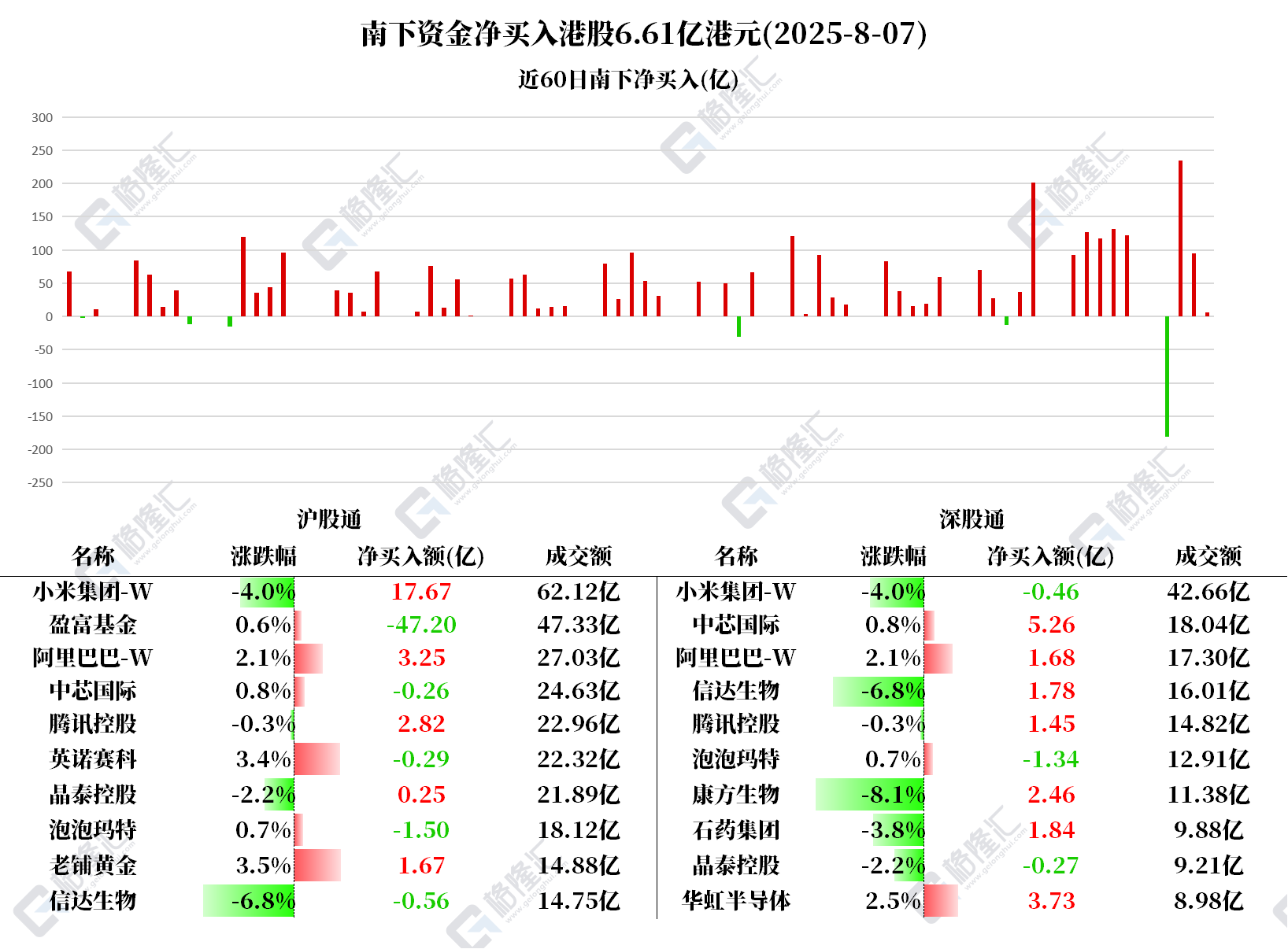
图解丨南下资金加仓小米、中芯国际和阿里
Ge Long Hui A P P· 2025-08-07 10:07
Group 1 - Southbound funds net bought Hong Kong stocks worth 661 million HKD today [1] - Notable net purchases include Xiaomi Group-W at 1.722 billion HKD, SMIC at 499 million HKD, Alibaba-W at 492 million HKD, and Tencent Holdings at 426 million HKD [1] - Southbound funds have net bought Tencent for 11 consecutive days, totaling 6.3707 billion HKD, and Alibaba for 4 consecutive days, totaling 2.60865 billion HKD [1] Group 2 - The net selling included the Tracker Fund of Hong Kong at 4.72 billion HKD and Pop Mart at 283 million HKD [1] - Xiaomi Group-W experienced a price drop of 4.0% with a net buy of 1.767 billion HKD [3] - The Tracker Fund of Hong Kong had a slight increase of 0.6% but saw a significant net sell of 4.72 billion HKD [3]

康方生物20250806
2025-08-06 14:45
Summary of the Conference Call for Kangfang Biotech Company Overview - **Company**: Kangfang Biotech - **Date**: August 6, 2025 Key Points Industry and Company Focus - Kangfang Biotech has strategically shifted focus from PD-1 monoclonal antibodies to bispecific antibodies as limitations of PD-1 therapies become apparent, showcasing its market foresight and strategic vision [2][3] - The company has demonstrated exceptional R&D efficiency, with all early-stage innovative drugs successfully advancing to commercialization or registration clinical stages, particularly core products AK104 and AK112, which have surpassed domestic average development speeds [2][3] Product Development and Clinical Trials - AK112 has shown outstanding performance in clinical trials for first-line wild-type non-small cell lung cancer (NSCLC), with the Harmony II study indicating a 49% reduction in progression and mortality risk compared to K drug, without significant increase in severe adverse reactions [4][13] - AK112 is being tested across multiple indications, including triple-negative breast cancer, biliary cancer, pancreatic cancer, and colorectal cancer, aiming to cover more patient groups who cannot use PD-1 inhibitors or have poor responses [4][19] Internationalization Achievements - Kangfang Biotech has made significant strides in international development, including licensing its monoclonal antibody to Merck in 2015 and a $5 billion exclusive licensing deal with Summit for Ivosidenib in 2022, marking a record for Chinese innovative drug out-licensing [6] - The company’s PD-1 monoclonal antibody received FDA approval in April 2025, becoming the first innovative biopharmaceutical independently developed by a Chinese company to achieve this milestone [6] Market Potential and Competitive Advantage - The second-generation immuno-oncology (IO) market is projected to be 3 to 4 times larger than the PD-1/PD-L1 inhibitor market, with AK112 positioned as a first-mover with significant value potential [2][7] - AK112's unique tetravalent structure enhances affinity for PD-1 and VEGF, significantly improving related signaling pathway effects and demonstrating superior safety in clinical trials compared to monoclonal antibodies or monoclonal antibody-VEGF combinations [11] Future Development and Market Outlook - The market is expected to focus on AK112's overseas clinical layout and collaboration progress in 2025, with potential for re-licensing or acquisition impacting asset revaluation [7] - The overall market for PD-1/PD-L1 inhibitors is projected to exceed $90 billion by 2028, with second-generation IO drugs potentially surpassing $300 billion in market size [9] Financial Projections - AK104 is expected to exceed 4 billion RMB in risk-adjusted peak sales in China, while AK112 could reach 8.5 billion RMB domestically and $23.3 billion in overseas markets, leading to a total valuation exceeding $200 billion for Kangfang Biotech [28][29] Pipeline and Future Innovations - Kangfang Biotech is not limited to bispecific antibodies but is also developing a range of candidates, including dual-target ADCs and other innovative therapies across various indications, indicating a robust pipeline for future growth [25][26] Conclusion - Kangfang Biotech's strategic pivot towards bispecific antibodies, strong R&D capabilities, international partnerships, and a promising pipeline position it favorably within the rapidly evolving oncology market, with significant growth potential anticipated in the coming years [2][29]
智通港股解盘 | 第三方制裁仍有隐忧 消费“三剑客”在发力
Zhi Tong Cai Jing· 2025-08-06 12:53
Market Overview - The A-share market showed strong performance with the Shanghai Composite Index steadily rising, while the Hong Kong stock market experienced a narrow fluctuation, closing up by 0.03% [1] - Concerns in the market are heightened due to the U.S. President Trump's shortened ultimatum for sanctions against Russia, now set at 10 days, with potential impacts on India and other countries [1] - The U.S. is also set to impose significant tariffs on semiconductor chips and pharmaceuticals, with drug tariffs reaching as high as 250% [1] Company Developments - Jingtai Technology announced a pipeline cooperation agreement with DoveTree worth approximately HKD 470 billion (USD 59.9 billion), leading to a stock surge of over 12% [2] - A-share company Weixin New Materials faced regulatory scrutiny after a stock price surge related to the "embodied intelligent robot" concept and control change expectations [2] - The Shanghai government released a plan for the development of the embodied intelligence industry, aiming for breakthroughs in core algorithms and technologies by 2027 [2] Industry Trends - The 2025 World Robot Conference is set to showcase over 100 new products, nearly double from last year, indicating a growing interest in robotics [3] - The U.S. student loan delinquency rate has reached 12.9%, the highest in 21 years, which may influence Federal Reserve decisions on interest rates [3] - The steel and paper industries are experiencing positive momentum, with companies like Maanshan Steel and Nine Dragons Paper seeing significant stock price increases [3] Defense Sector Insights - The military industry is gaining traction with significant contracts, such as the sale of the Hongqi-9 air defense system and the export of submarines to Pakistan [4] - China Shipbuilding Defense announced a profit increase of 213.25% to 267.73% for the first half of the year, leading to a stock rise of nearly 8% [4] Consumer Market Activity - The new consumption sector is becoming active, with companies like Pop Mart seeing increased attention at recent toy exhibitions [5] - The liquor industry is also responding to market trends, with new product launches and stock price increases [5] Aviation Sector Developments - Cathay Pacific announced an $8.1 billion order for 14 Boeing 777-9 aircraft, marking its first deal with Boeing in 12 years, despite concerns over the safety record of Boeing aircraft [7] - The long delivery timeline for the 777-9 model raises potential issues regarding aircraft aging and maintenance [7] Energy Sector Updates - The State Grid reported record electricity usage due to high temperatures, with peak load reaching 1.233 billion kilowatts, an increase of 53 million kilowatts from last year [8] - Coal prices have risen significantly, impacting the steel industry, which is maintaining high production levels [8] Automotive Sector Performance - XPeng Motors reported a record monthly delivery of 36,717 vehicles in July, a year-on-year increase of 229.4% [10] - The company is expanding its presence in Europe, with significant sales growth and new model launches [11][12]
港股通(深)净买入50.16亿港元


Zheng Quan Shi Bao Wang· 2025-08-06 12:44
深市港股通前十大成交活跃股中,成交额居首的是晶泰控股,成交金额21.30亿港元;其次是阿里巴巴- W、美团-W,成交金额分别为20.54亿港元、18.55亿港元。以净买卖金额统计,有7只股为净买入,净 买入金额最多的是腾讯控股,净买入8.00亿港元,该股收盘上涨1.70%。净卖出金额最多的是美团-W, 净卖出3.84亿港元,收盘股价下跌1.46%。(数据宝) 8月6日港股通成交活跃股 | 代码 | 简称 | 类型 | 成交金额(万港元) | 成交净买入(万港元) | 日涨跌幅(%) | | --- | --- | --- | --- | --- | --- | | 00700 | 腾讯控股 | 港股通(沪) | 455358.46 | 71753.88 | 1.70 | | 02228 | 晶泰控股 | 港股通(沪) | 451811.07 | 47520.46 | 12.42 | | 09988 | 阿里巴巴-W | 港股通(沪) | 316394.87 | 67793.11 | 0.60 | | 00981 | 中芯国际 | 港股通(沪) | 233003.74 | 36379.08 | 3.14 | | ...
南向资金今日净买入94.85亿港元,腾讯控股净买入15.18亿港元
Zheng Quan Shi Bao Wang· 2025-08-06 12:44
成交活跃股方面,今日上榜个股中,南向资金成交金额最多的是晶泰控股,合计成交额66.48亿港元, 腾讯控股、阿里巴巴-W成交额紧随其后,分别成交63.65亿港元、52.18亿港元。以净买卖金额统计,净 买入的个股共有7只,腾讯控股净买入额为15.18亿港元,净买入金额居首,该股收盘股价上涨1.70%, 阿里巴巴-W净买入额为8.76亿港元,中芯国际净买入额为6.12亿港元。净卖出金额最多的是小米集团- W,净卖出2.29亿港元,该股收盘股价下跌0.55%,泡泡玛特、美团-W遭净卖出2.23亿港元、1.48亿港 元。 8月6日恒生指数上涨0.03%,南向资金全天合计成交金额为1259.74亿港元,其中,买入成交677.30亿港 元,卖出成交582.44亿港元,合计净买入金额94.85亿港元。具体来看,港股通(深)累计成交金额 471.73亿港元,买入成交260.95亿港元,卖出成交210.78亿港元,合计净买入金额50.16亿港元;港股通 (沪)累计成交金额788.01亿港元,买入成交416.35亿港元,卖出成交371.66亿港元,合计净买入金额 44.69亿港元。 从连续性进行统计, 有4只股获南向资金连续3天 ...