AKESO(09926)

Search documents
“公募女神”基金赚翻了,她们买了这些股票
Zheng Quan Shi Bao· 2025-08-10 08:44
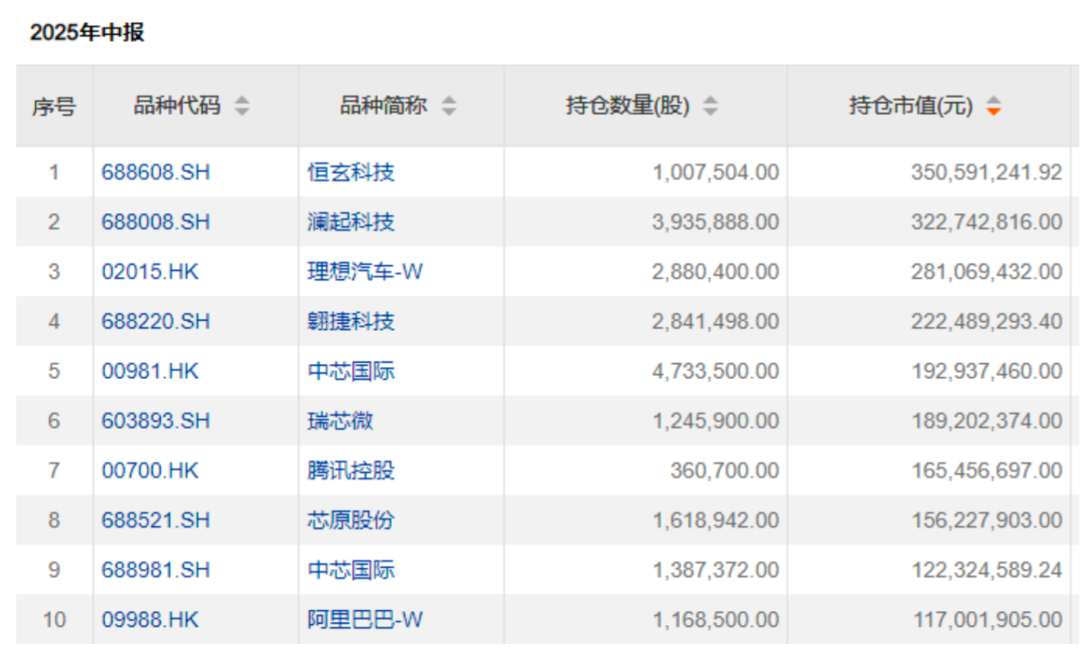
Group 1 - The core point of the news is that China Universal Asset Management has announced a subscription limit for two of its funds, the China Universal Science and Technology Innovation Fund and the China Universal Medical Innovation Fund, starting from August 11, to protect existing investors and maintain stable operations [1] - The China Universal Science and Technology Innovation Fund, managed by Shao Jie, has achieved a return rate of 132.55% since inception, with an annualized return of 14.79% for Class A shares and 39.66% with an annualized return of 13.11% for Class C shares [1] - The China Universal Medical Innovation Fund, managed by renowned fund manager Ge Lan, has a return rate of 68.74% for Class A shares and 60.24% for Class C shares since inception, with annualized returns of 8.45% and 7.59% respectively [1] Group 2 - The China Universal Science and Technology Innovation Fund focuses on the technology innovation industry, with significant investments in sectors such as smart vehicles, advanced manufacturing processes, and self-developed chip IP [2] - The top ten holdings of the China Universal Science and Technology Innovation Fund include companies like Hengxuan Technology, Lanyin Technology, and Tencent Holdings, with total market values ranging from approximately 117 million to 350 million yuan [2] - The China Universal Medical Innovation Fund primarily invests in stocks related to medical innovation, with a focus on innovative pharmaceuticals and medical devices [2][4] Group 3 - The top ten holdings of the China Universal Medical Innovation Fund include companies such as Sanofi Pharmaceutical and WuXi AppTec, with market values ranging from approximately 324 million to 729 million yuan [4] - Other funds managed by different companies, such as ICBC Credit Suisse and Great Wall Fund, have also reported high returns this year, with notable investments in similar sectors [5][6]


康方生物(09926):引领全球IO2.0,依沃西有望占据最大市场份额
Huafu Securities· 2025-08-09 08:36
Investment Rating - The report maintains a "Buy" rating for the company, expecting a relative increase of over 20% in stock price compared to the market benchmark index within the next six months [6][17]. Core Viewpoints - The company is leading the global progress with its product AK112, which is expected to capture the largest market share in the second-generation IO market [2][4]. - The broad-spectrum anti-cancer effects of PD-1 and VEGF targets are promising, with a significant existing market potential of nearly 60 billion USD globally [3]. - The company has already received approval for two indications of AK112 in China, making it the only PD-1/VEGF dual antibody product available globally [4]. Financial Forecast and Valuation - Projected revenues for the company from 2025 to 2027 are estimated at 35.18 billion, 57.65 billion, and 93.72 billion CNY respectively, with net profits expected to be -1.86 billion, 8.03 billion, and 29.66 billion CNY [6][8]. - The estimated peak overseas sales for AK112, after risk adjustments, could reach approximately 197 billion USD [6]. - The report calculates a reasonable market value of 222.8 billion HKD based on a DCF valuation with a WACC of 8.06% and a perpetual growth rate of 1% [6].
明星基金突发!葛兰管理的中欧医疗创新单日单账户限购10万元!
Zheng Quan Shi Bao· 2025-08-09 07:59
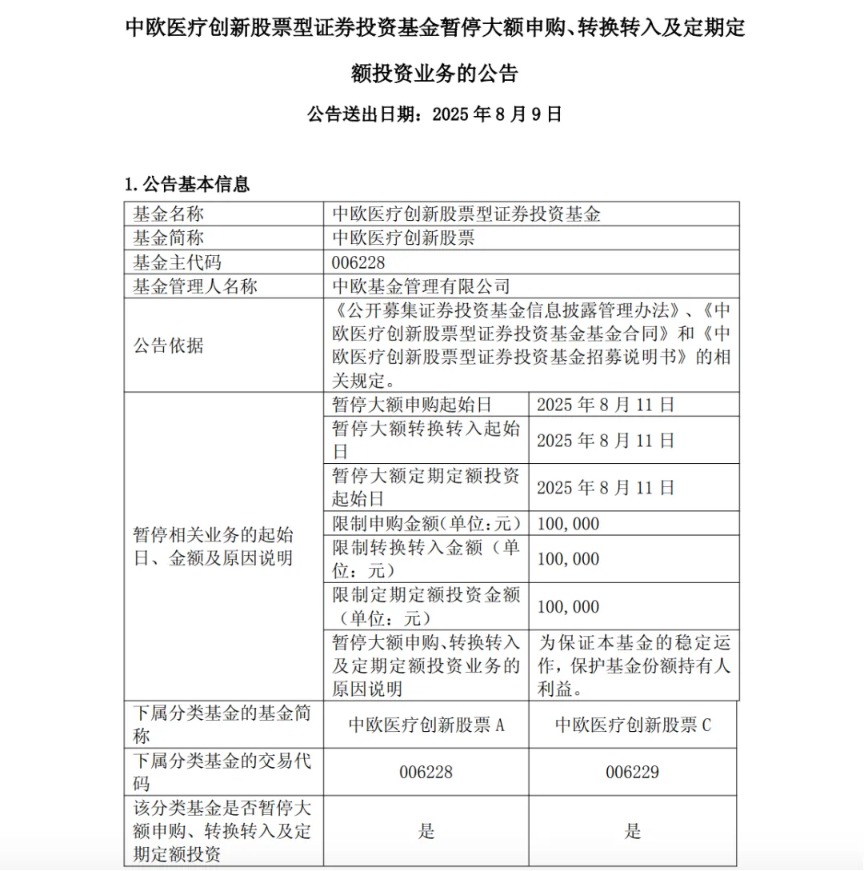
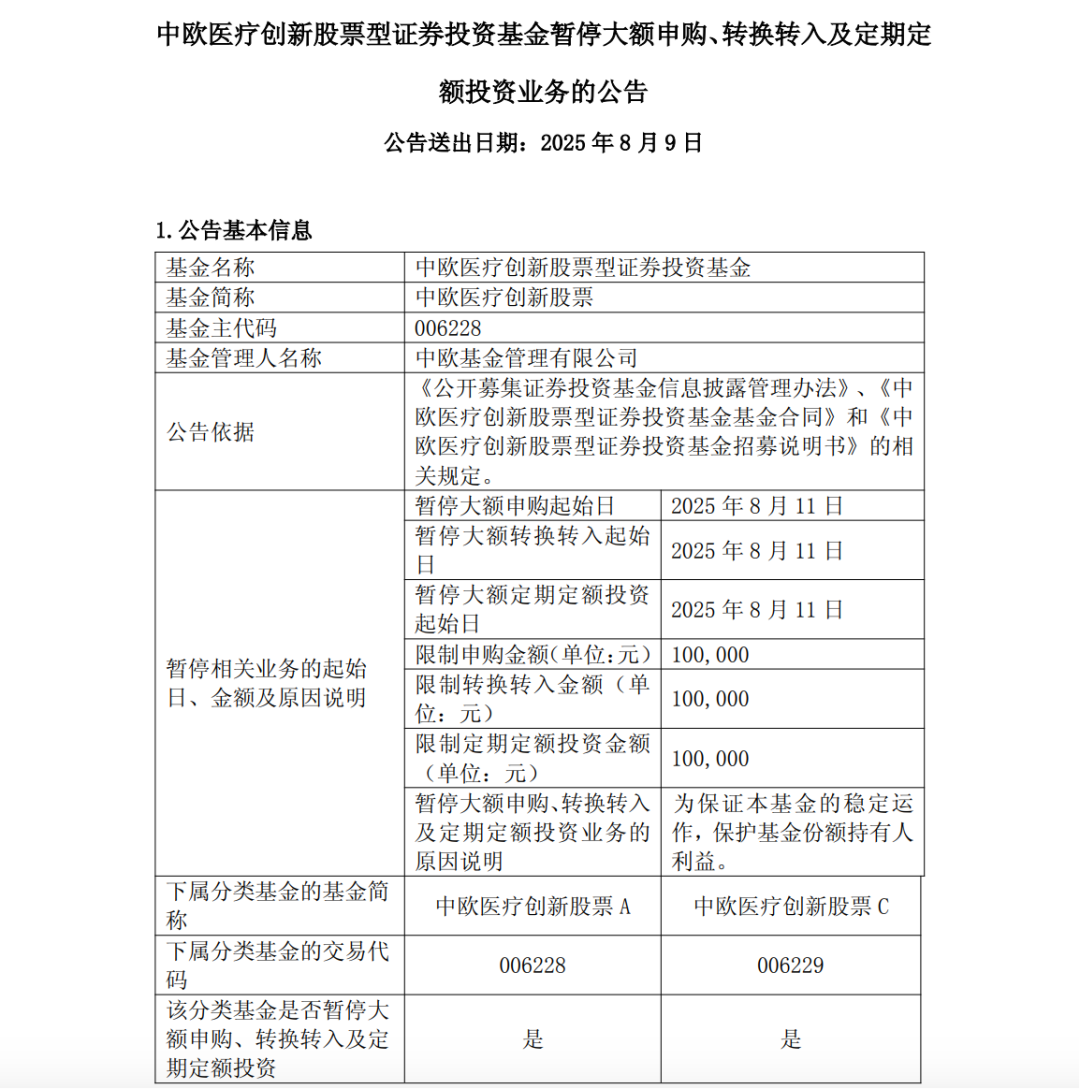
Group 1 - The core point of the news is that China Europe Fund announced a limit on daily subscriptions for the China Europe Medical Innovation Fund to 100,000 yuan starting from August 11, 2025, to ensure stable fund operations and protect the interests of fund shareholders [1][2][3] - The China Europe Medical Innovation Fund, managed by fund manager Ge Lan, was established in February 2019 and primarily invests in stocks related to medical innovation [3][4] - As of mid-2023, the fund's total net asset value exceeded 8.2 billion yuan, with major investments in healthcare and manufacturing sectors, accounting for 46.41% and 41.99% of the total assets, respectively [5][6] Group 2 - The top ten holdings of the fund include companies such as Sanofi Pharmaceutical, Keren Biotechnology, and Kangfang Biotech, with the largest holding, Sanofi Pharmaceutical, showing a year-to-date increase of nearly 400% [4][6] - The fund's unit net value has been rising, reaching 1.6874 yuan, compared to a low of below 0.9 yuan a year ago [7][8] - The fund's outlook for the third quarter highlights optimism in the innovative drug sector, with expectations for global collaboration and important clinical data disclosures, as well as ongoing domestic policy support for high-quality drug development [8]
明星基金突发!限购!
Zheng Quan Shi Bao· 2025-08-09 07:08
Group 1 - The core announcement from China Europe Fund is the suspension of large subscriptions, conversions, and regular investment for the China Europe Medical Innovation Equity Fund starting from August 11, 2025, with a daily limit of 100,000 yuan per account to ensure fund stability and protect the interests of fund shareholders [1][3][10] - The China Europe Medical Innovation Fund, established in February 2019 and managed by fund manager Ge Lan, primarily invests in stocks related to the medical innovation sector, aiming to achieve returns that exceed the performance benchmark while strictly controlling investment risks [1][3][5] - As of mid-2023, the fund's total net asset value exceeded 8.2 billion yuan, with major investments in healthcare and manufacturing sectors, accounting for 46.41% and 41.99% of the total assets, respectively [4][5] Group 2 - The top ten holdings of the fund include companies such as 3SBio, Kelun-Biotech, and Kangfang Biotech, with the largest holding, 3SBio, showing a remarkable increase of nearly 400% this year [4][6][8] - The fund's unit net value has been on the rise, reaching 1.6874 yuan, significantly up from below 0.9 yuan a year ago, reflecting the rebound in the innovative drug sector [7][8] - The fund's outlook for the third quarter highlights optimism in the innovative drug field, with expectations for global cooperation and important clinical data disclosures, alongside supportive domestic policies for high-quality development in innovative drugs [8]
6只股近一个月首次上榜港股通成交活跃榜
Zheng Quan Shi Bao Wang· 2025-08-08 13:44
Group 1 - On August 8, several stocks including Hutchison Whampoa, Nanjing Panda Electronics, Oriental Selection, Fubo Group, Zai Ding Pharmaceutical, and Huitongda Network made their debut on the Hong Kong Stock Connect active trading list for the first time in a month [1][2] - The total trading volume of active stocks on August 8 reached 33.757 billion HKD, accounting for 27.32% of the total trading amount on that day, with a net buying amount of 1.614 billion HKD [1] - Among the active stocks, SMIC had the highest trading volume at 11.074 billion HKD, followed by Alibaba and Xiaomi with trading amounts of 3.887 billion HKD and 3.800 billion HKD respectively [1] Group 2 - Hutchison Whampoa had a trading volume of 0.958 billion HKD with a net selling of 0.158 billion HKD, closing down 15.99% [2] - Nanjing Panda Electronics recorded a trading volume of 1.075 billion HKD with a net selling of 0.025 billion HKD, closing down 10.40% [2] - Oriental Selection had a trading volume of 1.024 billion HKD with a net buying of 0.056 billion HKD, closing up 12.32% [2] - Fubo Group had a trading volume of 0.747 billion HKD with a net buying of 0.031 billion HKD, closing up 18.36% [2] - Zai Ding Pharmaceutical had a trading volume of 0.768 billion HKD with a net buying of 0.217 billion HKD, closing down 10.47% [2] - Huitongda Network had a trading volume of 1.758 billion HKD with a net buying of 0.076 billion HKD, closing up 26.90% [2]

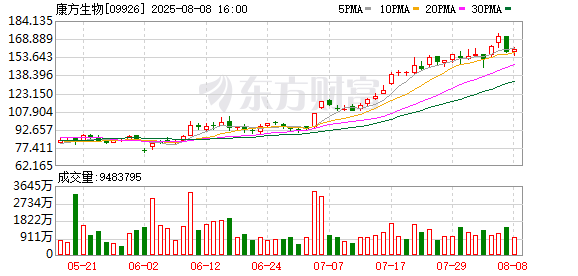
康方生物获南向资金连续4天净买入
Zheng Quan Shi Bao Wang· 2025-08-08 13:40
注:本文系新闻报道,不构成投资建议,股市有风险,投资需谨慎。 (文章来源:证券时报网) 证券时报·数据宝统计显示,8月8日港股通(包括沪市港股通及深市港股通)成交活跃股合计成交337.57 亿港元,净买入金额为16.14亿港元。 8月8日上榜的成交活跃股中,康方生物通过港股通渠道成交金额为8.93亿港元,净买入金额为2.02亿港 元,不仅如此,该股已连续4日出现成交净买入,累计净买入金额为8.76亿港元,其间股价上涨5.46%。 (数据宝) 康方生物获南向资金连续4天净买入,累计净买入金额为8.76亿港元,股价累计上涨5.46%。 ...
智通港股通活跃成交|8月8日





智通财经网· 2025-08-08 11:16
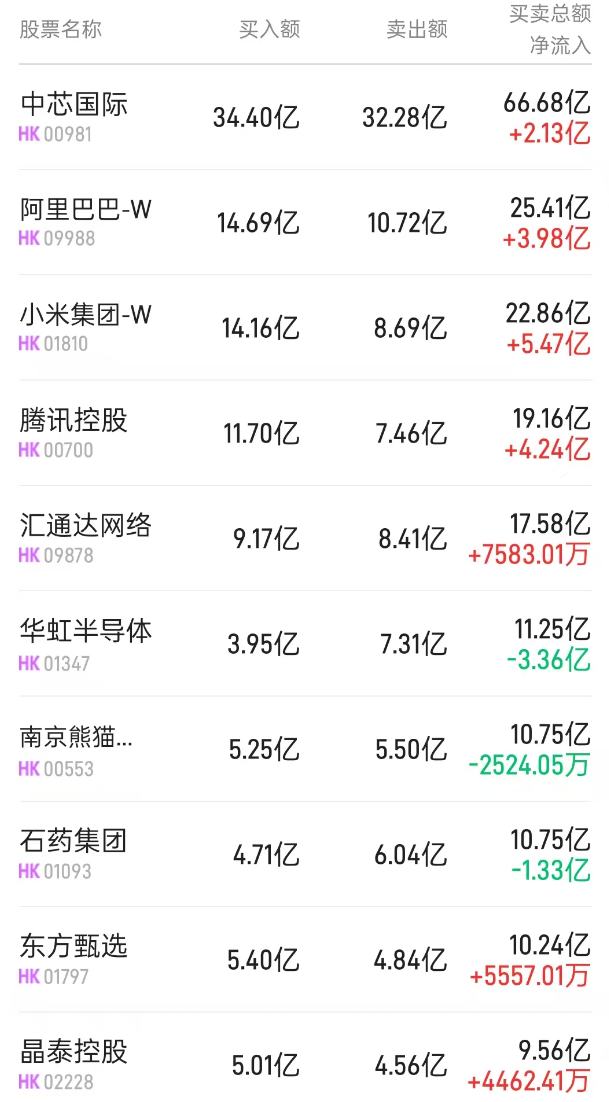
Core Insights - On August 8, 2025, SMIC (00981), Alibaba-W (09988), and Xiaomi Group-W (01810) were the top three companies by trading volume in the Southbound Stock Connect, with trading amounts of 6.668 billion, 2.541 billion, and 2.286 billion respectively [1] - In the Southbound Stock Connect for Shenzhen, SMIC (00981), Xiaomi Group-W (01810), and Alibaba-W (09988) also ranked as the top three, with trading amounts of 4.406 billion, 1.514 billion, and 1.346 billion respectively [1] Southbound Stock Connect (Shanghai) - Top active companies by trading volume: - SMIC (00981): 6.668 billion with a net buy of 0.213 billion - Alibaba-W (09988): 2.541 billion with a net buy of 0.398 billion - Xiaomi Group-W (01810): 2.286 billion with a net buy of 0.547 billion - Tencent Holdings (00700): 1.916 billion with a net buy of 0.424 billion - Huizhou Network (09878): 1.758 billion with a net buy of 0.0758 billion - Hua Hong Semiconductor (01347): 1.125 billion with a net sell of 0.336 billion - Nanjing Panda Electronics (00553): 1.075 billion with a net sell of 0.0252 billion - CSPC Pharmaceutical Group (01093): 1.075 billion with a net sell of 0.133 billion - Dongfang Zhenxuan (01797): 1.024 billion with a net buy of 0.0556 billion - Jing Tai Holdings (02228): 0.956 billion with a net buy of 0.0446 billion [1] Southbound Stock Connect (Shenzhen) - Top active companies by trading volume: - SMIC (00981): 4.406 billion with a net sell of 0.639 billion - Xiaomi Group-W (01810): 1.514 billion with a net sell of 0.0745 billion - Alibaba-W (09988): 1.346 billion with a net buy of 0.333 billion - Tencent Holdings (00700): 1.214 billion with a net sell of 0.319 billion - Hutchison China MediTech (00013): 0.958 billion with a net sell of 0.158 billion - CanSino Biologics (09926): 0.893 billion with a net buy of 0.0202 billion - Zai Lab (09688): 0.768 billion with a net buy of 0.0217 billion - Innovent Biologics (01801): 0.759 billion with a net buy of 0.0745 billion - Fufeng Group (03738): 0.747 billion with a net buy of 0.0315 billion - Tracker Fund of Hong Kong (02800): 0.729 billion with a net buy of 0.0684 billion [1]
北水动向|北水成交净买入62.71亿 创新药概念股出现分化 芯片股绩后遭北水减持
智通财经网· 2025-08-08 10:04
Core Viewpoint - The Hong Kong stock market experienced significant net inflows from northbound trading, with a total net buy of 62.71 billion HKD on August 8, 2023, indicating strong investor interest in certain stocks [1][2]. Group 1: Northbound Trading Activity - Northbound trading saw a net buy of 32.8 billion HKD through the Shanghai Stock Connect and 29.92 billion HKD through the Shenzhen Stock Connect [1]. - The most bought stocks included Alibaba-W (09988), with a net buy of 7.3 billion HKD, and the Tracker Fund of Hong Kong (02800), with a net buy of 6.83 billion HKD [4][5]. Group 2: Stock Performance - Semiconductor stocks like SMIC (00981) and Hua Hong Semiconductor (01347) faced significant net selling, with net outflows of 4.26 billion HKD and 3.35 billion HKD, respectively [7][8]. - In contrast, companies like Xiaomi Group-W (01810) and Tencent Holdings (00700) received net buys of 4.72 billion HKD and 1.04 billion HKD, respectively [8]. Group 3: Company-Specific Developments - Alibaba's new membership system, integrating various services, marks a strategic shift towards becoming a comprehensive consumer platform [4]. - The collaboration between Huida Network (09878) and Alibaba Cloud aims to explore innovations in AI and digital solutions, enhancing their market presence [5]. - Crystal Technology (02228) announced a record-breaking cooperation agreement worth approximately 470 billion HKD (59.9 billion USD) in the AI and robotics drug development sector [6].
智通港股通持股解析|8月8日
智通财经网· 2025-08-08 00:37
Core Insights - The top three companies by Hong Kong Stock Connect holding ratios are China Telecom (74.84%), Gree Power Environmental (70.10%), and China Shenhua (67.84%) [1][2] - Meituan-W, Kuaishou-W, and Tencent Holdings saw the largest increases in holding amounts over the last five trading days, with increases of +2.97 billion, +2.96 billion, and +2.22 billion respectively [1][2] - The largest decreases in holding amounts were observed in the Yingfu Fund (-1.743 billion), China Mobile (-1.358 billion), and Kangfang Biotech (-875 million) [2] Hong Kong Stock Connect Latest Holding Ratios - China Telecom (00728): 10.388 billion shares, 74.84% holding ratio [1] - Gree Power Environmental (01330): 284 million shares, 70.10% holding ratio [1] - China Shenhua (01088): 2.292 billion shares, 67.84% holding ratio [1] - Other notable companies include Tianjin Chuangye Environmental (64.49%) and Xintian Green Energy (63.83%) [1] Recent Increases in Holdings (Last 5 Trading Days) - Meituan-W (03690): +2.97 billion, +24.34 million shares [1] - Kuaishou-W (01024): +2.96 billion, +37.02 million shares [1] - Tencent Holdings (00700): +2.22 billion, +3.91 million shares [1] - Alibaba-W (09988): +2.14 billion, +17.96 million shares [1] Recent Decreases in Holdings (Last 5 Trading Days) - Yingfu Fund (02800): -1.743 billion, -68.19 million shares [2] - China Mobile (00941): -1.358 billion, -15.80 million shares [2] - Kangfang Biotech (09926): -875 million, -5.56 million shares [2] - Other companies with notable decreases include Heng Seng China Enterprises (-705 million) and Pop Mart (-529 million) [2]




智通港股沽空统计|8月8日
智通财经网· 2025-08-08 00:22
前十大沽空金额排行 | 股票名称 | 沽空金额↓ | 沽空比率 | 偏离值 | | --- | --- | --- | --- | | 小米集团-W(01810) | 30.06 亿元 | 18.44% | 5.50% | | 腾讯控股(00700) | 20.99 亿元 | 21.87% | 10.87% | | 阿里巴巴-SW(09988) | 10.88 亿元 | 13.67% | 0.85% | | 美团-W(03690) | 9.37 亿元 | 26.46% | 8.17% | | 比亚迪股份(01211) | 7.59 亿元 | 19.35% | -11.84% | | 石药集团(01093) | 6.80 亿元 | 25.96% | 4.29% | | 康方生物(09926) | 4.97 亿元 | 21.07% | 10.42% | | 中国平安(02318) | 4.97 亿元 | 29.85% | 7.51% | | 理想汽车-W(02015) | 4.66 亿元 | 21.28% | -4.21% | | 快手-W(01024) | 4.60 亿元 | 17.58% | -0.63% | ...