
TRIP.COM(09961)

Search documents
2026年元旦数据预测报告-携程
Sou Hu Cai Jing· 2026-01-07 01:21
Market Overview - The tourism market is experiencing a comprehensive recovery during the 2026 New Year's holiday, with a surge in demand for staggered travel, significant growth in both hotel and flight bookings, and a strong rebound in the inbound market [1][11] - The domestic market is stimulated by the "take 3 days off and rest 8" holiday mode, leading to over 100% year-on-year increase in hotel search volume and over 50% increase in flight search volume [1][8] - The inbound market benefits from visa-free policies, with hotel search volume increasing by over 150% year-on-year, and popular destinations include Shanghai, Guangzhou, Beijing, Sanya, and Shenzhen [1][11] User Behavior Changes - There is a notable change in user behavior, with an expected over 50% share of hotel stays being cross-province, and the demand for stays of 2 days or more increasing [2][17] - The majority of travelers are from major cities such as Shanghai, Beijing, Guangzhou, Shenzhen, and Hangzhou, with a north-south travel preference emerging [2][20] - Emerging destinations like Kaifeng and Jingdezhen are gaining popularity due to rich New Year activities, with the top 10 hotel destinations including major cities from both northern and southern China [2][21] Thematic Consumption Trends - The focus on thematic consumption is driving the growth of related hotel categories, with keywords like hot springs, private baths, and skiing becoming top search terms [2] - Hotel night volume for hot spring hotels has increased by over 600% year-on-year, while ski hotels have seen a 200% increase [2] - Events such as New Year concerts and music festivals significantly boost hotel bookings, with surrounding hotel search volume increasing by over 800% during specific events [2] Operational Strategies for Hotels - Hotels need to optimize operations from multiple dimensions, particularly in OTA operations by leveraging booking peaks around December 31 [3] - Marketing strategies should include participation in EBK seasonal coverage activities to gain exclusive traffic and enhance sales through online travel photography campaigns [3] - Product design should focus on early booking discounts and multi-night stay packages, integrating New Year activities, attraction tickets, and dining services to meet the needs of staggered travel and long-term stays [3]


智通ADR统计 | 1月7日





智通财经网· 2026-01-06 22:17
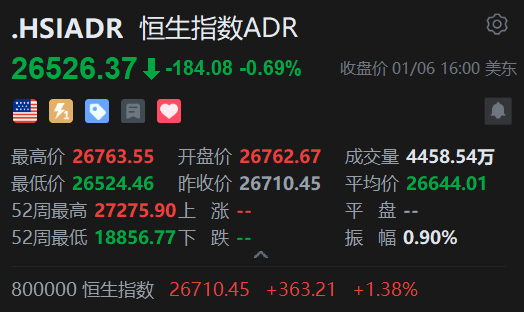
Market Overview - The Hang Seng Index (HSI) closed at 26,526.37, down by 184.08 points or 0.69% from the previous close [1] - The index opened at 26,762.67 and reached a low of 26,524.46 during the trading session [1] - The trading volume was 44.585 million shares, with an average price of 26,644.01 [1] Major Blue-Chip Stocks Performance - HSBC Holdings closed at HKD 127.849, down 0.74% compared to the Hong Kong close [2] - Tencent Holdings closed at HKD 630.832, down 0.26% from the Hong Kong close [2] - Alibaba Group (W) saw a decline of 1.31%, closing at HKD 150.800 [3] - China Ping An increased by 4.96%, closing at HKD 72.000 [3] - Meituan (W) had a slight increase of 0.66%, closing at HKD 106.100 [3] ADR Performance - Tencent's ADR price was USD 630.832, reflecting a decrease of 0.26% compared to its Hong Kong stock price [3] - Alibaba's ADR was USD 146.902, down 2.58% from its Hong Kong counterpart [3] - HSBC's ADR closed at USD 127.849, down 0.74% compared to its Hong Kong price [3]
26年元旦,免税入境游山岳型景区表现亮眼
Orient Securities· 2026-01-06 15:04
Investment Rating - The report maintains a "Positive" outlook for the social services industry [4] Core Insights - The Ministry of Culture and Tourism data aligns with expectations, highlighting strong performance in duty-free shopping, inbound tourism, and leading mountain scenic spots. The upcoming long Spring Festival holiday and supportive tourism policies are expected to boost domestic consumption, leading to a favorable outlook for the social services industry in 2026 [3][7] Summary by Sections Domestic Tourism Demand - Domestic travel demand is steadily increasing, with 142 million domestic trips taken during the New Year holiday, a 5.2% increase compared to 2024. Total domestic travel expenditure reached 84.79 billion yuan, up 6.3% year-on-year, with per capita spending increasing by 1.1% [7] Duty-Free Shopping - Duty-free sales in Hainan during the New Year holiday showed significant growth, with 442,000 items sold, a 52.4% increase year-on-year. The number of shoppers reached 83,500, up 60.6%, and total spending was 712 million yuan, a 128.9% increase. This growth is attributed to the official launch of duty-free operations, new policies, and promotional activities [7] Scenic Spots - Leading mountain scenic spots demonstrated strong visitor elasticity, with Huangshan receiving over 75,000 visitors (up 76.5% year-on-year), Emei Mountain hosting 126,200 visitors (up 20.9%), and Changbai Mountain seeing a 41% increase in visitors compared to 2025. The expansion of high-speed rail and airports contributed to this growth [7] Online Travel Agencies (OTAs) - Inbound tourism and winter sports are emerging as key growth drivers, with a 110% year-on-year increase in inbound ticket bookings and a more than 30-fold increase in experiential product bookings. Domestic winter sports continue to be a central theme for growth in 2026 [7]



2025年5月以来携程入境团队人次实现5倍增长
Bei Jing Shang Bao· 2026-01-06 13:17
Group 1 - The core viewpoint is that the inbound tourism market in China is entering a "golden window period," with inbound group travel becoming a new growth engine for tourism companies [1] - Policies such as visa exemptions and transit visa waivers are continuously optimized, facilitating foreign tourists' travel to China [1] - The inbound tourism market in China is expected to reach a scale of $180 billion by 2030, but its current contribution to GDP is still less than 0.5%, indicating significant growth potential [1] Group 2 - The tourism platform is becoming a key hub connecting domestic travel agencies with international customers by building a global product matrix and implementing refined scenario operations and cross-border integrated marketing [1] - Ctrip's inbound team travel has seen a fivefold increase in visitor numbers since May 2025, with daily order volume increasing eightfold, demonstrating strong momentum [1] - The tourism industry is undergoing a profound transformation from "traffic-driven" to "experience-driven" due to the deep application of AI technology and the rapid growth of the inbound tourism market [1] Group 3 - Personalized travel demands are being captured and responded to more accurately through multimodal AI technology, which can understand text, voice, images, and videos [2] - AI has improved recommendation effectiveness by 8%, significantly enhancing product recommendation rates for merchants, with a 20-fold increase in efficiency compared to previous manual operations [2] - Ctrip's AI-driven "Smart Engine 3.0" has achieved large-scale application, bringing over 10% order growth to merchants and enabling core partners to achieve a GMV growth rate that outpaces the market by 38% [2]
2026年格隆汇“下注中国”十大核心资产涨疯啦!
格隆汇APP· 2026-01-06 11:23
Core Viewpoint - The article emphasizes the strong performance of the "Betting on China" top ten core asset portfolio, which has significantly outperformed major indices, showcasing the effectiveness of the research institute's asset selection strategy [2][3]. Performance Summary - As of January 5, 2026, the "Betting on China" portfolio increased by 3.6%, outperforming the Shanghai Composite Index's 1.4% and the Hang Seng Index's 2.8% [3]. - Year-to-date, the portfolio has risen by 6.14%, surpassing the Shanghai Composite Index's 2.89% and the Hang Seng Index's 4.29% [3][4]. - Notable individual performances include Alibaba (+7.0%), China Ping An (+5.8%), and WuXi AppTec (+4.4%) from January 2 to 5, 2026 [3][4]. Asset Selection - The core assets selected include: - Zhongji Xuchuang (AI computing/advanced manufacturing) with a market cap of 6,778 million RMB - Tencent (AI applications) with a market cap of 49,160 million RMB - Alibaba (AI/cloud computing) with a market cap of 24,500 million RMB - China Ping An (finance) with a market cap of 12,400 million RMB - WuXi AppTec (pharmaceuticals) with a market cap of 15,151 million RMB [2]. Future Outlook - The strong performance at the beginning of the year is seen as just the start of the value release of the core assets, with the research institute committed to identifying quality targets in China's economic transformation [6].





大行评级|花旗:预期今年AI主题聚焦三大方向,看好腾讯与阿里作为核心AI受益股
Ge Long Hui· 2026-01-06 06:59
在投资标的选择上,该行看好腾讯与阿里巴巴作为核心AI受益股;携程与网易则凭借稳健的盈利能力 展现韧性;极兔速递具备跨境业务的增长潜力。 花旗发表研报指,中国互联网板块在2025年表现突出,以31%的涨幅领跑全球主要市场。展望2026年, 中国的AI主题有望成为互联网行业的核心焦点,市场预期将围绕三大方向展开:首先是云基础设施、 及推理Token使用所带来的持续性收入增长;其次是AI聊天机器人之间的流量入口争夺战,主要互联网 企业正加速抢占AI时代的流量关口,以便未来生态系统的变现;最后是垂直领域的玩家透过自主训练 的专有数据AI代理,保持领先地位并加强用户黏性与变现潜力。 ...

港股旅游概念股集体走高
Mei Ri Jing Ji Xin Wen· 2026-01-06 06:49
Core Viewpoint - The Hong Kong tourism sector stocks experienced a collective rise, indicating positive market sentiment towards the industry [1] Group 1: Stock Performance - Tongcheng Travel (00780.HK) increased by 5.02%, reaching HKD 23.86 [1] - Trip.com Group (09961.HK) rose by 4.08%, trading at HKD 600 [1] - Huazhu Group (01179.HK) saw a gain of 4.01%, priced at HKD 38.36 [1] - Meituan-W (03690.HK) grew by 1.42%, with a share price of HKD 106.9 [1]

港股异动 | 旅游概念股集体走高 2026年旅游市场开门红 花旗预期春节表现将较为强劲
智通财经网· 2026-01-06 06:43
Group 1 - The tourism sector stocks have collectively risen, with notable increases in companies such as Tongcheng Travel (up 5.02% to HKD 23.86), Trip.com Group (up 4.08% to HKD 600), Huazhu Group (up 4.01% to HKD 38.36), and Meituan (up 1.42% to HKD 106.9) [1] - During the New Year's holiday, domestic travel reached 142 million trips, a 5.2% increase compared to the 2024 New Year's holiday, with total spending amounting to CNY 84.789 billion, reflecting a 6.3% growth [1] - The average spending per person during the holiday increased by 1.1% compared to the previous year, driven by a rich supply of winter-themed travel options such as ice and snow tourism, winter escapes, and New Year celebrations [1] Group 2 - The National Immigration Administration reported an average of 2.2 million inbound and outbound trips per day during the holiday, marking a 28.6% year-on-year increase and approximately 28% higher than 2019 levels, with outbound trips by mainland residents rising by 39.1% [1] - Citigroup's research indicates that while domestic travel performance is expected to remain stable for the upcoming 2026 New Year, cross-border travel is anticipated to show robust growth [1] - The upcoming Spring Festival is projected to be more significant, with expectations for strong performance due to a 9-day holiday in 2026, one day longer than in 2025 [1]
旅游概念股集体走高 2026年旅游市场开门红 花旗预期春节表现将较为强劲
Zhi Tong Cai Jing· 2026-01-06 06:42
Core Viewpoint - The tourism sector stocks have collectively risen, driven by positive data from the New Year's holiday travel, indicating a robust recovery in domestic and cross-border travel [1] Group 1: Stock Performance - Tongcheng Travel (00780) increased by 5.02%, reaching HKD 23.86 [1] - Trip.com Group (09961) rose by 4.08%, trading at HKD 600 [1] - Huazhu Group (01179) saw a 4.01% increase, priced at HKD 38.36 [1] - Meituan (03690) gained 1.42%, with a share price of HKD 106.9 [1] Group 2: Travel Data Insights - During the three-day New Year's holiday, 142 million domestic trips were made, a 5.2% increase compared to the 2024 New Year's holiday [1] - Total domestic travel expenditure reached CNY 84.789 billion, marking a 6.3% increase from the previous year [1] - Per capita spending increased by 1.1% compared to the 2024 New Year's holiday [1] Group 3: Cross-Border Travel Trends - The National Immigration Administration reported an average of 2.2 million daily inbound and outbound travelers during the holiday, a year-on-year increase of 28.6% [1] - The number of outbound trips by mainland residents grew by 39.1% year-on-year [1] - Citigroup's report anticipates stable domestic travel performance for the 2026 New Year, with strong expectations for cross-border travel, particularly for the upcoming Spring Festival, which will have a nine-day holiday, one day longer than in 2025 [1]
港股异动 | 携程集团-S(09961)午后涨超4% 元旦假期跨境游显著升温 花旗预期春节出行将成为重要催化
智通财经网· 2026-01-06 06:22
Group 1 - Ctrip Group-S (09961) saw a stock increase of over 4%, trading at 599.5 HKD with a transaction volume of 830 million HKD [1] - The upcoming New Year's holiday in 2026 is expected to boost tourism consumption due to a three-day holiday combined with a "take 3 days off for 8" vacation trend, leading to increased bookings for flights, hotels, and homestays [1] - A report from Citigroup indicates that the average daily inbound and outbound passenger numbers reached 2.2 million during the New Year's holiday, representing a year-on-year increase of 28.6% and surpassing 2019 levels by approximately 28% [1] Group 2 - Domestic travel is expected to perform steadily during the New Year's holiday, while cross-border travel is anticipated to show robust growth, particularly with the upcoming Spring Festival holiday expected to last 9 days in 2026, one day longer than in 2025 [1] - Citigroup maintains a "buy" rating for Ctrip Group-S and Tongcheng Travel, reflecting confidence in their performance amid the anticipated tourism trends [1]