BABA(09988)

Search documents
阿里、字节同日上新图像生成模型,对标Nano Banana Pro
Mei Ri Jing Ji Xin Wen· 2026-02-12 00:50
Core Insights - The competition between Chinese tech giants Alibaba and ByteDance in AI image generation is intensifying, with both companies launching new models aimed at competing with Google's Nano Banana Pro [1][2] - Alibaba's Qwen-Image-2.0 focuses on semantic understanding and practical editing, while ByteDance's Seedream5.0Preview emphasizes image retrieval and fine-tuning capabilities [1][2] Group 1: Model Features - Alibaba's Qwen-Image-2.0 supports 1K tokens for long text input and 2K high resolution, enhancing the ability to render complex instructions and generate professional presentations [2] - The model integrates image generation and editing into a single framework, significantly improving performance compared to previous versions [2] - ByteDance's Seedream5.0Preview offers 2K and 4K resolution outputs, currently available for free trials on its platform [2] Group 2: Industry Applications - AI image generation technology is expanding beyond visual creation to enterprise-level applications, particularly in e-commerce and animation markets [2][4] - The AI animation market is experiencing rapid growth, with AI-generated images being transformed into videos, significantly reducing production costs by up to 90% [4][5] - In e-commerce, AI image generation is becoming a major demand, with applications in product detail pages and model outfit displays, enhancing efficiency for sellers [6] Group 3: Challenges and Limitations - Current AI image generation models face challenges in maintaining text detail and image consistency, primarily due to the limitations of the Variational Autoencoder (VAE) technology used [3] - The reliance on AI's understanding and reasoning capabilities in the animation sector raises concerns about the quality of generated content, particularly in style consistency and emotional expression in voiceovers [5]

小米车主遭特斯拉车主恶意别车、持续辱骂,「母亲吓得脸色发白」,小米发声;曝字节拟年产10万颗自研AI芯片;曝魅族手机业务即将解散
雷峰网· 2026-02-12 00:35
Group 1 - Xiaomi's legal department supports a car owner's rights after a road rage incident involving a Tesla driver, emphasizing the importance of protecting brand reputation and user rights [5][6][7] - ByteDance plans to produce 100,000 self-developed AI chips this year, with ambitions to increase production to 350,000, and is negotiating with Samsung for manufacturing [10][11] - Meizu's mobile phone business is reportedly facing dissolution, with indications of project halts and employee layoffs, although no large-scale layoffs have been confirmed yet [12][13] - Alibaba is increasing investments in Taobao's flash sales, with a focus on instant retail and a commitment to not worry about losses for the next three years [13][14] - TSMC reported a net profit of approximately 378.2 billion yuan for 2025, with plans for a capital budget of about 44.9 billion USD to expand production capacity [15][16] - Domestic AI models are rapidly evolving, with new releases from DeepSeek and Zhiyuan, indicating a competitive landscape in AI development [18][19] Group 2 - xAI, founded by Elon Musk, is experiencing significant personnel changes, with two co-founders leaving within 48 hours, raising concerns about the company's stability [40][41][42] - Amazon has received approval to deploy 4,500 satellites as part of its plan to compete with SpaceX, aiming to provide satellite internet services [42][43][44] - New regulations in the U.S. require that electric vehicle charging stations funded by federal money be 100% manufactured in the U.S., which may hinder the development of the charging network [45][46] - OpenAI is collaborating with Samsung and SK Hynix to establish data centers in South Korea, reflecting the growing demand for AI infrastructure [47] - BYD has surpassed Ford in global sales, achieving 4.6 million units sold, marking a significant milestone in the automotive industry [48]






阿里深夜王炸,Qwen-Image-2.0实测:换装、合影全搞定,写字不再「鬼画符」
3 6 Ke· 2026-02-12 00:32
Core Viewpoint - Alibaba's Qwen-Image-2.0 has been launched, showcasing significant advancements in image generation capabilities, particularly in understanding complex instructions and generating high-quality images in Chinese context [2][4][60]. Group 1: Product Features - Qwen-Image-2.0 supports native 2K resolution (2048x2048 pixels) and can process complex instructions up to 1000 tokens, featuring a lighter model architecture compared to its predecessor [4][7]. - The model excels in long instruction adherence and rendering capabilities, allowing users to input detailed prompts without losing context [5][12]. - Compared to competitors like Nano Banana Pro, Qwen-Image-2.0 demonstrates superior understanding of Chinese idioms and context, resulting in more accurate image generation [12][58]. Group 2: Performance Comparison - In tests, Qwen-Image-2.0 produced more coherent and contextually accurate images than Nano Banana Pro, particularly in scenarios requiring detailed narrative structures [12][29]. - The model's performance in generating images from complex prompts was validated through various tests, showing high completion rates and adherence to user specifications [15][30]. - Qwen-Image-2.0 ranked third in the global AI Arena, indicating its competitive edge in the market, especially in text consistency and instruction adherence [54][60]. Group 3: Applications and Market Position - The model is positioned as a productivity tool for commercial design, capable of generating and editing images in a single command, making it suitable for applications in e-commerce, advertising, and UI design [60]. - Qwen-Image-2.0 aims to transform AI image generation from a mere technical showcase into a practical tool for real-world workflows, reflecting a shift in the industry towards more functional applications of AI technology [60][61].
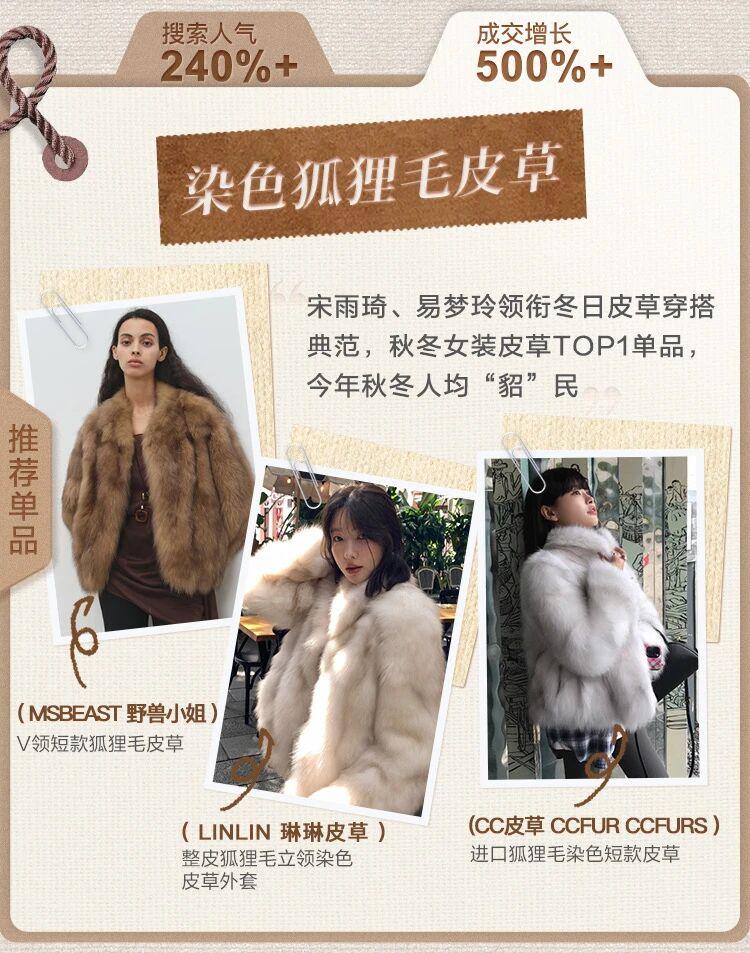
穿皮草,怎么就又火了
3 6 Ke· 2026-02-12 00:31
Core Insights - The resurgence of fur fashion among young consumers is notable, with a significant increase in sales and interest in fur products, particularly during festive seasons [1][3][5] Demand Side - The demand for fur has seen a remarkable increase, with platforms like Taobao reporting a 70% increase in daily sales of fur clothing during the New Year festival [1] - Fur has historically symbolized power and wealth, and its appeal has returned as consumers seek to express status and confidence in uncertain economic times [6][8] - Young consumers are increasingly viewing fur as a sustainable fashion choice, with a focus on ethical sourcing and the longevity of fur garments compared to fast fashion [11][13] Supply Side - The fur industry is adapting to consumer preferences by offering shorter, lighter designs that are more suitable for everyday wear, moving away from traditional heavy styles [18][20] - Innovations in fur processing have led to softer, lighter materials that enhance comfort while maintaining warmth, making fur more accessible to younger buyers [20][21] - The rise of "light fur" accessories, such as collars and cuffs, allows consumers to engage with fur fashion at a lower price point, with sales of fur accessories on platforms like Taobao increasing by over 80% [21][23]


智通港股沽空统计|2月12日
智通财经网· 2026-02-12 00:28
Group 1 - AIA Group (81299), JD Health (86618), and JD Group (89618) have the highest short-selling ratios at 100.00% each [1][2] - Alibaba (09988), Tencent Holdings (00700), and Xiaomi Group (01810) lead in short-selling amounts, with HKD 1.557 billion, HKD 1.404 billion, and HKD 1.183 billion respectively [1][2] - Zhaojin Mining (01818), OSL Group (00863), and Prada (01913) have the highest deviation values at 44.29%, 35.21%, and 34.72% respectively [1][2] Group 2 - The top ten short-selling ratios include AIA Group (81299) at 100.00%, JD Health (86618) at 100.00%, and JD Group (89618) at 100.00% [2] - The top ten short-selling amounts show Alibaba (09988) leading with HKD 1.557 billion, followed by Tencent Holdings (00700) with HKD 1.404 billion [2] - The top ten deviation values highlight Zhaojin Mining (01818) with a deviation of 44.29%, indicating significant short-selling activity compared to its historical average [2][3]


今年春节流行“AI年货”
Huan Qiu Wang· 2026-02-11 22:51
Core Viewpoint - The upcoming Chinese New Year is expected to drive significant consumer spending, particularly in AI-related products, as companies like Alibaba and Tencent engage in a competitive marketing push to attract users through innovative applications and technology [1][5]. Group 1: AI Product Sales Surge - Sales of AI toys and other tech-related products have seen a dramatic increase during the Chinese New Year shopping season, with JD.com reporting nearly a threefold increase in sales of AI toys and robots since the start of the New Year shopping festival [3][4]. - AI glasses have experienced a sales surge of over 700%, while smart robots saw an 88% year-on-year increase in transactions during the same period [4]. - The introduction of AI glasses into the national subsidy program has made them more affordable, further boosting sales among consumers [2]. Group 2: Marketing Strategies and Consumer Engagement - Major tech companies are launching "AI red envelope" campaigns to attract users, with Tencent and Alibaba investing heavily in these initiatives, totaling at least 4.5 billion yuan in marketing efforts [5][6]. - The campaigns aim to replicate the success of previous marketing strategies that popularized mobile payment systems, leveraging AI applications to create new user engagement opportunities [5][6]. - Companies are focusing on enhancing user experience, particularly for older demographics, by simplifying interactions with AI technology [8]. Group 3: Emerging Consumer Trends - There is a notable trend of younger consumers purchasing or renting cleaning robots, referred to as "cyber nannies," indicating a shift towards automation in household chores [7]. - The demand for smart home appliances, such as window-cleaning robots and vacuum cleaners, has surged, with some products seeing order volumes increase by over 376% compared to the previous year [7]. - Companies are also adapting AI applications to better serve older users, allowing them to interact with technology in familiar contexts without needing extensive training [8]. Group 4: Future Growth Potential - Experts suggest that the deepening application of AI technology could be a key driver for expanding domestic demand, with potential new business models emerging from AI innovations [8]. - The AI industry is still in a rapid growth phase, and while it shows promise, it has yet to achieve widespread economic impact comparable to the early internet economy [8].

智通ADR统计 | 2月12日
智通财经网· 2026-02-11 22:31
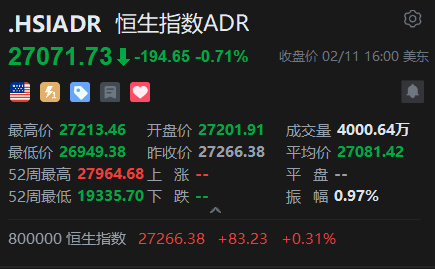
Core Viewpoint - The Hang Seng Index (HSI) closed at 27,071.73, down 194.65 points or 0.71% from the previous close, indicating a decline in market performance [1]. Group 1: Market Performance - The HSI reached a high of 27,213.46 and a low of 26,949.38 during the trading session, with a trading volume of 40 million shares [1]. - The average price for the HSI was 27,081.42, while the 52-week high and low were 27,964.68 and 19,335.70, respectively [1]. Group 2: Major Blue-Chip Stocks - HSBC Holdings closed at HKD 139.794, unchanged from the Hong Kong close, while Tencent Holdings closed at HKD 543.262, down 0.86% [2]. - Among the major stocks, Alibaba (HKD 160.100, down 0.25%), and Xiaomi (HKD 37.100, up 4.27%) showed varied performance [3]. - Notable gainers included BYD Company, which rose by 3.50% to HKD 99.150, while Pop Mart International fell by 5.49% to HKD 255.000 [3].


非农提振昙花一现,美股三大指数集体收跌,中国金龙指数跌0.65%
Feng Huang Wang· 2026-02-11 22:18
Economic Data - The U.S. added 130,000 jobs in January, significantly exceeding the market expectation of 55,000 [1] - The unemployment rate stands at 4.3%, slightly below the economists' forecast of 4.4% [1] - Job growth is primarily concentrated in the healthcare sector, which added 124,000 jobs, double the normal growth rate for 2025 [1] - There is a persistent downward revision in the labor market data, with the average monthly job addition for last year adjusted to only 15,000 [1] Company News - Apple is reportedly facing setbacks in the development of an upgraded version of Siri, which may delay the release of several anticipated AI features [3] - Meta has begun construction on a new data center in Lebanon, Indiana, with an investment exceeding $10 billion, aimed at enhancing its AI infrastructure [5] - Google is integrating AI shopping features into its search engine and Gemini chatbot, allowing consumers to purchase products directly through AI-driven answers [7] - T-Mobile anticipates service revenue to reach approximately $77 billion by 2026, with plans to achieve 18 to 19 million broadband users by 2030 [8] - Ancora Capital has increased its stake in Warner Bros. Discovery and plans to oppose the company's deal with Netflix regarding its production and streaming assets [9] - Kraft Heinz has paused its planned spin-off, focusing instead on improving company performance under the new CEO Steve Cahillane [10]


春节“红包大战”争的是什么
Jing Ji Ri Bao· 2026-02-11 21:56
Core Viewpoint - The "red envelope war" led by major internet companies is shifting from traditional methods of mobile payment and e-commerce to a competition for AI-driven traffic entry points, aiming to enhance user engagement and ecosystem advantages [1][2]. Group 1: Company Initiatives - Tencent announced a cash distribution of 1 billion yuan for its Spring Festival activity, aiming to recreate the excitement of the WeChat red envelope phenomenon from 11 years ago [1]. - Baidu launched a 500 million yuan red envelope plan, encouraging users to engage with its "Wenxin Assistant" AI tool [1]. - Alibaba's Qianwen introduced a 3 billion yuan "Spring Festival treat plan," allowing users to redeem large red envelopes for various services [1]. Group 2: User Engagement and AI Impact - The activities have shown significant initial results, with the daily usage of the Yuanbao AI feature increasing by 30 times and user engagement time rising over 80% since the launch [2]. - Baidu's Wenxin Assistant attracted over 1 million participants on its first day, with 50 million total participants by February 1 [2]. - The Qianwen app saw over 10 million AI orders within just 9 hours of launching its Spring Festival promotion [2]. Group 3: Challenges and Future Considerations - The sustainability of user engagement remains a concern, as experts suggest that while red envelope marketing can attract new users, long-term retention depends on the quality of products and services [3]. - The influx of users during peak times has raised challenges regarding system capacity, with reports of server issues during high traffic events [3]. - Industry experts emphasize the need for differentiated applications and effective value loops to convert short-term interest into long-term user loyalty [4].
果然财评|从“比好看”到“拼好用”,AI画图进入深水区
Sou Hu Cai Jing· 2026-02-11 21:20
这场同台竞技没有绝对的赢家,却清晰勾勒出行业两大发展路径。阿里依托电商、办公生态,将模型向商业实用倾斜,瞄准海报设计、PPT制作、电商详 情页等高频场景,直击企业级生产的真实痛点;字节则绑定剪映、抖音等内容平台,把模型嵌入创作—剪辑—分发全链路,大幅降低普通人的创作门槛。 一个如同严谨的工程师,追求精准高效;一个更像懂流量的设计师,擅长美感与传播,二者分化,正是图像大模型走向场景化的必然选择。 当然,图像生成的"深水区"仍有大量难题待解:复杂指令理解、图层分离编辑、精准局部调整、模型幻觉抑制等关键能力,尚未被头部厂商完全攻克。这 也意味着,真正的较量才刚刚开始,未来的竞争将更加考验技术深耕能力与场景融合效率。 放眼全球,IDC预测2026年全球生成式AI市场规模将达到1431亿美元,视觉生成是其中最确定的核心增量之一。中国厂商正凭借短剧、漫剧、短视频、电 商设计等本土场景优势快速追赶,应用反哺技术、产业牵引模型的闭环正在形成。 齐鲁晚报·齐鲁壹点 魏银科 马年春节前夕,一场没有硝烟的AI图像大战打响。2月10日,阿里云Qwen-Image-2.0与字节跳动Seedream5.0同日上新,将文生图赛道的春节档热 ...