BABA(09988)

Search documents
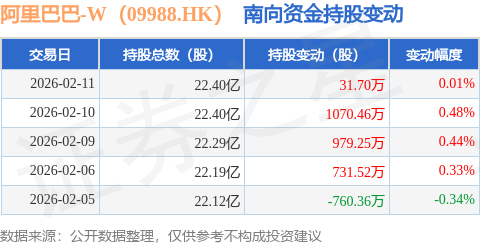
阿里巴巴-W(09988.HK):2月11日南向资金增持31.7万股
Sou Hu Cai Jing· 2026-02-11 19:32
Group 1 - Southbound funds increased their holdings in Alibaba-W (09988.HK) by 317,000 shares on February 11, 2026, marking an increase of 0.01% [1][2] - Over the past five trading days, southbound funds have increased their holdings on four occasions, with a total net increase of 20.53 million shares [1] - In the last 20 trading days, there have been 13 days of net increases, totaling 42.86 million shares, bringing the total shares held by southbound funds to 2.24 billion, which represents 11.72% of the company's issued ordinary shares [1][2] Group 2 - Alibaba Group operates seven business segments, including Chinese retail (Taobao, Tmall, Hema), international retail (Lazada, AliExpress), local services (Ele.me, Amap, Fliggy), logistics (Cainiao), cloud services (Alibaba Cloud, DingTalk), digital media and entertainment (Youku, Quark, Alibaba Pictures), and innovation and other businesses (Damo Academy, Tmall Genie) [2]


阿里巴巴AI战略深化,股价波动中获资金青睐
Jing Ji Guan Cha Wang· 2026-02-11 17:59
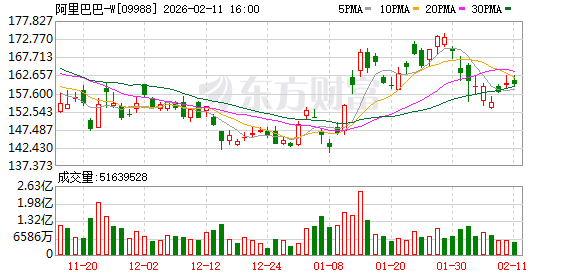
Core Insights - Alibaba's AI strategy has shifted from a single model competition to a systematic capability of "model + ecosystem + AI infrastructure" [1] - The integration of Tongyi Qianwen with high-frequency scenarios like e-commerce and local services aims to create a closed-loop experience, with increased capital expenditure on cloud and AI infrastructure to secure next-generation platform dominance [1] - Market forecasts predict Alibaba's cloud revenue will grow over 33% year-on-year in the 2026 calendar year, with AI cloud contributing significantly to this growth [1] Recent Developments - Alibaba has launched the next-generation image generation model Qwen-Image-2.0, which performs well in text-to-image evaluations and supports the generation of professional PPTs and infographics [2] - A partnership between Tongyi Qianwen and Fliggy has resulted in the introduction of AI ticketing services with over 40 travel brands, providing users with exclusive subsidies and intelligent experiences [2] - Monthly active users of Tongyi Qianwen have surpassed 100 million, with plans for a significant product iteration soon [2] Stock Performance - Alibaba's stock has shown significant volatility, with a 2.27% fluctuation over the past week and a range of 7.26% [3] - On February 11, the stock price dropped by 2.26%, closing at $162.75 with a trading volume of approximately $648 million [3] - Despite the fluctuations, net buying from southbound funds over five consecutive days totaled HKD 45.91 billion, indicating positive capital signals [3] - Year-to-date, the stock has increased by 11.03%, influenced by AI-related positive news and market sentiment [3]
对标Nano Banana Pro 阿里、字节同一天发布图像生成模型 AI生图将迎来规模化应用市场?
Mei Ri Jing Ji Xin Wen· 2026-02-11 15:51
Core Insights - Alibaba and ByteDance both launched new image generation models on February 10, targeting Google's Nano Banana Pro [1] - Alibaba's Qwen-Image-2.0 focuses on semantic understanding and practical editing, while ByteDance's Seedream 5.0 Preview emphasizes image retrieval and fine-tuning [1][3] - The advancements in AI image generation are expected to penetrate e-commerce and animation markets by 2025, with potential for large-scale applications by 2026 [1] Company Developments - Alibaba's Qwen-Image-2.0 supports 1K tokens for long text input and 2K high resolution, enhancing the ability to render complex instructions and generate professional presentations [3] - ByteDance's Seedream 5.0 Preview offers 2K and 4K resolution outputs, currently available for free on the Jiyun platform [3] - Both companies aim to unify image generation and editing into a single model, significantly improving performance [3] Industry Trends - AI image generation is increasingly being applied in e-commerce, with significant token consumption noted in digital human applications and AI-generated images [7] - The AI animation market is experiencing rapid growth, with AI technology reducing production costs by up to 90% and streamlining the creation process from 11 steps to 4 [5][6] - Despite the benefits, challenges remain in maintaining visual consistency and emotional expression in AI-generated content [5][6] Market Potential - The integration of AI image generation in e-commerce is seen as a mainstream application, with the potential to enhance efficiency for sellers by combining image editing and generation tasks [7] - The AI animation market is expected to see explosive growth, driven by the dual pressures of cost reduction and the need for improved content quality [6]

从机器人到电车:豆包春晚炸出科技礼包 字节跳动AI消费野心藏不住了
Mei Ri Jing Ji Xin Wen· 2026-02-11 14:12
Core Insights - ByteDance's AI application Doubao is entering the competitive landscape of the internet's AI battle during the Spring Festival, with plans to distribute cash red envelopes and over 100,000 tech gifts during the 2026 Spring Festival Gala [1][2] - The competition among major internet companies has intensified, with Tencent and Alibaba also launching significant cash and promotional campaigns to capture market share in the AI space [2][5] Group 1: Doubao's Strategy - Doubao's Spring Festival campaign includes two phases: the first phase starts on February 13, allowing users to engage with AI-generated greetings and participate in a lottery for cash prizes [2][3] - The second phase will coincide with the Spring Festival Gala on February 16, featuring live interactions and the distribution of tech gifts, including 17 popular products such as robots and drones [3][4] - Doubao's approach emphasizes integrating its AI capabilities with hardware products, aiming to create a deeper user experience and establish a foothold in the AI hardware market [4][6] Group 2: Competitive Landscape - Tencent is focusing on social interaction through its AI application Yuanbao, aiming to enhance user engagement by integrating music and video content into its platform [5][6] - Alibaba's strategy involves direct consumer subsidies through its AI application Qianwen, which has seen significant user engagement and rapid growth in daily active users [6][7] - The competition is not just about cash giveaways but also about establishing a comprehensive AI ecosystem that includes hardware, software, and user engagement strategies [2][5] Group 3: Market Analysis - Analysts suggest that while Tencent's approach may generate quick engagement, its long-term effectiveness in forming user habits is uncertain [7][8] - Alibaba's method is seen as more effective in creating immediate user engagement and establishing a value loop, while ByteDance's strategy is viewed as deeper but potentially slower to yield results [8] - The overall battle for AI market share during the Spring Festival reflects a shift from traditional marketing to a focus on creating sustainable user engagement and ecosystem integration [5][8]


国泰海通|计算机:从能力领先到入口级产品:阿里押注模型、生态与 AI 基础设施
国泰海通证券研究· 2026-02-11 14:02
Core Insights - Alibaba's top-level strategy is shifting from "model competition" to "system integration," focusing on creating a closed-loop experience that integrates AI with high-frequency scenarios in its digital economy ecosystem [1] - The core of Alibaba's AI strategy post-2025 will not be about the scale of individual models but rather about integrating "Tongyi Qianwen" with various services like e-commerce, local life, payment, travel, and office solutions [1] Group 1 - The "Tongyun Ge" concept emphasizes the integration of Tongyi Lab, Alibaba Cloud, and Pingtouge into a unified "golden triangle," highlighting the collaboration of computing power, model capabilities, and system engineering [1] - The AI2C initiative focuses on user scale and super applications, while AI2B targets enterprise commercialization [2] - The "Qianwen App" will undergo a significant upgrade in January 2026, fully integrating with Alibaba's ecosystem services such as Taobao, Alipay, and Fliggy, marking a transition from conceptualization to practical implementation in the C-end "entry battle" [2] Group 2 - DingTalk is positioned as an "enterprise-level AI intelligent platform," embedding model capabilities into business workflows and systems [2] - The business model is evolving from selling functional subscriptions to selling outcomes and results, indicating a shift in focus towards effectiveness [2] - Significant capital investments will be directed towards cloud and AI infrastructure, including data center expansions, server clusters, and high-performance GPU procurement to support model and platform expansion [2]

春节档红包大战背后的支付考验
Bei Jing Shang Bao· 2026-02-11 13:53
Core Viewpoint - The Spring Festival red envelope competition has intensified, with major companies like Tencent, Baidu, Alibaba, and ByteDance launching significant cash giveaways, highlighting the integration of AI and marketing strategies, while the underlying battle focuses on payment settlement capabilities [1][3][8] Group 1: Red Envelope Competition - Tencent has announced a distribution of 1 billion yuan in cash red envelopes through its Yuanbao app, while Baidu is offering 500 million yuan linked to its AI features [1][3] - Alibaba's Qianwen app has introduced a 3 billion yuan "treating guests" plan, and ByteDance is giving away 100,000 tech gifts and cash red envelopes up to 8,888 yuan during the Spring Festival [1][3] - The scale of red envelope distribution has reached new heights, with companies leveraging AI integration and scenario binding as new highlights [1][3] Group 2: Payment Settlement Challenges - The red envelope competition is not just about consumer engagement but also tests the payment settlement systems of these companies, which must handle high concurrency and ensure accurate and timely transactions [3][4] - The ability to process millions of transactions per second and maintain system stability during peak times is crucial for payment institutions [4][7] - Companies are focusing on enhancing their payment systems to support high-volume transactions and ensure seamless user experiences during promotional events [6][7] Group 3: Technological and Compliance Considerations - The competition is evolving into a test of technological strength, compliance levels, and ecosystem collaboration capabilities among payment institutions [8][9] - Future competition will center on the flexibility of settlement architectures, automated error handling, and support for digital currency transactions [8][9] - Companies are encouraged to develop cloud-native, modular payment systems that integrate with merchants and regulatory bodies to create a fully automated transaction ecosystem [8][9] Group 4: Security and Risk Management - Payment institutions must conduct capacity assessments and stress tests on their settlement systems to ensure business continuity and security during peak transaction periods [5][7] - Companies are implementing advanced security measures to protect against cyber threats and ensure the safety of user accounts and funds [6][7] - The focus on risk management includes identifying and intercepting fraudulent activities to maintain the integrity of the payment process [7][9]


恒指站稳27000点盘整向上 短线活跃资金离场观望
Xin Lang Cai Jing· 2026-02-11 13:36
Market Performance - The Hong Kong stock market continued its upward momentum, with the Hang Seng Index and the Hang Seng China Enterprises Index rising by 0.31% and 0.28% respectively, while the Hang Seng Tech Index saw a peak increase of 1.3% before closing up by 0.9% [2] - Major tech stocks showed recovery, with Xiaomi surging by 5.4%, and slight increases in NetEase, Kuaishou, Baidu, and Meituan [2] Sector Analysis - Gold stocks rebounded strongly, contributing to the activity in the non-ferrous sector, while other industries such as building materials, cement, automotive, lithium batteries, shipping, and coal also experienced gains [3][4] - In contrast, sectors such as film, semiconductors, insurance, dining, and aviation showed weak performance, with AI application concepts experiencing divergence [4] Trading Volume and Short Selling - The total trading volume for the day was HKD 217.218 billion, indicating a continued trend of reduced trading activity as some funds began to exit ahead of the holiday [4] - The total short selling amount reached HKD 28.824 billion, accounting for 13.27% of the Hang Seng Index's trading volume, with Alibaba, Tencent, and Xiaomi leading in short selling amounts [4] Macroeconomic Context - The macroeconomic environment appears to be warming, with overseas markets showing overall strength, as evidenced by the Dow Jones Index reaching a new high [5] - The People's Bank of China released a report indicating a focus on supporting key areas such as expanding domestic demand and technological innovation, which may benefit sectors like chemicals and raw material imports [6] Investment Outlook - Analysts suggest that the technology sector remains a long-term investment focus, supported by rising prices in the supply chain, trends towards domestic production, and accelerated AI applications [8] - The consumer sector is also expected to benefit from policy support, with current valuations at relatively low levels, indicating potential for long-term growth [8]




2025电商十大事件:告别红利,电商开始打硬仗
3 6 Ke· 2026-02-11 13:28
Core Insights - The e-commerce and retail sectors are experiencing significant changes, with the peak of traffic dividends and a shift in consumer behavior being the most critical factors for 2025 [1] - The year 2025 is marked by a decline in e-commerce penetration rate, with online retail sales expected to reach nearly 16 trillion yuan, growing by 8.6% compared to the previous year [1] Group 1: E-commerce Industry Trends - A "de-involution" movement in the e-commerce industry is led by platforms optimizing rules, regulating promotions, and enhancing technology [2] - Major platforms are adjusting controversial rules like "only refunds" and "mandatory shipping insurance" to balance consumer and merchant rights [2] - The introduction of supportive policies for merchants aims to lower costs and optimize traffic distribution, with Douyin e-commerce saving merchants over 32 billion yuan [2] Group 2: Instant Retail Competition - A fierce competition in instant retail has emerged, with major players like JD, Alibaba, and Meituan investing at least 30 billion yuan in marketing during Q2 [4] - The battle for market share in the instant retail sector is expected to reshape competition rules, leading to a stable state where Alibaba and Meituan may become long-term rivals [4] Group 3: Brand and Consumer Dynamics - The disappearance of top influencers has led brands to shift towards self-operated live streaming, with KOCs (Key Opinion Consumers) gaining traction as cost-effective marketing tools [9] - The 2025 Double 11 shopping festival has transformed into a battle of rationality among platforms, merchants, and consumers, with a focus on maintaining the lowest prices [10] Group 4: Regulatory Changes - The implementation of new tax regulations for e-commerce platforms marks the end of the long-standing "tax-free dividend," requiring merchants to report comprehensive income data [16] - The new tax rules are expected to impact how merchants operate, with a focus on compliance becoming essential for survival in the industry [16] Group 5: AI Integration - Major companies are heavily investing in AI, with Alibaba planning to invest over 380 billion yuan in AI and cloud infrastructure over the next three years [17] - The integration of AI tools is changing e-commerce operations, enhancing search capabilities and content conversion efficiency [18]


阿里发布RynnBrain大模型,让机器人具备“思考大脑”!
Ge Long Hui· 2026-02-11 13:16
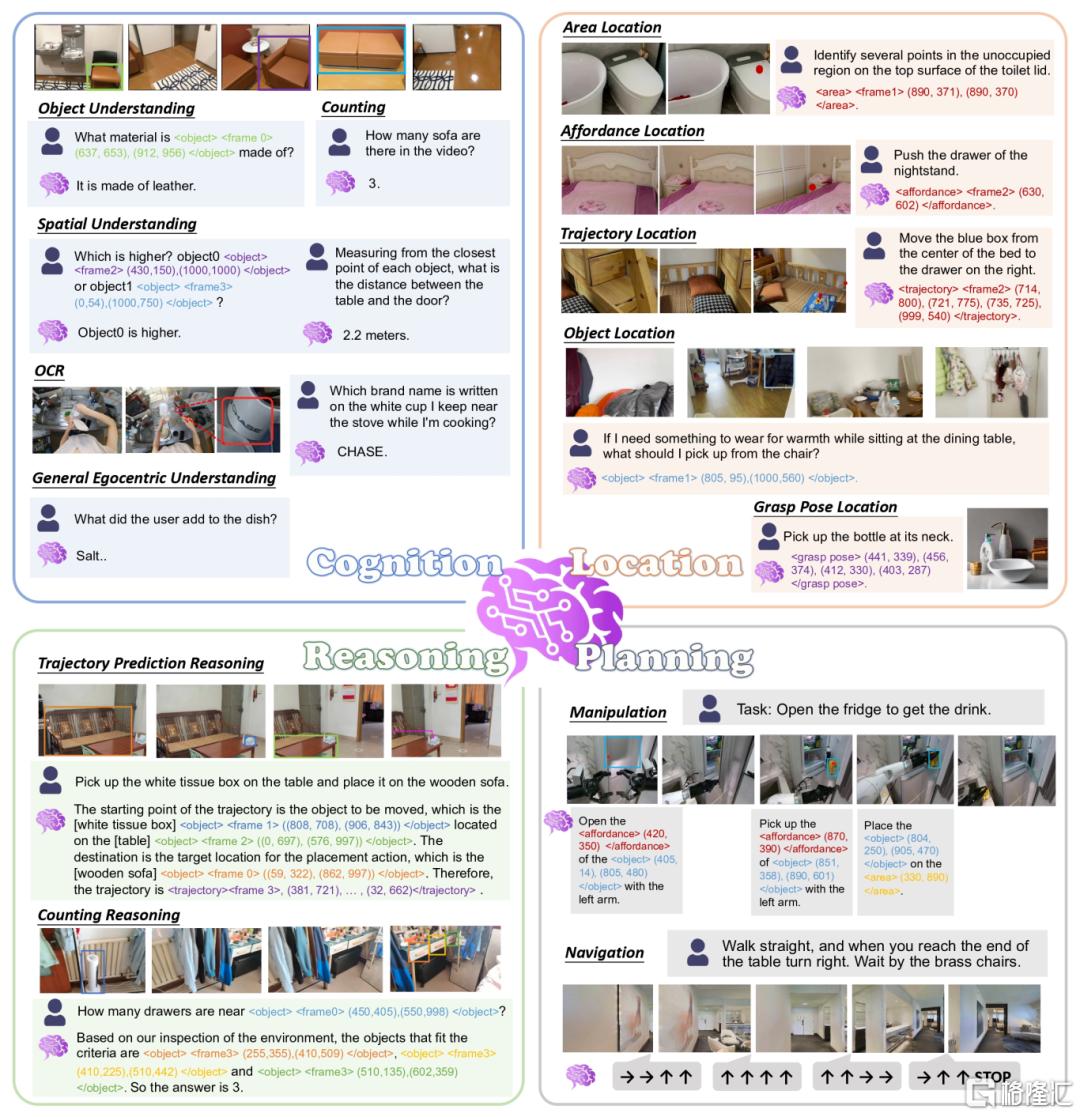
Core Insights - Alibaba's Damo Academy has released the RynnBrain foundational model for embodied intelligence, which includes seven models, notably the 30B MoE model, all of which are open-sourced [1][6] - RynnBrain significantly enhances robots' capabilities by introducing spatiotemporal memory and physical world reasoning, achieving state-of-the-art (SOTA) results in 16 embodied open-source evaluation benchmarks, surpassing leading models like Google's Gemini Robotics ER 1.5 [1][4] Model Capabilities - RynnBrain enables robots to locate objects and predict motion trajectories using its spatiotemporal memory, providing global recall capabilities [2] - The model employs a reasoning strategy that intertwines text and spatial positioning, effectively reducing hallucination issues during reasoning processes [2] - RynnBrain possesses multiple capabilities, including cognition, localization, reasoning, and planning [3] Training and Performance - Trained on the Qwen3-VL foundation using the proprietary RynnScale architecture, RynnBrain's training data exceeds 20 million pairs, resulting in a performance boost of two times with equivalent resources [4] - RynnBrain has set new records in various benchmarks, including environmental perception, object reasoning, first-person visual question answering, spatial reasoning, and trajectory prediction [4][5] Benchmark Results - RynnBrain outperforms other top models in multiple benchmarks, achieving scores such as 74.5 in VSI-Bench and 78.9 in EgoTaskQA, demonstrating its superior performance across various tasks [5] Scalability and Applications - RynnBrain exhibits excellent scalability, allowing for rapid fine-tuning to create various embodied models, such as navigation and planning models, with minimal data [6] - The model's architecture allows it to exceed the performance of Gemini 3 Pro with just a few hundred data points for fine-tuning [6] Open Source and Industry Impact - The open-sourcing of RynnBrain's complete reasoning and training code, including the first MoE architecture in the industry, positions it as a foundational model for the embodied intelligence sector [6][8] - Damo Academy aims to accelerate the transition of AI from digital to real-world applications, contributing to the development of deployable, scalable, and evolvable embodied intelligence systems [8]
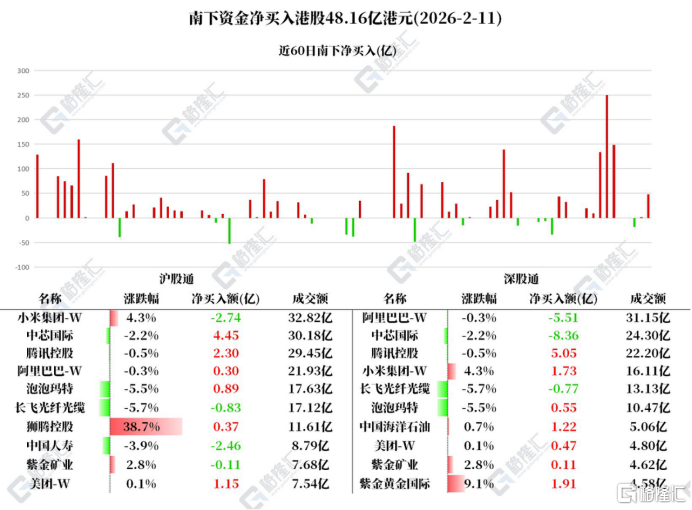
北水净买入腾讯超7亿,净卖出阿里巴巴超5亿
Ge Long Hui· 2026-02-11 12:19
Group 1 - Southbound funds net bought Hong Kong stocks worth HKD 4.816 billion on February 11, with notable net purchases in Tencent Holdings (HKD 735 million), Zijin Mining International (HKD 191 million), Meituan-W (HKD 162 million), Pop Mart (HKD 144 million), and China National Offshore Oil Corporation (HKD 122 million) [1] - Significant net sales were observed in Alibaba-W (HKD 520 million), SMIC (HKD 390 million), China Life (HKD 246 million), Yangtze Optical Fibre and Cable (HKD 159 million), and Xiaomi Group-W (HKD 100 million) [1] Group 2 - Meituan announced plans to invest approximately USD 717 million to acquire Dingdong Group's "Dingdong Grocery" business in China, which Morgan Stanley believes will create synergies with Meituan's existing Xiaoxiang Supermarket and strengthen its position in the fresh food delivery market in East China [5] - CNOOC is influenced by geopolitical tensions, particularly regarding U.S.-Iran relations, which may affect short-term oil price volatility [5] Group 3 - Xiaomi is rumored to use the Snapdragon 8 Elite Gen6 for its standard version, with potential costs exceeding USD 300, approximately CNY 2074, amid rising DRAM and NAND prices increasing pressure on smartphone manufacturers [7] Group 4 - Lion Group Holdings is positioned to benefit from Hong Kong's growing status as a global Web3 and cryptocurrency innovation hub, supported by the implementation of the Stablecoin Regulation and the upcoming issuance of licenses for stablecoin issuers [6]