BABA(09988)

Search documents
千问的出圈绝非偶然!这是阿里全链布局 + 场景融合的生态爆发
Xi Niu Cai Jing· 2026-02-09 15:27
Core Insights - The article highlights Alibaba's strategic shift from an e-commerce giant to an AI super entrance, exemplified by the success of the Qianwen App during the Spring Festival promotion, which saw over 10 million AI orders within 9 hours of launch [2][4][9] Group 1: Promotional Strategy - The Qianwen App's "Spring Festival 3 billion big free order" campaign was designed to cultivate user habits by offering substantial incentives, contrasting with competitors who relied on cash for user acquisition [3][4] - The simplicity of Qianwen's promotional mechanics, such as offering a 25 yuan free order card upon download, significantly lowered barriers for user participation compared to competitors' more complex systems [3][4] Group 2: Ecosystem Integration - Qianwen's integration with various Alibaba platforms like Taobao and Alipay allows for a seamless user experience, enhancing the likelihood of sustained engagement rather than one-time participation [4][6] - The app's design encourages users to adopt AI for everyday tasks, positioning it as a core tool for future consumer interactions, thus creating a closed-loop ecosystem [6][8] Group 3: Long-term Investment and Infrastructure - Alibaba's commitment to AI and cloud computing, with an investment exceeding 380 billion yuan over three years, underpins the technological advancements seen in the Qianwen App [7][8] - The development of proprietary AI infrastructure, including advanced chips and cloud services, supports the app's functionality and scalability, setting it apart from competitors [7][8] Group 4: Market Trends and Future Outlook - The article notes a significant shift in the AI market, with the global AI agent market projected to grow from $5.29 billion in 2024 to $47.1 billion by 2030, indicating a strong demand for AI solutions that go beyond basic interactions [9][10] - Qianwen's rapid success serves as a case study for how AI can be integrated into daily life, suggesting that companies that can make AI a default option for consumers will dominate the next decade [9][10]



阿里千问工具箱小程序遭微信限制,提示存欺诈风险
Bei Ke Cai Jing· 2026-02-09 14:46
【#千问工具箱小程序被微信限制# 】智通财经2月9日电,阿里"千问工具箱|原通义效率助手"小程序被 微信官方限制,打开时会弹出警示窗口。用户尝试打开该小程序时,系统会弹出安全提示界面,显示该 小程序"近期被大量用户投诉,可能存在欺诈行为"。(智通财经) ...


港股系列研究报告(3):当前时点坚定看好恒生科技的六大理由
CMS· 2026-02-09 14:04
Group 1 - The report maintains a strong positive outlook on the Hang Seng Technology Index, citing that recent declines are primarily due to liquidity shocks rather than fundamental changes in the market [2][4] - The report emphasizes that the peak of overseas liquidity shocks has passed, and strategies such as "buy the dip" are expected to be effective moving forward [5][6] - The relative valuation of Hong Kong technology stocks is at a historical low compared to A-share technology stocks, indicating potential for a rebound [4][27] Group 2 - Domestic liquidity issues caused by public funds over-allocating to Hong Kong stocks have eased, reducing selling pressure on the market [23][24] - The report highlights that the earnings expectations for the Hang Seng Index have been gently revised upwards, contributing to its resilience compared to the Hang Seng Technology Index, which has seen a stabilization in earnings expectations [38][39] - The report notes that the technology sector is experiencing significant advancements, with major companies like Tencent and Alibaba actively promoting AI models and applications [40][41] Group 3 - The report discusses the impact of stricter IPO quality controls by the Hong Kong Securities and Futures Commission, which is expected to improve market sentiment [29][30] - It is noted that the current absolute valuation of the Hang Seng Technology Index is low, with a price-to-earnings ratio of 22.13, suggesting limited downside potential for leading tech stocks [27][28] - The report indicates that the fundamentals of the Hong Kong market remain solid, with earnings expectations stabilizing, which is crucial for investor confidence [38][39]

千问爆单 率先“撕开”AI生活方式的口子
Nan Fang Du Shi Bao· 2026-02-09 14:03
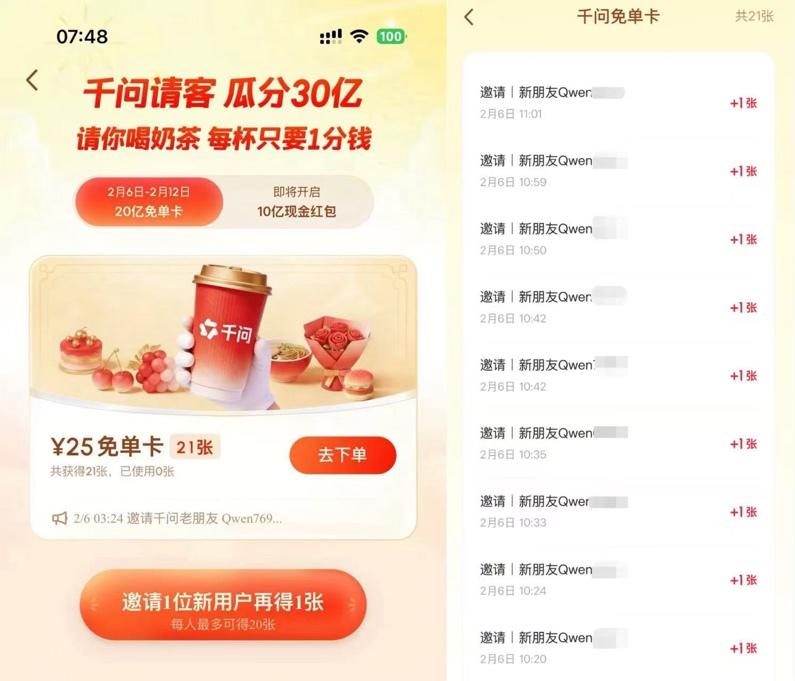
9小时1000万单,千问被挤到"求放过"? 过去几天,大概没什么人没体验过千问App送奶茶的活动了吧。网友们晒出的免单卡越来越多,千问官方也从一开始的狂晒战绩,变成后面"求放过"、延长 免单卡使用期限。 全民狂下单的节奏下,如果此前大众还觉得AI是一个触不可及的概念,那么大家现在应该真的相信了:AI办事能力已经进一步迭代,它已经从聊天回应、 有时候还出点幻觉的对话人,变成了真的能交付办事结果、进入日常生活的助手。 活动上线不到3小时,用户下单奶茶量超100万单;不到4小时,下单量超200万单;5小时,突破500万单;活动上线9小时,订单量已超过1000万单......这是过 去几天内,阿里系千问砸30亿开启史上最猛春节攻势后,不断对外披露的成绩单。 2月6日,千问APP"春节30亿大免单"正式上线、首先发动了奶茶攻势。当时有千问APP人士向南都N视频记者表示,"我们希望通过春节大免单活动,邀请全 国人民体验AI时代的全新生活方式,让AI融入到人们真实的生活消费之中。" (图源网络) 千问发动的"春节30亿大免单"大战只是今年春节AI大战硝烟弥漫的其中一幕。在阿里千问AI以外,百度在百度App发放5亿红包、用户 ...
千问掀起AI购物风暴,率先“撕开”AI生活方式的口子
Nan Fang Du Shi Bao· 2026-02-09 13:17
Core Insights - The article highlights the significant impact of the Qianwen app's promotional campaign, which offered free milk tea, demonstrating the integration of AI into everyday life and consumer behavior [1][2][4] Group 1: Promotional Campaign - Qianwen app launched a "Spring Festival 30 billion free order" campaign, achieving over 10 million orders within 9 hours, marking the largest investment in a Spring Festival promotion by Alibaba [2][3] - The campaign aimed to invite the public to experience a new lifestyle with AI, showcasing its practical applications in daily consumption [2][4] Group 2: AI Integration - The Qianwen app has evolved from a conversational AI to a functional assistant capable of executing tasks, such as ordering food and planning travel, indicating a shift towards practical AI applications in daily life [4][8] - The app's integration with Alibaba's ecosystem allows it to coordinate multiple services, enhancing user experience and demonstrating AI's capabilities beyond mere conversation [4][9] Group 3: Market Comparison - The article contrasts the promotional strategies of Chinese companies like Qianwen with those in the West, emphasizing the direct and accessible approach of offering free products to engage users with AI technology [8][9] - It notes that Qianwen's method of introducing AI to everyday consumers is effective in familiarizing them with AI's potential, thus paving the way for broader acceptance and usage [8][9] Group 4: Future Trends - The ongoing AI promotional campaigns are seen as a nationwide experiment to validate AI's role in daily life, with the potential to change consumer behavior and lifestyle in the coming decade [9] - Alibaba's proactive investment in AI technology and its applications positions it as a leader in shaping future consumer experiences with AI [9]
全球产业趋势跟踪周报(0209):AI应用加速产业渗透,机器人商业化时间节点前移-20260209
CMS· 2026-02-09 12:34
Core Insights - The report highlights the acceleration of AI applications and the commercialization timeline of humanoid robots, indicating a significant shift in industry dynamics [2][3][31]. AI Applications - Tencent's Yuanbao launched a 1 billion yuan cash red envelope campaign on February 1, aiming to replicate the success of WeChat's previous red envelope strategy, integrating cash incentives with AI functionalities [3][13]. - Since the launch, Yuanbao's AI image generation feature has seen a 30-fold increase in daily usage, with new users engaging in over 8 interactions per day and daily usage time increasing by over 80% [4][14]. - Alibaba's Qianwen initiated a 3 billion yuan campaign to enhance consumer experiences through AI, covering various lifestyle scenarios and aiming to establish a strong user connection with AI [15][17]. Humanoid Robots - The global humanoid robot industry is experiencing rapid developments, with Tesla planning to launch the third generation of its Optimus robot in Q1 2026, focusing on production adjustments and scaling [31][32]. - Figure AI introduced the Helix 02 humanoid robot, achieving autonomous control through a single neural network, showcasing significant advancements in robot dexterity and functionality [31][36]. - The investment and financing market for robots is becoming increasingly active, with several automotive companies confirming their entry into the humanoid robot sector [2][31]. Market Trends - The report notes a rising trend in the industrial robot market, with China's industrial robot production expected to exceed 90,000 units by December 2025, reflecting a robust demand in advanced manufacturing [45][48]. - The humanoid robot supply chain is segmented into three main areas: AI chips and algorithms, core mechanical components, and complete machine integration, with the middle segment holding the highest value [48][49]. Investment Recommendations - Short-term focus areas include overseas computing power, chemicals, AI applications, smart driving, and domestic computing power, indicating sectors with potential marginal improvements [4][5]. - Long-term strategies should consider the ongoing technological cycles, the progress of AI integration across industries, and the implications of carbon neutrality initiatives on various sectors [5].

钉钉AI应用服务中心落户扬州广陵,“钉钉扬州城市合伙人计划”启动
Yang Zi Wan Bao Wang· 2026-02-09 12:22
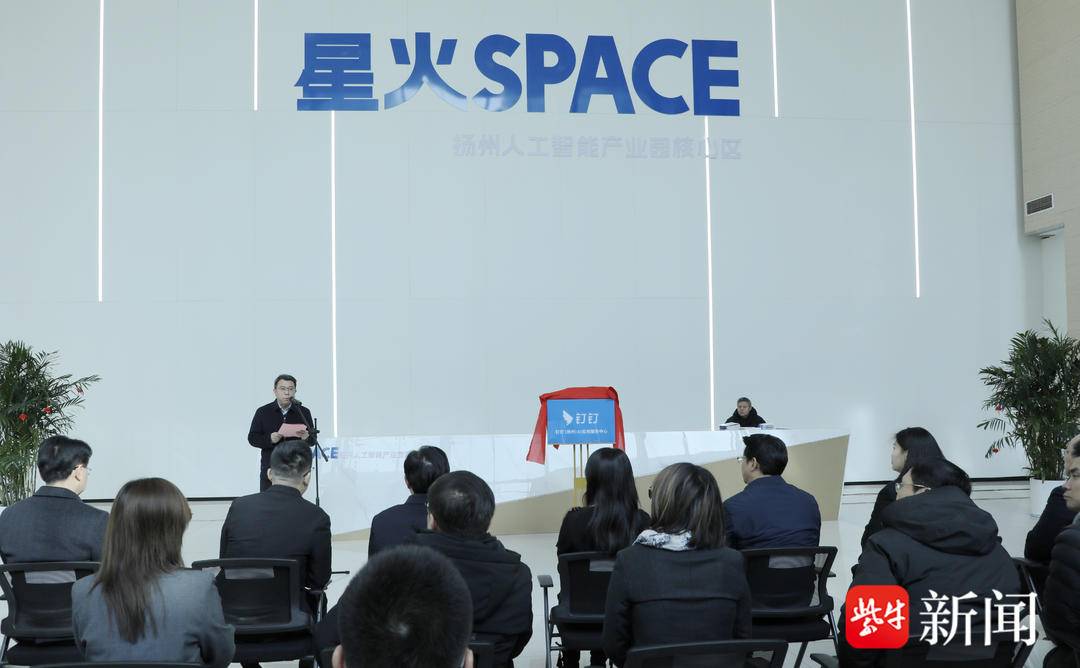
记者了解到,作为市"613"、区"513"产业体系的重要一环,广陵把人工智能作为未来发展的主攻方向,以全市首家扬州人工智能产业园打造为抓手,加快 布局新赛道、培塑新优势。截至目前,园区已集聚软件、信息、航空等企业超600家,数字经济及人工智能从业人口达2.63万人,涉及地理信息、网络安 全、软件开发与应用等多个细分领域。"十五五"末,园区人工智能相关产业规模将突破50亿元,全市人工智能创新策源地、产业集聚地和应用示范地的优 势地位进一步巩固。 据介绍,阿里巴巴集团是服务全社会AI创新的开放科技平台,钉钉作为旗下重要的AI办公应用平台,是全球领先的智能办公操作系统,在赋能企业数字 化转型方面积累了深厚经验。钉钉AI应用服务中心落户扬州广陵,中心将充分整合钉钉的技术、平台与生态资源,为广大企业提供集即时沟通、协同办 公、流程优化于一体的数字化支持,以及可快速部署、即插即用的智能体与场景解决方案,推动实现"人与AI协同"的新型工作模式,为扬州"产业科创"名 城建设注入强劲的数字化动力。 钉钉方面相关负责人表示,扬州是被运河智慧浸润的千年名城,更是在新时代抢抓机遇,锐意创新的奋进之城。扬州走在数字化与智能化融合发展前 ...
字节、阿里、腾讯 AI 大战全记录:一场影响命运的战争
混沌学园· 2026-02-09 12:08
Core Insights - The article discusses the intense competition among major Chinese tech companies, particularly Tencent, Alibaba, and ByteDance, in the AI sector as they invest heavily to capture user engagement and market share during the upcoming Spring Festival [4][5][15]. Group 1: AI Competition Dynamics - Tencent is aggressively investing 10 billion yuan in cash and leveraging social media to attract users, while Alibaba is committing 30 billion yuan to enhance user experience through its AI product, Qianwen [4][11]. - ByteDance is utilizing its extensive traffic from platforms like Douyin and Toutiao to gain a competitive edge, with its AI product, Doubao, achieving over 100 million daily active users by the end of 2025 [12][25]. - The competition is characterized by a race to establish AI as a fundamental infrastructure, with companies vying for dominance in user engagement and application scenarios [11][24]. Group 2: Company Strategies and Developments - Tencent's cautious approach to AI investments changed in 2025 with the hiring of top talent like Yao Shunyu, who identified issues in their existing AI model, leading to a significant restructuring of their AI team [8][9][10]. - Alibaba is focusing on a comprehensive AI strategy that integrates AI, cloud computing, and chip development, aiming to enhance its overall capabilities and market position [11][12]. - ByteDance's Doubao has become the leading AI product in China, with a daily token processing volume exceeding 63 trillion, reflecting its rapid growth and user adoption [12][25]. Group 3: Market Position and Financials - In the first three quarters of the year, ByteDance reported a net profit of approximately 40 billion USD, while Tencent and Alibaba reported 30 billion USD and 10 billion USD, respectively, indicating varying profitability levels among the giants [11][12]. - Alibaba is considering increasing its investment in AI infrastructure and cloud computing from 380 billion yuan to 480 billion yuan over the next three years, demonstrating its commitment to AI development [12][24]. - The article highlights the importance of user engagement metrics, with companies focusing on increasing daily active users and improving user retention strategies [25][34]. Group 4: Future Outlook and Challenges - The competition is expected to intensify during the Spring Festival, with all three companies launching aggressive marketing campaigns and product features to capture user attention [14][15]. - The article suggests that the outcome of this competition could significantly impact the future trajectories of these companies, likening it to a pivotal moment in a larger strategic war [15][39]. - As AI becomes a core component of their business models, companies are also facing challenges in talent acquisition and internal collaboration, which are crucial for sustaining innovation and competitive advantage [48][52].

阿里千问、淘宝闪购:求求大家明天再来
Sou Hu Cai Jing· 2026-02-09 12:07
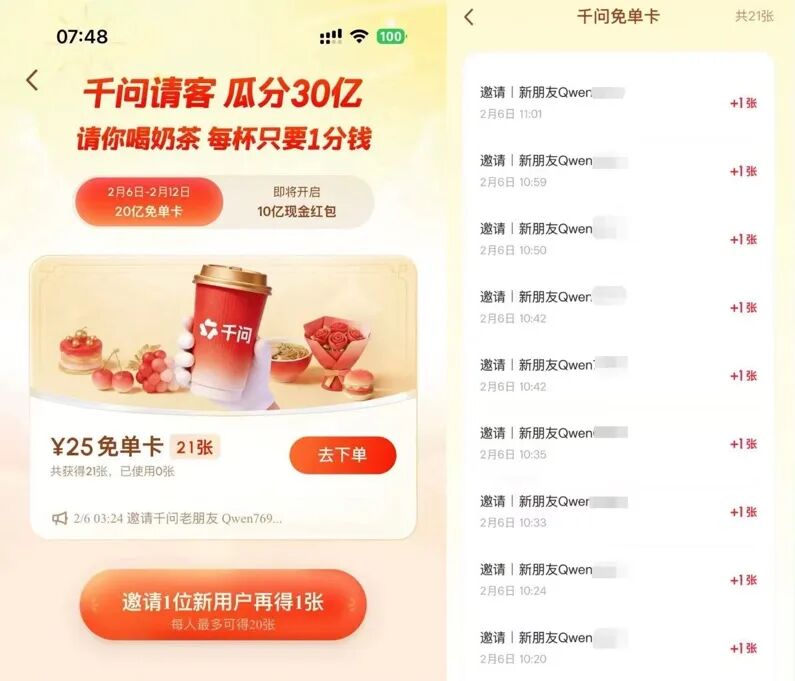
Group 1 - The core message of the news is that Qianwen launched a promotional campaign called "Spring Festival 3 Billion Free Orders," distributing free milk tea vouchers, which has led to significant user engagement and order volume [3][6]. - Following the launch, Qianwen's sharing links for the promotion were blocked by WeChat, indicating a competitive tension in the market, particularly after similar actions against Tencent's Yuanshi and Baidu's Wenxin Assistant [3]. - Users have been actively sharing links and copying codes in the comments section of Qianwen's official Weibo, demonstrating high user interest and participation in the promotion [6][8]. Group 2 - The promotional campaign has resulted in a surge in order volume, which has affected the logistics and delivery sector, causing delays in order fulfillment as delivery personnel struggle to keep up with demand [8].

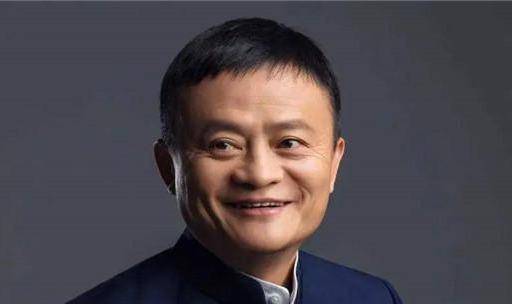
曹德旺评价马云:吹牛谁都会,淘宝的市场根本没有13亿!
Sou Hu Cai Jing· 2026-02-09 12:07
Core Viewpoint - The debate between two prominent figures in Chinese business, Cao Dewang and Jack Ma, highlights the contrasting perspectives of traditional manufacturing and emerging virtual economies, raising questions about the actual consumer market potential in China [1][3]. Group 1: E-commerce Market Debate - Cao Dewang challenges Jack Ma's claim of a 1.3 billion potential user base for Taobao, stating that only 200 million have actual purchasing power, while the remaining 900 million to 1 billion lack the ability to consume [3]. - This statement has sparked significant public discourse, questioning the validity of the 1.3 billion market claim and suggesting it may be an inflated figure [3][5]. - The disparity in consumer capability, particularly in rural areas, indicates that the touted market size may not reflect true economic conditions [3][5]. Group 2: Understanding Consumer Power - The argument that all consumption is equal overlooks the nuances of consumer spending, where survival needs differ from discretionary spending [5]. - Cao Dewang's critique emphasizes the importance of distinguishing between basic survival consumption and higher-level enjoyment consumption, which reflects societal wealth and development [5]. - The ongoing poverty among a significant portion of the population limits their participation in the e-commerce market, suggesting that the 1.3 billion figure is more of an ideal than a reality [5]. Group 3: Collision of Economies - Cao Dewang's strong reaction to Jack Ma's statements stems from his deep commitment to the manufacturing sector, which he views as the foundation of national economic development [7][11]. - The rise of e-commerce, led by figures like Jack Ma, has transformed consumer behavior, particularly among younger generations, often at the expense of traditional industries [9]. - The tension between the virtual economy and the real economy reflects broader anxieties about the marginalization of manufacturing in favor of digital platforms [11]. Group 4: Future Outlook - The challenge lies in balancing the strengths of both the real and virtual economies to ensure sustainable economic growth in China [13]. - Cao Dewang's perspective represents a traditional manufacturing entrepreneur's concerns about the future of the economy, while Jack Ma symbolizes the innovative potential of the virtual economy [13]. - A harmonious relationship between manufacturing and e-commerce is essential for China's competitive edge in the global market, with each sector providing unique contributions to economic stability and innovation [13].