Cambricon(688256)

Search documents
54股获杠杆资金净买入超亿元
Zheng Quan Shi Bao Wang· 2025-10-27 06:51
Core Insights - As of October 24, the total market financing balance reached 2.44 trillion yuan, an increase of 58.95 billion yuan from the previous trading day [1] - A total of 1,619 stocks received net financing purchases, with 472 stocks having net purchases exceeding 10 million yuan, and 54 stocks exceeding 100 million yuan [1] - The top net purchase stock was Zhongji Xuchuang, with a net purchase amount of 1.63 billion yuan, followed by Hanwujing-U and Shenghong Technology [1][2] Financing Balance and Stock Performance - The financing balance in the Shanghai market was 1.235 trillion yuan, increasing by 29.86 billion yuan, while the Shenzhen market's financing balance was 1.197297 trillion yuan, also up by 29.34 billion yuan [1] - The Beijing Stock Exchange saw a decrease in financing balance to 75.21 billion yuan, down by 2.55 million yuan [1] - The average financing balance as a percentage of circulating market value for stocks with significant net purchases was 4.07% [2] Sector Analysis - The industries with the highest concentration of stocks receiving net purchases over 100 million yuan were electronics, power equipment, and non-ferrous metals, with 25, 4, and 4 stocks respectively [1] - The distribution of major net purchase stocks included 34 from the main board, 11 from the ChiNext board, and 9 from the Sci-Tech Innovation board [1] Notable Stocks and Their Financing Ratios - Cambridge Technology had the highest financing balance as a percentage of circulating market value at 7.92%, followed by Xiechuang Data and Yinzhijie at 7.06% and 7.03% respectively [2] - The top net purchase stocks on October 24 included Zhongji Xuchuang (12.05% increase), Hanwujing-U (9.01% increase), and Shenghong Technology (7.95% increase) [2][3]





光模块大涨,AI人工智能ETF(512930)涨超2.6%,近3月跟踪精度同类第1
Sou Hu Cai Jing· 2025-10-27 06:28
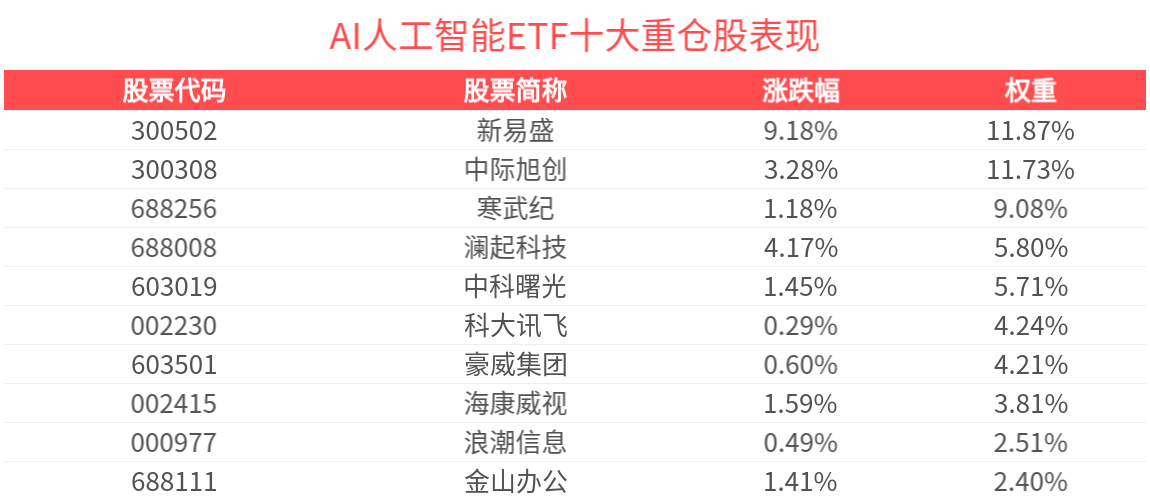
Core Insights - The China Securities Artificial Intelligence Theme Index (930713) has shown a strong increase of 2.54% as of October 27, 2025, with notable gains in constituent stocks such as Xinyi Sheng (300502) up 9.18% and Dahua Technology (002236) up 8.07% [1] - The AI Artificial Intelligence ETF (512930) has also risen by 2.60%, with a recent price of 2.25 yuan, and has accumulated a weekly increase of 10.84% as of October 24, 2025 [1] - The ETF has a low management fee rate of 0.15% and a custody fee rate of 0.05%, making it one of the most cost-effective options in its category [1] - The tracking error for the AI Artificial Intelligence ETF over the past three months is 0.009%, indicating the highest tracking precision among comparable funds [1] Index Composition - As of September 30, 2025, the top ten weighted stocks in the China Securities Artificial Intelligence Theme Index account for 61.36% of the index, with Xinyi Sheng (300502) and Zhongji Xuchuang (300308) being the top two [2] - The top ten stocks by weight include: - Xinyi Sheng (300502) - 11.87% - Zhongji Xuchuang (300308) - 11.73% - Cambricon (688256) - 9.08% - Lianqi Technology (688008) - 5.80% - Zhongke Shuguang (603019) - 5.71% - iFlytek (002230) - 4.24% - OmniVision Technologies (603501) - 4.21% - Hikvision (002415) - 3.81% - Inspur Information (000977) - 2.51% - Kingsoft Office (688111) - 2.40% [4]





权重股兆易创新涨停,消费电子ETF(561600)涨超3%,近一周净流入同类第1
Xin Lang Cai Jing· 2025-10-27 06:23
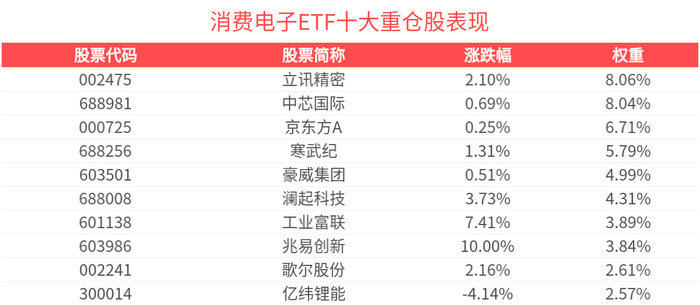
Core Insights - The China Securities Consumer Electronics Theme Index (931494) has seen a strong increase of 2.89% as of October 27, 2025, with significant gains in constituent stocks such as Jingwang Electronics (603228) and Zhaoyi Innovation (603986), both rising by 10.00% [1][2] - The Consumer Electronics ETF (561600) has also risen by 2.90%, with a recent price of 1.31 yuan, and has accumulated a 9.16% increase over the past week [1][2] Market Activity - The Consumer Electronics ETF experienced a turnover rate of 10.85% during trading, with a transaction volume of 46.21 million yuan, indicating active market participation [2] - Over the past week, the ETF's shares increased by 11 million, ranking it in the top fifth among comparable funds [2] Index Composition - The China Securities Consumer Electronics Theme Index includes 50 listed companies involved in component production and consumer electronics design and manufacturing, reflecting the overall performance of the sector [2] - As of September 30, 2025, the top ten weighted stocks in the index accounted for 55.93% of the total, with notable companies including Luxshare Precision (002475) and SMIC (688981) [2][4]





知名基金经理调仓动向曝光,下一个“风口”在哪里?
2 1 Shi Ji Jing Ji Bao Dao· 2025-10-27 06:14
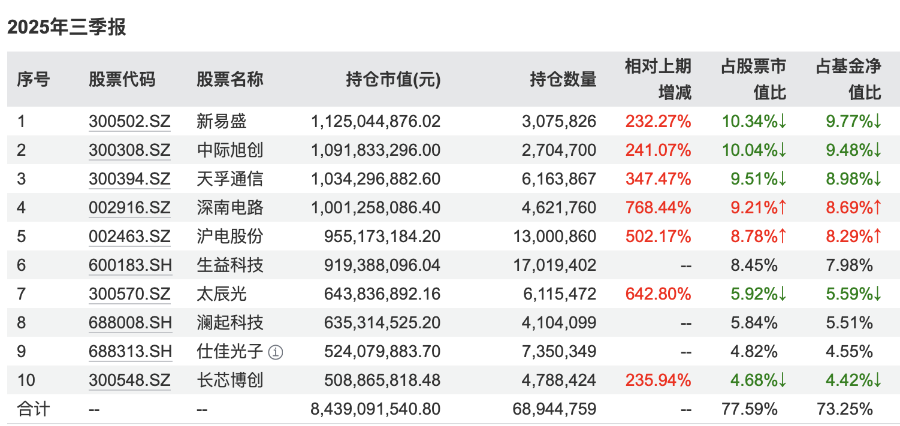
Group 1 - The core focus of several fund managers in Q3 has been on PCB leading stocks, particularly East Mountain Precision, with notable increases in holdings by prominent funds [2][3] - The fund "Yongying Technology Smart Select" has shown significant performance, with a year-to-date return exceeding 200%, and has heavily invested in the PCB sector and optical module leaders [3][5] - Fund managers have expressed confidence in the A-share market, highlighting the potential for further asset allocation towards equity due to favorable domestic fiscal and monetary policies [10][11] Group 2 - Fund managers have adjusted their portfolios, with some reducing holdings in optical module leaders while increasing investments in the robotics industry [6][7] - The "Yongying Technology Smart Select" fund has seen its net asset value growth rate approach 100%, leading to a substantial increase in fund size from 11.66 billion to 115.21 billion [12] - There is a growing interest in Hong Kong stocks, with funds increasing their positions in companies like Alibaba and various biotech firms, reflecting a dual focus on technology and recovery sectors [9]


半年2亿营收,400亿市值,它是又一个“寒武纪”?
Xin Lang Cai Jing· 2025-10-27 05:12
Core Insights - The article highlights the breakthrough of Yuanjie Technology in the high-end optical chip market, traditionally dominated by foreign companies, marking a significant shift in China's optical communication and AI industries [2][6][54]. Group 1: Company Overview - Yuanjie Technology successfully validated its 25G laser chip in 2018, a pivotal moment in the optical chip sector [2][6]. - The company was founded by Zhang Xingang, a Chinese-American with extensive experience in the optical communication industry, who returned to China in 2013 to establish Yuanjie [6][7]. - Yuanjie has achieved significant milestones, including becoming the top domestic revenue earner in the InP semiconductor laser chip sector by 2020 [14][40]. Group 2: Market Position and Growth - The domestic market for optical chips above 25G has been heavily reliant on foreign manufacturers, with a current localization rate of only 5% [6]. - Yuanjie’s entry into the market has attracted substantial investment, including from Huawei's Hubble Investment, which accelerated the company's growth trajectory [9][11][13]. - The company reported a revenue of 205 million yuan in the first half of 2025, a year-on-year increase of 70.57%, with net profit surging by 330.31% [19]. Group 3: Technological Advancements - Yuanjie has developed high-performance CW 70mW laser chips for 400G/800G optical modules, achieving mass production [16][43]. - The company has also made strides in the EML chip sector, breaking international monopolies with its 100G PAM4 EML chip [43]. - Yuanjie’s commitment to rigorous testing and reliability has earned it a reputation for quality, leading to long-term partnerships with major clients like Huawei [38][39]. Group 4: Strategic Decisions - Zhang Xingang's decision to adopt an IDM (Integrated Device Manufacturer) model allows Yuanjie to control the entire production process, enhancing its competitive edge [50][51]. - The company plans to establish a production base in the United States, aiming to penetrate the global market and collaborate with top-tier clients [47][48]. - The global optical chip market is projected to grow significantly, reaching $3.9 billion in 2024 and $9.7 billion by 2029, indicating a robust growth opportunity for companies like Yuanjie [53].

科创板科创成长层面面观|培育与硬科技企业发展相适配的“资本生态”
Zheng Quan Ri Bao· 2025-10-27 05:08
Group 1 - The core point of the article highlights the emergence of the "Science and Technology Innovation Growth Layer" in the Chinese capital market, which aims to support high R&D, unprofitable "hard technology" companies, providing them with a platform to connect technological advancements with capital [1][2] - The establishment of the Science and Technology Innovation Growth Layer is a response to the development patterns of hard technology and global tech competition, enhancing market confidence in deepening investments in hard technology [2][3] - Companies like Cambricon Technologies (寒武纪) have benefited from this new layer, securing 3.985 billion yuan in funding for hardware and software development, which enhances their long-term competitiveness in the smart chip industry [1][2] Group 2 - The Science and Technology Innovation Growth Layer has attracted 32 companies to transition into it, with 18 new applications submitted since the introduction of the "1+6" policy, indicating a growing interest and participation in this sector [3] - The layer is designed to address key core technology issues, enabling technological empowerment of the real economy, with a focus on domestic alternatives in the new generation of information technology [4][5] - Companies in the semiconductor manufacturing sector, such as Chipone Technology (芯联), have become significant players, penetrating over 90% of domestic new energy vehicle manufacturers [5][6] Group 3 - Several companies are focusing on long-term R&D investments to seize future growth opportunities, such as Efort Intelligent Equipment (埃夫特) in the industrial robotics sector, which is developing core components for robotic movement [7] - The introduction of the fifth set of standards for listing on the Science and Technology Innovation Board aims to expand the scope for high-quality companies in artificial intelligence, commercial aerospace, and low-altitude economy sectors [8] - The new pre-review mechanism for core enterprises in the information industry is crucial for protecting business secrets and avoiding negative impacts from premature disclosures, especially amid increasing global tech competition [8]
公募斥资逾300亿元参与定增
Shen Zhen Shang Bao· 2025-10-27 04:49
Core Insights - Public fundraising enthusiasm has rebounded this year, with 74 A-share companies involved in public placements, totaling 30.292 billion yuan, a year-on-year increase of 28.5% [1][2] Group 1: Industry Performance - The electronic industry is the most favored by public institutions, with 13 electronic stocks attracting a total of 8.986 billion yuan in public placements [2] - The pharmaceutical and biotechnology sector follows, with 6 stocks, including Baili Tianheng and Dize Pharmaceutical, raising a total of 4.518 billion yuan [2] Group 2: Investment Gains - Among the 74 stocks involved in public placements, 71 are currently in a profit state, with 39 stocks having a profit margin within 50%, 12 stocks between 50%-99.99%, and 7 stocks exceeding 100% [1] - A total of 36 public institutions have achieved profits from their investments, representing 97.30% of the participants, with varying profit margins across different institutions [2]




科创创业ETF(588360)开盘涨2.58%,重仓股宁德时代涨1.87%,中芯国际涨2.57%




Xin Lang Cai Jing· 2025-10-27 04:24
Core Viewpoint - The Science and Technology Innovation ETF (588360) opened with a gain of 2.58%, reaching a price of 1.032 yuan, indicating positive market sentiment towards technology and innovation sectors [1] Group 1: ETF Performance - The ETF's performance benchmark is the CSI Science and Technology Innovation 50 Index return [1] - Since its establishment on June 29, 2021, the ETF has achieved a return of 0.60% [1] - Over the past month, the ETF has recorded a return of 2.09% [1] Group 2: Major Holdings - Key stocks in the ETF include: - Ningde Times, which opened with a gain of 1.87% [1] - SMIC (Semiconductor Manufacturing International Corporation) increased by 2.57% [1] - Mindray Medical gained 0.65% [1] - Haiguang Information rose by 1.60% [1] - Zhongji Xuchuang increased by 2.02% [1] - Xinyisheng surged by 4.57% [1] - Cambrian Technology rose by 2.30% [1] - Huichuan Technology gained 0.88% [1] - Sunshine Power increased by 2.53% [1] - Lanke Technology surged by 4.76% [1]
聚焦科创成长层丨继往开来,看科创成长层如何托举新一代信息技术企业成长
证券时报· 2025-10-27 04:14
Core Viewpoint - The establishment of the "Science and Technology Innovation Growth Layer" aims to bridge the gap between high R&D, temporarily unprofitable "hard technology" entities and capital markets, providing timely support for the new generation of information technology industry [3][4]. Group 1: Company Developments - A domestic AI chip company, previously in a long-term loss state, has raised 3.985 billion yuan through a private placement to enhance its competitiveness in the smart chip industry [1]. - The company, Cambrian, has completed two rounds of refinancing totaling over 8.2 billion yuan since its IPO, allowing it to address urgent development needs [3]. - The "Science and Technology Innovation Growth Layer" has attracted 32 companies, with 18 new applications submitted after the introduction of the "1+6" policy [4]. Group 2: Technological Advancements - Companies in the growth layer are focusing on solving key core technology issues, contributing to the development of the real economy [6]. - In the semiconductor manufacturing sector, ChipLink has become one of China's largest production bases for automotive-grade IGBTs, penetrating over 90% of domestic new energy vehicle manufacturers [7]. - Cambrian is deepening technical cooperation with leading companies in the AI field, integrating into the domestic AI infrastructure [7]. Group 3: Market Confidence and Future Outlook - The growth layer has instilled confidence in the market to continue investing in hard technology, paving the way for the future development of the new generation of information technology [3]. - Companies like Efort and Orbbec are actively investing in long-term R&D to seize opportunities in emerging markets, such as industrial robotics and 3D vision products [10]. - The introduction of more inclusive policies and reforms aims to cultivate a capital ecosystem that aligns with the development of hard technology enterprises [11][12].

【产业互联网周报】全球多家网站突然瘫痪,与亚马逊云服务有关;寒武纪近40亿元定增完成;DeepSeek团队开源新模型DeepSeek-OCR
Tai Mei Ti A P P· 2025-10-27 04:03
Group 1 - Green Alliance Technology emphasizes the importance of a comprehensive data element security system to support the digital economy, focusing on identification, protection, circulation, and governance of data [2] - Meituan announces a significant reduction in drone misdetection rates to 0.68% through advancements in intelligent obstacle avoidance systems, enhancing delivery efficiency in complex environments [3] - Cambrian Technology completes a private placement raising approximately 3.985 billion RMB, with Guangfa Fund receiving the largest allocation of shares [4] Group 2 - iFlytek reports a net profit of 172 million RMB for Q3 2025, marking a 202.4% year-on-year increase, with total revenue reaching 6.078 billion RMB [6] - Alibaba's Quark launches a dialogue assistant as part of its "C Plan," integrating various AI functionalities for enhanced user interaction [7] - Yushun Technology unveils the H2 bionic humanoid robot, showcasing advancements in robotics with a height of 180 cm and weight of 70 kg [8] Group 3 - Tencent reveals that 50% of its new code in 2025 is generated with AI assistance, significantly improving development efficiency [20] - OpenAI initiates a secret project to train AI for automating tasks traditionally performed by junior bankers, involving over 100 former investment banking professionals [24] - Vercel's CEO claims that the Kimi K2 model outperforms GPT-5 in accuracy by 50% and is five times faster in real-world scenarios [25] Group 4 - The Ministry of Industry and Information Technology plans to revise over 50 standards related to computing power infrastructure by 2027 to support the development of a unified computing power network [34] - IDC reports a 122.4% year-on-year growth in China's AI IaaS market in the first half of 2025, with a total market size of 19.87 billion RMB [35] - Gartner highlights the role of generative AI and edge AI in smart city development, emphasizing their potential to enhance productivity and provide personalized services [36]