SMIC(688981)

Search documents
中芯国际(688981)披露发行股份购买中芯北方49%股权事项,1月28日股价上涨3.63%
Sou Hu Cai Jing· 2026-01-28 09:41
Core Viewpoint - Semiconductor Manufacturing International Corporation (SMIC) is planning to acquire a 49% stake in SMIC North from various state-backed entities for a total consideration of 40.60091 billion RMB, which will be paid through the issuance of new shares at a price of 74.20 RMB per share [1] Group 1 - As of January 28, 2026, SMIC's stock closed at 128.55 RMB, up 3.63% from the previous trading day, with a total market capitalization of 1,028.46 billion RMB [1] - The stock opened at 124.99 RMB, reached a high of 128.99 RMB, and a low of 124.99 RMB, with a trading volume of 12.644 billion RMB and a turnover rate of 4.97% [1] - The transaction to acquire the stake in SMIC North is classified as a related party transaction and will require approval at the upcoming temporary shareholders' meeting [1] Group 2 - The independent board committee and independent financial advisor have deemed the terms of the transaction to be fair and reasonable, aligning with the overall interests of the company and its shareholders [1]



行情依旧“指数涨,个股跌”!赚钱效应遇冷,还有哪些投资机会?
Sou Hu Cai Jing· 2026-01-28 07:57
Group 1 - The A-share profit cycle may have reached a turning point, with a significant probability of profit indicators rebounding, indicating a gradual stabilization at the bottom of A-share profits [1] - Key profit indicators across the A-share market are showing signs of recovery, with a narrowing year-on-year decline in EPS and clear signs of ROE stabilization and rebound [1] - The main sectors with net inflows include non-ferrous metals, semiconductors, and automotive chips, indicating strong investor interest in these areas [1] Group 2 - The announcement to adjust export tax rebate policies for photovoltaic products will lower the VAT export rebate rate for battery products from 9% to 6% starting April 1, 2026, and eliminate it entirely from January 1, 2027, which may lead to a short-term surge in exports [3] - The aluminum market is expected to see a decline in demand for photovoltaic aluminum, while demand for electrolytic aluminum is projected to grow, supported by high demand in the power grid and automotive sectors [3] - Citic Securities forecasts that the average aluminum price will reach 23,000 yuan/ton in 2026, indicating a bullish outlook for the aluminum sector [3] Group 3 - The Chinese technology sector is expected to experience a significant profit growth turning point in 2026, potentially surpassing the profitability of the "seven giants" in the US stock market for the first time since 2022 [5] - The coal industry is anticipated to maintain a weak supply-demand balance in 2026, but with supportive policies, coal prices may perform better than in 2025, improving profit and dividend expectations for listed companies [5] - The TMT and consumer sectors are expected to show resilience in growth rates, while public utilities and transportation may face greater earnings pressure [11]




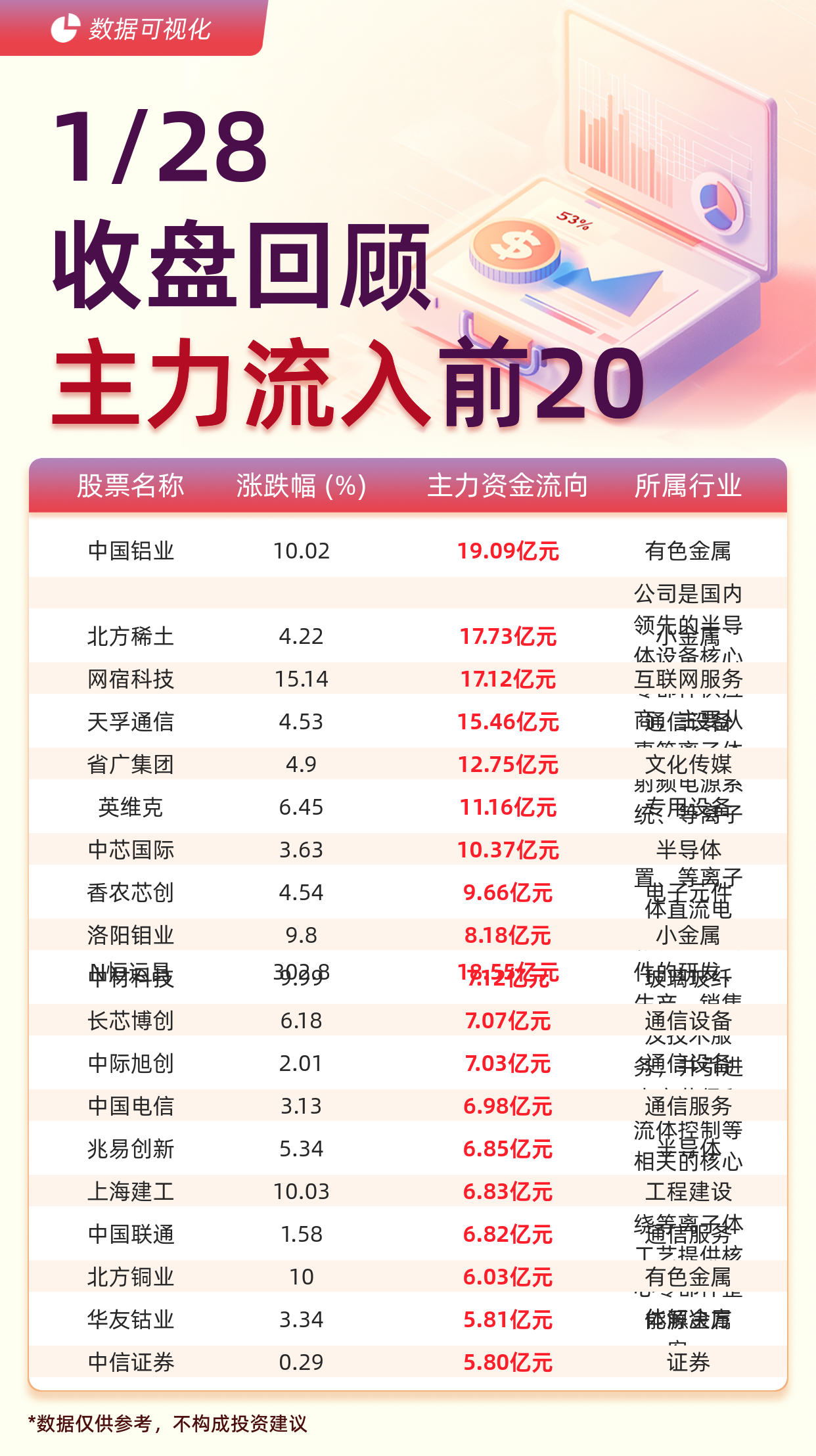
主力资金流入前20:中国铝业流入19.09亿元、N恒运昌流入18.55亿元
Jin Rong Jie· 2026-01-28 07:25
Core Viewpoint - The data indicates significant capital inflows into various stocks, highlighting potential investment opportunities in the market. Group 1: Stock Performance and Capital Inflows - China Aluminum (中国铝业) saw a capital inflow of 1.909 billion, with a price increase of 10.02% [1][2] - Northern Rare Earth (北方稀土) experienced a capital inflow of 1.773 billion, with a price increase of 4.22% [1][2] - Wangsu Science & Technology (网宿科技) had a capital inflow of 1.712 billion, with a notable price increase of 15.14% [1][2] - Tianfu Communication (天孚通信) recorded a capital inflow of 1.546 billion, with a price increase of 4.53% [1][2] - Province Advertising Group (省广集团) attracted a capital inflow of 1.275 billion, with a price increase of 4.9% [1][2] Group 2: Additional Notable Stocks - Invech (英维克) had a capital inflow of 1.116 billion, with a price increase of 6.45% [1][2] - SMIC (中芯国际) saw a capital inflow of 1.037 billion, with a price increase of 3.63% [1][2] - Shannon Chip Creation (香农芯创) experienced a capital inflow of 966 million, with a price increase of 4.54% [1][2] - Luoyang Molybdenum (洛阳钼业) had a capital inflow of 818 million, with a price increase of 9.8% [1][2] Group 3: Other Stocks with Capital Inflows - Changxin Bochuang (长芯博创) recorded a capital inflow of 707 million, with a price increase of 6.18% [3] - Zhongji Xuchuang (中际旭创) had a capital inflow of 703 million, with a price increase of 2.01% [3] - China Telecom (中国电信) saw a capital inflow of 698 million, with a price increase of 3.13% [3] - Zhaoyi Innovation (兆易创新) attracted a capital inflow of 685 million, with a price increase of 5.34% [3] - Shanghai Construction (上海建工) had a capital inflow of 683 million, with a price increase of 10.03% [3] - China Unicom (中国联通) recorded a capital inflow of 682 million, with a price increase of 1.58% [3] - Northern Copper (北方铜业) saw a capital inflow of 603 million, with a price increase of 10% [3] - Huayou Cobalt (华友钴业) had a capital inflow of 581 million, with a price increase of 3.34% [3] - CITIC Securities (中信证券) recorded a capital inflow of 580 million, with a price increase of 0.29% [3]



产业经济周报:BD出海加速,AI应用竞赛升级
Tebon Securities· 2026-01-28 07:25
Market Performance - The market showed mixed performance from January 19 to January 23, with the Shanghai Composite Index rising by 0.84% and the Shenzhen Component Index increasing by 1.11%[5] - The average daily trading volume was 2.80 trillion yuan, a decrease compared to the previous week[5] Healthcare Sector - At the JPM 2026 conference, over 20 Chinese innovative pharmaceutical companies showcased their products, with significant business development (BD) transactions announced[16] - In 2025, the value of China's innovative drug patent licensing transactions reached approximately $135.7 billion, a 143% increase year-on-year, with 157 total transactions[20] Consumer Sector - The Qianwen APP integrated with Alibaba's ecosystem, achieving over 100 million monthly active users within two months of launch, marking its entry into the "billion-level club"[25] - This integration allows for a seamless process from search to decision-making and payment, establishing a comprehensive AI application ecosystem[26] Hard Technology Sector - The supply of storage and logic chips remains tight, leading to widespread price increases across the industry[32] - The price of enterprise SSDs continues to rise, with a projected increase of 33-38% for NAND Flash products due to supply constraints[36] High-end Manufacturing - The State Grid announced a total fixed asset investment of 4 trillion yuan for the 14th Five-Year Plan period (2026-2030), a 40% increase from the previous period, averaging 800 billion yuan annually[42] - The goal is to achieve a 30% share of renewable energy in total power generation by 2030, indicating significant growth potential for the solar and wind energy sectors[46]



连MCU都开始涨价了!(附最新涨价函汇总)
芯世相· 2026-01-28 07:07
Core Viewpoint - The semiconductor industry is experiencing a widespread price increase, affecting various segments including memory, passive components, and main control chips, driven by rising raw material costs and strong demand, particularly in AI applications [2][3][35]. Price Increases in Semiconductor Components - Companies like Zhongwei Semiconductor announced price hikes of 15%-50% for MCU and NOR Flash products starting January 2026 [2][60]. - Major memory manufacturers such as Samsung and SK Hynix have also raised prices significantly, with Samsung increasing NAND Flash prices by over 100% in Q1 2026 [20][22]. - Micron has reported a general price increase of approximately 20% across its product lines [23][24]. Price Increases in Raw Materials and PCB - Resonac announced a 30% price increase for copper-clad laminates and adhesive films starting March 1, 2026, due to tight supply and rising costs [8]. - Nanya Plastics raised prices for all CCL and PP products by 8% due to increases in raw material costs [12]. - Taisil has implemented price increases of 5%-10% for its copper-clad laminates in response to rising material costs [9]. Price Increases in Wafer Foundries - TSMC has informed clients of price increases for advanced nodes (5nm, 4nm, 3nm, 2nm) over four consecutive years, with expected increases of 8%-10% for 5nm and up to 50% for 2nm [15]. - SMIC has also raised prices by approximately 10% for certain capacities [16]. - TrendForce predicts that the average capacity utilization rate for 8-inch wafer foundries will rise to 85%-90% in 2026, prompting price increases of 5%-20% across the board [14]. Price Increases in Passive Components - Companies like Yageo and Walsin have announced price increases for tantalum capacitors and resistors, with Yageo raising prices by 15%-20% for certain resistor products [33][34]. - Other passive component manufacturers are also adjusting prices due to rising raw material costs, with increases ranging from 5% to 30% [32][40]. General Market Trends - The semiconductor market is seeing a significant increase in demand driven by AI applications, leading to widespread price adjustments across various sectors [35][58]. - Many companies are experiencing full order books, prompting them to consider further price increases in the near future [19][20].



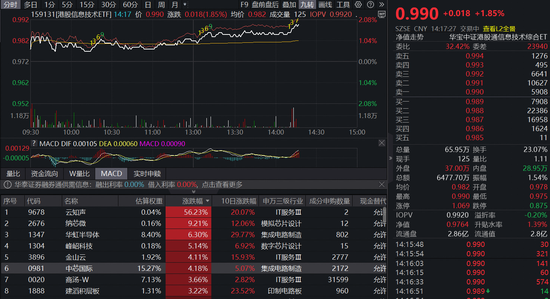
ETF盘中资讯|港股芯片午后急涨!华虹半导体、中芯国际双双大涨,港股信息技术ETF(159131)劲涨1.85%
Jin Rong Jie· 2026-01-28 07:04
Core Viewpoint - The Hong Kong stock market is experiencing a surge in the hard technology sector, particularly in the semiconductor industry, with significant gains in stocks like Yunzhisheng and Naxinwei, and the launch of the first ETF focused on the Hong Kong chip industry [1][3]. Group 1: Market Performance - Yunzhisheng's stock price surged by 56%, while Naxinwei increased by over 9%, Huahong Semiconductor rose by over 6%, and SMIC gained over 4% [1]. - The newly launched Hong Kong Information Technology ETF (159131) saw a price increase of 1.85%, with a real-time transaction volume exceeding 64.77 million CNY [1][2]. Group 2: ETF Details - The Hong Kong Information Technology ETF (159131) is the first ETF focusing on the "Hong Kong chip" industry chain, with a composition of 70% hardware and 30% software, covering 42 hard technology companies [3]. - Key holdings in the ETF include SMIC with a weight of 15.26%, Xiaomi Group-W at 11.95%, and Huahong Semiconductor at 8.40% [3]. Group 3: Semiconductor Market Insights - According to SIA data, global semiconductor sales are projected to reach 75.28 billion USD by November 2025, marking 25 consecutive months of year-on-year growth [1]. - China's semiconductor sales are expected to be 20.23 billion USD, reflecting a year-on-year increase of 22.9% and a month-on-month increase of 3.9% [1].
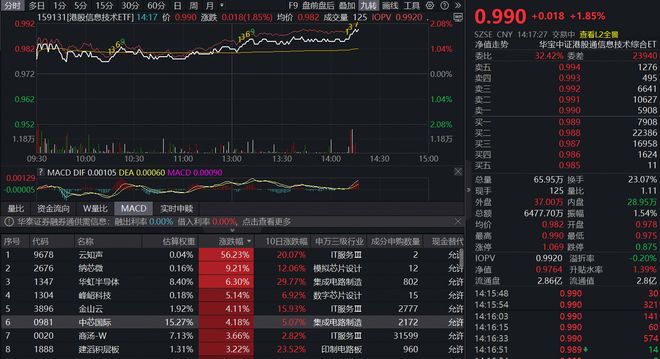
港股芯片午后急涨!华虹半导体、中芯国际双双大涨,港股信息技术ETF(159131)劲涨1.85%
Xin Lang Cai Jing· 2026-01-28 06:46
Core Viewpoint - The Hong Kong stock market's hard technology sector is experiencing a significant rally, with notable increases in stock prices for companies like Yunzhisheng and Naxinwei, alongside the launch of the first ETF focused on the Hong Kong chip industry [1][5]. Group 1: Market Performance - Yunzhisheng's stock surged by 56%, Naxinwei increased by over 9%, Huahong Semiconductor rose by over 6%, and SMIC gained over 4% [1][5]. - The Hong Kong Information Technology ETF (159131), which focuses on the chip industry, saw its price rise by 1.85%, with a trading volume exceeding 64.77 million yuan [1][5]. Group 2: ETF Details - The ETF is the first in the market to focus on the Hong Kong chip industry, with a composition of 70% hardware and 30% software, covering 42 hard technology companies [3][7]. - Key holdings in the ETF include SMIC with a weight of 15.26%, Xiaomi Group-W at 11.95%, and Huahong Semiconductor at 8.40% [3][7]. - The ETF excludes major internet companies like Alibaba, Tencent, and Meituan, allowing for a sharper focus on the AI hard technology sector [3][7]. Group 3: Semiconductor Market Insights - According to SIA data, global semiconductor sales are projected to reach $75.28 billion by November 2025, marking 25 consecutive months of year-on-year growth [6][8]. - China's semiconductor sales are expected to be $20.23 billion, reflecting a year-on-year increase of 22.9% and a month-on-month increase of 3.9% [6][8]. - In the storage segment, both DRAM and NAND Flash contract prices rose in November, with DRAM spot prices continuing to increase in December [6][8].
债市早报:2025年全国规模以上工业企业利润实现增长;资金面有所改善,债市震荡调整
Jin Rong Jie· 2026-01-28 03:42
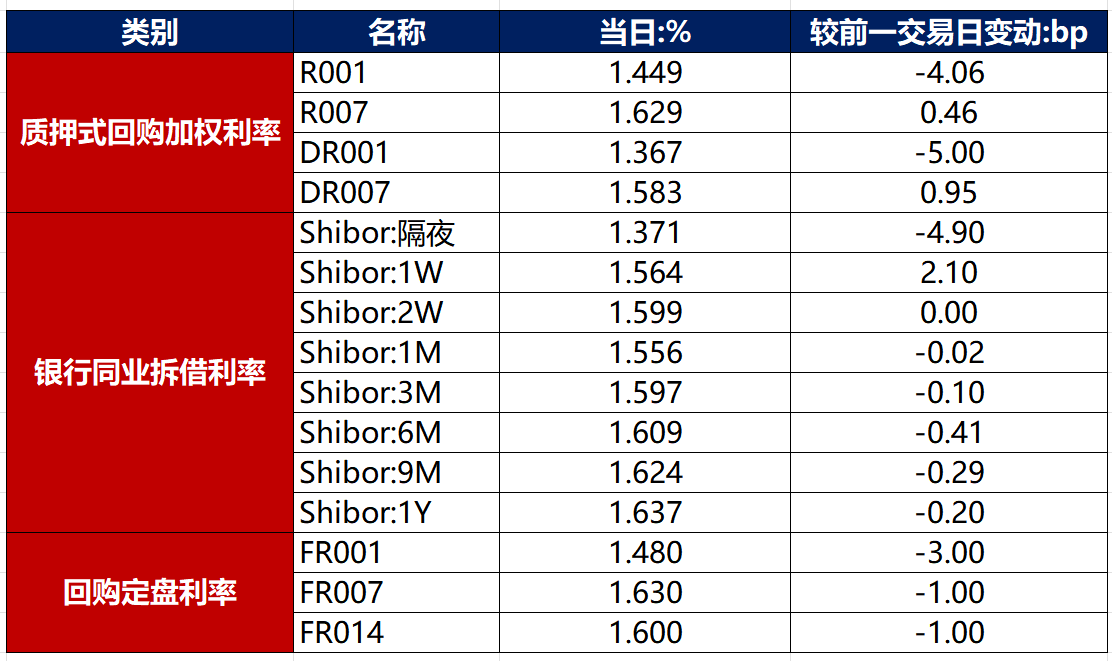
Group 1: Domestic News - The UK Prime Minister Starmer will visit China from January 28 to 31, marking the first visit by a UK Prime Minister in eight years, with discussions on trade and investment cooperation expected [2] - The Ministry of Human Resources and Social Security plans to expand the scale of entrusted investment of the basic pension insurance fund, with the total income of three social insurance funds reaching 9.1 trillion yuan and total expenditure at 8.1 trillion yuan by the end of 2025 [2] - By the end of 2025, the loan acquisition rate for technology-based small and medium-sized enterprises reached 50.2%, an increase of 2 percentage points from the previous year [3] Group 2: Economic Indicators - The profits of industrial enterprises above designated size in China increased by 0.6% year-on-year in 2025, reversing a three-year decline, with significant contributions from equipment manufacturing and high-tech industries [3] - Jilin Province has successfully exited the list of key local debt provinces, achieving the standards set in its 14th Five-Year Plan [4] Group 3: International News - The Federal Reserve is expected to pause interest rate cuts for the first time since September, maintaining the benchmark rate between 3.5% and 3.75% [5] - India and the EU have finalized a historic free trade agreement, with India agreeing to eliminate tariffs on over 90% of EU goods, marking a significant shift in trade relations [6] Group 4: Market Dynamics - The bond market showed fluctuations with the stock market's performance, as the yield on the 10-year government bond rose by 0.70 basis points to 1.8320% [11] - The convertible bond market saw a collective increase in major indices, although most individual convertible bonds experienced declines, with 162 bonds rising and 207 falling [14] Group 5: Commodity Prices - International crude oil prices increased, with WTI crude rising by 2.90% to $62.39 per barrel, while natural gas prices saw a slight decline [7] Group 6: Financial Operations - The central bank conducted a reverse repurchase operation of 402 billion yuan at a fixed rate, resulting in a net injection of 78 billion yuan into the market [8] - The money market showed improvement with the DR001 rate decreasing by 5.00 basis points to 1.367% [9]



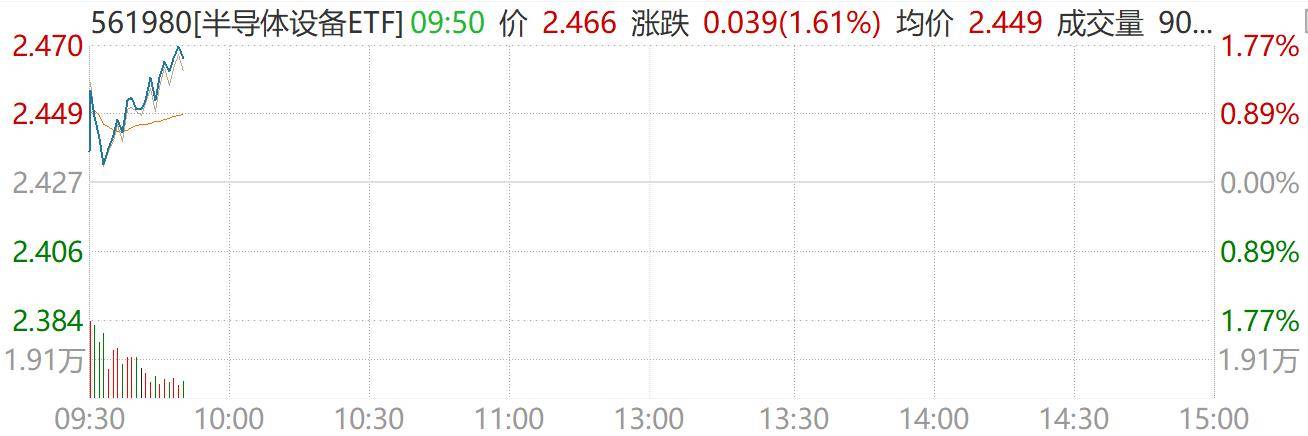
星星之火,全面燎原!芯片涨价潮蔓延,半导体设备ETF(561980)盘中拉涨1.61%!
Sou Hu Cai Jing· 2026-01-28 02:35
1月28日早盘,受产业链涨价潮蔓延提振,存储芯片概念反复走强,核心受益板块半导体设备板块逆势拉升。热门半导体设备ETF(561980)盘中拉涨 1.61%,权重股中微公司、中芯国际涨超2%,拓荆科技涨超5%,康强电子二度封板,金海通、盛美上海、神工股份等多股走强。 半导体设备ETF(561980)跟踪中证半导,重仓中微公司、北方华创等设备龙头以及晶圆厂龙头中芯国际,芯片设计龙头海光信息、寒武纪和材料龙头南大 光电等,前十大集中度约75%,在同类指数中位居前列。 资金面数据显示,半导体设备ETF(561980)最近10个交易日累计获资金净流入超4.6亿元,最新规模超36亿。标的指数中证半导2025年至今最大涨幅超 112%,在科创芯片、半导体材料设备等同类指数中位居第一,弹性突出。 消息面上,多家芯片设计公司最新发布涨价函通知,确认产业链景气传导全面蔓延。 中微半导1月27日宣布,受封装交付周期拉长、框架及封测费用上涨影响,对MCU(微控制器)、Nor Flash(闪存)等产品提价15%-50%,直接反映了半导 体制造后道环节的成本压力已传导至芯片设计公司。 国科微同日宣布,因存储芯片供应紧张、成本上升及基板等 ...



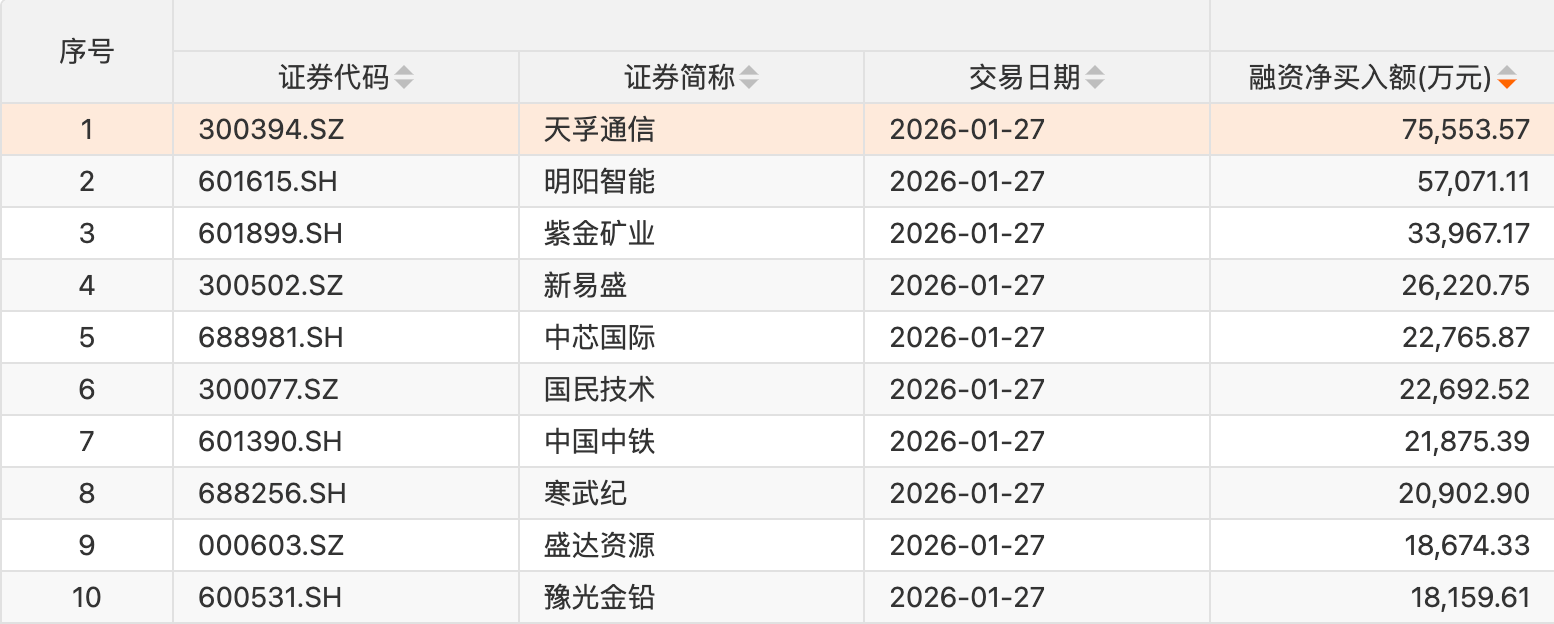
资金风向标|两融余额较上一日减少20.5亿元 通信行业获融资净买入额居首
Sou Hu Cai Jing· 2026-01-28 02:01
Group 1 - As of January 27, the A-share margin balance is 27,233.91 billion yuan, a decrease of 20.5 billion yuan from the previous trading day, accounting for 2.61% of the A-share circulating market value [1] - The margin trading volume on the same day was 2,794.96 billion yuan, down by 319.11 billion yuan from the previous trading day, representing 9.56% of the A-share transaction volume [1] - Among the 31 primary industries in Shenwan, 17 industries experienced net financing inflows, with the communication industry leading at a net inflow of 1.11 billion yuan [1] Group 2 - A total of 41 stocks had net financing inflows exceeding 100 million yuan, with Tianfu Communication leading at a net inflow of 756 million yuan [1] - Other stocks with significant net financing inflows include Mingyang Smart Energy, Zijin Mining, New Yisheng, SMIC, Guomao Technology, China Railway, Cambricon, Shengda Resources, and Yuguang Gold Lead [1][2] - Recently, Amazon Web Services announced a price increase of approximately 15% for its EC2 machine learning capacity blocks used for large model training, indicating sustained high demand for AI computing power [2]