SPD BANK(600000)

Search documents
股份行前三季度盈利承压,4家营收净利双降
Di Yi Cai Jing Zi Xun· 2025-11-04 11:40
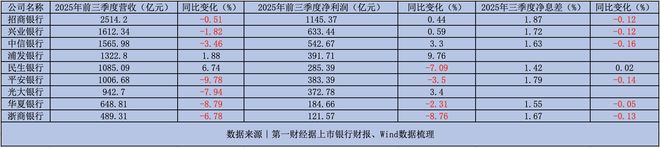
Core Insights - The overall profitability of A-share listed joint-stock banks faces significant pressure, with both revenue and net profit showing a year-on-year decline [1][2] - Among the nine listed banks, total revenue reached approximately 1.12 trillion yuan, down 2.56% year-on-year, while net profit was 406.1 billion yuan, with a nearly 1% decrease [2][3] - Leading banks like China Merchants Bank and Shanghai Pudong Development Bank performed relatively well, with the latter being the only bank to achieve "double growth" in both revenue and net profit [4] Revenue and Profit Performance - China Merchants Bank led with a revenue of 251.42 billion yuan, a slight decline of 0.51%, and a net profit of 114.54 billion yuan, an increase of 0.44% [3][4] - Shanghai Pudong Development Bank reported a revenue increase of 1.88% to 132.28 billion yuan and a net profit growth of 9.76% to 39.17 billion yuan [4] - Other banks like Ping An Bank, Everbright Bank, Huaxia Bank, and Zheshang Bank experienced declines in both revenue and net profit [4] Net Interest Margin and Asset Quality - The net interest margin (NIM) remains low but shows signs of stabilization, with five banks reporting a decrease in non-performing loan (NPL) ratios compared to the end of the previous year [1][6] - The average NPL ratio for the nine banks was 1.24%, with China Merchants Bank having the lowest at 0.94% and Huaxia Bank the highest at 1.58% [9][10] - The NIM for major banks like China Merchants Bank, Ping An Bank, and Industrial Bank showed a year-on-year decline, while Minsheng Bank saw a slight increase [6][7] Non-Interest Income and Market Trends - Non-interest income growth varied, with China Merchants Bank leading in wealth management, achieving a nearly 20% increase in fee and commission income [8] - The capital market's increased activity has positively impacted some banks' agency and custody businesses, although overall non-interest income growth remains weaker than that of state-owned banks [8] - Analysts suggest that wealth management, investment banking, and custody services are becoming new differentiators among joint-stock banks [8] Asset Quality and Risk Management - The overall asset quality of joint-stock banks remains stable, with a slight decline in NPL ratios and sufficient risk coverage [9][11] - Seven out of nine banks experienced a decline in their provision coverage ratios, with Ping An Bank showing the largest drop [11] - The risk management focus includes monitoring the asset quality of small and micro enterprises and unsecured retail loans, with expectations for stable asset quality in the coming year [12]







浦发银行中层调整涉及零售条线多部门和一级分行
Xin Lang Cai Jing· 2025-11-04 10:01
Core Viewpoint - The article highlights that among nine A-share listed commercial banks, only Shanghai Pudong Development Bank (SPDB) achieved growth in both revenue and net profit for the first three quarters of 2025, with a revenue of 132.28 billion yuan and a net profit of 38.8 billion yuan, marking a year-on-year increase of 1.88% and a leading net profit growth rate exceeding 10% among peers [1][7]. Management Changes - SPDB has undergone significant management changes, particularly in its retail banking division, with key appointments including Zhang Ruilin as the Director of Retail Business and General Manager of the Retail Business Department [1]. - Li Zhi has been appointed as the General Manager of the Retail Credit Department, while other notable changes include the appointment of various branch vice presidents to new roles within the bank [2][3]. Business Performance - As of September 2025, SPDB's personal deposit balance reached 1.717 trillion yuan, an increase of 166.85 billion yuan or 10.76% from the end of the previous year [4]. - Retail loans (excluding personal business loans) amounted to 1.504 trillion yuan, reflecting a growth of 2.84% [4]. - The bank's asset management scale in wealth management and private banking reached 3.19 trillion yuan, with a net increase of 503.06 billion yuan, and intermediary business income grew by 15.4% year-on-year [4]. Financial Metrics - SPDB's total assets as of September 2025 were 9.892 trillion yuan, an increase of 430.33 billion yuan or 4.55% from the end of the previous year [6]. - The bank's group loan total (including bill discounting) increased by 280.6 billion yuan, a growth of 5.20% [7]. - The total deposits of the group rose by 472.76 billion yuan, a growth of 9.19%, while the average interest rate on deposits decreased by 38 basis points compared to the same period last year [8].
9家股份行三季报透视:5家不良率降,零售AUM增长成亮点
Nan Fang Du Shi Bao· 2025-11-04 09:59
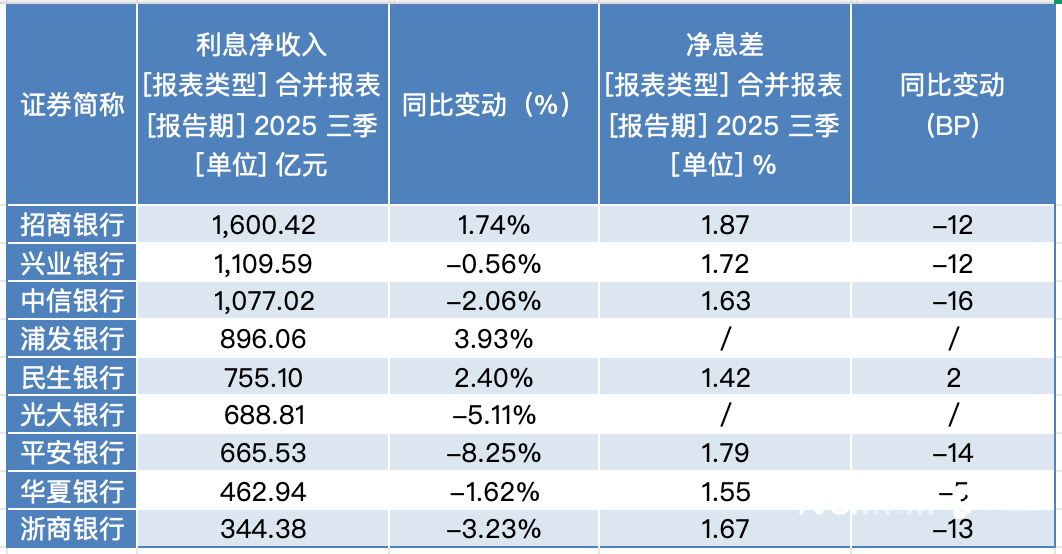
Core Viewpoint - The performance of nine A-share listed joint-stock banks in the third quarter of 2025 shows a mixed picture, with seven banks experiencing a year-on-year decline in operating income and five banks seeing a drop in net profit. Only Shanghai Pudong Development Bank achieved growth in both metrics [1][2]. Financial Performance - Among the nine banks, only Shanghai Pudong Development Bank and Minsheng Bank reported year-on-year growth in operating income, while four banks, including China Merchants Bank and Industrial Bank, saw an increase in net profit [2][3]. - China Merchants Bank led in operating income with CNY 251.42 billion, followed by Industrial Bank and CITIC Bank with CNY 161.23 billion and CNY 156.60 billion, respectively. Zhejiang Commercial Bank ranked last with CNY 48.93 billion [2]. - Minsheng Bank recorded the highest operating income growth rate at 6.74%, while Ping An Bank experienced the most significant decline at -9.78% [2]. Net Profit Analysis - China Merchants Bank maintained the highest net profit at CNY 113.77 billion, with a slight increase of 0.52%. Shanghai Pudong Development Bank saw a notable increase of 10.21% in net profit [3]. - The only bank to achieve growth in both operating income and net profit was Shanghai Pudong Development Bank, which reported a 1.88% increase in operating income [3]. Interest Income and Net Interest Margin - Six banks reported a year-on-year decline in net interest income, with the overall industry facing pressure on net interest margins, although the rate of decline has narrowed [4][6]. - China Merchants Bank led in net interest income with CNY 160.04 billion, showing a 1.74% increase, while Ping An Bank faced the largest decline at -8.25% [5][6]. Asset Quality - The asset quality of the banks showed mixed results, with five banks reporting a decline in non-performing loan (NPL) ratios, while three banks saw an increase [7][9]. - China Merchants Bank maintained the best asset quality with an NPL ratio of 0.94%, while Ping An Bank's NPL ratio was 1.05% [8][9]. Retail and Corporate Loan Trends - The third quarter of 2025 revealed a shift in loan structure, with corporate loans expanding while retail loans showed weakness. Three banks reported negative growth in retail loans [10][12]. - Among the banks, only Shanghai Pudong Development Bank, China Merchants Bank, and CITIC Bank saw growth in personal loans, while others experienced declines [11][12]. Retail Asset Under Management (AUM) - Several banks reported strong growth in retail AUM, with China Merchants Bank managing CNY 16.60 trillion in retail customer assets, an increase of 11.19% [12][14]. - Shanghai Pudong Development Bank's retail AUM reached CNY 4.62 trillion, reflecting a growth of 19.07% [13].


股份制银行板块11月4日涨2.44%,中信银行领涨,主力资金净流入17.63亿元
Zheng Xing Xing Ye Ri Bao· 2025-11-04 08:48
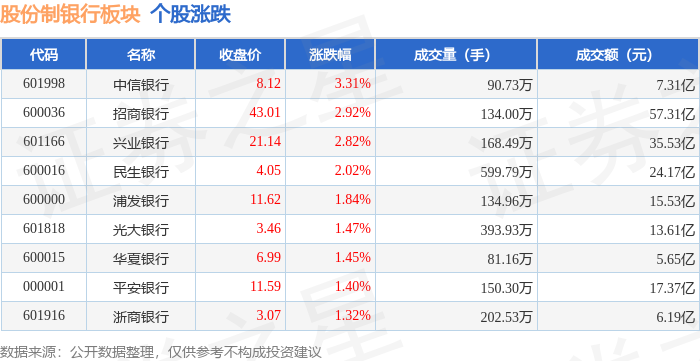
Core Viewpoint - The banking sector, particularly the joint-stock banks, experienced a notable increase of 2.44% on November 4, with CITIC Bank leading the gains, despite the overall decline in major stock indices [1] Group 1: Market Performance - The Shanghai Composite Index closed at 3960.19, down 0.41%, while the Shenzhen Component Index closed at 13175.22, down 1.71% [1] - CITIC Bank's stock price rose by 3.31% to 8.12, with a trading volume of 907,300 shares and a transaction value of 731 million [1] - Other notable performers included China Merchants Bank, which increased by 2.92% to 43.01, and Industrial Bank, which rose by 2.82% to 21.14 [1] Group 2: Capital Flow - The joint-stock banking sector saw a net inflow of 1.763 billion in main funds, while retail investors experienced a net outflow of 664 million [1] - Specific banks like Shanghai Pudong Development Bank had a main fund net inflow of 413 million, while retail investors saw a net outflow of 251 million [2] - Ping An Bank recorded a main fund net inflow of 294 million, with retail investors also experiencing a net outflow of 165 million [2]

银行ETF指数(512730)涨超1%,上市银行营收开始企稳
Xin Lang Cai Jing· 2025-11-04 02:28
Core Insights - The banking sector in China shows signs of stabilization in operating income after two years of decline, with a slight increase of 0.9% year-on-year in the first three quarters of 2023, totaling 4.32 trillion yuan [1] - Net profit for the 42 listed banks in China reached 1.68 trillion yuan in the same period, reflecting a growth of 1.5% compared to the previous year, outpacing revenue growth by 0.6 percentage points [1] - The current low valuation of the banking sector, combined with attractive dividend yields compared to bonds and wealth management products, suggests potential for increased investment in the sector [1] Banking Index Performance - The China Securities Banking Index (399986) rose by 1.14%, with significant gains from constituent stocks such as Shanghai Bank (up 2.48%) and CITIC Bank (up 1.91%) [1] - The Banking ETF Index (512730) also increased by 1.01%, closing at 1.7 yuan [1] Dividend and Market Sentiment - The concentrated dividend distribution period for banks has largely concluded since July, leading to a shift in market sentiment and increased risk appetite among investors [1] - The ongoing dividend distribution from banks remains robust, enhancing the attractiveness of bank stocks as a viable investment option [1] Index Composition - As of October 31, 2025, the top ten weighted stocks in the China Securities Banking Index account for 64.87% of the index, with major players including China Merchants Bank and Industrial and Commercial Bank of China [2]



零售贷款增速显著跑输对公,民生兴业平安个贷增速为负!哪家对公强?
Xin Lang Cai Jing· 2025-11-04 01:00
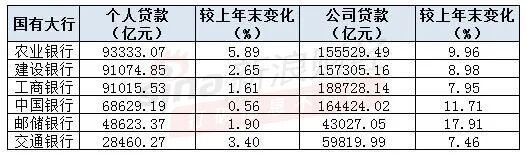
Core Viewpoint - The report highlights that corporate loans continue to drive the growth of bank credit, significantly outpacing retail loans in the first three quarters of 2025, with state-owned banks showing a notable increase in corporate lending compared to retail lending [1][5][11]. Group 1: State-Owned Banks Performance - Among state-owned banks, Agricultural Bank of China leads in personal loan size at 93,333.07 million yuan, with a growth of 5.89% compared to the end of the previous year [3][5]. - Postal Savings Bank shows a remarkable increase in corporate loans, with a growth rate of 17.91%, while its personal loans grew by only 1.90% [5][7]. - The overall trend indicates that personal loan growth is lagging behind corporate loan growth, with only Agricultural Bank exceeding a 5% increase in personal loans among the major banks [5][11]. Group 2: Joint-Stock Banks Performance - Several joint-stock banks, including Minsheng Bank, Industrial Bank, and Ping An Bank, reported negative growth in retail loans, while their corporate loans continued to grow positively [1][11]. - For instance, Ping An Bank's personal loans decreased by 2.10% to 17,291.92 million yuan, while its corporate loans saw a decline in bad debt rates [11][12]. - In contrast, China Merchants Bank reported a retail loan balance of 36,966.19 million yuan, with a modest growth of 1.43%, but its corporate loans grew significantly [9][13]. Group 3: Retail Asset Under Management (AUM) - Despite the challenges in retail loan growth, several banks reported strong growth in retail AUM. For example, China Merchants Bank's retail AUM reached 16.6 trillion yuan, growing by 11.19% [1][15]. - Shanghai Pudong Development Bank also reported a significant increase in personal financial assets, with a growth of 19.07% to 4.62 trillion yuan [15]. - Management teams from various banks emphasized their commitment to enhancing retail market share, indicating a long-term strategic focus on retail banking despite current market conditions [15][16].

机遇“金闪闪” 银行贵金属业务规模大增
Shang Hai Zheng Quan Bao· 2025-11-03 18:11
Core Viewpoint - The strong international gold prices and rising global risk aversion are driving the growth of banks' precious metals businesses, with significant year-on-year increases reported in the third-quarter financial results of listed banks. However, the recent fluctuations in gold prices present new challenges for these banking operations [1]. Group 1: Growth in Precious Metals Business - The precious metals business of banks has rapidly expanded due to the sustained rise in gold prices, with smaller banks showing particularly impressive growth. As of the end of September, Nanjing Bank's precious metals business reached 7.201 billion yuan, a staggering increase of 11,914.36% compared to the end of 2024. Hangzhou Bank's precious metals business grew to 1.217 billion yuan, up 1,523.57% from the end of 2024 [2]. - Joint-stock banks also experienced significant growth in their precious metals business. By the end of September, compared to the end of 2024, the precious metals business of Shanghai Pudong Development Bank increased by over 350%, while China CITIC Bank saw an increase of over 200%. Other banks like Zhejiang Commercial Bank, Industrial Bank, China Merchants Bank, and Minsheng Bank all reported growth exceeding 100% [2]. - Major banks maintained steady growth from a high base, with the precious metals business of Bank of China, China Construction Bank, and Agricultural Bank of China all increasing by over 10% compared to the end of 2024 [2]. Group 2: Strategic Focus on Precious Metals - The precious metals business combines wealth management and increased intermediary income, potentially becoming a significant factor in banks' intermediary income. Precious metals, especially gold, are seen as irreplaceable in banks' wealth management offerings and are crucial for customer asset allocation [3]. - Analysts note that the demand for gold as a hedge and a store of value is rising among residents. Banks, as key channels for gold bar sales and coin distribution, are well-positioned to meet this demand through the continued popularity of online investment products like account gold and gold accumulation [3]. - The decline in gold jewelry consumption may lead banks to reduce reliance on traditional jewelry sales and instead focus on innovation and promotion of their precious metals business [3]. Group 3: Risk Management Amid Price Volatility - Despite the growth, the high volatility of precious metals, particularly gold and silver, poses challenges for banks. Since October, these metals have entered a period of high volatility, prompting banks to enhance their risk management strategies [4]. - In response to market fluctuations, banks have adjusted trading rules and increased the minimum purchase thresholds for gold accumulation products to a range of 950 to 1,200 yuan, compared to around 500 yuan last year. Additionally, some banks have modified their precious metals wallet services to align with real-time gold price fluctuations [4]. - Looking ahead, institutions expect gold to retain its upward potential, maintaining its importance in asset allocation. The profitability of banks' precious metals business will increasingly depend on their internal capabilities, including the establishment of robust risk management systems to mitigate price volatility risks and the optimization of asset allocation for stable returns [4].


浦发银行三季报出炉:经营业绩持续向好 集团协同效应卓见成效
Jing Ji Guan Cha Bao· 2025-11-03 13:51
Core Viewpoint - Shanghai Pudong Development Bank (SPDB) demonstrated strong operational growth and improved asset quality in the first three quarters of 2025, driven by its "digital intelligence" strategy and a focus on enhancing financial support for the real economy [1][2]. Financial Performance - For the first three quarters, SPDB achieved operating income of 132.28 billion yuan, a year-on-year increase of 1.88% - The net profit attributable to shareholders reached 38.82 billion yuan, reflecting a year-on-year growth of 10.21% [1]. - As of the end of September, total assets amounted to 9,892.21 billion yuan, up 4.55% from the end of the previous year [2]. Asset Quality and Risk Management - SPDB's non-performing loan (NPL) balance and NPL ratio both decreased, with the NPL ratio at 1.29%, down 0.07 percentage points from the end of the previous year - The provision coverage ratio improved to 198.04%, an increase of 11.08 percentage points, enhancing the bank's risk mitigation capabilities [2]. Strategic Initiatives - The bank focused on key sectors and regions, enhancing its digital and scenario-based development capabilities, and deepening the integration of technology with financial services [3]. - In the technology finance sector, SPDB established a comprehensive "Group Innovation" ecosystem, serving over 250,000 technology enterprises with a loan balance exceeding 1 trillion yuan [3]. Supply Chain and Inclusive Finance - SPDB served 32,708 supply chain clients, a growth of 72.91% year-on-year, with online supply chain business volume reaching 574.86 billion yuan, up 267.65% [4]. - The "Puhui Loan" product system was developed to meet the diverse financing needs of small and micro enterprises, with a balance of 127.8 billion yuan, growing over 130% from the end of the previous year [4]. Cross-Border and Wealth Management - Cross-border transaction settlement volume increased by 47%, with cross-border loans growing by 23% [5]. - Personal financial assets under management reached 4.62 trillion yuan, a year-on-year increase of 19.07%, indicating strong growth in wealth management services [5]. Future Outlook - SPDB plans to continue aligning with national strategic deployments, enhancing financial service quality, and supporting high-quality development through digital transformation and risk management [6].
上市银行信披考评出炉:光大、华夏、浙商提级,上海银行降级
2 1 Shi Ji Jing Ji Bao Dao· 2025-11-03 10:57
Core Viewpoint - The quality of information disclosure is a crucial indicator of the quality of listed companies and serves as an important basis for investors' decision-making. The Shanghai and Shenzhen Stock Exchanges have emphasized the importance of information disclosure quality and have implemented comprehensive evaluations of listed companies' disclosure practices [1][3]. Group 1: Regulatory Framework - In March, the Shanghai and Shenzhen Stock Exchanges released guidelines focusing on enhancing information disclosure regulation, punishing financial fraud, strengthening cash dividend supervision, and promoting the enhancement of investment value for listed companies [1][3]. - The evaluation criteria for information disclosure quality include eight aspects: normative disclosure, effective disclosure, investor relations management, return to investors, social responsibility disclosure, penalties and regulatory measures, support for exchange work, and other factors recognized by the exchange [3][5]. Group 2: Evaluation Results - Among the 42 A-share listed banks, all received ratings of B or above, with 22 banks rated A. Most banks maintained their ratings from the previous year, with only six experiencing changes [3][6]. - The banks rated A include major state-owned banks such as Industrial and Commercial Bank of China, Agricultural Bank of China, and China Bank, as well as several joint-stock and city commercial banks [6][7]. Group 3: Impact on Capital Activities - The evaluation results of information disclosure will influence the review of refinancing and mergers and acquisitions for listed banks, establishing a strong market incentive and constraint mechanism [5][8]. - Both the Shanghai and Shenzhen Stock Exchanges provide various supports and conveniences for companies rated A, such as exemptions from post-review for temporary reports and reduced inquiry rounds for restructuring audits [8][9]. Group 4: Commitment to Improvement - Several banks, including Hangzhou Bank and China CITIC Bank, have publicly committed to further enhancing their information disclosure quality following their A ratings, emphasizing transparency, effective communication, and governance [10][11]. - China CITIC Bank has highlighted its commitment to investor rights protection, having distributed over RMB 170 billion in cash dividends and planning to increase its mid-term dividend payout ratio [11].

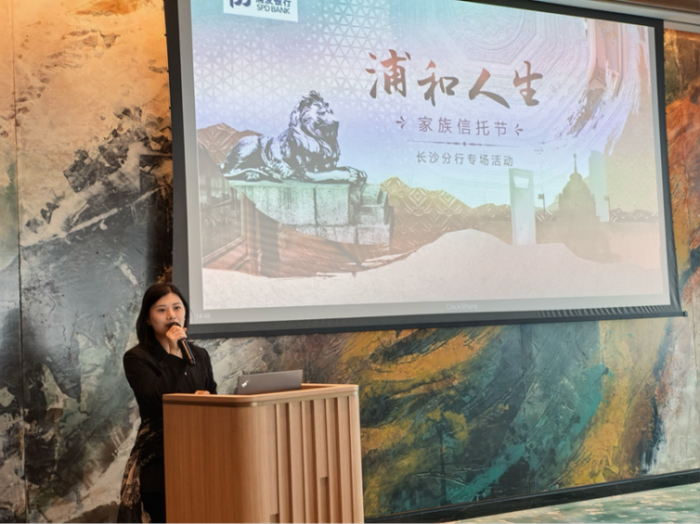
赋能高净值客户财富管理新实践,“浦和人生” 家族信托节举行
Chang Sha Wan Bao· 2025-11-03 10:24
Core Insights - The event "浦和人生" Family Trust Festival focused on new wealth management strategies amid changing times, featuring expert speakers from the insurance and trust sectors [1][3] Group 1: Event Overview - The second customer-focused event of the "浦和人生" Family Trust Festival was successfully held by SPD Bank's Changsha branch [1] - The event aimed to explore new paths for wealth preservation, appreciation, and inheritance [1] Group 2: Expert Presentations - The general manager of the bank's private banking department introduced the core advantages of the "浦和人生" wealth management trust account service system, emphasizing customized solutions for high-net-worth clients [3] - The first speaker, Lu Chen from Sunshine Life Insurance, discussed wealth management strategies in the context of economic cycles and the three distribution systems under the common prosperity framework [3] - The second speaker, Ding Yuxiang from Shanghai International Trust, focused on the domestic family trust sector, analyzing industry development, client demand trends, and key compliance issues [3] Group 3: Future Directions - SPD Bank aims to enhance the brand awareness and market influence of the "浦和人生" wealth management trust business through ongoing events [4] - The bank plans to deepen its "digital intelligence" development strategy, focusing on new ecosystems in the financial sector, and to enrich family trust service applications and functionalities [4]