DFAC(600006)

Search documents
比亚迪、小米汽车、理想、蔚来、小鹏、赛力斯等车企,集体表态!
Mei Ri Jing Ji Xin Wen· 2025-09-15 07:37
Core Viewpoint - The China Automotive Industry Association has released the "Supplier Payment Norms Initiative for Complete Vehicle Enterprises," which aims to standardize key aspects of procurement contracts between automakers and suppliers, including order confirmation, delivery and acceptance, payment and settlement, and contract duration [1] Group 1: Initiative Details - The initiative specifies requirements for goods delivery acceptance, account period commencement, reconciliation and settlement, and payment, such as a maximum goods acceptance time of three working days and a minimum contract validity of one year [1] - The initiative is expected to significantly promote the standardized development of the automotive industry [1] Group 2: Company Responses - SAIC Group announced it will unify supplier payment terms to within 60 days by June 2025 and will not use commercial acceptance bills to avoid increasing suppliers' financial pressure [3] - BYD Auto expressed its commitment to the initiative and aims to foster a collaborative ecosystem for high-quality development in the Chinese automotive industry through technological innovation and management optimization [5] - GAC Group has consistently adhered to a payment principle of not exceeding 60 days for suppliers since its establishment in 1997, emphasizing integrity and collaboration within the industry [7] - Changan Automobile has implemented a payment scheme that ensures a 60-day payment commitment and is exploring efficient payment processes for suppliers [10] - Dongfeng Motor pledged to implement the initiative's requirements to protect supplier rights and enhance supply chain resilience [12] - Xiaomi Auto fully supports the initiative and commits to maintaining a payment period of within 60 days while focusing on key procurement aspects [14] - Li Auto will continue to uphold its 60-day payment commitment and ensure timely acceptance and reconciliation of goods [16] - NIO aims to establish long-term, mutually beneficial relationships with partners while adhering to the supplier payment norms [17] - Seres Group calls for self-discipline among enterprises to promote high-quality industry development and enhance competitiveness [18] - Beijing Automotive Group is optimizing its payment mechanisms and opposing unreasonable payment practices to safeguard supplier rights [20]





上汽、比亚迪、长安、小米、理想等车企,集体表态
财联社· 2025-09-15 06:55
Core Viewpoint - The China Automotive Industry Association has released the "Supplier Payment Norms Initiative for Complete Vehicle Enterprises," which aims to standardize key aspects of procurement contracts between automakers and suppliers, including order confirmation, delivery and acceptance, payment and settlement, and contract duration [1] Group 1: Industry Response - Multiple automakers, including SAIC Motor, BYD, GAC Group, Xiaomi Auto, and Seres, have expressed their support for the initiative [2] - SAIC Motor has committed to unifying supplier payment terms to within 60 days and will not use commercial acceptance bills to alleviate supplier financial pressure [3] - BYD emphasizes the importance of technological innovation and management optimization to build a collaborative ecosystem for high-quality development in the automotive industry [5] - GAC Group has maintained a payment principle of not exceeding 60 days for 28 years, demonstrating its commitment to supplier relationships and supply chain stability [7] - Changan Automobile has implemented a payment process that ensures payments are made within 60 days, showcasing its commitment to supplier payment norms [10] - Dongfeng Motor aims to protect supplier rights and enhance industry resilience by adhering to the initiative's requirements [12] - Xiaomi Auto reaffirms its commitment to a 60-day payment term and aims to enhance supplier rights and industry resilience [14] - Li Auto is committed to maintaining a 60-day payment term and ensuring timely delivery and settlement processes [17] - NIO focuses on establishing long-term, mutually beneficial relationships with partners while adhering to the payment norms [19] - Seres calls for self-discipline among enterprises to promote high-quality industry development and enhance competitiveness [20] - XPeng Motors is dedicated to maintaining a 60-day payment term and ensuring efficient payment processes for partners [22]

上汽、比亚迪、小米等车企迅速响应:积极落实账款支付倡议
Xin Lang Cai Jing· 2025-09-15 06:53
Core Viewpoint - The China Automobile Industry Association has launched the "Supplier Payment Norms Initiative" to standardize payment practices between automobile manufacturers and suppliers, aiming to promote the healthy development of the automotive industry [1] Group 1: Initiative Details - The initiative specifies requirements for delivery acceptance, payment terms, and contract duration, including a maximum delivery acceptance time of three working days and a minimum contract duration of one year [1] - The initiative is expected to significantly contribute to the standardized development of the automotive industry [1] Group 2: Company Responses - SAIC Motor Group has unified supplier payment terms to within 60 days and will not use commercial acceptance bills to alleviate supplier financial pressure [2] - BYD has committed to implementing the initiative and enhancing collaboration with upstream and downstream partners to foster a win-win ecosystem [4] - GAC Group has consistently adhered to a payment principle of not exceeding 60 days for suppliers since its establishment in 1997, demonstrating its commitment to supplier relationships [6] - Changan Automobile has implemented a payment scheme that ensures a 60-day payment period, promoting high-quality industry development [9] - Dongfeng Motor has pledged to protect supplier rights and enhance supply chain resilience [11] - Xiaomi Auto has reaffirmed its commitment to a 60-day payment period and aims to strengthen supplier relationships [13] - Li Auto has committed to timely delivery acceptance and settlement standards to ensure partner stability [16] - NIO has expressed its intention to build long-term mutually beneficial relationships with partners while adhering to the payment norms [17] - Xpeng Motors has committed to strict adherence to the initiative and ensuring timely payment and acceptance processes [22]
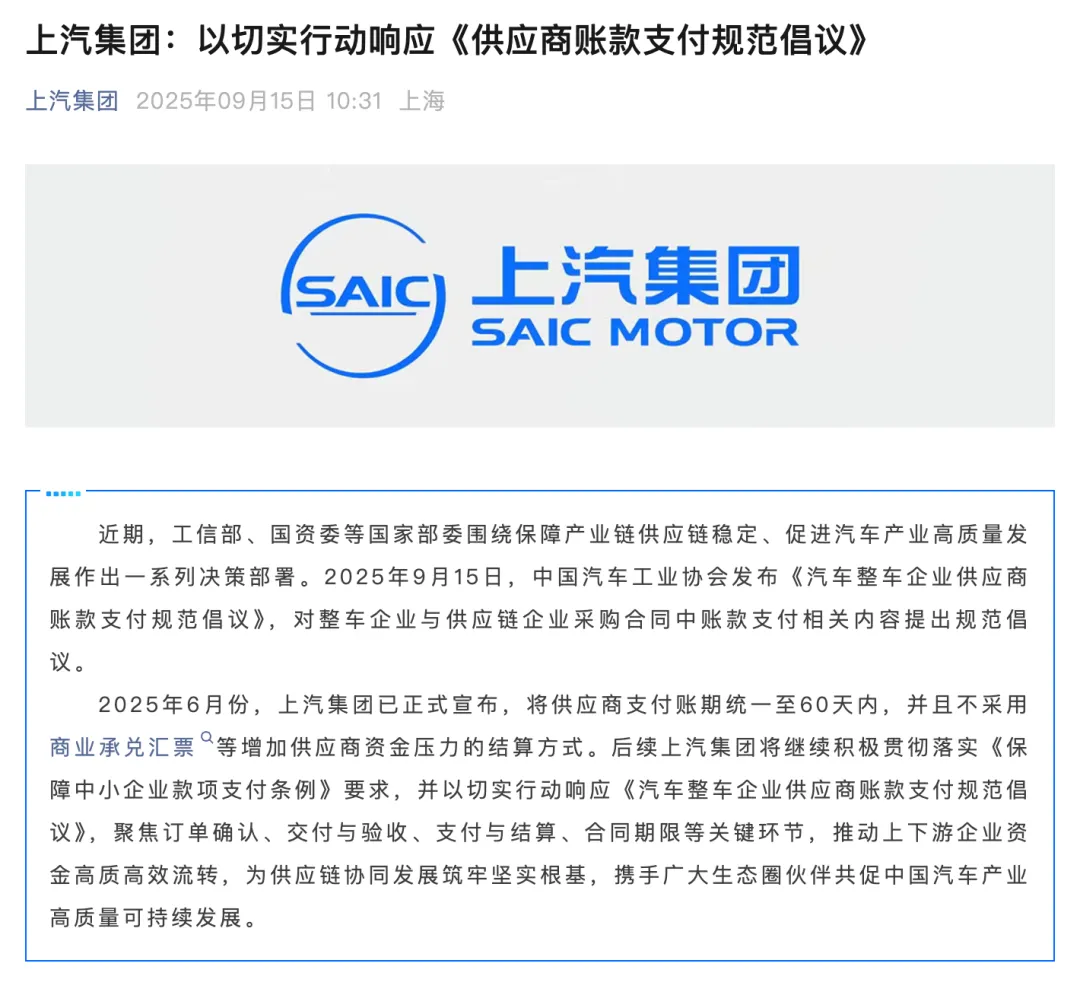
多家车企表态供应商账期不超60天
Bei Jing Wan Bao· 2025-09-15 06:51
Core Viewpoint - Multiple automotive companies are responding positively to the China Automotive Industry Association's initiative to standardize supplier payment terms, aiming to enhance the stability and health of the automotive supply chain [1] Group 1: Industry Response - The China Automotive Industry Association issued a proposal on September 15, 2023, to regulate payment terms between automotive manufacturers and suppliers, emphasizing key aspects such as order confirmation, delivery and acceptance, payment and settlement, and contract duration [1] - The initiative specifies that the acceptance of goods should ideally be completed within three working days, and encourages stable cooperation between suppliers and manufacturers, with contracts lasting no less than one year [1] Group 2: Company Commitments - SAIC Motor Group announced that by June 2025, it will unify supplier payment terms to within 60 days and will not use commercial acceptance bills that increase financial pressure on suppliers [1] - BYD Auto expressed its commitment to the initiative, focusing on key areas such as order confirmation and payment processes, and aims to foster a collaborative ecosystem for high-quality development in the Chinese automotive industry [1] - GAC Group has consistently adhered to the principle of not exceeding 60 days for supplier payment since its establishment in 1997, demonstrating its commitment to supply chain stability [1] - Changan Automobile is actively supporting the initiative and has implemented a payment process that ensures compliance with the 60-day payment commitment [1]
上汽、比亚迪、长安、小米、理想等车企,集体表态
Bei Jing Ri Bao Ke Hu Duan· 2025-09-15 06:42
Core Viewpoint - The China Automotive Industry Association has released a proposal to standardize payment practices between automotive manufacturers and suppliers, emphasizing key aspects such as order confirmation, delivery and acceptance, payment and settlement, and contract duration [1] Group 1: Industry Response - Major automotive companies including SAIC Motor, BYD, GAC Group, Changan Automobile, Dongfeng Motor, Xiaomi Auto, Li Auto, NIO, Seres, and Xpeng have expressed their support for the initiative [1] - These companies are committed to adhering to a payment term of 60 days or less, ensuring timely payment to suppliers and fostering stable partnerships [2][4][6][9][11][13][15][16][19] Group 2: Specific Company Actions - SAIC Motor has officially announced a unified payment term of 60 days by June 2025, avoiding methods that increase financial pressure on suppliers [2] - BYD focuses on technological innovation and management optimization to enhance collaboration with upstream and downstream partners [4] - GAC Group has maintained a strict 60-day payment principle since its establishment in 1997, demonstrating long-term commitment to supplier relationships [6] - Changan Automobile has implemented a payment process that ensures compliance with the 60-day payment commitment [9] - Dongfeng Motor emphasizes the protection of supplier rights and the stability of supplier expectations [11] - Xiaomi Auto and Li Auto both reaffirm their commitment to the 60-day payment term and focus on key operational aspects [13][15] - NIO aims to establish long-term mutually beneficial relationships with partners while adhering to the payment proposal [16] - Seres advocates for self-discipline among enterprises to promote high-quality industry development [17] - Xpeng Auto is committed to timely payment and efficient settlement processes to support supplier stability [19]
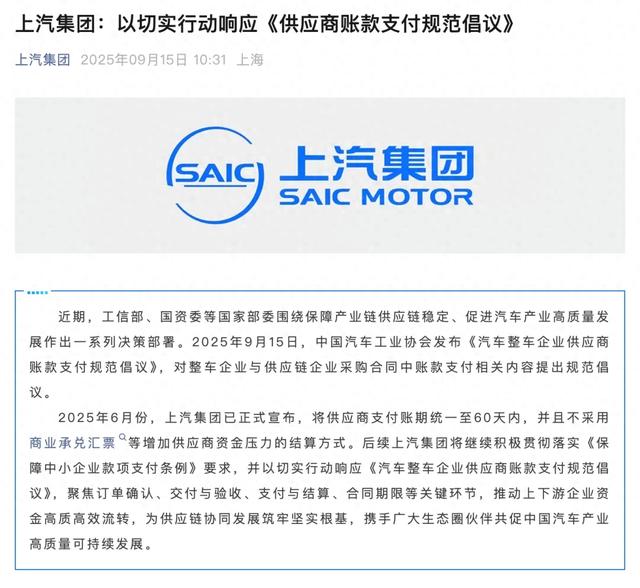
多家车企声明:积极落实账款支付倡议!
Ge Long Hui· 2025-09-15 05:45
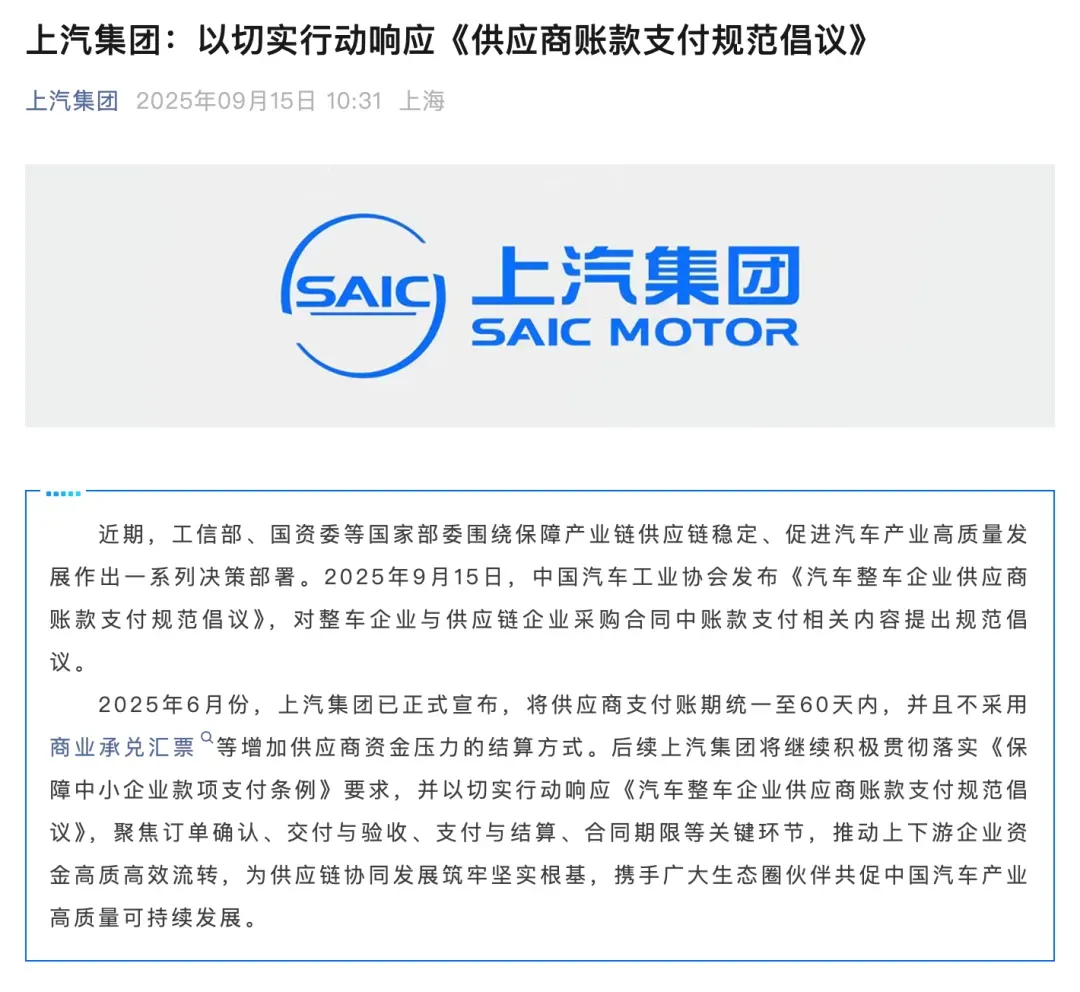
本文综合自:东风汽车、上汽集团、奇瑞集团等微信公众号 9月15日,中国汽车工业协会发布《汽车整车企业供应商账款支付规范倡议》,东风汽车、上汽集团、奇瑞集团、赛力斯、理想汽车、长安汽车、广汽集 团、比亚迪等多家车企先后发表声明,表示将积极落实《汽车整车企业供应商账款支付规范倡议》,构建"整车—零部件"协作共赢发展生态,共同推动汽 车产业高质量发展。此次八家企业具体声明内容如下: 东风 9月15日,中国汽车工业协会发布《汽车整车企业供应商账款支付规范倡议》,为构建"整车—零部件"协作共赢生态、推动汽车产业高质量发展提供明确 指引。东风汽车集团有限公司(以下简称"东风汽车")积极响应倡议号召,将在订单确认、交付与验收、支付与结算、合同期限等关键环节落实倡议要 求,切实保障供应商权益,稳定供应商预期,增强产业链韧性。 作为中央直管的特大型汽车企业,东风汽车将以切实行动践行央企责任,进一步发挥产业链"链长"作用,不断优化产业生态,加强产业技术创新和产业链 供应链体系建设,共同推动行业高质量发展。 上汽 近期,工信部、国资委等国家部委围绕保障产业链供应链稳定、促进汽车产业高质量发展作出一系列决策部署。2025年9月15日 ...


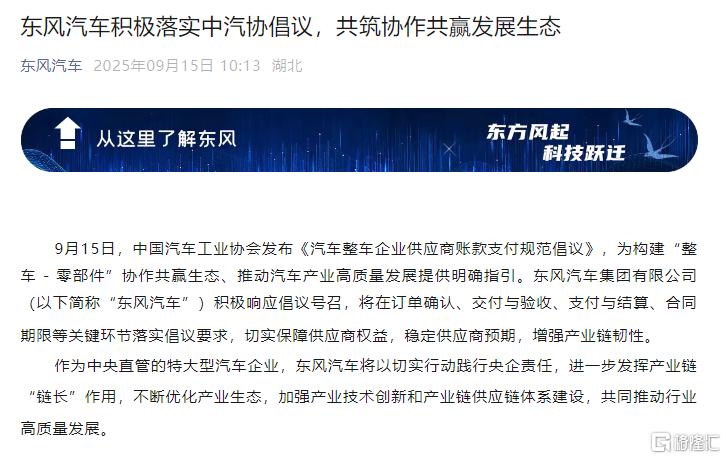
东风汽车:将积极落实中汽协倡议,切实保障供应商权益
Ge Long Hui· 2025-09-15 02:21
格隆汇9月15日|东风汽车积极响应倡议号召,将在订单确认、交付与验收、支付与结算、合同期限等 关键环节落实倡议要求,切实保障供应商权益,稳定供应商预期,增强产业链韧性。 ...
汽车早餐 | 滴滴2024年所有订单平均抽成14%;广州3亿元汽车消费补贴将启动;宝骏年底首发城市领航辅助
Zhong Guo Qi Che Bao Wang· 2025-09-15 01:59
Domestic News - The Ministry of Commerce has initiated an anti-dumping investigation into imported analog chips originating from the United States, following a formal application submitted by the Jiangsu Semiconductor Industry Association on July 23, 2025 [2] - As of September 10, 2025, the number of applications for the vehicle trade-in program has reached 8.3 million, with the Ministry of Commerce working with relevant departments to support local reforms in automotive consumption [3] - The Ministry of Ecology and Environment will continue to conduct consistency checks on new car production and in-use vehicles, aiming for comprehensive inspections of problematic enterprises and risky models [4] - Guangzhou is launching a 300 million yuan automotive consumption subsidy program, offering up to 5,000 yuan for eligible car purchases from September 15 to 30, 2025 [5] International News - Volvo is recalling 1,355 vehicles in the U.S. due to a potential issue with the front seatbelt retractor's torque rod, with dealers set to replace the affected components free of charge [6] - The International Energy Agency projects strong growth in low-emission hydrogen projects despite facing multiple challenges, with global hydrogen demand expected to rise to nearly 100 million tons by 2024, a 2% increase from 2023 [7] - Elon Musk's xAI has laid off approximately 500 employees, about one-third of its data annotation team, as part of a restructuring plan [8] - Rivian is recalling 24,214 electric vehicles in the U.S. due to a software defect that may cause the highway assist system to misidentify vehicles ahead [9] Corporate News - Changan Automobile forecasts that the Robotaxi market in China will grow to 430 billion yuan by 2035, as automotive companies transition from manufacturing to mobility service providers [10] - Dongfeng Motor Group is developing a self-developed solid-state battery with a capacity of 350Wh/kg, expected to debut in vehicles by 2026, achieving a range of 1,000 kilometers [11] - Faraday Future is planning to spin off its Crypto and related assets for public listing, having successfully completed two rounds of crypto asset allocation totaling approximately 7 million dollars [12] - Didi announced that the average commission for all orders in 2024 will be 14%, with most of the commission being used for subsidies and platform maintenance [13] - Zijin Mining has launched a lithium carbonate project in Argentina with an annual production capacity of 20,000 tons, with plans for further expansion to 60,000-80,000 tons [14] - Baojun is set to unveil its industry-first urban navigation assistance feature by the end of the year, with plans for OTA updates across multiple models [15]




新能源与新材料周度报告:新能源汽车全年目标销量1550万辆,增速20%左右-20250914
Dong Zheng Qi Huo· 2025-09-14 13:16
1. Report Industry Investment Rating No relevant content provided. 2. Core Viewpoints of the Report - The "Automobile Industry Steady Growth Work Plan (2025 - 2026)" aims for about 32.3 million vehicle sales in 2025, a 3% YoY increase, with around 15.5 million new energy vehicle sales, a 20% YoY increase, and a 6% YoY growth in automobile manufacturing added - value. In 2026, the industry is expected to maintain a stable and positive development trend [1][105][116]. - From January to August, China's automobile sales reached 21.128 million, a 12.6% YoY increase, and new energy vehicle sales were 9.62 million, a 36.7% YoY increase, achieving 65.4% and 61.9% of the annual targets respectively [1][106][118]. - In the 36th week (September 1 - 7), new energy passenger vehicle retail sales were 220,000, a 0.5% YoY decrease, and the annual cumulative retail sales were 7.645 million, a 23.4% YoY increase. The single - week penetration rate reached 60.6%, and the annual cumulative penetration rate was 51.9%, showing a slow upward trend [2][109][118]. - In July, global new energy vehicle sales reached 1.392 million, an 18.5% YoY increase, and from January to July, sales were 9.233 million, a 25.9% YoY increase. Except for China, Europe and other regions had significant growth, with 29.5% and 53.4% growth respectively from January to July [2][118]. - In August, the US new energy vehicle sales were 177,000, an 18.4% YoY increase, much higher than the overall vehicle growth rate of 2%. From January to August, the cumulative sales were 1.01 million, a 2.4% YoY increase [2][112][119]. 3. Summary by Related Catalogs 3.1 Financial Market Tracking - The weekly price changes of relevant sectors and listed companies are presented. For example, BYD's closing price on September 12 was 105.91 yuan, with a - 1.26% weekly change; CATL's closing price was 325 yuan, with a - 0.03% weekly change [13][15][16]. 3.2产业链数据跟踪 3.2.1 China New Energy Vehicle Market Tracking - **Sales and Exports**: In August, new energy vehicle production and sales were 1.391 million and 1.395 million respectively, with YoY growth of 27.4% and 26.8%. From January to August, production and sales were 9.625 million and 9.62 million respectively, with YoY growth of 37.3% and 36.7%. In August, new energy vehicle exports were 224,000, a 100% YoY increase. From January to August, exports were 1.532 million, an 87.3% YoY increase [106][107][108]. - **Inventory Changes**: Data on monthly new additions to new energy passenger vehicle channel inventory and manufacturer inventory are provided [25][26]. - **Delivery Volumes of Chinese New Energy Vehicle Manufacturers**: Monthly delivery volumes of manufacturers such as Leapmotor, Li Auto, XPeng, NIO, Zeekr, Aion, Voyah, and Deepal are presented [28][29][33]. 3.2.2 Global and Overseas New Energy Vehicle Market Tracking - **Global Market**: In July, global new energy vehicle sales reached 1.392 million, an 18.5% YoY increase, and from January to July, sales were 9.233 million, a 25.9% YoY increase [2][118]. - **European Market**: Relevant data on new energy vehicle sales and penetration rates in Europe, including the UK, Germany, and France, are provided [44][45][49]. - **North American Market**: In August, US new energy vehicle sales were 177,000, an 18.4% YoY increase. From January to August, the cumulative sales were 1.01 million, a 2.4% YoY increase. Data on North American new energy vehicle sales and penetration rates are also presented [2][112][119]. - **Other Regions**: Data on new energy vehicle sales and penetration rates in other regions, such as Japan, South Korea, and Thailand, are provided [60][61][65]. 3.2.3 Power Battery Industry Chain - Data on power battery installation volume (by material), export volume (by material), weekly average price of power battery cells, and material costs are presented. Information on the operating rates and prices of ternary materials, precursors, lithium iron phosphate, negative electrode materials, electrolytes, and other related materials is also provided [76][78][82]. 3.2.4 Other Upstream Raw Materials - Data on the daily prices of rubber, glass, steel, and aluminum are provided [97][98][100]. 3.3 Hot News Summaries 3.3.1 China: Policy Dynamics - The eight - department joint issuance of the "Automobile Industry Steady Growth Work Plan (2025 - 2026)" aims to achieve specific sales and growth targets for 2025 and 2026 [1][105][116]. - The six - department joint launch of a three - month special rectification action for online chaos in the automobile industry aims to improve the handling efficiency of online chaos and regulate marketing and publicity behaviors [105]. - The two - department release of the "Implementation Opinions on Promoting High - Quality Development of 'Artificial Intelligence +' Energy" promotes the application of artificial intelligence in energy - related fields [106]. 3.3.2 China: Industry Dynamics - In August, new energy vehicle production and sales data are as stated above. From January to August, the production and sales of new energy vehicles also showed significant growth [106][107][108]. - From September 1 - 7, new energy retail sales decreased by 3% YoY, and the cumulative retail sales increased by 25% [109]. - In August, China's power battery installation volume was 62.5GWh, a 32.4% YoY increase. From January to August, the cumulative installation volume was 417.9GWh, a 43.1% YoY increase [110][111]. - The China Association of Automobile Manufacturers is preparing to establish a new energy vehicle battery branch [111]. 3.3.3 Overseas: Policy Dynamics - Mexico plans to raise import tariffs on products from Asian countries such as China, South Korea, and India to 50%, which requires congressional approval [112]. - The US has exempted a variety of products, including gold, graphite, and nickel, from tariffs [112]. 3.3.4 Overseas: Industry Dynamics - In August, US new energy vehicle sales were 177,000, an 18.4% YoY increase [112][113][119]. 3.3.5 Overseas: Enterprise Dynamics - Construction of South Korean battery factories in the US has been interrupted due to immigration enforcement. LG Energy Solution has taken corresponding measures [113][114]. - VinFast delivered 72,167 vehicles globally in the first half of 2025, with significant growth in vehicle and motorcycle sales. In the second quarter, revenue increased by 91.6% YoY, and the net loss was approximately 812 million US dollars [115]. - InoBat, a Slovakian electric vehicle battery manufacturer, received 54 million euros in subsidies and 456,000 euros in loans from the Spanish government to support the construction of a battery super - factory [116][117]. 3.4 Industry Views The "Automobile Industry Steady Growth Work Plan (2025 - 2026)" sets clear goals for 2025 and 2026, and current market data shows the development status of the new energy vehicle industry [1][116][118]. 3.5 Investment Suggestions - China's new energy vehicle market penetration rate has reached a relatively high level. In 2025, high - competitiveness new models are continuously launched, and price wars are gradually ending. - Due to severe trade protectionism in Europe and the US, there are risks in exports. Attention should be paid to new growth points such as Belt and Road countries and the Middle East. - In the competitive landscape, domestic brands' market shares continue to expand. Attention should be paid to enterprises with strong product capabilities, smooth overseas expansion, and stable supply [3][120][121].



1.8万辆爆表!8月新能源重卡渗透率创新高!TOP3均超2000 TA暴涨11倍!| 头条
第一商用车网· 2025-09-14 07:13
Core Viewpoint - The domestic new energy heavy truck market has shown remarkable growth in 2025, with sales consistently exceeding 10,000 units per month and an average year-on-year growth rate of 190% from January to July [1]. Sales Performance - In August 2025, the new energy heavy truck market sold 17,800 units, marking a 7% increase from July and a 182% increase year-on-year, making it the second-highest sales month in the history of the market [3][5]. - The average monthly sales from January to August 2025 reached 13,700 units, with a total of 113,700 units sold, reflecting a 180% year-on-year increase [22][28]. Market Penetration - The penetration rate of new energy heavy trucks reached a record high of 26.61% in August 2025, up from 25.89% in July and significantly higher than the 13.61% for the entire year of 2024 [9][12]. - From January to August 2025, the penetration rate averaged 23.39%, compared to 10.48% in the same period last year [9]. Competitive Landscape - In August 2025, five companies held over 10% market share: XCMG (15.98%), FAW Liberation (15.21%), SANY (14.36%), Shaanxi Automobile (10.91%), and China National Heavy Duty Truck Group (10.04%) [17]. - A total of 14 companies sold over 100 units in August, with three companies exceeding 2,500 units [12]. Company Performance - The top three companies in August 2025 were XCMG (2,839 units), FAW Liberation (2,702 units), and SANY (2,551 units) [13]. - Year-to-date, XCMG and SANY have sold 18,600 and 17,600 units respectively, with year-on-year growth rates of 169% and 164% [22][25]. Future Outlook - The new energy heavy truck market is expected to exceed 180,000 units in total sales for 2025, with over 20 companies already surpassing their total sales from the previous year [28].