Sinopec Corp.(600028)

Search documents
中国石化(600028) - 中国石化H股公告-翌日披露表格
2025-11-17 10:00
EE305 Next Day Disclosure Return (Equity issuer - changes in issued shares or treasury shares, share buybacks and/or on-market sales of treasury shares) Instrument: Equity issuer Status: New Submission Name of Issuer: China Petroleum & Chemical Corporation 17 November 2025 Date Submitted: Section I must be completed by a listed issuer where has been a charge in its issued shares or teasury shares which is discloseable pursuant to rule 13.25A of the Rules Gov .i.sting of Securities on The Stock Exchange of H ...
中国石油化工股份(00386) - 翌日披露报表
2025-11-17 09:10
FF305 翌日披露報表 (股份發行人 ── 已發行股份或庫存股份變動、股份購回及/或在場内出售庫存股份) 表格類別: 股票 狀態: 新提交 公司名稱: 中國石油化工股份有限公司 呈交日期: 2025年11月17日 如上市發行人的已發行股份或庫存股份出現變動而須根據《香港聯合交易所有限公司(「香港聯交所」)證券上市規則》(「《主板上市規則》」)第13.25A條 / 《香港聯合交易所有限公司GEM證券 上市規則》(「《GEM上市規則》」)第17.27A條作出披露,必須填妥第一章節 。 | 第一章節 | | | | | | | | --- | --- | --- | --- | --- | --- | --- | | 1. 股份分類 | 普通股 | H 股份類別 | | 於香港聯交所上市 | 是 | | | 證券代號 (如上市) | 00386 | 說明 | | | | | | A. 已發行股份或庫存股份變動 | | 已發行股份(不包括庫存股份)變動 | | 庫存股份變動 | | | | | 事件 | | 佔有關事件前的現有已發 | | 每股發行/出售價 (註4) | 已發行股份總數 | | | | 已發行股份( ...
炼化及贸易板块11月17日涨0.95%,统一股份领涨,主力资金净流入6738.96万元
Zheng Xing Xing Ye Ri Bao· 2025-11-17 09:00
Market Overview - The refining and trading sector increased by 0.95% compared to the previous trading day, with Unity Co. leading the gains [1] - The Shanghai Composite Index closed at 3972.03, down 0.46%, while the Shenzhen Component Index closed at 13202.0, down 0.11% [1] Stock Performance - Notable declines in individual stocks include: - Kangzhidun (603798) down 5.38% to 16.71 with a trading volume of 64,400 shares and a turnover of 110 million yuan [1] - Baomo Co. (002476) down 3.95% to 6.08 with a trading volume of 279,800 shares and a turnover of 172 million yuan [1] - Other stocks showed minor fluctuations, with Guanghui Energy (600256) and Taishan Petroleum (000554) remaining unchanged at 5.42 and 7.24 respectively [1] Capital Flow - The refining and trading sector saw a net inflow of 67.39 million yuan from main funds, while retail funds experienced a net outflow of 84.64 million yuan [1] - Retail investors contributed a net inflow of 17.25 million yuan [1] Individual Stock Capital Flow - China Petroleum (601857) had a main fund net inflow of 14.02 million yuan, while retail funds saw a net outflow of 10.08 million yuan [2] - Hengli Petrochemical (600346) reported a main fund net inflow of 10.9 million yuan, with retail funds experiencing a net outflow of 79.96 million yuan [2] - Qixiang Tengda (002408) had a main fund net inflow of 9.00 million yuan, while retail funds saw a net outflow of 12.66 million yuan [2]


OPEC预期供给过剩,本周油价下跌:能源周报(20251110-20251116)-20251117
Huachuang Securities· 2025-11-17 08:34
Investment Strategy - The oil and gas capital expenditure trend is declining, leading to a slowdown in supply growth. Since the signing of the Paris Agreement in 2015, global capital expenditure in the oil and gas upstream sector has significantly decreased, with a notable drop of nearly 22% from the 2014 peak to $351 billion in 2021. This trend is expected to continue as major energy companies face pressure from policies aimed at carbon reduction and are shifting focus towards energy transition and renewable projects [10][27]. - The current active drilling rig count in the US remains low, and the cost of new wells is close to current oil prices, limiting profit margins. This suggests that the growth rate of US oil production is likely to slow down, with evidence of this trend emerging in the first half of 2025 [10][27]. - OPEC+ has implemented production cuts that exceed expectations, indicating that there will be limited supply growth in the coming year [10][27]. Oil Industry - OPEC has shifted its outlook from a supply shortage to an anticipated oversupply in the global oil market, resulting in a significant drop in oil prices. Brent crude oil prices fell to $63.14 per barrel, down 2.56% week-on-week, while WTI prices decreased to $59.69 per barrel, down 0.65% [11][32]. - The report suggests monitoring companies that may benefit from the mid-high price fluctuations of oil, such as China National Offshore Oil Corporation (CNOOC), China Petroleum & Chemical Corporation (Sinopec), and China National Petroleum Corporation (PetroChina) [11]. Coal Industry - The market for thermal coal remains stable, with prices experiencing fluctuations. The average market price for thermal coal at Qinhuangdao Port was reported at 817.1 yuan per ton, an increase of 4.67% from the previous week. However, downstream demand remains cautious, with many buyers adopting a wait-and-see approach [12][13]. - The report highlights the importance of domestic coal companies like China Shenhua Energy and Shaanxi Coal and Chemical Industry Group, which are expected to benefit from the stable pricing environment and their resource advantages [13]. Natural Gas Industry - There is a growing demand for LNG imports in Asia, driven by energy transition efforts in major economies such as China, Japan, and South Korea. This has led to active negotiations for long-term contracts with major LNG exporting countries [15][16]. - The average price of natural gas in the US increased to $4.5 per million British thermal units, reflecting a 4.6% rise from the previous week [15][30]. Oilfield Services Industry - The oilfield services sector is expected to maintain its growth due to government policies aimed at ensuring energy security. In 2023, the total capital expenditure of the three major oil companies reached 583.3 billion yuan, reflecting a compound annual growth rate of 4.9% since 2018 [17][18]. - The report indicates that despite falling oil prices, capital expenditures remain high, which is likely to sustain the industry's overall health [17].




油价底部支撑叠加红利属性,油气ETF(159697)冲击4连涨
Sou Hu Cai Jing· 2025-11-17 07:15
Core Viewpoint - The oil and gas sector is experiencing upward movement in stock prices, driven by geopolitical tensions and supply disruptions, particularly from Russia, which has halted exports equivalent to 2% of global supply [1]. Group 1: Market Performance - As of November 17, 2025, the National Oil and Gas Index (399439) increased by 0.28%, with significant gains in constituent stocks such as Shun Oil (603353) up 9.99% and Victory Shares (000407) up 9.93% [1]. - The Oil and Gas ETF (159697) rose by 0.60%, marking its fourth consecutive increase, with the latest price at 1.18 yuan [1]. Group 2: Supply and Price Dynamics - The geopolitical situation has led to a suspension of exports from Russian Black Sea ports, impacting supply by approximately 2% of global oil production, equating to 2.2 million barrels per day [1]. - According to Huatai Securities, multiple factors including OPEC+ production increases, rising risks of Russian oil sanctions, and an increase in U.S. commercial crude oil inventories have contributed to a downward trend in oil price levels [1]. Group 3: Key Holdings - As of October 31, 2025, the top ten weighted stocks in the National Oil and Gas Index include major companies such as China National Petroleum (601857) and Sinopec (600028), collectively accounting for 65.09% of the index [2]. - The Oil and Gas ETF is closely tracking the National Oil and Gas Index, reflecting the price changes of publicly listed companies in the oil and gas sector [1][2].




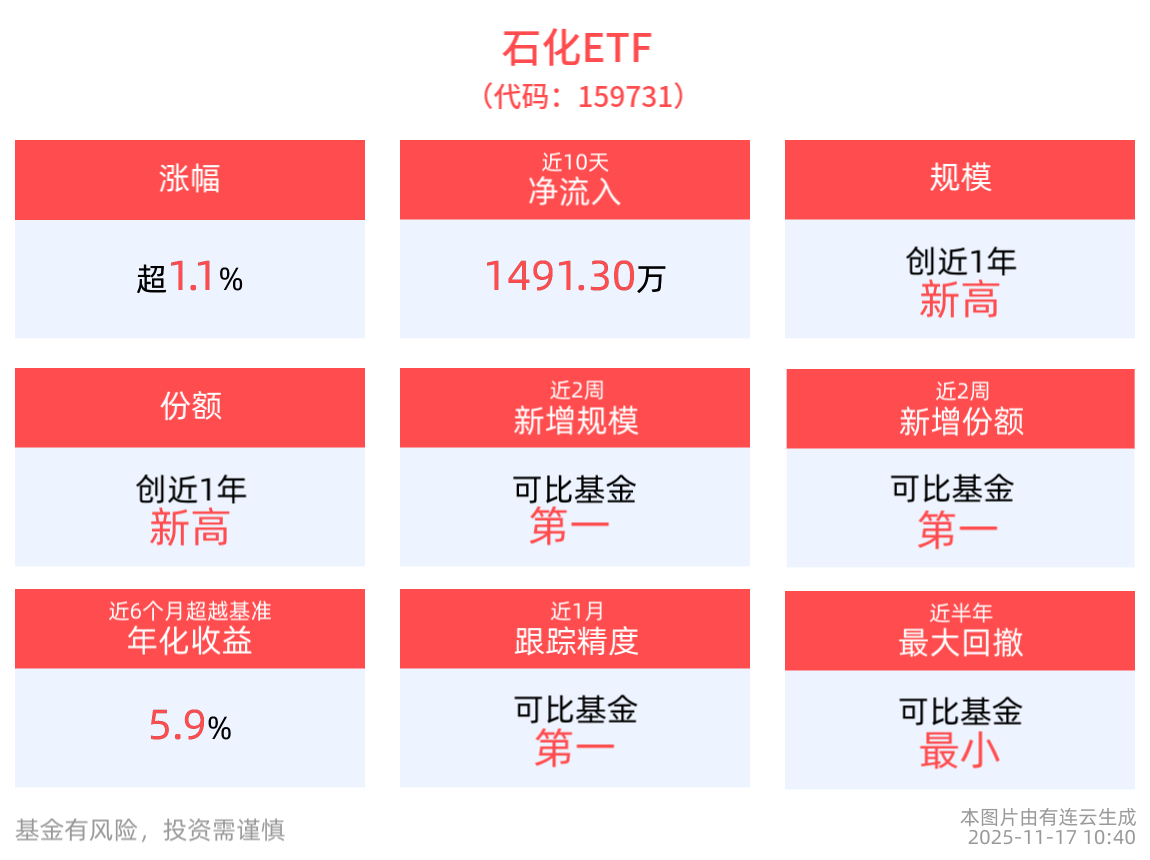
涨超1.1%,石化ETF(159731)近10个交易日净流入1491.3万元
Sou Hu Cai Jing· 2025-11-17 03:02
Core Insights - The China Petroleum Industry Index has seen a strong increase of 1.22% as of November 17, 2025, with leading stocks including Salt Lake Co., Jinfa Technology, and Hengli Petrochemical [1] - The Petrochemical ETF (159731) rose by 1.18%, reaching a latest price of 0.86 yuan, with a net inflow of 4.2581 million yuan [1] - Over the past 10 trading days, there have been 8 days of net inflows totaling 14.913 million yuan, with the ETF's latest share count reaching 204 million and a total scale of 173 million yuan, both hitting a one-year high [1] Performance Metrics - As of November 14, 2025, the Petrochemical ETF has experienced a net value increase of 26.25% over the past six months [3] - The ETF's highest single-month return since inception was 15.86%, with the longest consecutive monthly gains being 6 months and a maximum increase of 23.51% [3] - The average return during the rising months is 5.06%, and the ETF has outperformed its benchmark with an annualized excess return of 5.9% over the last six months [3] Top Holdings - The top ten weighted stocks in the China Petroleum Industry Index account for 56.05% of the index, with Wanhua Chemical, China Petroleum, and Salt Lake Co. being the top three [3] - The weightings of the top stocks are as follows: Wanhua Chemical (10.47%), China Petroleum (7.63%), Salt Lake Co. (6.44%), and China Petrochemical (6.44%) [5]



“绿色石油”时代:全国已规划800+氢氨醇项目,锚定900万吨绿氢产能
Zhong Guo Neng Yuan Wang· 2025-11-17 02:38
Core Insights - The National Energy Administration has identified "expanding non-electric utilization of renewable energy" as a key focus for the 14th Five-Year Plan, emphasizing the development of integrated wind-solar hydrogen, ammonia, and methanol production [1] - The wind-solar hydrogen-ammonia-methanol integration model is seen as a transformative approach to convert unstable green electricity into green hydrogen, which can then be synthesized into storable and transportable green ammonia and methanol, addressing the issue of renewable energy intermittency [2] - As of October 2023, over 800 hydrogen-ammonia-methanol integration projects have been planned in China, with a total planned green hydrogen capacity of nearly 9 million tons per year, positioning China as a global leader in this sector [2] Industry Development - Most of the green hydrogen and methanol projects are concentrated in resource-rich regions such as Northwest, North, and Northeast China, with provinces like Inner Mongolia, Jilin, and Xinjiang actively promoting large-scale development [3] - Notable operational projects include the China Petroleum & Chemical Corporation's green hydrogen demonstration project in Xinjiang and the 100,000-ton green methanol project in Inner Mongolia, among others [3][4] - The industry is witnessing increasing participation from both state-owned enterprises and private companies, creating a competitive landscape [4] Challenges and Future Outlook - The green hydrogen and methanol industry faces challenges such as high production costs, insufficient technological integration, and a lack of standardized systems [6] - Industry experts emphasize the need to reduce investment costs and improve operational rates to enhance competitiveness [6] - Despite current challenges, the market potential for green methanol and ammonia is significant, particularly in the context of low-carbon development trends in shipping and aviation, suggesting a promising long-term outlook for the hydrogen-ammonia-methanol market [6]



供给过剩趋势下,国际油价走势纠结 | 投研报告
Zhong Guo Neng Yuan Wang· 2025-11-17 02:22
Group 1 - The core viewpoint of the report indicates that international oil prices experienced slight fluctuations, with Brent crude oil prices increasing slightly while WTI prices decreased slightly as of November 14, 2025 [1][2] - In the first half of the week, China's crude oil imports increased, and the US dollar weakened, contributing to a rise in oil prices due to improved market risk appetite [1][2] - The latter part of the week saw a downward adjustment in OPEC's monthly report, indicating a supply surplus, which released bearish signals to the market [1][2] Group 2 - As of November 14, 2025, Brent crude oil futures settled at $64.39 per barrel, up $0.76 per barrel (+1.19%), while WTI crude oil futures settled at $59.39 per barrel, down $0.45 per barrel (-0.75%) [2] - The price of Russian Urals crude remained stable at $65.49 per barrel, while Russian ESPO crude decreased by $1.43 per barrel (-2.51%) to $55.47 per barrel [2] Group 3 - As of November 10, 2025, the number of global offshore self-elevating drilling rigs was 370, an increase of 1 rig from the previous week, while the number of floating drilling rigs decreased by 2 to 128 [3] - As of November 7, 2025, US crude oil production was 13.862 million barrels per day, an increase of 211,000 barrels per day from the previous week [3] - The number of active drilling rigs in the US increased by 3 to 417 as of November 14, 2025 [3] Group 4 - As of November 7, 2025, US total crude oil inventories increased by 7.211 million barrels (+0.87%) to 838 million barrels [4] - The US gasoline inventory decreased by 0.946 million barrels (-0.46%), while diesel inventory decreased by 0.637 million barrels (-0.57%) [4] Group 5 - The report highlights relevant companies in the sector, including China National Offshore Oil Corporation (CNOOC), China Petroleum & Chemical Corporation (Sinopec), and China National Petroleum Corporation (PetroChina) [5]


立“军令状”为诺 践绿色发展之责
Qi Lu Wan Bao· 2025-11-16 16:19
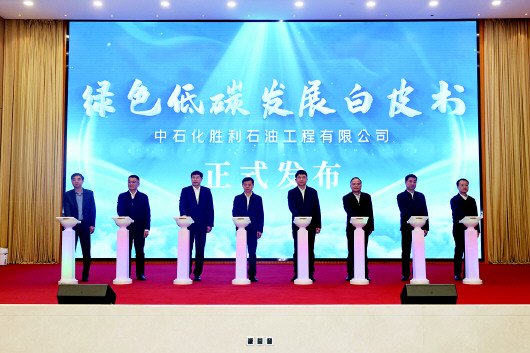
Core Insights - China Petroleum's Shengli Oil Engineering Company has released a "Green Low-Carbon Development White Paper," aiming to establish itself as a leading technology-driven oil and gas new energy service provider, contributing to the green transformation of the industry [2][3] Group 1: Green Low-Carbon Practices - The white paper outlines Shengli Oil Engineering's green low-carbon practices since the 14th Five-Year Plan, highlighting its commitment to integrating green low-carbon concepts throughout its development processes [2] - The company has achieved significant improvements, with the electrification rate of drilling rigs increasing from 40% to 80%, and the carbon emissions per ten thousand yuan of output decreasing by 42% [2] Group 2: Industry Leadership and Initiatives - The release of the white paper is seen as a pioneering move in the oil and gas engineering sector, marking it as the first green low-carbon initiative led by a company [2] - The event was attended by various stakeholders, including government officials and industry experts, showcasing the company's achievements and future goals in green low-carbon development [3]
中石化石科院院长李明丰:废塑料热解油加工工艺研究进展
DT新材料· 2025-11-16 15:32
Core Viewpoint - Sinopec is leading the domestic industry in the recycling of waste plastics through a combination of independent research and international cooperation, establishing a comprehensive technical system from chemical recycling to physical regeneration [2][4]. Group 1: RPCC Technology Development - The RPCC technology developed by Sinopec's Research Institute represents the forefront of domestic chemical recycling of waste plastics, specifically targeting polyethylene (PE) and polypropylene (PP) [2]. - The RPCC technology features three main innovations: the ability to process mixed waste plastics containing varying levels of PVC, achieving a thermal oil yield exceeding 80%, and forming a complete closed-loop cycle from "plastic-waste plastic-olefins-resins-plastic" [7][8]. Group 2: Industrial Application and Investment - The RPCC technology is set to transition from laboratory to industrial application in 2024, with the RDC equipment being a core component of the first global chemical recycling industrial demonstration project for waste agricultural film [5]. - The Tahe Refining and Chemical's project, utilizing RPCC technology, has a total investment of 162 million yuan and aims to process 35,000 tons of waste agricultural film annually, converting it into pyrolysis oil to partially replace naphtha as a feedstock for ethylene production [5]. Group 3: Waste Plastic Pyrolysis Oil Processing - The processing of waste plastic pyrolysis oil is crucial due to its complex composition and high impurity content, necessitating deep processing to enhance quality [12][24]. - Key processing methods include dechlorination, hydrogenation refining, catalytic upgrading, and steam cracking, which are essential for transforming waste plastic pyrolysis oil into high-value products [12][22]. Group 4: Future Directions - Future development directions for the processing of waste plastic pyrolysis oil include improving analytical techniques for precise composition analysis, optimizing hydrogenation technologies, and developing integrated processing methods to address the challenges posed by diverse impurities [24].