SAIC MOTOR(600104)

Search documents
天永智能(603895.SH)中标2030万元上汽集团GS6四期改造项目-发动机装配线
智通财经网· 2025-09-11 09:53
Group 1 - The company, Tianyong Intelligent (603895.SH), has received a bid notification from Shanghai Mechanical and Electrical Equipment Tendering Co., Ltd. for the engine assembly line of the GS6 Phase IV renovation project of SAIC Motor Corporation Limited [1] - The bid amount for the project is 20.3 million yuan (including tax) [1] - The formal contract signing and successful implementation of the project are expected to have a positive impact on the company's operating performance, although it will not affect the company's operational independence [1]


天永智能(603895.SH):中标2030万元的GS6四期改造项目-发动机装配线
Ge Long Hui A P P· 2025-09-11 09:47
Group 1 - The company Tianyong Intelligent (603895.SH) has recently received a bid notification from Shanghai Mechanical and Electrical Equipment Tendering Co., Ltd. regarding the GS6 Phase IV renovation project for the engine assembly line of SAIC Motor Corporation Limited [1] - The company has been confirmed as the winning bidder for the project, with a bid amount of 20.3 million yuan (including tax) [1]
天永智能:中标上海汽车集团股份有限公司GS6四期改造项目-发动机装配线项目
Ge Long Hui A P P· 2025-09-11 09:47
Group 1 - The company, Tianyong Intelligent Equipment Co., Ltd., has received a bid notification from Shanghai Electromechanical Equipment Bidding Co., Ltd. for the GS6 Phase IV renovation project of Shanghai Automotive Group Co., Ltd. [1] - The company has been confirmed as the winning bidder for the engine assembly line project with a bid amount of 20.3 million yuan (including tax) [1]
天永智能:拟中标2030万元项目
Zheng Quan Shi Bao Wang· 2025-09-11 09:43
Group 1 - The company Tianyong Intelligent (603895) has recently received a bid notification for the GS6 Phase IV renovation project - engine assembly line from Shanghai Automotive Group [1] - The company has been confirmed as the winning bidder for the project with a bid amount of 20.3 million yuan (including tax) [1]
天永智能:中标上汽集团GS6四期改造项目-发动机装配线
Xin Lang Cai Jing· 2025-09-11 09:40
Core Viewpoint - Tianyong Intelligent has won the bid for the SAIC Group GS6 Phase IV renovation project, specifically for the engine assembly line, with a bid amount of 20.3 million yuan (including tax) [1] Company Summary - The company received a notification from the bidding agency confirming it as the winning bidder for the project [1] - The formal contract is expected to be signed and implemented smoothly, which is anticipated to have a positive impact on the company's operating performance [1] - It is important to note that the bid notification does not constitute a formal order or sales contract, and the final settlement amount and performance terms will be based on the formal contract [1] Industry Summary - The project may involve various uncertainties and risks during its execution [1]
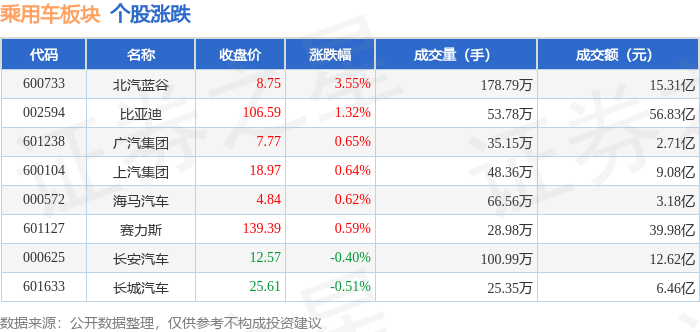
乘用车板块9月11日涨0.7%,北汽蓝谷领涨,主力资金净流出6.56亿元
Zheng Xing Xing Ye Ri Bao· 2025-09-11 08:43
Market Overview - The passenger car sector increased by 0.7% on September 11, with Beiqi Blue Valley leading the gains [1] - The Shanghai Composite Index closed at 3875.31, up 1.65%, while the Shenzhen Component Index closed at 12979.89, up 3.36% [1] Individual Stock Performance - Beiqi Blue Valley (600733) closed at 8.75, up 3.55% with a trading volume of 1.7879 million shares and a transaction value of 1.531 billion [1] - BYD (002594) closed at 106.59, up 1.32% with a trading volume of 537,800 shares and a transaction value of 5.683 billion [1] - GAC Group (601238) closed at 7.77, up 0.65% with a trading volume of 351,500 shares and a transaction value of 271 million [1] - SAIC Motor (600104) closed at 18.97, up 0.64% with a trading volume of 483,600 shares and a transaction value of 908 million [1] - Changan Automobile (000625) closed at 12.57, down 0.40% with a trading volume of 1.0099 million shares and a transaction value of 1.262 billion [1] - Great Wall Motors (601633) closed at 25.61, down 0.51% with a trading volume of 253,500 shares and a transaction value of 646 million [1] Fund Flow Analysis - The passenger car sector experienced a net outflow of 656 million from institutional investors, while retail investors saw a net inflow of 692 million [1] - Beiqi Blue Valley had a net inflow of 138 million from institutional investors, while retail investors had a net outflow of 305,220 [2] - BYD experienced a net outflow of 122 million from institutional investors, but a net inflow of 143 million from retail investors [2] - GAC Group saw a net outflow of 13.15 million from institutional investors, with a net inflow of 22.63 million from retail investors [2]






中汽协:8月汽车产销同比增长均超10% 新能源汽车达汽车新车总销量48.8%
智通财经网· 2025-09-11 06:41
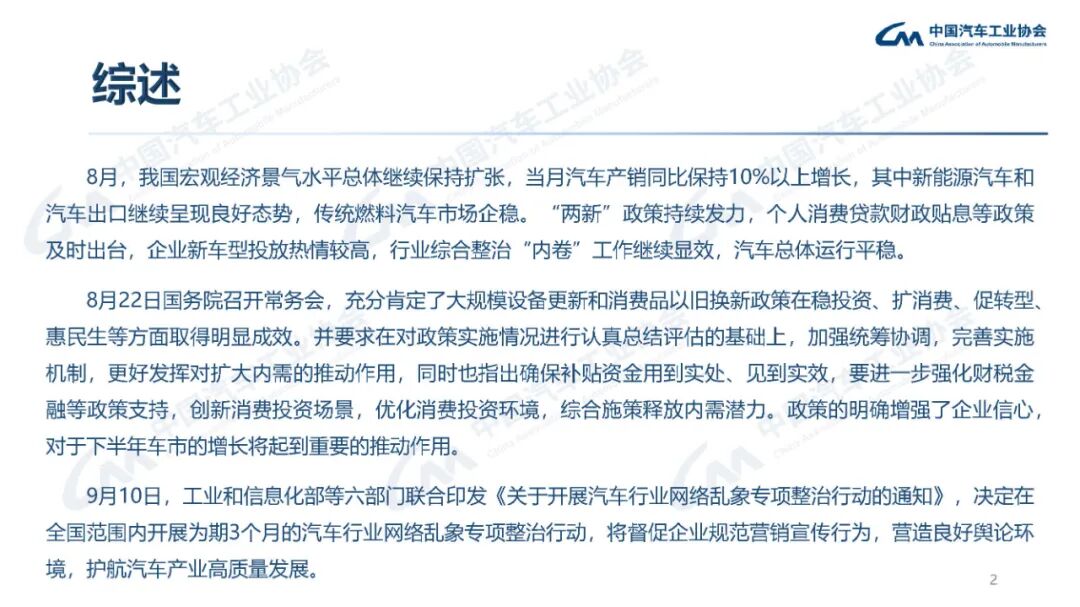
Overall Automotive Industry Performance - In August, automotive production and sales reached 2.815 million and 2.857 million units, respectively, with month-on-month growth of 8.7% and 10.1%, and year-on-year growth of 13% and 16.4% [7] - From January to August, automotive production and sales totaled 21.051 million and 21.128 million units, reflecting year-on-year growth of 12.7% and 12.6% [7] Passenger Vehicle Market - In August, passenger vehicle production and sales were 2.5 million and 2.54 million units, with month-on-month growth of 9% and 11.1%, and year-on-year growth of 12.5% and 16.5% [19] - From January to August, passenger vehicle production and sales reached 18.338 million and 18.384 million units, with year-on-year growth of 13.6% and 13.8% [19] New Energy Vehicles (NEVs) - In August, NEV production and sales were 1.391 million and 1.395 million units, with year-on-year growth of 27.4% and 26.8%, accounting for 48.8% of total new vehicle sales [2] - From January to August, NEV production and sales totaled 9.625 million and 9.62 million units, with year-on-year growth of 37.3% and 36.7% [2] Traditional Fuel Vehicles - In August, domestic sales of traditional fuel vehicles were 1.074 million units, with month-on-month growth of 9.5% and year-on-year growth of 12.9%, marking three consecutive months of growth [8] - From January to August, domestic sales of traditional fuel vehicles totaled 8.747 million units, showing a slight year-on-year decline of 0.3% [8] Export Performance - In August, total automotive exports reached 611,000 units, with month-on-month growth of 6.2% and year-on-year growth of 19.6% [10] - From January to August, automotive exports totaled 4.292 million units, reflecting a year-on-year increase of 13.7% [10] Key Enterprises Performance - The top fifteen automotive groups sold a total of 19.49 million units from January to August, with a year-on-year growth of 12.5%, accounting for 92.3% of total automotive sales [69] - The top fifteen NEV groups sold a total of 9.146 million units, with a year-on-year growth of 39%, representing 95.1% of total NEV sales [72]


固态电池上车倒计时,上游设备企业先迎来“好日子”
3 6 Ke· 2025-09-11 02:55
Core Insights - The Chinese solid-state battery industry is transitioning from laboratory validation to industrialization, with several companies achieving mass production or vehicle application in semi-solid state batteries, while research and pilot testing for all-solid-state batteries are accelerating [1][4] - The entire industry chain is beginning to show profits, with upstream sectors being the first to benefit [1][4] - The solid-state battery concept has gained significant market attention, with the Wande Solid-State Battery Index rising over 11% since September, and several concept stocks experiencing substantial gains [1] Industry Developments - As of September 2025, leading equipment companies like Xian Dao Intelligent, Hai Mu Xing, Ying He Technology, and Li Yuan Heng reported new and existing orders exceeding 30 billion yuan, reflecting a year-on-year increase of 70% to 80% [2] - The lithium battery industry is entering a structural recovery phase, with a notable increase in demand for new technologies such as solid-state batteries, high-voltage lithium iron phosphate, and silicon-carbon anodes [2] - Major battery manufacturers are increasing investments in solid-state battery production, with companies like CATL planning 10-15 GWh capacity by 2025, BYD focusing on sulfide routes, and Guoxuan High-Tech launching a pilot line with a 90% yield [2][3] Vehicle Manufacturers - Dongfeng Motor has implemented semi-solid state battery installations and is set to mass-produce solid-state batteries with energy densities of 350 Wh/kg, aiming for 550 Wh/kg in future models [3] - SAIC Motor's MG4 model has integrated semi-solid state batteries, with plans for all-solid-state battery deliveries starting in 2026 [3] - GAC Group's self-developed solid-state battery has an energy density exceeding 350 Wh/kg, with expectations for mass production in 2026 [3] Market Outlook - Domestic solid-state battery products are expected to undergo small-scale vehicle trials by the end of 2025, with widespread testing planned for 2026-2027, contingent on material availability and equipment readiness [3] - The order volume for leading equipment companies has seen significant growth, with Xian Dao Intelligent reporting 12.4 billion yuan in new orders for the first half of 2025, a nearly 70% increase [3]




中欧车企携手正当时
Jing Ji Ri Bao· 2025-09-10 22:14
Core Viewpoint - The global automotive industry is undergoing significant transformation, with a strong emphasis on collaboration between Chinese and European car manufacturers to navigate challenges and seize opportunities in the market [1][2] Group 1: Chinese Automotive Industry in Europe - Chinese electric vehicle (EV) manufacturers, such as BYD, NIO, and SAIC, are gaining traction in the European market, with BYD surpassing Tesla in sales in July [1] - Several Chinese companies are investing in manufacturing plants or joint ventures in Europe, while others like Xiaomi and Li Auto are establishing R&D centers to prepare for future market expansion [1] - Chinese car manufacturers benefit from a complete industry chain integration, leading to cost competitiveness and high efficiency in battery development and vehicle manufacturing [1] Group 2: Innovation and Market Appeal - The innovation speed of Chinese car manufacturers is significantly faster than that of their European, American, and Japanese counterparts, with quicker new model launches and advancements in battery technology [1] - Chinese EVs not only offer price advantages but also possess appealing technology and design, particularly attracting younger consumers in Europe [1] Group 3: Impact of U.S. Trade Policies - The new U.S.-EU trade agreement imposes a 15% tariff on U.S. exports of cars and parts to the EU, a significant increase from the previous 2.5% [2] - This tariff policy poses a serious threat to the European automotive industry, which is a crucial pillar of the economy, affecting millions of jobs across countries like Germany, France, and Italy [2] - European car manufacturers may face pressure to absorb higher costs or pass them onto consumers, risking market share and impacting the entire automotive supply chain, including parts suppliers and distributors [2] Group 4: Call for Collaboration - The European automotive industry is in a challenging transition towards electrification, automation, and decarbonization, requiring substantial investment for R&D and production [2] - There is a call for strengthened collaboration between Chinese and European car manufacturers across various sectors, including manufacturing, battery technology, charging networks, and sustainable materials [2]


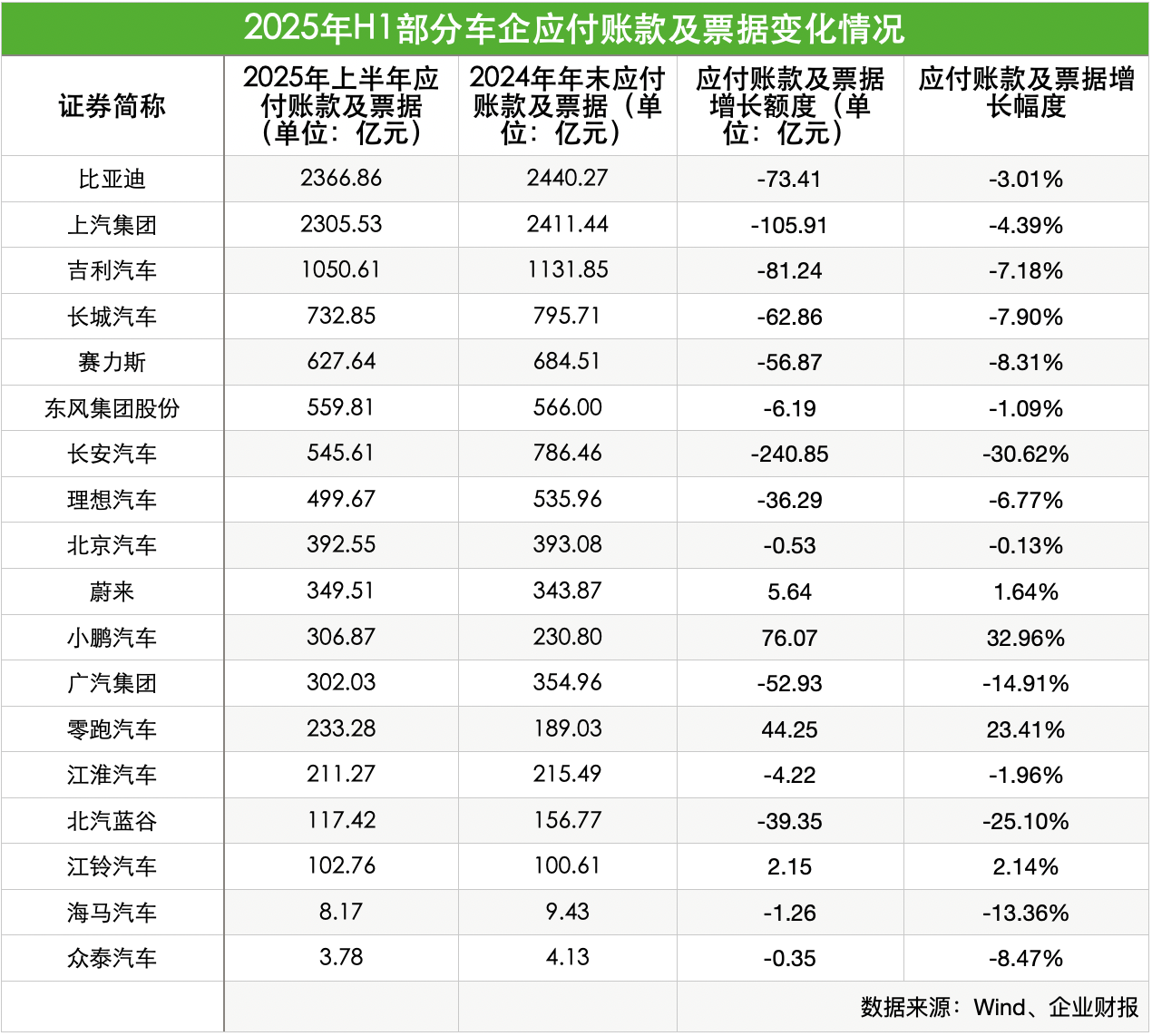
60天账期承诺是否达成?追踪18家上市车企应付账款状况:总额降,账期拉长
Mei Ri Jing Ji Xin Wen· 2025-09-10 10:17
Core Insights - The automotive industry in China is experiencing a trend of "anti-involution," with 17 companies committing to reduce supplier payment terms to within 60 days, aimed at alleviating financial pressure on parts manufacturers [1] - Despite a reduction in total accounts payable and notes to 10,209.03 billion yuan, the average turnover days increased to 192.46 days, indicating a divergence between total amount reduction and extended payment terms [1][2] - BYD, SAIC Motor, and Geely are the top three companies in terms of accounts payable, each exceeding 100 billion yuan [1] Accounts Payable Changes - 14 companies reported a decrease in accounts payable compared to the end of last year, with Changan Automobile, SAIC Motor, and Geely showing the largest reductions of 240.85 billion yuan, 105.91 billion yuan, and 81.24 billion yuan respectively [2] - NIO, Xpeng Motors, and Leap Motor saw increases in accounts payable, with Xpeng Motors rising by 76.07 billion yuan, a 32.96% increase [4] Turnover Days Analysis - Only six companies improved their accounts payable turnover days, with Xpeng Motors achieving the most significant reduction of approximately 63 days, bringing it down to 170 days [5][6] - Companies like SAIC Motor and Changan Automobile also saw improvements, while others like BYD and Ideal Auto experienced increases in turnover days [8] Cash Flow and Payment Terms - Ideal Auto reported a significant increase in cash used in operating activities but a worsening free cash flow, attributed to the adjustment of supplier payment terms to 60 days [9] - The adjustment of payment terms is complex and requires coordination across various departments within companies, posing challenges for timely payments [10][11] Cash Reserves and Coverage - Among 18 companies, only Jiangling Motors and Haima Automobile have cash reserves sufficient to cover their accounts payable [13] - Companies like BYD, Geely, and NIO have cash reserves that fall short of their accounts payable, indicating pressure on short-term liquidity [13]