CSSC Holdings(600150)

Search documents
2025年中国LNG油改气行业政策、产业链全景、发展现状及未来发展趋势研判:重卡主导需求韧性凸显,细分市场潜力持续释放[图]
Chan Ye Xin Xi Wang· 2025-10-14 00:37
Core Viewpoint - LNG oil-to-gas conversion is a significant direction for clean energy transition, utilizing the low-temperature liquid characteristics of LNG for efficient storage and transportation, while significantly reducing pollutant emissions and fuel costs [1][2] Industry Overview - LNG oil-to-gas conversion refers to the process of retrofitting traditional fuel-driven vehicles to use liquefied natural gas (LNG) as the primary fuel, leveraging LNG's low-temperature liquid properties for efficient storage and combustion [2][3] - Compared to traditional fuels, LNG combustion results in a significant reduction in emissions, with nitrogen oxides reduced by 85% and particulate matter by 95%, while fuel costs can decrease by 30%-55% [2] Policy Analysis - China has implemented multiple top-level policies, such as the "2030 Carbon Peak Action Plan," to support the LNG oil-to-gas industry, focusing on energy structure optimization and infrastructure improvement [5][6] - Local policies, like the LNG refueling station layout plan in Hunan Province, aim to address refueling bottlenecks and enhance user confidence in LNG vehicles [5] Industry Chain - The LNG oil-to-gas industry chain consists of upstream gas source development, midstream storage and transportation infrastructure, and downstream application expansion [6] - Upstream includes natural gas extraction and importation, while midstream focuses on vehicle retrofitting and LNG refueling infrastructure [6] Current Development Status - China's energy structure shows a "rich coal, poor oil, and scarce gas" characteristic, leading to a growing supply-demand gap for natural gas [7] - LNG demand has rapidly increased due to policies promoting "coal-to-gas" and "oil-to-gas" transitions, with LNG's superior peak-shaving capabilities making it a key transitional energy source [7][8] Market Performance - The LNG oil-to-gas market is projected to grow significantly, with an estimated market size of approximately 760 billion yuan in 2024, expected to reach around 900 billion yuan by 2025 [9] - The number of LNG refueling stations is anticipated to exceed 7,000 by 2025, enhancing the refueling network across the country [8][9] Future Trends - The industry is expected to evolve towards three main trends: intelligent upgrades across the entire chain, low-carbon and hydrogen energy integration, and regional market differentiation alongside global resource integration [10][11][12] - Intelligent upgrades will enhance efficiency and safety through advanced technologies like IoT and AI, while low-carbon initiatives will focus on integrating LNG with renewable energy sources [10][11] - The market will see a differentiated layout domestically, with high-density LNG refueling networks in key regions, and internationally, Chinese companies will expand their global LNG resource footprint [12]




【读财报】9月上市公司定增动态:实际募资总额1447亿元,中国船舶、芯联集成募资额居前
Xin Hua Cai Jing· 2025-10-13 23:12
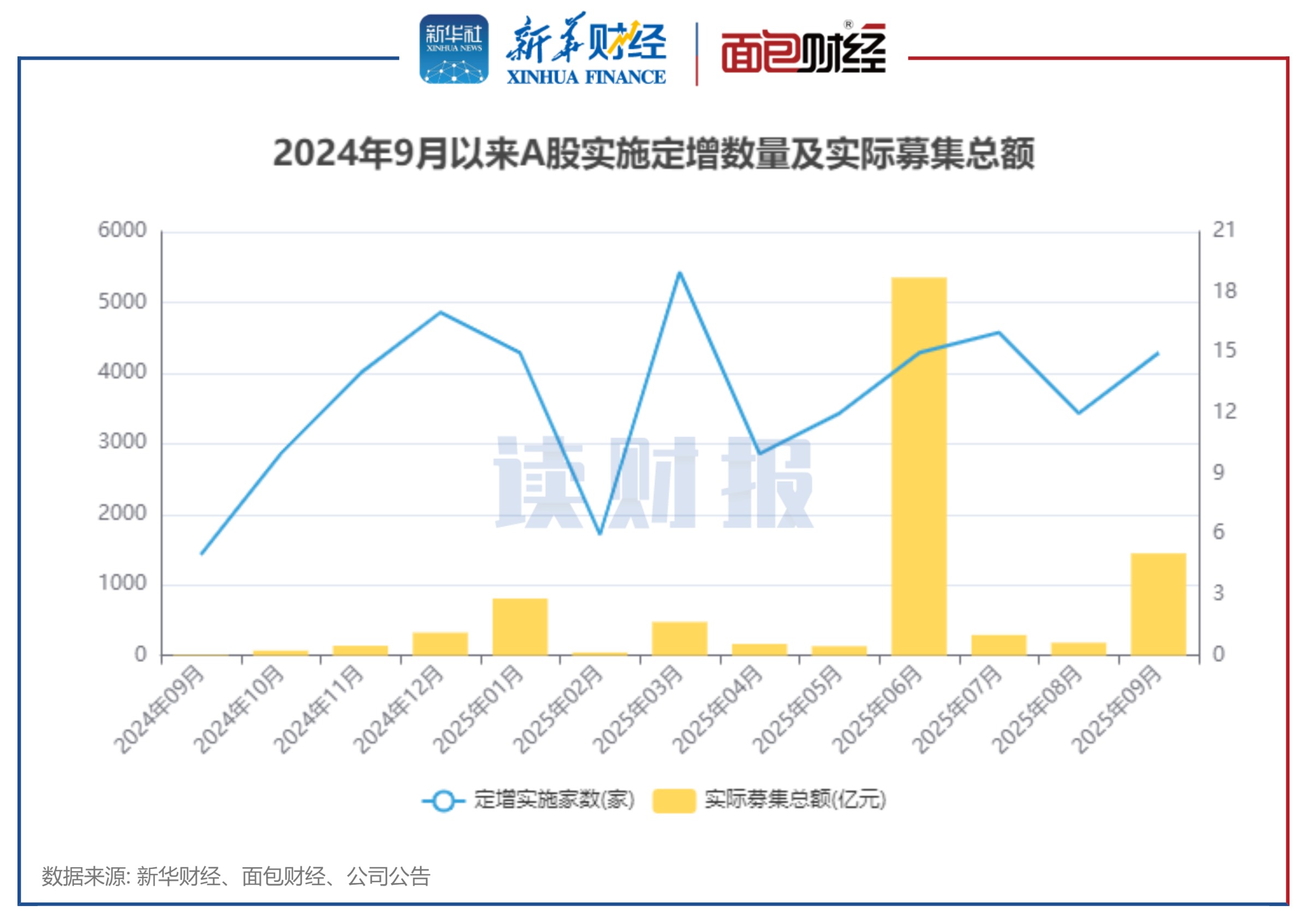
Core Points - In September 2025, A-share listed companies in China executed 15 private placements, marking a 200% year-on-year increase, with total funds raised amounting to approximately 144.71 billion yuan, a staggering 10,359% increase year-on-year [1][2] - A total of 33 private placement proposals were disclosed in September 2025, with a proposed fundraising scale of approximately 32.6 billion yuan, reflecting a 37.45% year-on-year increase [1][7] Company Summaries - China Shipbuilding ranked first in actual fundraising, raising 114.77 billion yuan by issuing 3.053 billion shares at a price of 37.59 yuan per share, with funds intended for the merger with China Shipbuilding Industry Corporation [4][5] - ChipLink Integrated raised 5.307 billion yuan through the issuance of approximately 1.314 billion shares at 4.04 yuan per share, with the funds aimed at acquiring 72.33% equity in ChipLink Integrated Circuit Manufacturing (Shaoxing) Co., Ltd. [4][5] - Guosen Securities raised 5.192 billion yuan by issuing shares at 8.25 yuan per share, with the net proceeds intended for the acquisition of 96.08% of Wanhe Securities [4][5] Industry Analysis - The industrial sector led the private placements with 5 instances, raising a total of approximately 122.44 billion yuan, followed by the information technology sector with 4 placements, and the materials sector with 2 placements [6][7] - The information technology and industrial sectors each disclosed 8 private placement proposals in September 2025, with the information technology sector proposing a total fundraising amount exceeding 6.9 billion yuan [14][15]




中马联合军演临近,当前军工板块具有较高配置价值
Jianghai Securities· 2025-10-13 12:40
Investment Rating - The industry investment rating is maintained at "Overweight" [5] Core Viewpoints - The military industry is entering a medium to long-term layout turning point, with significant investment opportunities emerging due to international political turbulence and domestic military modernization efforts [4][5] - The recent unveiling of the J-35 aircraft production line indicates a continuous enhancement of national military strength, which is expected to lead to a rapid development phase in military trade [7] - The acceleration of satellite launches suggests that the commercial aerospace industry is poised for a new phase of rapid growth, benefiting related enterprises in the supply chain [7] Summary by Relevant Sections Recent Industry Performance - Over the past 12 months, the absolute return of the industry is 21.1%, while the relative return compared to the CSI 300 is 4.39% [3] Key Events - The "Peace and Friendship - 2025" joint military exercise between China and Malaysia is set to take place from October 15 to 23, involving over 1,000 personnel and more than 500 pieces of equipment [5] Investment Highlights - The military industry is expected to see a rebound after previous adjustments, with increasing investment value highlighted by the upcoming "14th Five-Year Plan" conclusion and ongoing geopolitical tensions [8] - The report suggests focusing on specific stocks such as AVIC Xi'an Aircraft Industry Group, AVIC Shenyang Aircraft Corporation, and others within the military sector [8]


中美开辟新战线,美国将对中国船舶收取港口服务费,中国率先反制
Sou Hu Cai Jing· 2025-10-13 11:01
Core Viewpoint - The U.S. is implementing a "port service fee" targeting Chinese shipping and shipbuilding industries, which is seen as a retaliatory measure against China's competitive pricing in the global shipbuilding market [1][3]. Group 1: U.S. Actions and Motivations - The U.S. aims to undermine China's growing dominance in shipbuilding, as 90% of new ship orders are now directed to China, which threatens U.S. maritime supremacy [3]. - The new "port service fee" is a continuation of Trump's tariff policies, aimed at revitalizing the hollowed-out U.S. shipbuilding industry by imposing additional costs on Chinese vessels [3]. - The fee may extend beyond Chinese-flagged ships to include those manufactured, operated, or financed by Chinese entities, pressuring global shipping companies to choose between cost-effective Chinese vessels and more expensive U.S. alternatives [3][5]. Group 2: China's Response and Strategy - In response to U.S. pressure, China has enacted a revised International Shipping Regulations, which includes provisions for sanctions against countries that harm Chinese shipping interests, regardless of existing agreements [5]. - The new regulations also ensure that the Chinese government will support domestic shipowners and companies facing losses due to U.S. actions, indicating a strong protective stance [5]. - China's countermeasures are designed to target not only U.S.-flagged vessels but also any ships with U.S. financial ties, signaling a comprehensive approach to retaliate against U.S. policies [7]. Group 3: Market Reactions and Implications - As the implementation date of the U.S. policy approaches, global shipping markets are experiencing tension and uncertainty, with shipping companies unsure of how to navigate the new fee structure [9]. - Major shipping firms like CMA CGM and Maersk are adjusting their fleets to mitigate risks, indicating a cautious approach to U.S. routes while maintaining ties with China [9]. - The ongoing conflict in the maritime sector reflects a broader competition between the U.S. and China, emphasizing the importance of resilience and strategic capabilities in the face of economic pressures [11].
从“十年磨一剑”到“一年磨十剑” 中国LNG船建造效率大幅度提升
Yang Shi Xin Wen· 2025-10-13 07:21
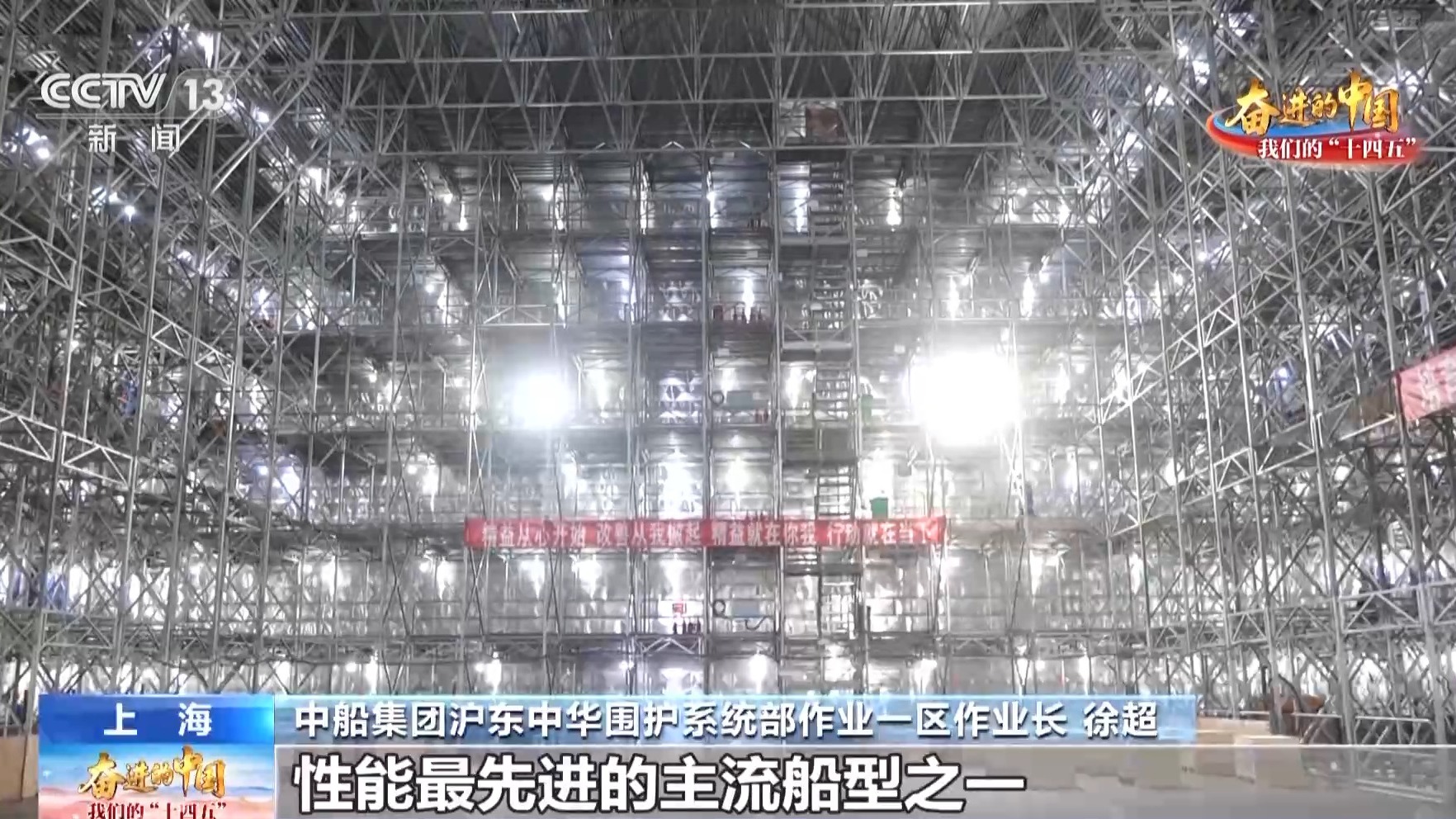
Core Viewpoint - The article highlights the significant advancements in the domestic production of Yinvag Steel, a core material for LNG ship construction, during China's 14th Five-Year Plan period, marking a shift from reliance on imports to breakthroughs in domestic technology [1][5]. Group 1: LNG Ship Construction - The construction of an LNG ship is compared to that of an aircraft carrier, with over 3 million components involved in the enclosure system alone, requiring expertise in fluid mechanics, low-temperature materials, and automatic control [3][5]. - The Yinvag Steel used in LNG ship welding is extremely thin at 0.7 mm, with a welding error tolerance of just 0.1 mm, illustrating the precision required in the construction process [3][5]. Group 2: Technological Advancements - The technological breakthroughs achieved during the 14th Five-Year Plan have led to a significant increase in construction efficiency, reducing the production time for a large LNG transport ship from over 30 months to 17 months [7]. - The China Shipbuilding Group has collaborated with over 300 domestic supporting enterprises to create an "innovation consortium" that encompasses the entire industry chain, facilitating multiple technological advancements in LNG ship construction [5][9]. Group 3: Future Aspirations - The leadership at the China Shipbuilding Group emphasizes a shift in approach, aiming to achieve in one year what previously took ten years, reflecting a commitment to rapid innovation and efficiency in shipbuilding [9].
中方港口费反制航运造船再迎历史机会,滞港效率损失油散运费受益,关注中国制造船舶是否豁免
Shenwan Hongyuan Securities· 2025-10-12 11:51
Investment Rating - The report does not explicitly state an investment rating for the industry Core Views - The shipping and shipbuilding industry is poised for historical opportunities due to China's countermeasures against the U.S. shipping fees, which may lead to non-linear price increases in the short term and a reduction in available vessels in the medium term [19][20] - The report highlights the potential for a surge in shipbuilding orders if U.S. investments in Chinese shipbuilding are exempted from tariffs, and the implications of U.S.-China negotiations on the industry [19][20] Summary by Sections 1. Industry Market Performance - The transportation index increased by 1.09%, outperforming the CSI 300 index by 1.60 percentage points, with the road freight sector showing the highest increase of 3.04% [4][5] - Shipping data indicates that the coastal dry bulk freight index in China remained stable, while the Shanghai export container freight index rose by 4.12% [4][5] 2. Sub-industry Weekly Insights - The shipping and shipbuilding sector is expected to benefit from China's recent regulatory changes, which impose special port fees on U.S. vessels, potentially leading to increased operational costs for U.S. shipping companies [20][21] - The report identifies key companies to watch, including China Shipping and China State Shipbuilding, as they may benefit from these developments [19] 3. High Dividend Stocks in Transportation - The report lists high dividend stocks in the transportation sector, including China Shipping (603167.SH) with a projected dividend yield of 10.92% and Daqin Railway (601006.SH) with a yield of 3.75% [17] - The report emphasizes the importance of dividend yields as a factor for investment decisions in the transportation sector [17] 4. ETF Size Changes - The report provides data on the changes in the size of various ETFs related to the transportation sector, indicating a general trend of growth in assets under management [13][14] 5. Potential Investment Opportunities - The report suggests that the shipping sector, particularly oil tankers and dry bulk carriers, may present significant investment opportunities due to the ongoing geopolitical tensions and regulatory changes [19][20] - Companies such as China Shipping and China State Shipbuilding are highlighted as potential beneficiaries of these market dynamics [19]





突然变卦的特朗普, 与一份美国内参刺激有关?
Hu Xiu· 2025-10-12 09:23
Group 1 - The U.S. government plans to impose a 100% additional tariff on all Chinese goods starting November 1, 2025, raising the total tariff rate to over 150% [1] - This decision is influenced by China's new regulations on rare earth exports and the ongoing competition in the shipbuilding industry between the U.S. and China [1] Group 2 - The U.S. shipbuilding industry has faced a significant decline, with only five large ocean-going vessels built in 2024, totaling 76,000 tons, compared to over 250 vessels built by a single Chinese company during the same period [2][5] - The U.S. market share in global commercial shipbuilding has shrunk from 0.33% in 2014 to just 0.11% in 2024, highlighting the industry's long-term decline [5][6] Group 3 - The decline of the U.S. shipbuilding industry is attributed to a combination of international competition, structural challenges, and domestic policy changes [4][9] - The U.S. shipbuilding industry once dominated globally during World War II but has since lost its competitive edge, with significant impacts on economic development and national security [3][4] Group 4 - The U.S. government is exploring strategies to revitalize the shipbuilding industry, focusing on icebreaker ships as a strategic entry point due to their military and commercial significance [26][27] - The report emphasizes the need for a comprehensive national shipbuilding strategy to address capacity limitations and enhance international competitiveness [39][40] Group 5 - The report outlines several structural challenges facing the U.S. shipbuilding industry, including high construction costs, a shortage of skilled labor, and inefficiencies in government procurement processes [10][11][12] - The U.S. shipbuilding costs are reported to be two to four times higher than those in countries like China, Korea, and Japan, severely limiting competitiveness [10] Group 6 - The global shipbuilding landscape has shifted dramatically, with China now dominating the market, capturing over 80% of new container ship orders and 30% of LNG carrier orders by 2024 [20][21] - Traditional shipbuilding powers like Japan and Korea are also facing challenges, with Japan's workforce shrinking significantly and Korea focusing on high-value segments [21][22] Group 7 - The decline of the U.S. shipbuilding industry has implications beyond economic competitiveness, affecting military capabilities and national security [23][25] - The U.S. Navy's ability to maintain and enhance its operational capacity is directly impacted by the challenges faced in the shipbuilding sector [25] Group 8 - The U.S. government is considering a trilateral cooperation initiative with Finland and Canada to enhance icebreaker ship production, leveraging each country's strengths [33][35] - The proposed "ICE Pact" aims to integrate strategic advantages and technical capabilities among the three nations to boost shipbuilding efforts [33][35]
美对中国船舶收费中方对美同时实施
Huan Qiu Shi Bao· 2025-10-10 15:30
Core Viewpoint - The U.S. has announced unilateral measures against China's maritime, logistics, and shipbuilding sectors, prompting China to implement countermeasures to protect its domestic industries [1] Group 1: U.S. Measures - On April 17, the U.S. Trade Representative's Office announced final measures from the 301 investigation targeting China's maritime, logistics, and shipbuilding sectors [1] - The U.S. will impose port fees on Chinese vessels starting October 14, which is seen as a discriminatory action harming Chinese enterprises [1] Group 2: China's Response - In response, China will impose special port fees on vessels with U.S. elements, including those flagged, built, or owned by U.S. companies, effective October 14 [1] - China's countermeasures are described as a "justifiable defense" aimed at maintaining fair competition in the international shipping and shipbuilding markets [1] - China urges the U.S. to reconsider its actions and seek resolution through equal negotiations and cooperation [1]
交运行业2025Q3业绩前瞻:快递三季报验证利润修复弹性,造船进入业绩释放,把握油运造船上行机会
Shenwan Hongyuan Securities· 2025-10-10 13:49
Investment Rating - The report maintains an "Overweight" rating for the transportation industry, indicating a positive outlook compared to the overall market performance [12]. Core Insights - The report highlights a recovery in profits for the express delivery sector driven by anti-competition policies, with an expected increase in prices leading to improved profitability for companies like Shentong Express and YTO Express [5][6]. - The shipping sector is experiencing strong demand, particularly for oil tankers, with historical high freight rates observed in August and September 2025. The report anticipates continued demand growth due to OPEC+ production increases and a release of pent-up inventory demand [5]. - The shipbuilding industry is in a phase of profit release as high-priced orders are being delivered, with a strong demand for replacing old vessels. The report notes that the implementation of the 301 policy is expected to stimulate order volumes and ship prices [5]. - The airline sector is projected to see significant improvements in operational performance due to increased capacity and a recovery in international travel, with major airlines like China Eastern Airlines and Southern Airlines expected to benefit [5][6]. - The report also indicates that the highway and railway sectors are likely to maintain growth in traffic volumes, with improvements in railway freight performance anticipated due to the retraction of previous freight rate reductions [5]. Summary by Sections Shipping - Oil tanker freight rates reached historical highs in August and September 2025, with a projected 14% decline in VLCC market rates for Q3, while Cape-sized bulk carriers are expected to see a 19% increase in rates [5]. - The report recommends companies such as China Merchants Energy Shipping and China Merchants Heavy Industry, highlighting the strong demand and supply constraints in the sector [5]. Shipbuilding - The shipbuilding industry is characterized by a tight supply-demand balance, with ongoing demand for replacing old vessels. The report suggests that the implementation of the 301 policy will positively impact order volumes and ship prices [5]. - Recommended companies include China Shipbuilding Industry Corporation and China State Shipbuilding Corporation, which are expected to benefit from the current market dynamics [5]. Airlines - The airline sector is entering a peak travel season with increased capacity and improved passenger flow. The report anticipates significant operational improvements for major airlines due to favorable external factors such as lower oil prices [5][6]. - Companies like China Eastern Airlines and Spring Airlines are highlighted as key beneficiaries of this trend [5]. Express Delivery - The express delivery sector is expected to see a recovery in profits due to rising prices and reduced competition. The report notes a 12.3% year-on-year growth in express delivery volume in August 2025 [5]. - Recommended companies include Shentong Express and YTO Express, which are expected to benefit from the ongoing price increases [5]. Highway and Railway - The report forecasts growth in highway traffic and railway passenger and freight volumes, with a notable increase in railway freight performance expected in Q3 2025 [5]. - Recommended companies include Zhejiang Huhangyong and Beijing-Shanghai High-Speed Railway, which are expected to perform well in the current environment [5].





航海装备板块10月9日涨1.13%,海兰信领涨,主力资金净流出1.26亿元
Zheng Xing Xing Ye Ri Bao· 2025-10-09 09:00
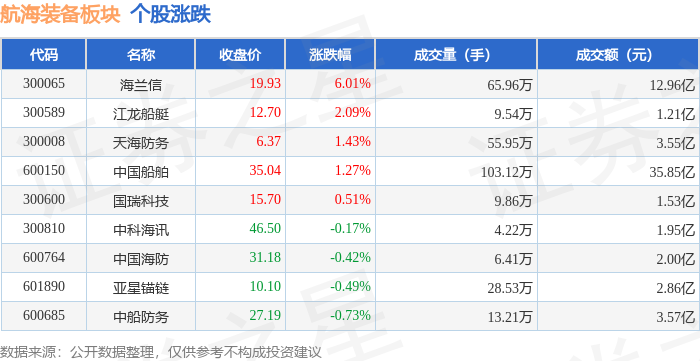
Core Insights - The maritime equipment sector experienced a 1.13% increase on October 9, with Hailanxin leading the gains [1] - The Shanghai Composite Index closed at 3933.97, up 1.32%, while the Shenzhen Component Index closed at 13725.56, up 1.47% [1] Sector Performance - Hailanxin (300065) closed at 19.93, with a rise of 6.01% and a trading volume of 659,600 shares, amounting to 1.296 billion yuan [1] - Jianglong Shipbuilding (300589) closed at 12.70, up 2.09%, with a trading volume of 95,400 shares, totaling 121 million yuan [1] - Tianhai Defense (300008) closed at 6.37, increasing by 1.43%, with a trading volume of 559,500 shares, amounting to 355 million yuan [1] - China Shipbuilding (600150) closed at 35.04, up 1.27%, with a trading volume of 1,031,200 shares, totaling 3.585 billion yuan [1] - Other notable stocks include Yuanrui Technology (300600) at 15.70 (+0.51%), Wuyi Jun (300810) at 46.50 (-0.17%), and China Marine Defense (600764) at 31.18 (-0.42%) [1] Capital Flow - The maritime equipment sector saw a net outflow of 126 million yuan from institutional investors, while retail investors contributed a net inflow of 147 million yuan [1] - Hailanxin had a net inflow of 82.7194 million yuan from institutional investors, despite a net outflow from retail and speculative investors [2] - Jianglong Shipbuilding experienced a net inflow of 13.4569 million yuan from institutional investors, while retail investors had a net outflow of 13.8493 million yuan [2]