ZTT(600522)

Search documents
中天科技:公司遵循相关规则履行信息披露义务
Zheng Quan Ri Bao· 2026-02-05 12:13
证券日报网讯 2月5日,中天科技在互动平台回答投资者提问时表示,公司遵循相关规则,履行信息披 露义务。 (文章来源:证券日报) ...


海洋经济板块2月5日跌1.9%,中天科技领跌,主力资金净流出31.18亿元
Sou Hu Cai Jing· 2026-02-05 09:25
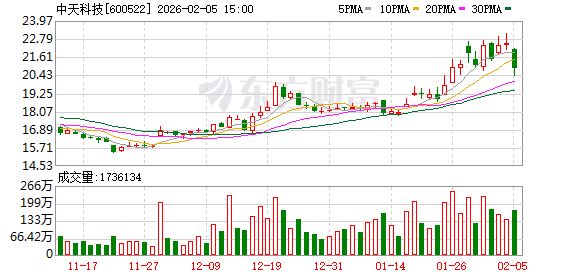
Group 1 - The marine economy sector declined by 1.9% compared to the previous trading day, with Zhongtian Technology leading the decline [1] - The Shanghai Composite Index closed at 4075.92, down 0.64%, while the Shenzhen Component Index closed at 13952.71, down 1.44% [1] - The net outflow of main funds in the marine economy sector was 3.118 billion yuan, while retail investors saw a net inflow of 2.732 billion yuan [1] Group 2 - The net inflow of funds from speculative investors in the marine economy sector was 387 million yuan [1] - Detailed fund flow for individual stocks in the marine economy sector is available in the accompanying table [1]

国泰海通:光纤光缆供不应求 看好行业涨价趋势
Zhi Tong Cai Jing· 2026-02-05 09:01
Group 1 - The core viewpoint is that the fiber optic industry is entering a price increase trend, driven by rising demand for G657A2 and other products, leading to reduced supply of G652D and longer delivery times [2][4] - The demand for fiber optics is significantly boosted by AI-driven data centers and DCI (Data Center Interconnect) scenarios, with global fiber demand expected to continue rising [3][4] - The export performance of fiber optic and cable companies is strong, with overseas markets becoming an important growth point for the industry [3][6] Group 2 - The competition in computing power is driving a concentrated explosion in fiber demand, with AI data centers requiring significantly more fiber than traditional data centers [4][5] - The demand for specialty and multimode fibers is growing, with companies rapidly advancing in the development and application of hollow-core fibers [5] - Major domestic fiber optic manufacturers are expected to benefit from the price increase trend, with profit elasticity likely to be continuously revised upwards [6]


特高压指数下跌2%,成分股多数走低
Xin Lang Cai Jing· 2026-02-05 07:10
Group 1 - The ultra-high voltage index declined by 2% on February 5, indicating a downward trend in the sector [1] - Most constituent stocks experienced a drop, with Hengtong Optic-Electric, Zhongtian Technology, Changgao Electric, and Jinpan Technology all falling over 4% [1] - Trina Solar also saw a decrease, with its stock down by 3% [1]



通信设备及服务:光纤光缆供不应求,看好涨价趋势
GUOTAI HAITONG SECURITIES· 2026-02-05 06:29
Investment Rating - The report assigns an "Overweight" rating to the fiber optic cable industry [1]. Core Insights - The fiber optic industry is experiencing a significant price increase trend, driven by a surge in demand due to computational power competition and the growth of special and multimode fibers. The export performance of fiber optic cables is strong, confirming the industry's upward pricing trend [3][4]. Summary by Sections 1. Fiber Optic Industry Cycle and Price Trends - After being under pressure in the first half of last year, the price of fiber optic cables has been gradually recovering, particularly with increased demand for G657A2 overseas, leading to a reduction in G652D supply and longer delivery times. The price of G652D fiber has seen significant increases, with expectations for continued price hikes as major telecom operators prepare for procurement [8][9]. 2. Factors Driving Price Increases - The demand for fiber optic cables is continuously growing, with G652D fiber experiencing a structural shortage. Prices have risen significantly, with the latest market quotes reaching 30-40 yuan per core kilometer, reflecting a more than 50% increase over the previous year [16][22]. - The competition for computational power is a core driver of fiber demand, with data centers requiring significantly more fiber than traditional setups. The global demand for fiber optic cables is expected to increase by 75.9% in 2025, particularly for high-end products like G.654.E and OM5 multimode fibers [20][22]. - The supply side is constrained, with a slow growth in global fiber preform capacity and a shift towards high-demand AI and specialty fibers, leading to a more orderly supply of traditional products [30]. 3. Export Performance and Growth Opportunities - The export of fiber optic cables has become a crucial growth point for companies in the industry, with significant increases in overseas demand. In 2025, the total export volume of fiber optic products reached 454,000 tons, a year-on-year increase of 11.1%, with export value rising by 44.1% [12][10]. 4. Investment Recommendations - The report recommends investing in leading domestic fiber optic manufacturers such as Yangtze Optical Fibre and Cable Joint Stock Limited Company, Hengtong Optic-Electric Co., Ltd., and Zhongtian Technology Co., Ltd., which are expected to benefit from the price increase trend and growing demand [51].
再谈光纤光缆行业的供需变化
2026-02-05 02:21
Summary of Fiber Optic Cable Industry Conference Call Industry Overview - The fiber optic cable industry is experiencing a significant demand surge driven by short-term needs from drone operations and strategic stockpiling in Europe and the U.S. [1] - Long-term demand driven by AI is expected to be a key growth driver, with AI-related demand projected to account for 20% of global demand by 2026 [1][4][5]. Key Points and Arguments - **Short-term Demand Drivers**: The demand for 657A fiber optics is significantly influenced by military needs, particularly for drone operations in the Russia-Ukraine conflict and strategic stockpiling by Western countries [2]. - **Long-term AI Demand**: AI is anticipated to create a sustained demand for high-performance connectors, with projections indicating that AI-related demand will rise from less than 10% in 2025 to 20% by 2026 [4][5]. - **Supply Constraints**: Major North American suppliers like Corning and Prysmian are operating near full capacity, with new capacity additions expected to be slow, leading to a tight supply situation [2][4][6]. - **Market Dynamics**: Domestic manufacturers, such as Futong, are facing production halts due to bankruptcy restructuring, which, combined with slow recovery from smaller firms, exacerbates supply bottlenecks and drives prices higher [1][7]. Investment Opportunities - **Current Investment Window**: The current market conditions present a favorable investment opportunity in the fiber optic cable industry, supported by both short-term and long-term demand factors [8]. - **Key Companies to Watch**: - Leading manufacturers with significant optical fiber capacity, such as Yangtze Optical Fibre and Cable, Hengtong, and Zhongtian Technology, are recommended for investment due to their established presence in the North American market [12]. - Among second-tier manufacturers, companies like Avic's Fuchunjiang, which has a strong technical team and high capacity utilization, are also highlighted for their potential [13]. Price Trends and Market Expectations - **Price Sustainability**: The price increases in the fiber optic cable market are expected to be sustainable due to ongoing demand from military applications and AI, with no significant oversupply anticipated in the near term [3][8]. - **Challenges in Price Prediction**: Accurately predicting price increases remains challenging due to the complex relationship between capacity gaps and price movements [9]. Catalysts and Risks - **Potential Catalysts**: Upcoming financial reports from overseas companies and optimistic data from CRU are expected to positively influence market sentiment [10][11]. - **Market Influences**: The re-tendering and pricing strategies of domestic operators, along with order placements from overseas CSPs, will also play a crucial role in shaping market dynamics [11].

超导指数盘中走弱,主要成分股多数下挫
Mei Ri Jing Ji Xin Wen· 2026-02-05 02:09
Group 1 - The superconducting index experienced a decline of 2% during intraday trading, with most constituent stocks falling [1] - Zhongtian Technology led the decline with a drop of 6.58%, while other stocks such as Yuguang Jinlan, Tebian Electric Apparatus, Zhongfu Industrial, and Jinbei Electric also saw decreases [1]


一“纤”难求 光纤行业迎来强周期
Mei Ri Shang Bao· 2026-02-04 22:16
Core Viewpoint - The optical fiber and cable industry is experiencing a significant upturn, driven by increased demand from AI data centers and a global supply-demand imbalance, leading to substantial price increases and stock performance in related companies [1][4]. Industry Summary - The optical fiber market has seen a continuous rise in demand, with prices for G.652.D single-mode optical fibers in China reaching over 35 yuan per core kilometer, marking a 75% increase in January alone [1][4]. - A global trend is observed where optical fiber prices are rising sharply, with the Chinese market leading the way, and some manufacturers quoting prices as high as 50 yuan per core kilometer [4]. - The CRU China Optical Fiber and Cable Index (FOCI) has rebounded by 10.8%, indicating a shift from contraction to expansion in the market [4]. - The industry is entering a prolonged period of prosperity, driven by technological upgrades and the explosive growth of AI data centers, which is expected to sustain tight supply for 2-3 years due to the long production cycle of key materials [4][6]. Company Summary - Hangzhou Electric (杭电股份) has seen its stock price rise significantly, with a cumulative increase of 32.97% over three consecutive trading days, prompting the company to issue a risk warning due to potential irrational market speculation [2][3]. - The company reported a negative rolling price-to-earnings ratio of -33.93, significantly higher than the industry average of 24.23, indicating potential volatility in stock trading [2]. - Other companies in the optical fiber sector, such as Longfly Fiber and Hengtong Optic-Electric, have also experienced substantial stock price increases, with Longfly Fiber issuing a risk warning after its stock price deviated significantly from the norm [3][4].




重磅!2025年中国光模块行业政策汇总及解读(全)
Qian Zhan Wang· 2026-02-04 07:11
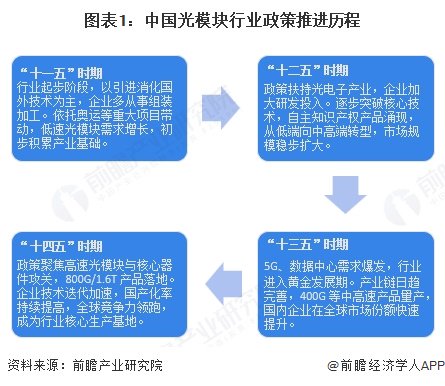
Core Insights - The Chinese optical module industry has evolved from technology introduction during the "11th Five-Year Plan" to achieving technological independence, product upgrades, and scale expansion, becoming a core player in the global optical module market during the "14th Five-Year Plan" period, focusing on high-end and domestic production driven by 5G and computing power demands [1] National Policy Summary - Recent policies in China show a collaborative effort between national and local governments, focusing on technological breakthroughs and practical applications in the optical module industry. The Ministry of Industry and Information Technology (MIIT) has issued multiple documents, including the "2025-2026 Action Plan for Stable Growth in the Electronic Information Manufacturing Industry," which aims to promote the trial of 10G optical networks and the layout of computing power infrastructure [4][5] - Key areas of focus include integrating CPO (Co-Packaged Optics) and high-speed optical modules into critical technological breakthroughs, supporting the mass production of products like 800G and 1.6T [4][5] Provincial Policy Summary - Various provinces have developed their own policies aligned with the national "14th Five-Year Plan," emphasizing the development of optical communication, millimeter-wave, 5G enhancement, and quantum communication technologies. Local governments are also providing funding support for core technology research and development [13] - For instance, Beijing's policies include promoting advanced packaging technology for 1.6T silicon optical modules and enhancing broadband network capabilities to support user experiences exceeding 100 Mbps by 2025 [14] - Shanghai's initiatives focus on deploying 50G PON and 400G optical transmission technologies, aiming to create a fully optical direct connection network for data centers [17] Industry Development Trends - The optical module industry is expected to see significant growth driven by the increasing demand for high-speed data transmission in AI, industrial internet, and other applications. Policies are encouraging the development of high-reliability, low-power products suitable for industrial scenarios [4][5] - The goal is to enhance the domestic production rate of key components and technologies, with specific targets set for the market share of domestic CPO modules to reach 40% by 2025 [5][6] Investment Opportunities - The ongoing policy support and technological advancements present substantial investment opportunities in the optical module sector, particularly for companies involved in high-speed optical modules and related technologies. The focus on domestic production and technological independence further enhances the attractiveness of this sector for investors [1][4][5]



通信设备板块2月3日涨2.95%,德科立领涨,主力资金净流入1.34亿元
Zheng Xing Xing Ye Ri Bao· 2026-02-03 09:11
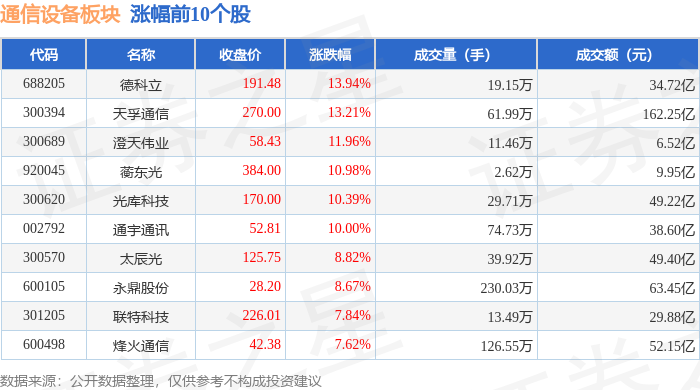
Core Viewpoint - The communication equipment sector experienced a significant increase, with a 2.95% rise on February 3, driven by strong performances from individual stocks like Dekoli and Tianfu Communication [1] Group 1: Market Performance - The Shanghai Composite Index closed at 4067.74, up 1.29%, while the Shenzhen Component Index closed at 14127.1, up 2.19% [1] - Dekoli led the gains in the communication equipment sector with a closing price of 191.48, reflecting a 13.94% increase [1] - Other notable performers included Tianfu Communication, which rose by 13.21% to 270.00, and Cheng Tian Wei Ye, which increased by 11.96% to 58.43 [1] Group 2: Trading Volume and Value - Dekoli had a trading volume of 191,500 shares, with a transaction value of 34.72 billion [1] - Tianfu Communication recorded a trading volume of 619,900 shares, with a transaction value of 162.25 billion [1] - The total trading volume and value for the communication equipment sector showed robust activity, indicating strong investor interest [1] Group 3: Capital Flow - The communication equipment sector saw a net inflow of 134 million from institutional investors, while retail investors experienced a net outflow of 1.38 billion [2] - Major stocks like Tongyu Communication and Yongding Co. attracted significant net inflows of 10.59 billion and 906 million, respectively [3] - The overall capital flow indicates a divergence in investor sentiment, with institutional investors favoring certain stocks while retail investors withdrew [2][3]