
SCIE(600546)

Search documents
26家银行派息落地,险资有望加码红利板块,国企红利ETF(159515)调整蓄势
Xin Lang Cai Jing· 2025-12-10 02:42
Group 1 - The core viewpoint of the news is that the China Securities State-Owned Enterprises Dividend Index has experienced a slight decline, while the dividend distribution from major banks is expected to attract long-term capital into the market [1][2] - As of December 10, 2025, the China Securities State-Owned Enterprises Dividend Index fell by 0.15%, with Xiamen International Trade leading the gains and China Merchants Bank leading the losses [1] - The China Securities State-Owned Enterprises Dividend ETF (159515) saw a scale increase of 2.33 million yuan and a share increase of 2.7 million shares over the past week [1][2] Group 2 - On December 8, Industrial and Commercial Bank of China and Agricultural Bank of China announced their mid-term dividend distributions, totaling 50.396 billion yuan and 41.823 billion yuan, respectively [1] - By December 9, 2025, 26 A-share listed banks had disclosed mid-term or quarterly dividend plans, with a total proposed payout exceeding 260 billion yuan [1] - China Galaxy Securities noted that the mid-term dividend distribution from listed banks remains strong and is occurring earlier than expected, enhancing the attractiveness of dividend stocks [1][2] Group 3 - The China Insurance Regulatory Commission announced a reduction in stock risk factors, which lowers the capital requirements for insurance companies investing in high-quality equity assets [2] - Recent policies focus on capital markets and consumer policies, with a goal for large state-owned insurance companies to allocate 30% of new premiums to A-shares [2] - The China Securities State-Owned Enterprises Dividend Index includes 100 listed companies with high cash dividend yields, reflecting the overall performance of high-dividend securities among state-owned enterprises [2]






中长期经济高质量发展背景下,红利资产配置价值凸显,国企红利ETF(159515)盘中蓄势
Xin Lang Cai Jing· 2025-12-08 06:01
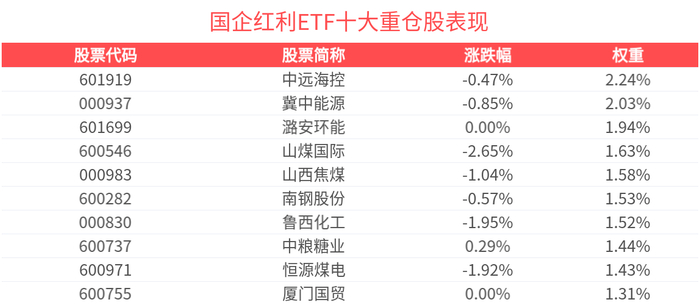
Group 1 - The core point of the news is the performance of the China Securities State-Owned Enterprises Dividend Index, which has seen a decline of 0.47% as of December 8, 2025, with Xiamen Bank leading the gains among constituent stocks [1] - The China Securities State-Owned Enterprises Dividend ETF (159515) has a latest scale of 47.8753 million yuan and a total of 41.1866 million shares, indicating a significant interest from investors with a net inflow of 3.4908 million yuan over the last three days [1] - The ETF closely tracks the China Securities State-Owned Enterprises Dividend Index, selecting 100 listed companies with high cash dividend yields and stable dividends from state-owned enterprises [2] Group 2 - According to Huachuang Securities, dividend assets show value across various sectors including transportation, finance, energy, food and beverage, home appliances, real estate, metals, and publishing [2] - In the transportation sector, long-duration assets such as highways, ports, and railways exhibit defensive stability, with a recommendation for high-quality highway assets with growth potential [2] - The coal industry is experiencing enhanced profitability stability due to unexpected anti-involution policies and supply constraints, indicating a positive outlook for dividend assets amid high-quality economic development [2] Group 3 - As of November 28, 2025, the top ten weighted stocks in the China Securities State-Owned Enterprises Dividend Index account for a total of 16.99%, with notable stocks including COSCO Shipping Holdings and Jizhong Energy [3] - The performance of the top ten stocks shows varied results, with COSCO Shipping Holdings declining by 0.47% and Jizhong Energy by 0.85%, while Lu'an Environmental Energy remained unchanged [3]


煤炭开采行业周报:12月煤价仍有上涨动能-20251207
Guohai Securities· 2025-12-07 10:33
Investment Rating - The report maintains a "Recommended" rating for the coal mining industry [1] Core Viewpoints - The coal price has upward momentum in December, driven by seasonal demand increases and supply constraints [4][7] - The coal mining industry is characterized by high asset quality and strong cash flow among leading companies, indicating a favorable long-term outlook for coal prices [7] Summary by Sections 1. Thermal Coal - As of December 5, the price of thermal coal at northern ports is 785 RMB/ton, a decrease of 31 RMB/ton week-on-week [14] - Production in the Sanxi region has seen a slight decrease in capacity utilization, down 0.61 percentage points [14][21] - Coastal and inland power plants have increased daily coal consumption by 7.3 and 35.3 thousand tons respectively [14][23] - The inventory of power plants in 25 provinces is 136.12 million tons, down 115 thousand tons year-on-year [14][34] 2. Coking Coal - The capacity utilization rate for coking coal mines has decreased by 0.17 percentage points to 84.5% [5][40] - The average crossing volume at Ganqimaodu port has increased, indicating stable import levels [5][44] - The price of main coking coal at ports is 1,630 RMB/ton, down 40 RMB/ton week-on-week [5][41] 3. Coke - The production rate of independent coking plants has increased slightly to 72.66% [53][59] - The average profit per ton of coke has decreased to approximately 30 RMB/ton, down 16 RMB/ton week-on-week [57] - The price of coke at Rizhao port is 1,630 RMB/ton, a decrease of 50 RMB/ton week-on-week [54] 4. Anthracite - The price of anthracite remains stable, with the small block price at 930 RMB/ton [69] 5. Key Companies and Profit Forecasts - Key companies to focus on include China Shenhua, Shaanxi Coal, and Yanzhou Coal, all rated as "Buy" [9]



日耗爬坡缓慢拖累煤价,供应偏紧不改后市可期
ZHONGTAI SECURITIES· 2025-12-06 12:00
Investment Rating - The report maintains an "Overweight" rating for the coal industry, indicating a positive outlook for investment opportunities in this sector [5]. Core Views - The coal price is expected to maintain a strong upward trend due to seasonal demand increases and supply constraints, despite short-term pressures from low consumption rates in certain regions [7][8]. - The report highlights the potential for coal prices to rise as winter approaches, with increased demand from power plants for stock replenishment [7]. - The introduction of stricter safety regulations is likely to impact coal production rates, further tightening supply [7][8]. Summary by Sections 1. Industry Overview - The coal industry consists of 37 listed companies with a total market capitalization of approximately 19,360.92 billion [2]. - The circulating market value of the industry is around 18,986.29 billion [2]. 2. Price Tracking - As of December 5, 2025, the average daily production of thermal coal from 462 sample mines is 5.512 million tons, showing a week-on-week increase of 0.22% but a year-on-year decrease of 7.53% [8]. - The price of thermal coal at the Qinhuangdao port is reported at 790 yuan per ton, down 31 yuan from the previous week, reflecting a week-on-week decline of 3.78% [8]. 3. Supply and Demand Dynamics - The report notes that the daily coal consumption across 25 provinces reached 5.839 million tons, an increase of 428,000 tons from the previous week, indicating a week-on-week growth of 7.91% [8]. - The report anticipates that as winter progresses, coal demand will increase, particularly in southern regions affected by cold weather [7]. 4. Company Performance and Recommendations - Key companies recommended for investment include Yanzhou Coal Mining Company, Shanxi Coal and Chemical Industry Group, and Jinneng Holding Group, which are expected to benefit from the anticipated rise in coal prices [7][8]. - The report emphasizes the importance of focusing on companies with high elasticity in their stock performance, particularly those involved in thermal coal production [7].


股票行情快报:山煤国际(600546)12月5日主力资金净卖出1281.52万元
Sou Hu Cai Jing· 2025-12-05 12:09
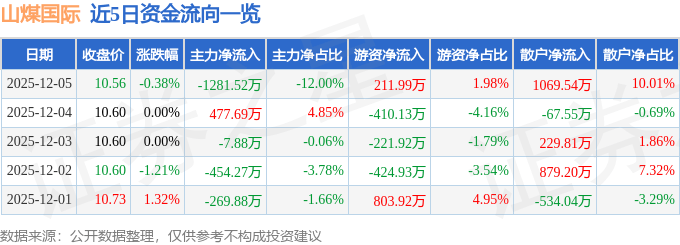
证券之星消息,截至2025年12月5日收盘,山煤国际(600546)报收于10.56元,下跌0.38%,换手率 0.51%,成交量10.13万手,成交额1.07亿元。 山煤国际2025年三季报显示,前三季度公司主营收入153.32亿元,同比下降30.2%;归母净利润10.46亿 元,同比下降49.74%;扣非净利润10.88亿元,同比下降50.23%;其中2025年第三季度,公司单季度主 营收入56.73亿元,同比下降28.27%;单季度归母净利润3.91亿元,同比下降50.53%;单季度扣非净利 润4.06亿元,同比下降49.65%;负债率49.71%,投资收益4219.74万元,财务费用1.56亿元,毛利率 34.71%。山煤国际(600546)主营业务:煤炭生产业务、煤炭销售和物流业务、非煤贸易业务。 12月5日的资金流向数据方面,主力资金净流出1281.52万元,占总成交额12.0%,游资资金净流入 211.99万元,占总成交额1.98%,散户资金净流入1069.54万元,占总成交额10.01%。 该股最近90天内共有10家机构给出评级,买入评级5家,增持评级5家;过去90天内机构目标均价为 11.6 ...
山煤国际能源集团股份有限公司关于控股股东与实际控制人之间产权层级减少的提示性公告
Shang Hai Zheng Quan Bao· 2025-12-02 19:17
证券代码:600546 证券简称:山煤国际 公告编号:临2025-048号 ■ 山煤国际能源集团股份有限公司 关于控股股东与实际控制人之间产权层级减少的提示性公告 本公司董事会及全体董事保证本公告内容不存在任何虚假记载、误导性陈述或者重大遗漏,并对其内容 的真实性、准确性和完整性承担法律责任。 重要内容提示: ● 本次控股股东与实际控制人之间产权层级减少系山西省人民政府将山西省国有资本运营有限公司(以 下简称"山西国资运营公司")持有的山西焦煤集团有限责任公司(以下简称"焦煤集团")90%股权划转 至山西省人民政府国有资产监督管理委员会(以下简称"山西省国资委")直接持有。 ● 本次控股股东与实际控制人之间产权层级减少不会导致公司直接控股股东及实际控制人发生变化。公 司直接控股股东仍为山西煤炭进出口集团有限公司,间接控股股东仍为焦煤集团,实际控制人仍为山西 省国资委。 ● 本次控股股东与实际控制人之间产权层级减少不涉及要约收购。 一、本次控股股东与实际控制人之间产权层级减少的基本情况 近日,公司收到焦煤集团转来的《山西省人民政府国有资产监督管理委员会关于将山西省国有资本运营 有限公司持有的相关企业国有股权划转 ...
山煤国际(600546) - 山煤国际关于控股股东与实际控制人之间产权层级减少的提示性公告
2025-12-02 11:01
重要内容提示: 本次控股股东与实际控制人之间产权层级减少系山西省人民政府将山西 省国有资本运营有限公司(以下简称"山西国资运营公司")持有的山西焦煤集 团有限责任公司(以下简称"焦煤集团")90%股权划转至山西省人民政府国有资 产监督管理委员会(以下简称"山西省国资委")直接持有。 本次控股股东与实际控制人之间产权层级减少不会导致公司直接控股股 东及实际控制人发生变化。公司直接控股股东仍为山西煤炭进出口集团有限公司, 间接控股股东仍为焦煤集团,实际控制人仍为山西省国资委。 本次控股股东与实际控制人之间产权层级减少不涉及要约收购。 一、本次控股股东与实际控制人之间产权层级减少的基本情况 近日,公司收到焦煤集团转来的《山西省人民政府国有资产监督管理委员会 关于将山西省国有资本运营有限公司持有的相关企业国有股权划转至省国资委 的通知》(晋国资产权[2025]75 号),根据文件要求,山西省人民政府决定将山 西国资运营公司所持有的焦煤集团90%股权划转至山西省国资委直接持有。目前, 上述事项尚未完成工商变更登记。 证券代码:600546 证券简称:山煤国际 公告编号:临 2025-048 号 山煤国际能源集团股份有限 ...
山煤国际20251128
2025-12-01 00:49
Summary of Shanxi Coal International Conference Call Company Overview - **Company**: Shanxi Coal International - **Industry**: Coal Production Key Points Production and Sales Forecast - Shanxi Coal International expects coal production to remain between 35-36 million tons in 2025, aligning with production capacity [2][3] - Sales target for 2025 is set at 26-27 million tons, with metallurgical coal sold based on market conditions and thermal coal primarily for supply assurance [2][3] Regulatory Environment - The impact of Shanxi Province's safety and environmental policies on production is expected to diminish starting January 2025, with regulatory intensity anticipated to remain similar to 2024 [2][5] Cost Control - Cost control has been effective, with costs dropping to 230 RMB/ton in Q3 2025, and an expected average cost below 300 RMB/ton for the year, down from 308 RMB/ton in 2024 [2][7] - The company attributes cost reductions to stable sales, passive cost reductions due to declining performance, and strict expense management [7] Price Expectations - Thermal coal prices are projected to fluctuate between 700-800 RMB/ton from December to Q1 2026, with limited demand growth and supply-side reforms influencing this stability [2][8] - For 2026, thermal coal prices are expected to range from 700-900 RMB/ton, with a central tendency around 750-800 RMB/ton [4][12] Inventory Management - Coal inventory was high at over 3 million tons in Q1 2025 but has decreased significantly by Q3, with expectations of returning to a reasonable level of around 300,000 tons by December [10] Import Policies - The company anticipates that if domestic demand weakens, there may be tighter controls on coal imports, which have been increasing but are expected to stabilize [11] Resource Development - Shanxi Coal International is actively monitoring resource release opportunities in Shanxi Province, with plans to pursue new mining rights as they become available [13] Market Dynamics - The company notes that the demand for thermal coal is stable, and the supply-side adjustments over the past two years have limited growth in new production capacity, reducing the likelihood of significant price fluctuations [12] Conclusion - Overall, Shanxi Coal International is positioned to maintain stable production and sales in the coming years, with effective cost management and a favorable regulatory environment contributing to its outlook. The company is also strategically focused on resource acquisition to support future growth.
行业周报:煤价第四目标上穿过程兑现,稳价逻辑依旧-20251130
KAIYUAN SECURITIES· 2025-11-30 12:44
Investment Rating - The report maintains a "Positive" investment rating for the coal industry [1] Core Viewpoints - The coal price has successfully crossed the fourth target, and the logic for price stability remains intact. The current dynamics are influenced by supply contraction and a surge in demand due to seasonal heating needs [3][4] - The report indicates that both thermal coal and coking coal prices are at a turning point, with thermal coal being a policy-driven commodity. The price recovery process involves several stages, including the restoration of long-term contracts and achieving a balance in profitability between coal and power companies [4][13] - The report highlights that the current coal prices are still at historical lows, providing room for a rebound, especially with the onset of the heating season and supply-side policies [5][14] Summary by Sections Industry Investment Rating - The coal industry is rated as "Positive" [1] Price Trends - As of November 28, the price of Qinhuangdao Q5500 thermal coal is 816 CNY/ton, showing a slight decrease from the previous week. The price at Guangzhou Port is 855 CNY/ton, having reached the target of 750 CNY for coal-power profitability [3][4] - Coking coal prices have also seen significant rebounds, with the price at Jing Tang Port reaching 1670 CNY/ton, up from 1230 CNY/ton in July, marking a 48.4% increase [3][4] Investment Logic - The report outlines that the price of thermal coal will follow a recovery process involving the restoration of long-term contracts and achieving a profitability balance for coal and power companies, with an ideal target price of around 750 CNY for 2025 [4][13] - Coking coal prices are more influenced by market dynamics, with target prices based on the ratio of coking coal to thermal coal prices, indicating potential target prices of 1608 CNY to 2064 CNY depending on market conditions [4][13] Investment Recommendations - The report suggests a dual logic for coal stocks: cyclical elasticity and stable dividends. It identifies four main lines for stock selection: cyclical logic, dividend logic, diversified aluminum elasticity, and growth logic [5][14] - Specific companies recommended include Jin控煤业, 兖矿能源 for cyclical logic, 中国神华, 中煤能源 for dividend logic, 神火股份, 电投能源 for diversified aluminum elasticity, and 新集能源, 广汇能源 for growth logic [5][14]


——煤炭行业周报(2025.11.22-2025.11.28):旺季需求韧性仍存,煤价有望企稳回升-20251130
Shenwan Hongyuan Securities· 2025-11-30 12:02
Investment Rating - The report maintains a positive outlook on the coal industry, suggesting that the demand during the peak season remains resilient, and coal prices are expected to rise after adjustments [2]. Core Views - The report highlights that the supply side is constrained due to increased safety and environmental inspections, while demand is bolstered by winter heating needs, leading to an anticipated rebound in coal prices [2][8]. - The report recommends focusing on companies with elastic demand for thermal coal, such as Jinkong Coal Industry, Huayang Co., and TBEA, as well as undervalued stocks like Shanxi Coking Coal and Huaibei Mining [2]. Summary by Sections 1. Recent Industry Policies and Dynamics - The 2026 National Coal Trading Conference is scheduled for December 3-5 in Rizhao, Shandong [7]. - The Longwanggou Coal Mine's capacity replacement plan has been approved, marking a significant development in coal production capacity [7]. - Shanxi has established 281 green mines, enhancing the province's coal production capabilities [7]. 2. Price Trends of Thermal and Coking Coal - As of November 28, thermal coal prices have decreased slightly, with prices reported at 619, 713, and 816 RMB/ton for different grades [2]. - Coking coal prices have shown stability with minor declines, such as the price for low-sulfur coking coal at 1580 RMB/ton [2][11]. 3. International Oil Price Movements - Brent crude oil futures settled at 63.2 USD/barrel, reflecting a 1.02% increase [14]. 4. Inventory Levels in the Bohai Rim - The average daily coal inflow in the Bohai Rim ports decreased to 2.0511 million tons, while the outflow increased to 1.9854 million tons, indicating a supply-demand adjustment [18]. - The total coal inventory at the Bohai Rim ports rose to 26.671 million tons, marking a 2.65% increase [18]. 5. Coastal Shipping Rates - Domestic coastal shipping rates have decreased to 42.62 RMB/ton, a drop of 9.84% [27]. - International shipping rates have seen an increase, with Indonesian coal prices rising to 10.36 USD/ton [27]. 6. Key Company Valuation Table - The report includes a valuation table for key companies, indicating stock prices and market capitalizations, such as China Shenhua at 41.14 RMB with a market cap of 817.4 billion RMB [33].

