
SCIE(600546)

Search documents
A股三大指数下挫,煤炭股大爆发,千亿巨头直线涨停,港股科网股跳水
21世纪经济报道· 2026-02-04 04:11
Market Overview - On February 4, the A-share market experienced a decline, with the Shanghai Composite Index turning negative and the ChiNext Index dropping over 2%. The total trading volume in the Shanghai and Shenzhen markets reached 1.63 trillion yuan, an increase of 12.7 billion yuan compared to the previous trading day, with over 2900 stocks declining [1]. Sector Performance - The space photovoltaic concept showed strong performance, with Zhonglai Co. hitting the daily limit and Guosheng Technology achieving two consecutive limits. The airport and shipping sectors also performed well, with China Eastern Airlines and Huaxia Airlines reaching their daily limits. The real estate sector was active, with Rong'an Real Estate and Caixin Development hitting their daily limits. The hydrogen energy concept surged, with Jingcheng Co. and Zhiyuan New Energy reaching their daily limits [4]. - The coal sector experienced a significant surge, with major coal companies like Yanzhou Coal Mining and China Coal Energy both hitting their daily limits. Other stocks such as Shaanxi Black Cat and Meijin Energy also reached their daily limits, while Shaanxi Coal and Chemical, Shanxi Coal International, Xinji Energy, and China Shenhua followed suit [4]. Coal Supply Impact - Reports indicate that the Indonesian government has proposed a significant production cut, leading to a suspension of spot coal exports by local miners. China is the largest importer of Indonesian coal, with an expected import of 242 million tons in 2024, accounting for 42.73% of Indonesia's total exports. This suspension is projected to impact China's thermal coal supply by 5.3%, increasing inventory pressure on power plants in Southeast China. Additionally, there are reports of rising coal prices domestically [6]. Precious Metals Market - The precious metals sector opened with a rebound but later turned negative, with companies like Zijin Mining and Hunan Gold experiencing declines. The National Investment Silver LOF resumed trading and hit the daily limit down, with a latest premium rate of 64.6%. After significant drops on January 30 and February 2, spot gold prices rebounded to over $5000, while spot silver reached $88 per ounce [7]. - Market sentiment remains volatile, with speculative funds showing significant movement. The geopolitical uncertainty surrounding US-Iran negotiations continues to pose risks. Overall, the precious metals market is influenced heavily by market emotions, with short-term volatility risks to be monitored, while long-term trends remain optimistic [7]. Individual Stock Highlights - Guizhou Moutai's stock rose over 2%, reaching a price above 1500 yuan for the first time since September 15, 2025 [8]. Hong Kong Market - The Hang Seng Technology Index fell over 2%, with many tech stocks in Hong Kong experiencing declines. Notable drops included Bilibili down over 4%, Tencent Holdings down over 3%, and other companies like Baidu, Lenovo, NetEase, Meituan, and Xiaomi all falling over 2% [9]. Cryptocurrency Market - The cryptocurrency market saw a collective downturn, with Bitcoin experiencing a high-level correction of nearly 40% [10].






海外减产催化煤价,煤炭领涨高股息方向,中证红利ETF(515080)盘中上涨1.98%
Sou Hu Cai Jing· 2026-02-04 03:16
Group 1 - The coal sector is experiencing a strong rally, with companies like Yanzhou Coal Mining and Jinneng Holding gaining significantly, indicating positive market sentiment [1][3] - The China Securities Index reported that the China Securities Red Chip ETF (515080) has seen a net inflow of approximately 1.93 billion yuan over the last two trading days, suggesting increased risk-averse sentiment among investors [1][3] - Analysts recommend focusing on coal-electricity integrated enterprises with stable cash flows and high dividend yields, as well as companies benefiting from a rebound in demand [3][6] Group 2 - The current dividend yield of the China Securities Red Chip Index is 4.98%, which is significantly higher than the 10-year government bond yield of 1.82%, highlighting the attractiveness of high-dividend assets [6] - The coal supply-demand dynamics are expected to improve due to government policies aimed at reducing production and the seasonal increase in heating demand [3][6] - The valuation levels of dividend assets in the A-share market are currently low, making them an attractive investment option compared to rental yields and government bond returns [4][6]



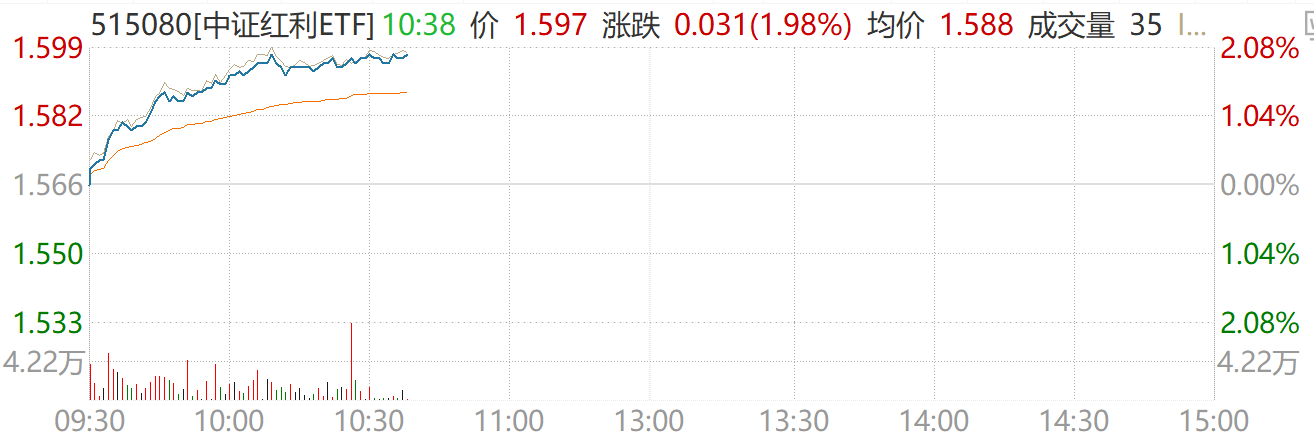
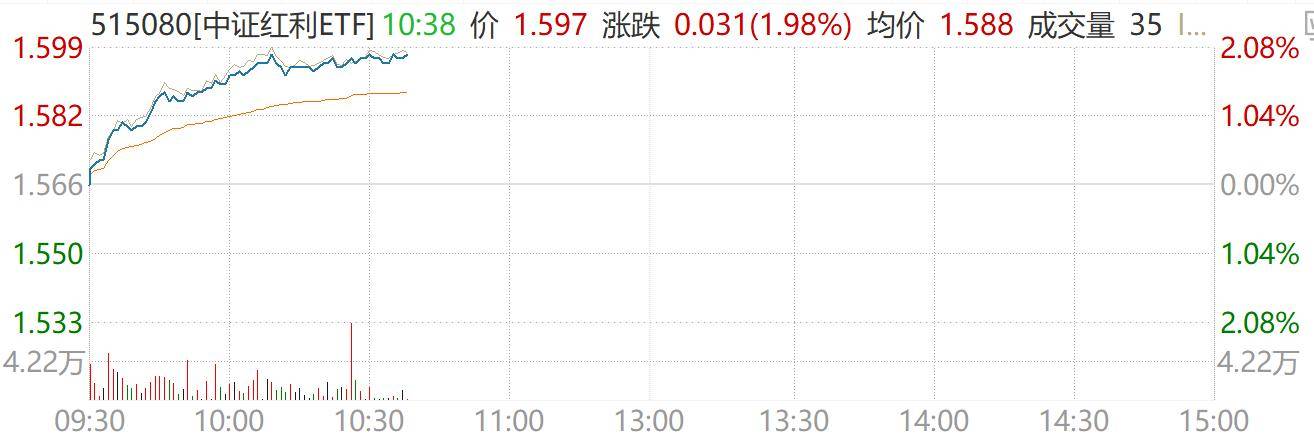
煤炭股集体大涨!兖矿能源、晋控煤业涨停,中证红利ETF(515080)盘中涨近2%、连续两日吸金近2亿
Sou Hu Cai Jing· 2026-02-04 02:55
2月4日早盘,煤炭板块集体走强,兖矿能源、晋控煤业双双涨停,潞安环能涨超 9%,陕西煤业、山煤国际、山西焦煤、平煤股份均跟涨。截至发稿,中证 红利ETF(515080)盘中上涨1.98%,实时成交额超1.8亿元、最新规模超82亿元。 资金面数据显示,中证红利ETF(515080)最近两个交易日连续获资金净流入约1.93 亿元,显示市场"攻势"放缓节奏下避险情绪或有所增强。 消息面上,据海外媒体报道,由于政府提出大幅减产计划,部分国家矿商已暂停现货煤炭出口;上月向主要矿商下达的产量配额比2025年水平降低40%至 70%,作为该国提振煤价计划的一部分。 资料显示,中证红利ETF(515080)跟踪A股标杆红利资产指数——中证红利指数,主要选取两市现金股息率高、分红连续性在三年及以上、同时具有一定 规模及流动性的100只股票为成份股,采用股息率加权,反映A股市场高红利股票的整体表现。 | 日期 | 市盈率2(计算 | 股息率2(计 算用股本) | | --- | --- | --- | | Date | 用股本) P/E2 | | | | | D/P2 | | 20260203 | 9.77 | 4.98 | | ...
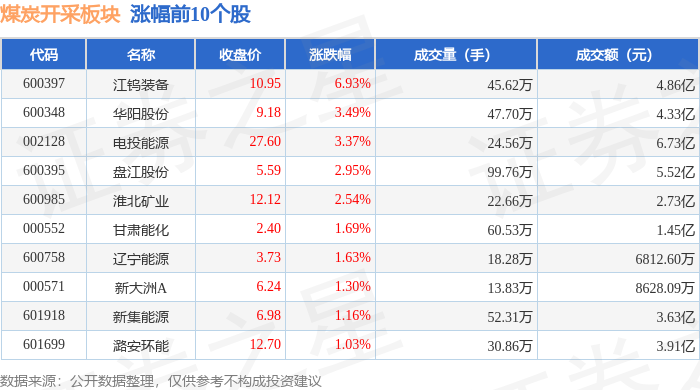
煤炭开采板块2月3日跌0.19%,昊华能源领跌,主力资金净流出4亿元
Zheng Xing Xing Ye Ri Bao· 2026-02-03 09:11
Group 1 - The coal mining sector experienced a decline of 0.19% on February 3, with Haohua Energy leading the drop [1] - The Shanghai Composite Index closed at 4067.74, up 1.29%, while the Shenzhen Component Index closed at 14127.1, up 2.19% [1] - Key stocks in the coal mining sector showed varied performance, with Jiangte Equipment rising by 6.93% and China Shenhua falling by 1.52% [2] Group 2 - The coal mining sector saw a net outflow of 400 million yuan from major funds, while retail investors contributed a net inflow of 301 million yuan [2] - Major funds showed a mixed trend, with Shaanxi Coal and Chemical Industries receiving a net inflow of 42.73 million yuan, while Jiangte Equipment faced a net outflow of 52.98 million yuan [3] - Retail investors favored stocks like SuNeng Co., which had a net inflow of 357.83 million yuan, despite overall sector challenges [3]





山煤国际股价连续3天下跌累计跌幅6.1%,汇泉基金旗下1只基金持9.29万股,浮亏损失6.41万元
Xin Lang Ji Jin· 2026-02-03 07:08
Group 1 - The core point of the news is that Shanmei International's stock has experienced a decline of 6.1% over the past three days, with the current stock price at 10.63 yuan per share and a market capitalization of 21.074 billion yuan [1] - Shanmei International Energy Group Co., Ltd. is based in Taiyuan, Shanxi Province, and was established on November 20, 2000. It was listed on July 31, 2003. The company's main business includes new energy development, coal and coke industry investment, and logistics information consulting services [1] - The revenue composition of Shanmei International includes self-produced coal (36.87%), traded coal (24.93%), metallurgical coal (18.62%), thermal coal (18.25%), transportation (1.16%), and others (0.17%) [1] Group 2 - From the perspective of major fund holdings, Huiquan Fund has one fund heavily invested in Shanmei International. The Huiquan Smart Quantitative Stock Mixed A Fund (020922) held 92,900 shares in the fourth quarter, accounting for 1.87% of the fund's net value, making it the fifth-largest holding [2] - The estimated floating loss for the Huiquan Smart Quantitative Stock Mixed A Fund today is approximately 3,716 yuan, with a total floating loss of 64,100 yuan during the three-day decline [2] - The Huiquan Smart Quantitative Stock Mixed A Fund was established on August 6, 2024, with a latest scale of 22.6603 million yuan. Year-to-date, it has a loss of 0.03%, ranking 7,604 out of 8,874 in its category, while it has a one-year return of 10.22%, ranking 6,174 out of 8,124 [2]
煤炭行业月报(2026年1月):25年供需整体宽松,26年开始有所改善-20260203
GF SECURITIES· 2026-02-03 06:31
Core Insights - The coal industry is expected to see an improvement in supply-demand dynamics starting in 2026 after a generally loose supply in 2025 [1] Group 1: Coal Sector Review - The coal sector outperformed the market in January, with a cumulative increase of 8.3% year-to-date, surpassing the CSI 300 index by 6.7 percentage points [16] - The coal sector's price-to-earnings (PE) ratio is currently at 15.7 times, ranking 5th among all sectors, indicating a relatively high valuation [20][26] - The coal sector's price-to-book (PB) ratio stands at 1.51 times, also reflecting a historical high level [24] Group 2: Coal Market Overview - In December, electricity consumption remained flat year-on-year, while coal imports increased by approximately 12% [29] - Domestic coal prices in January showed stability, with power coal prices rising slightly by 2.1% or 14 RMB/ton compared to the end of December [29] - International coal prices saw a notable increase, with Newcastle's 6000 kcal thermal coal price rising by 3.8% to 110.1 USD/ton [45] Group 3: Domestic Demand and Supply - In 2025, domestic coal production increased by 1.2% year-on-year, while coal imports decreased by 9.6% [56] - The total coal production in 2025 reached 483.2 million tons, with significant contributions from Shanxi, Inner Mongolia, and Shaanxi [56] - The demand for electricity in 2025 grew by 5.0%, with the industrial sector showing varied growth rates [46] Group 4: Key Companies and Financial Analysis - Key companies in the coal sector include China Shenhua, Yanzhou Coal, and Shaanxi Coal, all rated as "Buy" with robust dividend policies [6][7] - Financial metrics for these companies indicate a favorable outlook, with expected earnings per share (EPS) growth and attractive valuation ratios [7]

股市必读:山煤国际(600546)2月2日收盘跌5.41%,主力净流出3598万元
Sou Hu Cai Jing· 2026-02-02 17:10
交易信息汇总 股价提醒 2月2日山煤国际(600546)收盘报10.67元,跌5.41%,当日成交4012.08万元。该股已连续2日下跌。前 10个交易日中,主力资金累计净流出6000.23万元,股价累计下跌0.49%;融资余额累计增加6707.04万 元,融券余量累计减少7.02万股。近90天内共有7家机构给出评级,其中买入评级3家,增持评级4家, 机构目标均价为11.3元。 截至2026年2月2日收盘,山煤国际(600546)报收于10.67元,下跌5.41%,换手率2.02%,成交量40.12万 手,成交额4.36亿元。 当日关注点 2月2日主力资金净流出3598.0万元,占总成交额8.26%;游资资金净流入2991.68万元,占总成交额 6.87%;散户资金净流入606.32万元,占总成交额1.39%。 以上内容为证券之星据公开信息整理,由AI算法生成(网信算备310104345710301240019号),不构成 投资建议。 来自交易信息汇总:山煤国际2月2日收盘报10.67元,跌5.41%,已连续2日下跌。 来自交易信息汇总:当日主力资金净流出3598.0万元,占总成交额8.26%。 来自交易信息 ...
电煤消费规模是否已经达峰?
ZHONGTAI SECURITIES· 2026-02-02 00:45
Investment Rating - The report maintains a rating of "Buy" for key companies in the coal industry, including China Shenhua, Yanzhou Coal, Shaanxi Coal, and others, while some companies like Huayang Co. and Shanmei International are rated as "Overweight" [4]. Core Insights - The coal consumption scale has reached a peak plateau, with the demand for electricity generated from coal expected to stabilize in the coming years. The report suggests that the traditional growth model of coal-fired power generation may face a turning point due to the increasing share of clean energy [6][7]. - The transition of coal-fired power from a primary energy source to a supporting role in the new energy system is emphasized, with a significant expansion in installed capacity expected in the next few years [6][11]. Summary by Sections 1. Coal-fired Power: Transitioning to Peak Regulation and Support - The role of coal-fired power is shifting towards providing peak regulation and support, with its share in the energy mix declining but still remaining a core component of energy security [6][11]. - Installed capacity of coal-fired power is expected to continue expanding, with projections of new installations reaching 87 GW, 86 GW, and 43 GW from 2026 to 2028, respectively [6][29]. 2. Clean Energy: Becoming the Main Source of New Installations - Hydropower is expected to play a dual role in stable supply and peak regulation, with new installations projected to reach 17 GW, 18 GW, and 33 GW from 2026 to 2028 [7][39]. - Wind power is anticipated to see significant growth, with new installations expected to reach 109 GW, 161 GW, and 193 GW during the same period, reflecting its transition to a primary energy source [7][52]. - Solar energy is entering a stable development phase, with new installations projected at 192 GW, 139 GW, and 153 GW from 2026 to 2028, despite recent challenges in energy consumption and bidding processes [7][59]. 3. Investment Recommendations: Focus on Dividend and Flexibility - The report recommends focusing on companies with strong cash flow stability and dividend potential, such as China Shenhua and Shaanxi Coal, while also highlighting companies like Yanzhou Coal and Huayang Co. as having potential benefits from high coal demand [6][7][8].



煤炭行业周报:煤价回归合理才是常态,稳煤价逻辑依旧
KAIYUAN SECURITIES· 2026-02-02 00:24
Investment Rating - The industry investment rating is "Positive" (maintained) [1] Core Viewpoints - The report indicates that coal prices are expected to rebound, with a focus on the cyclical elasticity of both thermal coal and coking coal prices, which are currently at historical lows, providing room for recovery [5][15] - The report emphasizes that the price of thermal coal is influenced by supply constraints and increasing demand due to seasonal factors, while coking coal prices are more market-driven [4][5] Summary by Relevant Sections Investment Logic - Thermal coal prices are expected to rise through a four-step process: repairing central and local long-term contracts, reaching the coal-electricity profit-sharing line, and approaching the breakeven point for power plants, estimated at around 750 RMB per ton for 2025 [4][15] - Coking coal prices are determined by supply and demand fundamentals, with target prices based on the ratio of coking coal to thermal coal prices [4][15] Investment Recommendations - The report suggests a dual logic for coal stocks: cyclical elasticity and stable dividends. Key stocks to consider include: - Cyclical logic: Jin控煤业, 兖矿能源 for thermal coal; 平煤股份, 淮北矿业, 潞安环能 for metallurgical coal - Dividend logic: 中国神华, 中煤能源, 陕西煤业 - Diversification and growth logic: 神火股份, 电投能源, 新集能源, 广汇能源 [5][16] Key Market Indicators - The coal index increased by 3.68%, outperforming the Shanghai and Shenzhen 300 index by 3.6 percentage points [10][25] - As of January 30, the price of Qin港 Q5500 thermal coal was 692 RMB per ton, reflecting a slight increase of 7 RMB from the previous period [21] - The report notes a significant drop in coal inventory at ports, indicating tightening supply conditions [21][23]


煤炭行业周报:煤价回归合理才是常态,稳煤价逻辑依旧-20260201
KAIYUAN SECURITIES· 2026-02-01 14:41
Investment Rating - The industry investment rating is "Positive" (maintained) [1] Core Viewpoints - The report indicates that coal prices are expected to rebound, with a focus on the cyclical elasticity of both thermal coal and coking coal prices, which are currently at historical lows, providing room for recovery [5][15] - The report outlines a four-step process for the upward movement of thermal coal prices, including the restoration of long-term contracts and reaching a breakeven point for coal and power companies [4][15] - The report emphasizes that the overall investment logic remains unchanged, driven by a dual influence of tightening supply and increasing demand, particularly during the heating season [3][4] Summary by Sections Investment Logic - Thermal coal and coking coal prices are at a turning point, with thermal coal being a policy-driven commodity. The price recovery is expected to follow a specific process involving the restoration of long-term contracts and reaching a breakeven price of around 750 RMB per ton [4][15] - Coking coal prices are more influenced by market fundamentals, with target prices based on the ratio of coking coal to thermal coal prices, indicating potential target prices of 1608 RMB to 2064 RMB depending on thermal coal price movements [4][15] Investment Recommendations - The report suggests a dual logic for coal stocks: cyclical elasticity and stable dividends. It identifies four main lines for stock selection: 1. Cyclical logic: Jin控煤业 and 兖矿能源 for thermal coal; 平煤股份, 淮北矿业, and 潞安环能 for metallurgical coal 2. Dividend logic: 中国神华, 中煤能源, and 陕西煤业 3. Diversified aluminum elasticity: 神火股份 and 电投能源 4. Growth logic: 新集能源 and 广汇能源 [5][16] Key Market Indicators - The coal index increased by 3.68%, outperforming the Shanghai and Shenzhen 300 index by 3.6 percentage points, with notable gains from companies like 盘江股份 and 山西焦化 [10][25] - The report provides various market indicators, including port prices for thermal coal at 692 RMB per ton, reflecting a slight increase, and coking coal prices remaining stable at 1800 RMB per ton [21][23]