SD-GOLD(600547)

Search documents
有色金属:关注企稳后的布局机会
GUOTAI HAITONG SECURITIES· 2026-02-09 05:15
Investment Rating - The report assigns an "Overweight" rating for the non-ferrous metals industry [4] Core Insights - The report emphasizes the importance of macroeconomic factors such as monetary policy, macro expectations, geopolitical dynamics, and supply disruptions in influencing metal price trends [2] - The report highlights the need to focus on investment opportunities following stabilization in the market [8] Summary by Sections 1. Industry and Stock Performance - The non-ferrous metals sector experienced a decline of 8.51% last week, underperforming major indices [14][16] 2. Metal Prices and Inventory - Copper prices decreased by 3.45% to 100,100 CNY/ton, while aluminum prices fell by 5.07% to 23,315 CNY/ton [24] - SHFE gold prices dropped by 8.92% to 1,090.12 CNY/gram, while COMEX gold rose by 5.13% to 4,988.60 USD/ounce [26] - SHFE silver prices decreased by 37.17% to 18,799 CNY/kg, with COMEX silver down by 1.28% to 77.53 USD/ounce [26] 3. Macro Data Tracking - The report tracks key macroeconomic indicators, including the U.S. CPI and PCE, which show a year-on-year increase of 2.7% and 2.79%, respectively [29][30] - China's CPI and PPI for December were reported at 0.8% and -1.9%, respectively [30] 4. Precious Metals: Low Inventory Disturbances - The report notes that low inventory levels continue to disrupt precious metal prices, with significant fluctuations observed in both gold and silver markets [52][53] 5. Copper: Price Fluctuations - The report indicates that copper prices are expected to fluctuate, with supply-side adjustments and demand dynamics playing crucial roles [65][72] 6. Aluminum: Price Adjustments - Aluminum prices are under pressure due to macroeconomic sentiment and seasonal demand fluctuations, with a noted decrease in processing rates [10][80] 7. Energy Metals: Strong Demand - The report highlights robust demand for energy metals, particularly lithium, despite some price pressures due to macroeconomic factors [89][92] 8. Rare Earths: Price Trends - Prices for rare earth elements, particularly praseodymium and neodymium oxides, continue to rise, supported by tight supply conditions [11]





有色金属周报 20260208:情绪趋稳,商品价格筑底
Guolian Minsheng Securities· 2026-02-08 10:30
Investment Rating - The report maintains a "Buy" rating for all key companies listed, including Zijin Mining, Luoyang Molybdenum, and Huayou Cobalt, among others [2][3]. Core Views - The report indicates that the sentiment in the non-ferrous metals sector is stabilizing, with commodity prices forming a bottom [1]. - Industrial metal prices are experiencing fluctuations due to seasonal supply excess and macroeconomic factors, while energy metals like cobalt and nickel are expected to see price increases due to supply constraints [7][21][41][59]. - Precious metals are undergoing a significant price correction, but long-term support remains strong due to central bank purchases and geopolitical uncertainties [7][75]. Summary by Sections Industry and Stock Performance - The report highlights a decline in major indices, with the SW Non-ferrous Index dropping by 4.68% during the week [7]. - Key companies are recommended based on their earnings forecasts and valuations, with all listed companies receiving a "Buy" rating [2]. Base Metals - **Aluminum**: Prices have stabilized after a period of volatility, with LME aluminum prices at $3,110 per ton, down 0.81% week-on-week [13][21]. - **Copper**: The price remains under pressure due to macroeconomic factors, with a current price of $13,060 per ton, down 0.08% [13][41]. - **Zinc**: Prices are fluctuating, with LME zinc at $3,287.5 per ton, down 2.45% [13][47]. - **Lead and Tin**: Lead prices are under pressure, currently at $1,948.5 per ton, while tin prices are experiencing a downward trend due to seasonal demand [58][59]. Precious Metals and Minor Metals - **Gold and Silver**: Gold prices are at 1,110.73 CNY per gram, down 0.34%, while silver is at 25,465 CNY per kilogram, down 9.98% [75]. - **Cobalt**: The market is facing supply constraints, with prices expected to rise due to ongoing shortages [89]. Rare Earths - The report does not provide specific updates on rare earths but indicates ongoing interest in the sector due to its strategic importance [9].



有色金属周报 20260208:情绪趋稳,商品价格筑底-20260208
Guolian Minsheng Securities· 2026-02-08 07:18
Investment Rating - The report maintains a "Buy" rating for all key companies listed, including Zijin Mining, Luoyang Molybdenum, and Huayou Cobalt, among others [2][3]. Core Insights - The report indicates a stabilization in market sentiment, with commodity prices finding a bottom. Industrial metal prices have shown fluctuations, with copper and aluminum facing downward pressure due to macroeconomic factors and seasonal supply excess [7][21][41]. - The report highlights the ongoing supply constraints in cobalt and nickel, with expectations for price increases in these metals. Conversely, lithium prices are on a downward trend due to market dynamics [7][41][60]. - The precious metals market is experiencing a significant pullback, primarily driven by technical factors and profit-taking, but long-term support remains strong due to central bank purchases and geopolitical uncertainties [7][75]. Summary by Sections 1. Industry and Stock Performance - The report notes a decline in major indices, with the SW Nonferrous Index dropping by 4.68% during the week [7]. - Key companies such as Zijin Mining and Luoyang Molybdenum are highlighted for their strong earnings forecasts and attractive valuations [2]. 2. Base Metals 2.1 Price and Stock Correlation Review - The report provides a detailed analysis of the price movements of various base metals, including aluminum, copper, zinc, lead, nickel, and tin, with specific price changes noted for each metal [13][21]. 2.2 Industrial Metals - Aluminum prices have shown a slight decline, with LME prices at $3,110 per ton, down 0.81% week-on-week. Copper prices are at $13,060 per ton, down 0.08% [13][21]. - The report emphasizes the seasonal supply excess impacting copper demand, particularly as the Chinese New Year approaches [41]. 2.3 Lead, Tin, Nickel - Lead prices have decreased to $1,948.5 per ton, while nickel prices have faced significant pressure, dropping below $17,000 per ton due to macroeconomic sentiment shifts [58][60]. 3. Precious Metals and Minor Metals 3.1 Precious Metals - Gold prices have decreased to an average of 1,110.73 CNY per gram, while silver prices have dropped to 25,465 CNY per kilogram, reflecting a broader market correction [75]. 3.2 Energy Metals - Cobalt prices are under pressure but are expected to stabilize due to ongoing supply constraints. The report notes that the current market price for cobalt is around 415,000 CNY per ton [60].
金银市场遭遇黑色星期三,白银价格暴跌近15%,黄金也跌超3%,黄金股多股跌停,一些投资者却开始疯狂扫货
Sou Hu Cai Jing· 2026-02-06 17:08
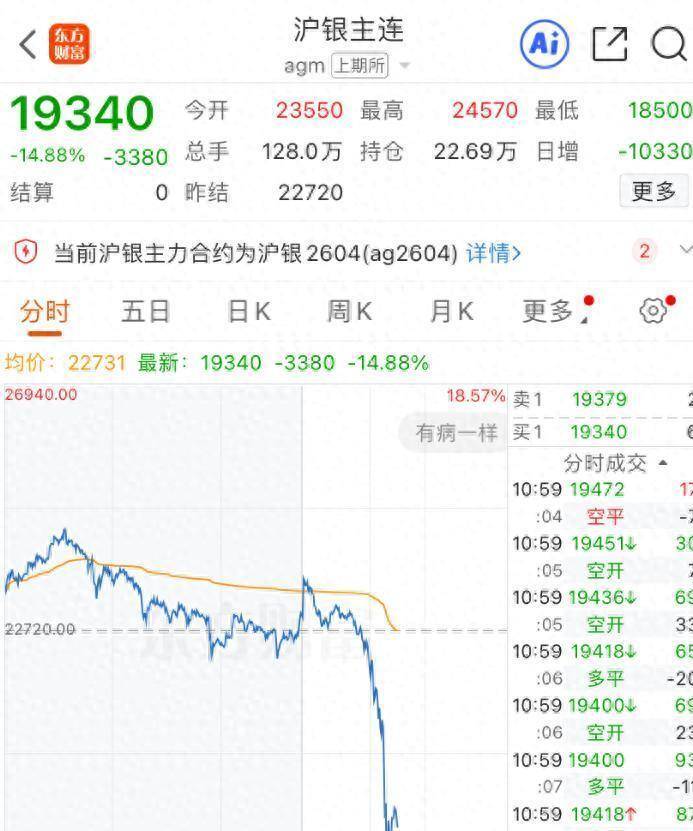
Core Viewpoint - The precious metals market experienced a dramatic decline on February 5, 2026, with silver prices plummeting over 14% and gold dropping more than 3%, leading to significant losses in related stocks and a stark contrast between capital market panic and physical market demand [1][3][4]. Market Performance - On February 5, silver prices fell to a low of $75.83 per ounce, while the Shanghai Futures Exchange saw silver contracts drop nearly 15% to 19,340 yuan per kilogram. Gold prices fell below the critical psychological level of $4,800 [1][4]. - A significant number of stocks related to gold and silver, such as Hunan Gold and Sichuan Gold, hit their daily limit down, reflecting a widespread sell-off in the sector [1][4][5]. Market Dynamics - The decline was preceded by a strong performance in January, where gold prices reached nearly $5,600 per ounce and silver exceeded $120 per ounce, resulting in gains of over 25% for gold and 60% for silver in just a month [3][4]. - The sell-off on February 5 was characterized by a lack of liquidity and a surge in stop-loss orders, creating a downward spiral in prices [4][6]. Regulatory Changes - Prior to the crash, exchanges raised margin requirements for silver contracts, which forced leveraged traders to either add funds or face forced liquidation, exacerbating the price decline [6][12]. - Major banks issued risk warnings to clients regarding the heightened volatility in the precious metals market, advising caution and stricter trading rules [12]. Institutional Behavior - Large investment institutions began to adjust their portfolios, with noticeable outflows from major gold ETFs during the price drop, indicating a shift in institutional sentiment [7][12]. - Analysts noted that the market's reaction was influenced by macroeconomic factors, including potential changes in U.S. Federal Reserve leadership and interest rate expectations, which could strengthen the dollar and negatively impact gold and silver prices [6][12]. Physical Market Response - Despite the turmoil in the capital markets, physical gold and silver demand surged in places like Shenzhen, where customers flocked to purchase gold bars, viewing the price drop as an opportunity [9][10]. - Retail gold prices adjusted downward in response to falling wholesale prices, making gold jewelry more attractive to consumers [10]. Analyst Perspectives - Analysts from various firms expressed differing views on the causes of the market decline, with some attributing it to technical adjustments and profit-taking, while others pointed to macroeconomic uncertainties stemming from U.S. Federal Reserve personnel changes [12][13]. - The overall sentiment in the market shifted from extreme optimism to fear, with many investors now closely monitoring support levels and physical demand to gauge future price stability [13].




主力个股资金流出前20:新易盛流出28.83亿元、中际旭创流出15.50亿元
Jin Rong Jie· 2026-02-06 07:29
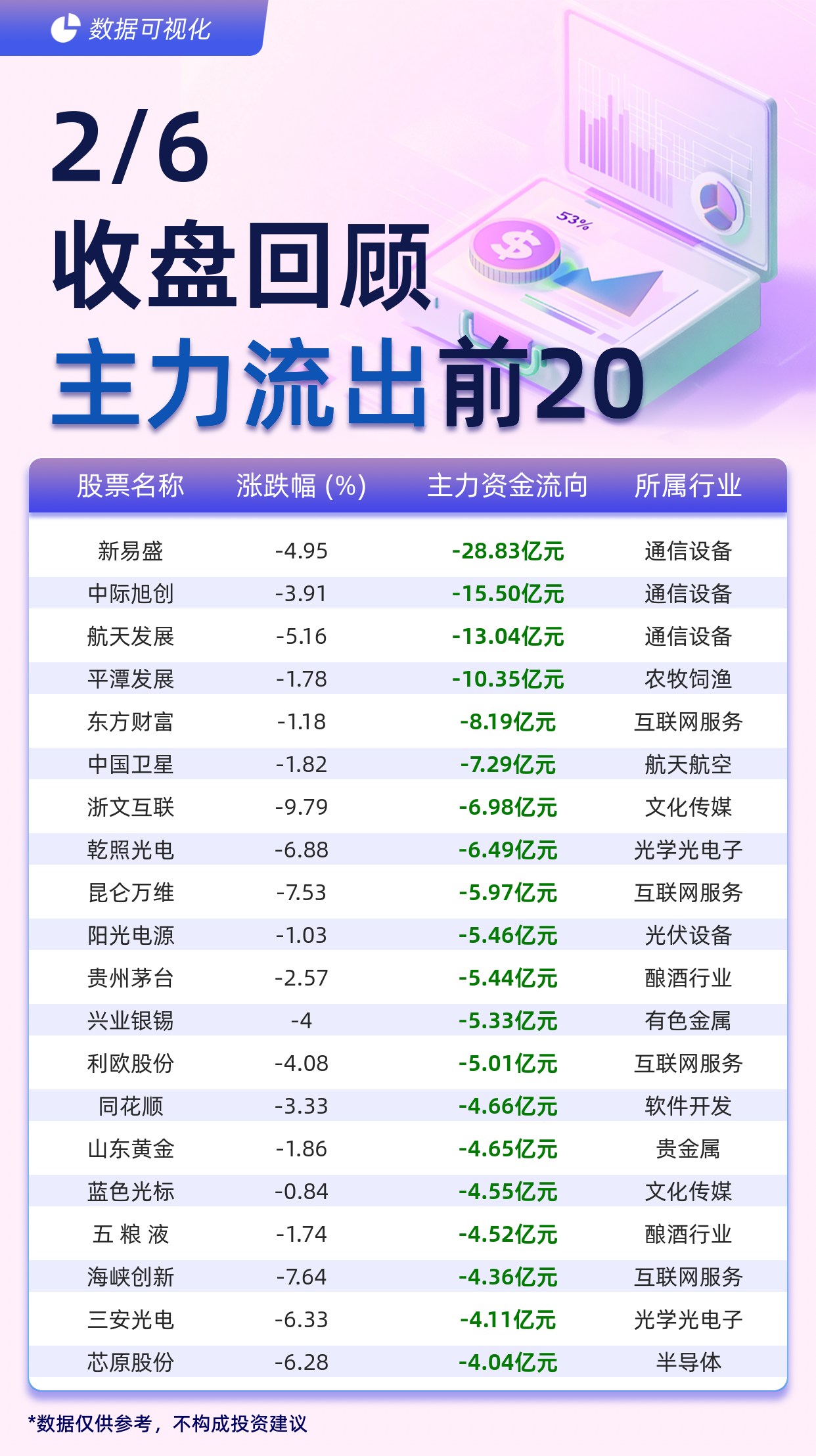
Group 1 - The main stocks with significant capital outflows include Xinyi Technology (-28.83 billion), Zhongji Xuchuang (-15.50 billion), and Aerospace Development (-13.04 billion) [1] - The sectors affected by the capital outflows primarily include communication equipment, internet services, and optical electronics [2][3] - The largest percentage decline in stock prices was observed in Zhejiang Wenlian, which fell by 9.79% [2] Group 2 - Other notable stocks with substantial capital outflows include Guizhou Moutai (-5.44 billion), Sunshine Power (-5.46 billion), and Sanan Optoelectronics (-4.11 billion) [1][3] - The overall trend indicates a negative sentiment in the market, particularly in the communication equipment and internet service sectors [2][3] - The data reflects a broader market trend of capital withdrawal, impacting various industries including agriculture, aerospace, and cultural media [1][2]


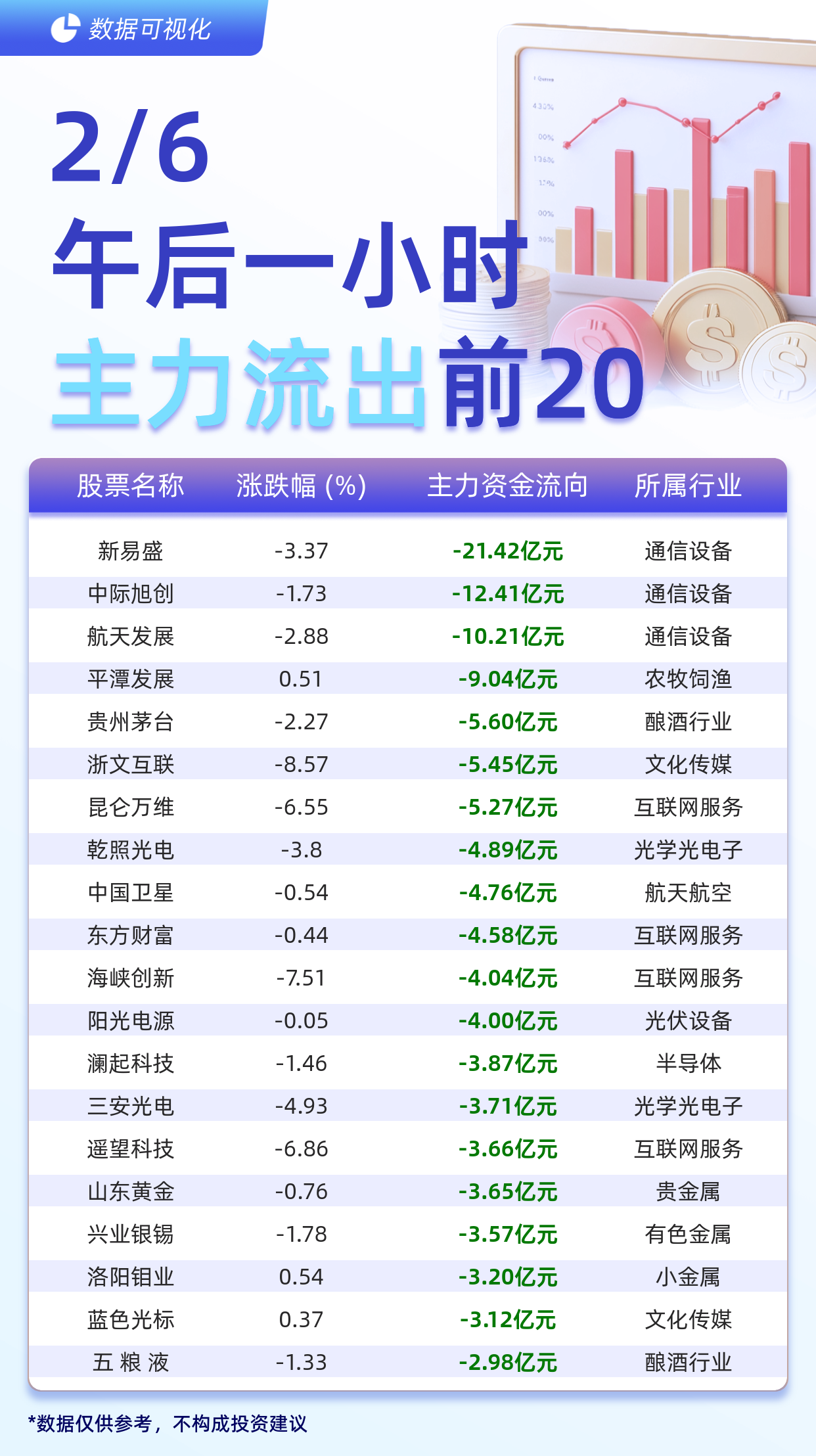
主力个股资金流出前20:新易盛流出21.42亿元、中际旭创流出12.41亿元
Jin Rong Jie· 2026-02-06 06:27
Main Points - The main focus of the news is on the significant outflow of capital from various stocks, highlighting the top 20 stocks with the largest capital outflows as of February 6, with New Yisheng leading at -21.42 billion yuan [1][2][3] Group 1: Stock Performance - New Yisheng experienced a capital outflow of -21.42 billion yuan, indicating a strong sell-off in the communication equipment sector [1][2] - Zhongji Xuchuang saw a capital outflow of -12.41 billion yuan, also within the communication equipment industry [1][2] - Aerospace Development had a capital outflow of -10.21 billion yuan, reflecting investor sentiment in the communication equipment sector [1][2] - Pingtan Development reported a capital outflow of -9.04 billion yuan, indicating challenges in the agriculture and animal husbandry sector [1][2] - Kweichow Moutai faced a capital outflow of -5.60 billion yuan, suggesting potential concerns in the liquor industry [1][2] Group 2: Sector Analysis - The communication equipment sector is notably affected, with three companies (New Yisheng, Zhongji Xuchuang, and Aerospace Development) among the top outflows [1][2] - The liquor industry, represented by Kweichow Moutai, shows a significant outflow, which may indicate market volatility or changing consumer preferences [1][2] - The internet services sector is also impacted, with companies like Kunlun Wanwei and Dongfang Caifu experiencing outflows of -5.27 billion yuan and -4.58 billion yuan respectively [1][2][3] Group 3: Additional Stocks - Other notable stocks with significant outflows include Sunshine Power (-4.00 billion yuan) in the photovoltaic equipment sector and Sanan Optoelectronics (-3.71 billion yuan) in the optical and optoelectronic sector [1][3] - The precious metals sector, represented by Shandong Gold, saw an outflow of -3.65 billion yuan, indicating potential investor caution [1][3] - The cultural media sector, with companies like Zhejiang Wenlian and Blue Focus, also faced outflows of -5.45 billion yuan and -3.12 billion yuan respectively, reflecting market dynamics in this industry [1][3]



有色矿业ETF招商(159690)开盘跌3.81%,重仓股紫金矿业跌5.07%,洛阳钼业跌5.28%
Xin Lang Cai Jing· 2026-02-06 05:55
Group 1 - The core viewpoint of the article highlights a significant decline in the performance of the non-ferrous metal mining ETF, with a drop of 3.81% on February 6, 2023, closing at 2.120 yuan [1] - Major holdings within the non-ferrous mining ETF experienced notable declines, including Zijin Mining down 5.07%, Luoyang Molybdenum down 5.28%, and Northern Rare Earth down 2.71% [1] - The ETF's performance benchmark is the CSI Non-Ferrous Metals Mining Theme Index, managed by China Merchants Fund Management Co., with a return of 120.70% since its inception on June 21, 2023, and a monthly return of 9.84% [1]

黄金股票ETF基金(159322)涨近1%,现货黄金重新站上4850美元/盎司
Xin Lang Cai Jing· 2026-02-06 05:45
Core Viewpoint - The gold industry is experiencing a positive trend, with significant increases in stock prices and a rebound in spot gold prices, indicating a favorable outlook for gold investments in the coming years [1][2]. Group 1: Market Performance - As of February 6, 2026, the CSI Hong Kong-Shenzhen Gold Industry Stock Index (931238) rose by 0.23%, with notable increases in constituent stocks such as Hunan Gold (up 10.00%), Chaohongji (up 9.98%), and Hangmin Co. (up 9.95%) [1]. - The gold ETF fund (159322) increased by 0.70%, with the latest price at 2.02 yuan [1]. Group 2: Gold Price Outlook - Spot gold has rebounded to over $4,850 per ounce, reflecting a daily increase of 1.57% and a recovery of nearly $200 from its daily low [1]. - Huatai Securities predicts that under the backdrop of de-globalization, central banks will continue to increase gold allocations, which will support a long-term rise in gold prices, potentially reaching a range of $5,400 to $6,800 per ounce between 2026 and 2028 [1]. Group 3: Investment Potential - Currently, the proportion of investable gold in global financial assets stands at 2.89%, which is significantly below the 2011 peak of 3.6%, indicating substantial room for increased allocation [1]. - The CSI Hong Kong-Shenzhen Gold Industry Stock Index comprises 50 large-cap companies involved in gold mining, refining, and sales, reflecting the overall performance of gold industry stocks in the mainland and Hong Kong markets [1][2].


现货金银延续下跌 中国黄金国际、灵宝黄金低开逾5%
Zhi Tong Cai Jing· 2026-02-06 05:11
Group 1 - The gold stocks collectively opened lower, with China Gold International (600916) down 5.36% at 180 HKD, Lingbao Gold (03330) down 5.11% at 20.78 HKD, Shandong Gold (600547) down 5.11% at 36.74 HKD, and Chifeng Gold (600988) down 4.74% at 33.8 HKD [2] - International precious metals continue to decline, with spot gold dropping below 4700 USD, experiencing a daily decline of over 1%, while spot silver hit a low of 64.035 USD per ounce, with a drop of over 20% yesterday, erasing gains made since the beginning of the year [2] - Recent economic data shows that the US JOLTS job openings for December hit a five-year low, significantly below expectations, and Challenger companies reported 108,000 layoffs in January, the highest for the same period since 2009, with a month-on-month increase of 205% [2] Group 2 - Federal Reserve Governor Cook stated that the Fed must bring inflation back to target levels soon to maintain its credibility, indicating that the current risks are skewed towards rising inflation, while economic uncertainty remains high [2]

港股大型科网股,全线下跌
Di Yi Cai Jing Zi Xun· 2026-02-06 01:50
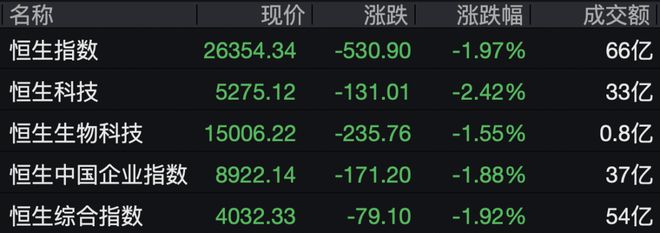
Market Overview - The Hang Seng Index opened down by 1.97%, closing at 26,354.34, a decrease of 530.90 points with a trading volume of 6.6 billion [2] - The Hang Seng Tech Index fell by 2.42%, closing at 5,275.12, down by 131.01 points with a trading volume of 3.3 billion [2] - The Hang Seng Biotech Index decreased by 1.55%, closing at 15,006.22, with a trading volume of 0.08 billion [2] - The Hang Seng China Enterprises Index dropped by 1.88%, closing at 8,922.14, with a trading volume of 3.7 billion [2] - The Hang Seng Composite Index fell by 1.92%, closing at 4,032.33, with a trading volume of 5.4 billion [2] Sector Performance - Technology stocks experienced a broad decline, with Baidu Group falling over 4%, and Alibaba, Kuaishou, Bilibili, NetEase, and Hua Hong Semiconductor all dropping over 3% [2] - Other notable declines included SenseTime, JD Group, Tencent Holdings, and SMIC, each down by more than 2% [2] Individual Stock Movements - Baidu Group-SW decreased by 4.33%, closing at 134.80 [3] - Kingdee International fell by 4.30%, closing at 10.90 [3] - JD Health dropped by 3.96%, closing at 58.25 [3] - Alibaba-W declined by 3.82%, closing at 153.50 [3] - Kuaishou-W decreased by 3.70%, closing at 70.30 [3] - Bilibili-W fell by 3.29%, closing at 234.80 [3] - NetEase-S dropped by 3.06%, closing at 186.70 [3] - Other notable declines included Xpeng Motors, SenseTime, JD Group-SW, Tencent Holdings, and SMIC, all experiencing declines between 2.15% and 2.90% [3] Commodity Sector - The non-ferrous metals sector continued to show weakness, with China Gold International, Jiangxi Copper, Lingbao Gold, and Shandong Gold all dropping over 5% [4] - China Gold International fell by 5.36%, closing at 180.00 [4] - Jiangxi Copper decreased by 5.34%, closing at 41.10 [4] - Lingbao Gold and Shandong Gold both fell by 5.11%, closing at 20.78 and 36.74 respectively [4]