
GXED(600617)

Search documents
国新能源:第三季度归母净利润亏损8405.07万元
Xin Lang Cai Jing· 2025-10-30 08:41
Core Viewpoint - The company reported a decline in revenue and net profit for the third quarter of 2025, indicating ongoing financial challenges [1] Financial Performance - In Q3 2025, the company achieved a revenue of 3.241 billion yuan, a year-on-year decrease of 7.78% [1] - The net profit attributable to shareholders was a loss of 84.0507 million yuan, with a basic earnings per share of -0.05 yuan [1] - For the first three quarters of 2025, the company reported a total revenue of 11.465 billion yuan, down 3.70% year-on-year [1] - The net profit attributable to shareholders for the first three quarters was a loss of 9.2236 million yuan, with a basic earnings per share of -0.01 yuan [1]

国新能源(600617) - 2025 Q3 - 季度财报
2025-10-30 08:30
Financial Performance - The company's operating revenue for Q3 2025 was ¥3,240,706,427.35, a decrease of 7.78% compared to the same period last year[4]. - The total profit for the period was -¥67,931,373.63, with a year-to-date profit of ¥109,165,773.90, reflecting a 27.05% increase year-on-year[4]. - The net profit attributable to shareholders was -¥84,050,664.37, while the year-to-date figure was -¥9,223,570.90[4]. - The basic and diluted earnings per share for the current period were both -¥0.05[4]. - Total operating revenue for the first three quarters of 2025 was approximately ¥11.46 billion, a decrease of 3.7% compared to ¥11.91 billion in the same period of 2024[18]. - Net profit for the first three quarters of 2025 was a loss of approximately ¥3.40 million, compared to a loss of ¥1.89 million in the same period of 2024[19]. Cash Flow and Liquidity - The net cash flow from operating activities for the year-to-date period increased by 94.32% to ¥1,612,569,760.11[4]. - In the first three quarters of 2025, the net cash flow from operating activities was CNY 1,612,569,760.11, a significant increase from CNY 829,851,287.99 in the same period of 2024, representing a growth of approximately 94.3%[21]. - Cash received from the sale of goods and services in the first three quarters of 2025 was CNY 14,236,666,937.03, slightly up from CNY 14,144,193,928.43 in 2024, marking an increase of approximately 0.65%[21]. - The total cash outflow from operating activities in the first three quarters of 2025 was CNY 13,051,312,172.72, down from CNY 13,750,058,001.01 in 2024, indicating a reduction of about 5.1%[21]. - The total cash and cash equivalents at the end of the first three quarters of 2025 amounted to CNY 1,894,849,277.89, compared to CNY 2,025,406,315.22 at the end of the same period in 2024, showing a decrease of about 6.4%[22]. Assets and Liabilities - The total assets at the end of the reporting period were ¥25,350,483,971.22, down 5.87% from the end of the previous year[4]. - Current assets totaled ¥4,771,241,806.03, down from ¥5,664,678,374.22, indicating a decrease of about 15.69%[14]. - The company's total liabilities decreased to approximately ¥20.60 billion in 2025 from ¥22.18 billion in 2024, reflecting a reduction of about 7.2%[16]. - The total liabilities and equity of the company amounted to approximately ¥25.35 billion in 2025, down from ¥26.93 billion in 2024, a decrease of about 5.8%[16]. - The company’s total current liabilities were approximately ¥8.02 billion in 2025, a decrease from ¥8.25 billion in 2024, reflecting a reduction of about 2.7%[16]. Shareholder Information - The company reported a total of 48,375 common shareholders at the end of the reporting period[12]. - The largest shareholder, Huaxin Gas Group Co., Ltd., holds 46.19% of the shares, totaling 891,136,436 shares[12]. - The company has no significant changes in the participation of major shareholders in margin trading or securities lending activities[12]. Expenses and Investments - Research and development expenses increased significantly to approximately ¥10.65 million in 2025, up from ¥5.07 million in 2024, marking a rise of 109.5%[18]. - The company reported a decrease in financial expenses to approximately ¥418.69 million in 2025 from ¥535.97 million in 2024, a reduction of about 22%[18]. - The cash inflow from the disposal of fixed assets and other long-term assets in 2025 was CNY 25,123,448.72, compared to CNY 4,859,634.99 in 2024, reflecting a significant increase of about 417.5%[21]. - The cash outflow for purchasing fixed assets and other long-term assets in the first three quarters of 2025 was CNY 256,542,730.57, compared to CNY 235,493,268.13 in 2024, indicating an increase of approximately 8.9%[22].
国网研究院预测2030年我国新能源总装机有望破 30 亿千瓦,新能源ETF(159875)盘中涨超1.2%
Sou Hu Cai Jing· 2025-10-30 03:09
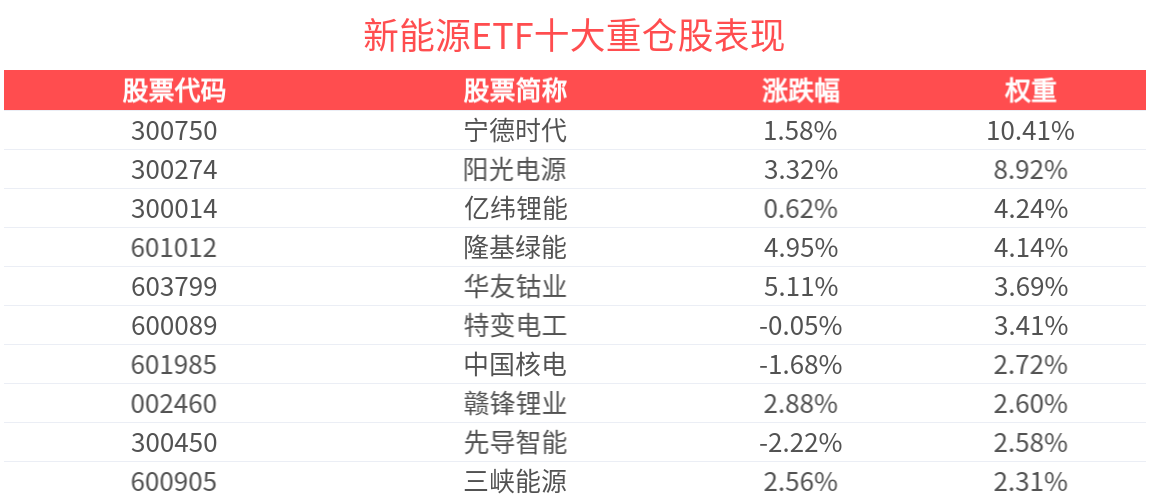
Core Insights - The renewable energy sector in China is experiencing significant growth, with the China Renewable Energy Index rising by 1.28% as of October 30, 2025, and key stocks like LONGi Green Energy and CATL showing substantial gains [1][2] - The National Grid Energy Research Institute predicts that during the 14th Five-Year Plan period, China's renewable energy generation will maintain a high growth rate, with an average annual new installed capacity expected to reach 300 million kilowatts [2] - The total installed capacity of renewable energy in China is projected to exceed 3 billion kilowatts by 2030, doubling the current scale [2] Market Performance - As of October 29, 2025, the renewable energy ETF has seen a net value increase of 68.45% over the past six months, ranking 313 out of 3838 in the index stock fund category, placing it in the top 8.16% [1] - The ETF has recorded a weekly increase of 9.97% and a monthly share growth of 11 million shares, indicating strong investor interest [1] - The ETF's highest single-month return since inception was 25.07%, with an average monthly return of 8.85% [1] Stock Performance - The top ten weighted stocks in the China Renewable Energy Index as of September 30, 2025, include CATL, Sungrow Power Supply, and EVE Energy, collectively accounting for 45.2% of the index [4] - Notable stock performances include CATL with a 1.58% increase and Sungrow Power Supply with a 3.32% increase [4]






2024年我国新能源车险保费将达2000亿元增速超过30%,金融监管总局财险司司长:探索新能源车险分级制度
Jin Rong Shi Bao· 2025-10-29 13:45
Core Insights - The core viewpoint of the article highlights the rapid growth of the new energy vehicle (NEV) insurance market in China, with projected premiums reaching 200 billion yuan and an annual growth rate exceeding 30% [1] Group 1: Market Growth - As of September this year, the penetration rate of new energy vehicles in China has reached 58% [1] - The commercial insurance coverage rate for new energy vehicles from January to September is reported at 91% [1] - The expected insurance premium for new energy vehicles this year is approximately 200 billion yuan [1] Group 2: Regulatory and Industry Initiatives - The Financial Regulatory Authority is exploring a tiered insurance system for new energy vehicles to reduce overall usage costs [1] - There is an emphasis on collaboration between the insurance industry and automotive manufacturers to lower repair costs and mitigate risks [1] - The high compensation costs associated with new energy vehicle insurance are prompting multiple insurance companies to strengthen partnerships with vehicle manufacturers [1]
中国新能源车以创新引领全球产业
Yang Shi Xin Wen· 2025-10-28 07:53
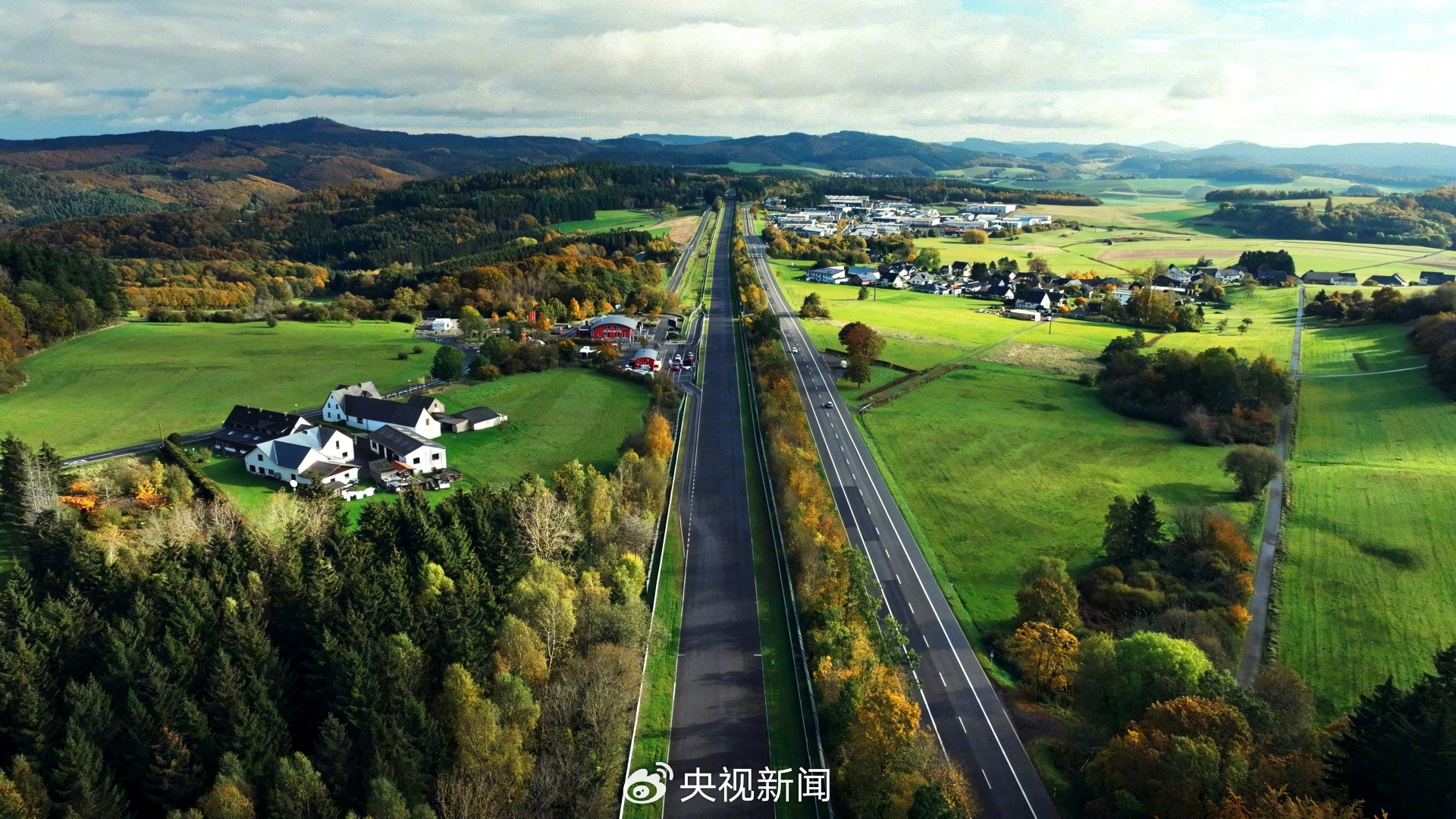
Group 1 - The core viewpoint of the articles highlights the rapid growth and global competitiveness of China's new energy vehicle (NEV) industry, with significant advancements in technology and performance [2][3][4] - In September 2025, China's NEV exports reached 222,000 units, marking a year-on-year increase of 100.9%, indicating a strong international market presence [2] - Chinese brands have achieved remarkable performance records on global tracks, with Xiaomi's SU7 Ultra setting a new record for mass-produced electric vehicles at the Nürburgring and BYD's U9 Xtreme breaking the record for supercars [2] Group 2 - Chinese NEV companies have excelled in endurance testing, with Xiaomi's YU7 achieving a record of 3,944 kilometers and the new Xiaopeng P7 reaching 3,961 kilometers, showcasing their leadership in battery technology [3] - In the global battery market, Chinese companies accounted for 68.9% of the total installed capacity of approximately 552.7 GWh from January to July 2025, reflecting a 1.1 percentage point increase from the previous year [3] - The Chinese Academy of Sciences has made breakthroughs in solid-state lithium battery technology, contributing to the development of high-performance and high-safety batteries [3] Group 3 - The growth of the NEV industry is attributed to collaborative efforts from government agencies, enterprises, and society, as highlighted in the "Energy-saving and New Energy Vehicle Technology Roadmap 3.0" released by the China Society of Automotive Engineers [4] - The roadmap emphasizes sustainable development, iterative upgrades of NEVs, and the evolution of intelligent connected vehicles, showcasing a global perspective on the automotive industry's future [4] Group 4 - The continuous investment in core technology research and development by leading companies like Xiaomi, BYD, and Xiaopeng, along with the support from government departments and research institutions, positions China's NEV industry for stable and sustainable growth [5] - The industry is expected to innovate and climb higher in the global industrial and value chains, breaking through internal competition [5]
我国新能源重卡连续7个月销量破万
Huan Qiu Wang Zi Xun· 2025-10-28 03:25
Core Insights - Since March this year, China's new energy heavy trucks have maintained sales exceeding 10,000 units for seven consecutive months, with September sales surpassing 20,000 units, setting a new record [1] - The domestic sales surge is complemented by strong international market performance, as regions like Europe, Southeast Asia, and the Middle East implement clean freight support policies, providing an excellent opportunity for Chinese new energy heavy trucks to enter international markets [1] - According to data from the China Association of Automobile Manufacturers, from January to September, exports of new energy commercial vehicles reached 64,000 units, representing a year-on-year increase of 150%, with new energy heavy trucks being a significant component of this category [1]
专访吉利陈益民:汽车低碳转型直面长供应链挑战,中国新能源“势不可挡”
Feng Huang Wang Cai Jing· 2025-10-27 03:35
凤凰网财经讯 10月24日,凤凰卫视集团联合多家国际机构举办"零碳使命国际气候峰会2025",以"十年共识·五年同行"为主题,旨在汇聚各方智慧,共同探 讨在气候治理新格局下应对气候变化的战略与行动,积极助力中国碳中和愿景及全球减排目标的实现。 吉利控股集团高级副总裁兼总法律顾问、首席合规官(CCO)陈益民 论坛期间,吉利控股集团高级副总裁兼总法律顾问、首席合规官(CCO)陈益民与凤凰网财经对话,直指全球大型汽车集团实现零碳目标所面临的核心困境。 "汽车产业链太长、范围太宽,可能延伸到第十级、第十二级供应商。碳足迹贡献的大头实际上集中在上游的能源、矿产和原材料领域,而这些环节离我们 最终产品最远。" 在他看来,这场席卷全球的绿色革命,对汽车产业而言,最大的难点并非终端制造环节的技术革新,而是对漫长供应链的碳管理以及由此产生的成本控制与 传导挑战。 车企之手,难够矿山的"碳" 陈益民进一步解释,整车厂商作为产业链的终端,想要直接拉动远在上游的能源、矿产等层级实现碳中和,"不管是从经济上还是实际管理手段上都是有限 的"。他坦言,如果这些高碳排的上游环节不主动进行减排,终端制造环节想单独实现碳中和将极为困难,这构成了 ...


钱智民:全链创新领航,助力2035年中国新能源装机目标达成
Sou Hu Cai Jing· 2025-10-25 16:13
Core Insights - The article highlights the achievements and future goals of China's renewable energy sector, emphasizing the need for full-chain innovation to reach the target of 3.6 billion kilowatts of installed wind and solar power capacity by 2035 [3] Industry Overview - Over the past 20 years, China's installed renewable energy capacity has increased from 820,000 kilowatts to over 1.6 billion kilowatts, with its share in total power generation rising from 0.2% to 42% by the end of last year [3] - China's share of global renewable energy has grown from 1% to over 40%, establishing the country as a significant player in global renewable energy development [3] Current Challenges - In the first eight months of this year, the consumption of renewable energy power has decreased by 2.3% compared to last year, with a continuing downward trend [3] - The photovoltaic manufacturing industry is facing difficulties, with profits dropping from nearly 100 billion in 2003 to a loss of 25.5 billion last year, and the overcapacity issue is severe, being approximately three times the global demand [3] Future Directions - The emphasis is placed on full-chain innovation, which includes significantly enhancing the grid's capacity to absorb renewable energy through technological advancements [3] - The application of intelligent technologies to balance load and generation optimization is crucial for expanding the use of renewable energy [3] - There is a strong push for the large-scale development of renewable energy in green fuels and green chemical raw materials [3]
崔东树:全国新能源乘用车库存持续回落 行业库存总体压力改善
智通财经网· 2025-10-25 07:55
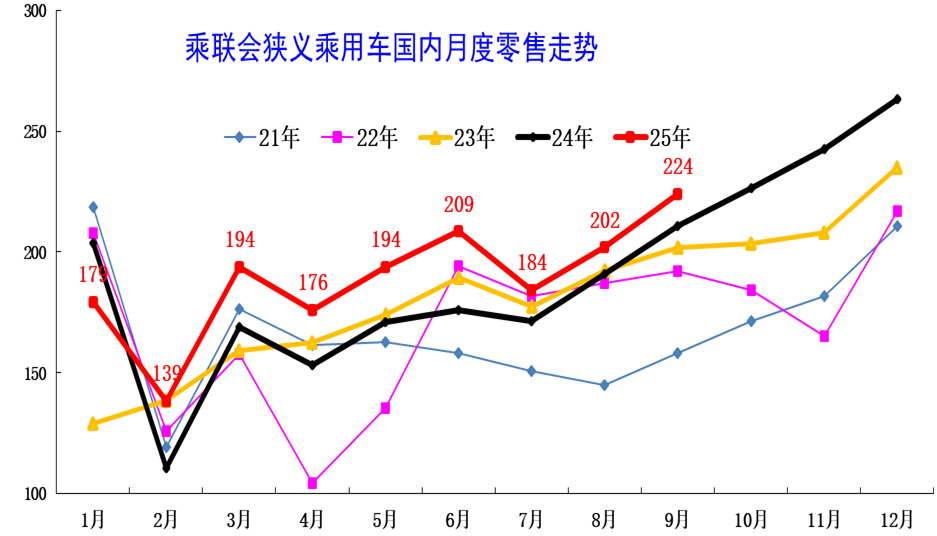
Group 1 - The core viewpoint of the article indicates that the inventory of the passenger car industry in China has shown a seasonal rebound, with a total of 3.28 million vehicles in stock by the end of September 2025, an increase of 120,000 vehicles from the previous month and 260,000 vehicles from September 2024 [1][12][15] - The inventory of new energy vehicles (NEVs) peaked at 880,000 units in April 2025, but has since decreased to 620,000 units by September, reflecting a 30% reduction from the peak [1][29] - The production of passenger cars in September 2025 reached 2.84 million units, representing a year-on-year increase of 17% and a month-on-month increase of 16% [8][9] Group 2 - The retail sales of passenger cars in September 2025 totaled 2.241 million units, showing a year-on-year growth of 6.3% and a month-on-month growth of 11% [5][6] - The overall inventory pressure in the industry has decreased, with the current inventory supporting a sales days estimate of 39 days, down from 50 days in September 2023 and 45 days in September 2024 [1][26] - The optimism in market predictions has increased, with the forecast team expressing an 82% satisfaction rate for October 2025, driven by favorable sales policies [17]
国新能源:关于股票交易异常波动的公告
Zheng Quan Ri Bao Zhi Sheng· 2025-10-24 15:17
(编辑 姚尧) 证券日报网讯 10月24日晚间,国新能源发布公告称,公司A股股票于2025年10月22日至10月24日连续三 个交易日收盘价格跌幅偏离值累计超过20%,属于股票交易异常波动。经公司自查,并向公司控股股东 发函确认,截至本公告披露日,公司及控股股东不存在应披露而未披露的重大信息,包括但不限于重大 资产重组、股份发行、重大交易类事项、业务重组、股份回购、破产重整、重大业务合作、引进战略投 资者等重大事项。 ...