
HAIER SMART HOME(600690)

Search documents
海尔智家9月15日斥资909.95万元回购35万股A股
Zhi Tong Cai Jing· 2025-09-15 13:44
海尔智家(600690)(06690)发布公告,于2025年9月15日斥资909.95万元回购35万股A股。 ...
海尔智家(06690)9月15日斥资909.95万元回购35万股A股
智通财经网· 2025-09-15 13:44
智通财经APP讯,海尔智家(06690)发布公告,于2025年9月15日斥资909.95万元回购35万股A股。 ...
海尔智家(06690) - 翌日披露报表
2025-09-15 13:37
FF305 翌日披露報表 (股份發行人 ── 已發行股份或庫存股份變動、股份購回及/或在場内出售庫存股份) 表格類別: 股票 狀態: 新提交 公司名稱: 海爾智家股份有限公司 如上市發行人的已發行股份或庫存股份出現變動而須根據《香港聯合交易所有限公司(「香港聯交所」)證券上市規則》(「《主板上市規則》」)第13.25A條 / 《香港聯合交易所有限公司GEM證券 上市規則》(「《GEM上市規則》」)第17.27A條作出披露,必須填妥第一章節 。 (註7) (i) 上市發行人已收取其在是次股份發行或庫存股份出售或轉讓應得的全部款項; (viii) 有關債券、借貸股份、票據或公司債券的信託契約/平邊契據經已製備及簽署,有關詳情已送呈公司註冊處處長存檔(如法律如此規定)。 第一章節註釋: | 第一章節 | | | | | | | | | --- | --- | --- | --- | --- | --- | --- | --- | | 1. 股份分類 | 普通股 | 股份類別 | A | | 於香港聯交所上市 | 否 | | | 證券代號 (如上市) | 600690 | 說明 | | 每股面值人民幣1元之普通股(A ...
AI战略深化落地!海尔空调启动全球创新大赛
Sou Hu Wang· 2025-09-15 09:01
Group 1 - The core idea of the news is the launch of a global innovation competition by Haier Air Conditioning, themed "AI Without Boundaries, New Realm of Heating and Cooling," aimed at advancing the "Whole House AI Smart Health Air Expert" strategy [1] - The competition invites global participation from university students, fans, and ecological partners, focusing on four innovation directions: product platform innovation, functional experience breakthroughs, design innovation, and optimization of existing product lifecycle [1][4] - The submission period for the competition is from September 16 to November 15, with preliminary evaluations from November 24 to November 28, and final evaluations from December 15 to December 23, culminating in an award announcement on December 31 [1] Group 2 - Outstanding innovative solutions will leverage resources from Haier's 13 global R&D centers for technology transformation, enhancing future product development and iteration [3] - The significance of the competition lies in integrating global innovation forces to promote a smarter, healthier, and more user-friendly direction in the air conditioning industry, while providing a platform for students and tech enthusiasts to showcase their ideas [4] - The evaluation criteria will include innovation, user value, technical feasibility, and commercial value, with awards for first, second, and third places, as well as a "Creative Star Award," and all finalists will receive certificates and gifts [4]


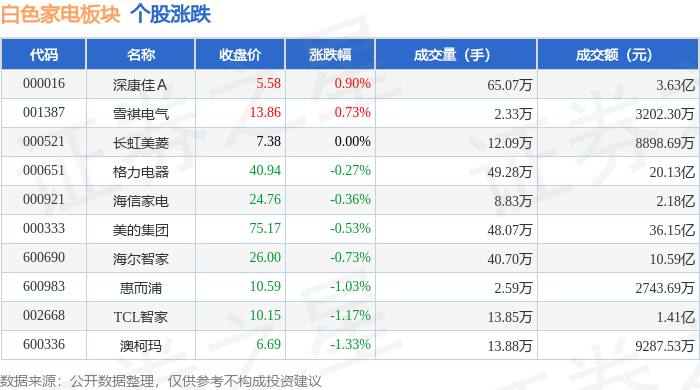
白色家电板块9月15日跌0.5%,澳柯玛领跌,主力资金净流出4.13亿元
Zheng Xing Xing Ye Ri Bao· 2025-09-15 08:42
Market Overview - The white goods sector experienced a decline of 0.5% on September 15, with Aucma leading the drop [1] - The Shanghai Composite Index closed at 3860.5, down 0.26%, while the Shenzhen Component Index rose by 0.63% to 13005.77 [1] Individual Stock Performance - Major stocks in the white goods sector showed varied performance, with Gree Electric down by 0.27% and Midea Group down by 0.53% [1] - Aucma saw the largest decline at 1.33%, while Snow Qi Electric and Changhong Meiling had slight increases of 0.73% and 0.00% respectively [1] Trading Volume and Capital Flow - The total net outflow of main funds in the white goods sector was 413 million yuan, while retail investors saw a net inflow of 432 million yuan [1] - The trading volume for Gree Electric reached 20.13 billion yuan, indicating significant investor interest despite the decline [1] Fund Flow Analysis - Snow Qi Electric had a net inflow of 2.33% from retail investors, while Aucma and Hisense Home Appliances experienced significant net outflows from main funds [2] - Retail investors contributed positively to the capital flow in several stocks, with notable inflows in Deep Kangjia A and Haier Smart Home [2]





家电行业8月月报及9月投资策略:业绩稳中有进相对估值底部-20250915
Guolian Minsheng Securities· 2025-09-15 08:28
Group 1 - The report highlights a stable performance in the home appliance industry, with a focus on the support for domestic demand through policies and the potential turning point in exports [5][6] - White goods are expected to maintain strong sales momentum, supported by the third batch of subsidies for trade-in programs, with leading companies like Midea Group, Haier Smart Home, Hisense Home Appliances, and Gree Electric showing robust financial performance [7][8] - The black goods segment benefits from domestic trade-in policies, with a steady increase in average prices and a projected stable growth in the global market size by 2025, recommending Hisense Visual and TCL Electronics as key players [7][8] Group 2 - The report indicates that the two-wheeler market will see accelerated growth due to national subsidies, with leading companies like Yadea Holdings expected to outperform the industry significantly [7] - The post-cycle segment shows improved operations, with a narrowing decline due to supportive policies in real estate, recommending companies like Robam Appliances and Vatti Corporation for investment [7] - The small appliance sector is experiencing a turnaround, with expectations for improved demand and market dynamics by 2025, highlighting companies like Ecovacs Robotics and Supor as potential investment opportunities [7] Group 3 - The report provides a market review for August, noting that the home appliance index increased by 4.73%, although it underperformed compared to the broader market indices [16][17] - The relative valuation of the home appliance sector is at a low point, with a PE ratio of 14.14 times, indicating potential investment value [17][18] - Key data tracking shows fluctuations in commodity prices, with copper and aluminum prices increasing year-on-year, while shipping rates have decreased [22][24]



中国家电行业:A 股会议及消费者调研关键要点-China Consumer Appliances Sector_ Key takeaways from A-Share Conference and consumer tour
2025-09-15 01:49
Summary of Key Points from the Conference Call Industry Overview - **Industry**: China Consumer Appliances Sector - **Event**: A-Share Conference and consumer tour held on September 1-4, 2025, involving major companies like Midea, Haier, Hisense, and Gongniu [2][3] Core Insights 1. **Intensified Domestic Competition**: - Midea has shifted its strategy from profitability to top-line growth, indicating increased competition in the air conditioning (AC) sector for the second half of 2025, which may pressure margins for smaller brands and Gree [3][6] - Hisense also noted heightened competition and potential pricing adjustments [3][6] 2. **Focus on Premiumization**: - Premium brands from Midea and Haier are experiencing robust sales growth, with Midea's premium brands generating a 60% year-over-year revenue increase to approximately RMB 10 billion in the first half of 2025 [3][6] 3. **Direct-to-Consumer (DTC) Transformation**: - Midea is enhancing customer engagement and traffic acquisition to improve operating profit margins (OPM) after establishing infrastructure [3][7] - Haier is leveraging digital inventory management to improve channel turnover and reduce stock-keeping units (SKUs) [3][12] 4. **Investor Interest in Arashi (Insta360)**: - Arashi, a leader in 360/action cameras, is gaining attention due to its software advantages in image processing, which are seen as a competitive edge over DJI [3][20][21] - Sales of Insta360 products surged following DJI's launch of a competing product, indicating a positive market response [3][20] 5. **Cautious Outlook for Appliance Sector**: - The overall outlook for China's appliance sector is cautious, anticipating a post-subsidy downcycle from Q3 2025 to 2027, with intensified competition impacting profitability [4][6] Company-Specific Highlights Midea - **Overseas Growth**: Midea is optimistic about its growth prospects in 2H25 and 2026, particularly in overseas markets, despite the diminishing impact of trade-in subsidies [6][8] - **Premium Brand Performance**: Revenue from premium brands is expected to grow by 10-20% even as subsidy benefits fade [6] Haier - **Retail Transformation**: Haier is focused on improving its retail operations and expects to benefit from the ongoing retail transformation in China [10][12] - **US Market Performance**: Haier reported low-single-digit revenue growth in the US, driven by price increases and market share gains [13][14] Hisense - **Stable Margins**: Despite price drops in the HVAC sector, Hisense anticipates stable margins in 2H25 due to reduced material costs and improved manufacturing efficiency [15][16] Gongniu - **Channel Transformation**: Gongniu plans to expand its flagship stores from 2,200 to approximately 3,000 by the end of 2025, focusing on improving store efficiency [17][18] - **New Product Development**: The company is exploring new energy solutions and smart lighting products, aiming to enhance its market presence [19] Additional Insights - **Ziel Home Furnishing**: Ziel is experiencing strong overseas sales, particularly in Europe and North America, despite challenges from rising US tariffs [23][24] - **Aqara's Smart Home Solutions**: Aqara is leveraging AIoT for product innovation, which could drive growth in the smart home segment [26][27] Risks and Considerations - **Market Risks**: The main risks for the consumer appliances sector include potential impacts from China's property market curbs, raw material price increases, and changes in US tax policy affecting exports [29]

破局与重构:2025 空调行业趋势与消费需求白皮书
艾瑞咨询· 2025-09-15 00:05
Core Viewpoint - The air conditioning industry is undergoing a critical phase of "breaking through and restructuring," driven by policies promoting low-carbon transformation, extreme high temperatures, and consumer subsidy policies, leading to increased market demand. The consumer focus is shifting from basic temperature control to "comfort + health + high-end" upgrades, with comfort and health-oriented air conditioners emerging as clear new growth points [1]. Group 1: Environmental Factors - The dual drivers of policy and technological innovation are reshaping the air conditioning market, emphasizing energy efficiency and low-carbon transformation, which is expected to stabilize the industry's lifecycle development [2]. - National subsidy policies have reduced consumer purchase costs, while extreme high temperatures have directly stimulated market demand, enhancing air conditioning sales and positively impacting the related supply chain [3]. Group 2: Market Dynamics - The air conditioning market is entering a mature phase with stable growth, where online sales account for 60% of the market, and traditional e-commerce remains the core traffic entry point. Price differentiation is evident, with low-priced and high-priced segments both seeing increased market share [5]. Group 3: Consumer Demand - Social media discussions reflect the evolving demands for air conditioning, with energy efficiency, comfort, cooling performance, aesthetics, and health becoming the top ten topics of interest for 2025 [9]. - The evolution of air conditioning from a "single temperature regulator" to a "quality lifestyle hub" that integrates comfort, health, and aesthetics is evident, with a focus on improving air quality and harmonizing with home decor [11]. - The high-end air conditioning market is evolving towards a comprehensive experience that combines "extreme comfort + health purification + aesthetic integration + smart connectivity" [13]. Group 4: Opportunities and Trends - The transition from "selling products" to "selling lifestyles" is a significant opportunity, focusing on specific living scenarios, spatial functions, and emotional needs of users [15]. - The demand for air conditioning is shifting towards comfort, health, and high-end features, indicating a deeper consumer need for quality and experience [17]. - The main consumer groups for air conditioning are shifting towards younger generations, particularly those born in the 2000s and 1990s, with a focus on comfort in family settings [19]. Group 5: Purchase Behavior - Consumers are increasingly motivated by the need for functionality and quality of life improvements, moving from basic needs to higher quality and better experiences [21]. - The primary information channel for consumers is e-commerce platforms, with JD.com recognized as the leading source for appliance information and purchases [24]. - Performance and quality are critical factors in purchase decisions, with consumers becoming more rational and focused on comprehensive experiences rather than just price sensitivity [28]. Group 6: Product Features and User Feedback - High satisfaction rates (over 99%) for features like "no-wind" and "soft wind" indicate strong consumer preference for comfort and health functionalities in air conditioning products [58]. - The integration of health features, such as air purification and self-cleaning technologies, is becoming a key selling point, enhancing the overall value of air conditioning products [57]. Group 7: Collaborative Innovations - JD.com collaborates with major air conditioning brands to promote comfort and health technologies, successfully driving sales of various air conditioning products that meet evolving consumer demands [61].




格力、小米,谁是“空调二哥”
21世纪经济报道· 2025-09-14 00:21
Core Viewpoint - The home appliance industry is experiencing a shift from stable competition among traditional giants to a more dynamic landscape influenced by digital transformation and new entrants like Xiaomi, which is aggressively pursuing market share in the major appliance sector [1][3]. Group 1: Performance of Major Players - Midea Group reported a revenue increase of 15.68% year-on-year, with total revenue reaching 252.3 billion yuan and net profit growing by 26% to 26.7 billion yuan [3][5]. - Haier's revenue grew by 10.22% year-on-year, while Gree Electric Appliances saw a revenue decline of 2.66% [1][3]. - Xiaomi's IOT and lifestyle products segment experienced a remarkable 50.7% growth, driven by increased sales of major appliances [1][5]. Group 2: Market Dynamics and Competition - The home appliance market is entering a phase of stock competition, with Xiaomi's entry disrupting the traditional market structure dominated by Midea, Haier, and Gree [1][3]. - Gree's core business, primarily air conditioning, faced a 5.09% decline, while its industrial products segment grew by 17.13% [6][8]. - The competition for the title of "second in air conditioning" is intensifying between Gree and Xiaomi, with Xiaomi's online air conditioning sales surpassing Gree's in recent months [8][9]. Group 3: Strategic Initiatives - Midea is focusing on R&D, with cumulative investments exceeding 43 billion yuan from 2022 to 2024, and a 14.4% increase in R&D spending in the first half of the year [4][5]. - Xiaomi's strategy emphasizes hardware sales at lower prices to build an ecosystem, contrasting with traditional models that prioritize hardware profit [9]. - Gree is facing challenges in diversifying its business and adapting to market changes, which has affected its performance [6][8]. Group 4: International Expansion - The overseas market is becoming a crucial growth area for home appliance giants, with Midea's overseas revenue growing from 116.78 billion yuan in 2019 to 169.03 billion yuan in 2024, reflecting a compound annual growth rate of 7.68% [11][12]. - Gree's overseas revenue also increased, but its contribution remains below 20% of total revenue, indicating a need for improvement in this area [13]. - Midea's global strategy includes establishing production bases in various countries, enhancing its brand presence and reducing costs [12][13].

海尔智家9月12日斥资1573.9万元回购60万股A股
Zhi Tong Cai Jing· 2025-09-12 13:21
Group 1 - Haier Smart Home announced a share buyback plan, intending to repurchase 600,000 A-shares at a total cost of 15.739 million yuan [1] - The buyback is scheduled to take place on September 12, 2025 [1] - The current stock price of Haier Smart Home is 26.19 yuan, reflecting a decrease of 0.43 yuan or 1.62% [1]