
HAIER SMART HOME(600690)

Search documents
先发明多筒洗衣机,才能主导多筒洗衣机国际标准
Quan Jing Wang· 2025-08-12 02:03
Core Insights - The washing machine market is expected to experience steady growth by 2025, driven by consumer demand for upgrades and the national "trade-in" policy for home appliances [1] - Haier washing machines hold the leading market share, with 34.4% offline and 27.6% online, attributed to their focus on addressing user pain points [1] - Haier pioneered the multi-tub washing machine category, overcoming significant technical challenges to launch the first dual-tub washing machine after six years of development [1][2] - The lack of unified technical standards in the multi-tub washing machine market has led to inconsistent product performance, complicating consumer choices and hindering healthy market development [1] Industry Developments - Haier has taken the initiative to lead the establishment of global standards for multi-tub washing machines, collaborating with the International Electrotechnical Commission (IEC) and industry experts over four years [2] - The recent release of the IEC international standard for multi-tub washing machines marks a significant milestone, ending the era of no standards in this category [2] - Haier's dual role as both the inventor of the multi-tub washing machine and the developer of its international standards underscores its leadership position in the industry [3]


海尔智家股价微跌0.04% 智能家居战略合作引关注
Jin Rong Jie· 2025-08-11 18:48
Group 1 - The stock price of Haier Smart Home is reported at 25.11 yuan, down 0.01 yuan from the previous trading day, with a decline of 0.04% [1] - The company’s main business includes the research, production, and sales of home appliances such as refrigerators, air conditioners, and washing machines, while actively expanding into the smart home sector [1] - Haier Smart Home is recognized as a representative enterprise in the home appliance industry, continuously promoting the intelligent upgrade of its products [1] Group 2 - Recently, Haier Smart Home has reached a strategic cooperation with Jomoo Group, focusing on deep collaboration in four major dimensions including smart living and technology interconnection [1] - The smart home market in China is expected to reach a scale of 682.1 billion yuan by 2024 [1] - On August 11, the net inflow of main funds was 19.58 million yuan, with a cumulative net inflow of 269 million yuan over the past five trading days [1]
2025年家用洗碗机行业词条报告
Tou Bao Yan Jiu Yuan· 2025-08-11 14:59
Investment Rating - The report indicates a significant growth potential in the household dishwasher industry, with a current low penetration rate of 4.8% in China, compared to over 70% in mature markets like North America, suggesting a strong investment opportunity [10][19]. Core Insights - The household dishwasher market in China is characterized by low penetration but substantial growth potential, primarily driven by younger consumers who favor smart solutions and embedded dishwashers [3][9][11]. - The market is currently facing challenges due to consumer perception issues, product adaptability, and a downturn in the real estate market, which affects demand [10][19]. - The industry is transitioning from a phase of imitation to one of independent innovation, with domestic brands gaining market share and improving their competitive edge [13][53]. Summary by Sections Industry Definition - Household dishwashers are integrated appliances that utilize chemical, mechanical, thermal, and electrical technologies for automated cleaning, rinsing, and drying of tableware [4]. Market Characteristics - The market penetration rate for household dishwashers in China is low at 4.8%, indicating significant growth potential [10]. - The primary consumer demographic is younger individuals, particularly those born in the 1980s and 1990s, who are increasingly reliant on smart home solutions [11]. Product Types - The market is dominated by embedded dishwashers, which accounted for 57.8% of purchases in 2023, reflecting consumer preferences for larger capacity and aesthetic integration with kitchen cabinetry [12]. Industry Development Stages - The industry has evolved through several stages, from its inception in the early 1990s to a rapid growth phase starting in 2016, with significant technological advancements and market expansion [13][17]. Market Size and Growth - The market size of the household dishwasher industry in China grew from 5.16 billion RMB in 2018 to 11.22 billion RMB in 2024, with a compound annual growth rate (CAGR) of 16.8% [41]. Competitive Landscape - The competitive landscape is becoming increasingly concentrated, with domestic brands surpassing foreign brands in market share for the first time in 2023 [51][53]. - The top five brands hold a significant market share, indicating a trend towards market consolidation [51]. Policy Environment - Recent policies aimed at promoting green appliances and enhancing consumer awareness are expected to further stimulate market growth [49][50]. Supply Chain Analysis - The supply chain consists of upstream component suppliers, midstream manufacturers, and downstream sales channels, with midstream brands holding significant bargaining power [22][21]. Consumer Behavior - Consumer preferences are shifting towards embedded dishwashers, which are favored for their space efficiency and functionality, leading to a transformation in the market structure [40]. Future Outlook - The market is expected to continue growing, driven by the increasing demand from younger consumers and the ongoing shift towards smart home technologies [48].


关税冲击几何?——美墨加协定下家电企业的风险评估和应对
Huachuang Securities· 2025-08-11 14:56
Investment Rating - The report maintains a recommendation for the home appliance industry [2] Core Viewpoints - The report analyzes the impact of the USMCA (United States-Mexico-Canada Agreement) and the potential risks posed by the U.S. government's tariff policies on Chinese home appliance companies operating in Mexico [6][8] - It emphasizes that the concerns regarding the USMCA's risks are primarily focused on two aspects: the potential for the U.S. government to invoke national security clauses and the upcoming review of the agreement in 2026 [6][8] - The report suggests that the short-term impact of the USMCA's implementation is limited, as many leading Chinese home appliance companies have already established significant production capacities in Mexico that comply with the agreement's rules [6][7] Summary by Sections Industry Basic Data - The home appliance industry consists of 80 listed companies with a total market value of 185.1 billion yuan and a circulating market value of 165.1 billion yuan [2] Relative Index Performance - The absolute performance of the industry over the past 1 month, 6 months, and 12 months is 0.3%, 1.1%, and 21.4% respectively, while the relative performance is -3.2%, -5.6%, and 3.0% [3] USMCA Agreement Analysis - The USMCA is designed to encourage regional production and supply chain integration, with specific rules for determining the origin of products [12][14] - The agreement provides trade benefits only to goods certified as originating from the USMCA region [12][14] - The report outlines two potential scenarios for the future of the USMCA: the continuation of the current tariff framework and the tightening of origin certification rules [55][58] Company Strategies - Leading Chinese home appliance companies like Haier, Midea, Hisense, and TCL have established substantial production capacities in Mexico, which allows them to mitigate tariff risks effectively [6][7][56] - The report highlights that these companies have the capability to meet the USMCA's origin certification requirements, thus reducing potential tariff impacts [6][7][57] - The white goods sector, particularly Haier, is expected to strengthen its market position in North America due to its localized production and supply chain flexibility [7][60] Market Dynamics - The report notes that while black goods manufacturers face challenges due to the concentration of LCD panel supply chains in Asia, they can still expand their market share through product upgrades [7][61] - The overall competitive landscape for Chinese home appliance companies has shifted from relying on cost advantages to focusing on brand development, operational efficiency, and product innovation [60]


深度求索系列 - 牛市思维看白电
2025-08-11 14:06
Summary of Key Points from the Conference Call on the White Goods Industry Industry Overview - The white goods industry is currently experiencing low valuations, with leading companies like Midea, Gree, and Haier trading below the 1/3 percentile of their historical valuation since 2010, contrasting with the rising valuations of the CSI 300 index [1][3] - Future growth in the white goods sector is expected to be driven primarily by overseas markets, particularly in emerging regions such as Asia, Africa, and Latin America, where Chinese appliance companies are likely to expand their market share through channel development and brand optimization [1][5] Valuation and Market Sentiment - Current valuations of leading white goods companies are at historically low levels, with Midea's price-to-earnings (P/E) ratio dropping from 15.3 to around 13, Gree from 8.4 to 7.6, and Haier from 14.2 to approximately 12 [3][4] - Despite concerns about short-term market conditions, historical trends indicate that the white goods sector has potential for price recovery, especially in the context of new public fund regulations and increased institutional investment [1][7] Financial Health and Shareholder Returns - Leading white goods companies have a high proportion of cash assets, approximately 35% of total assets, which provides them with the capacity and motivation to increase cash dividends and dividend yields [6][10] - The decline in government bond yields is expected to support a temporary recovery in the valuations of the white goods sector, making investments in this sector more attractive compared to government bonds [11] Growth Opportunities - The expansion of production capacity in Thailand is seen as beneficial for global stability in the white goods market, with long-term growth trends remaining reliable despite cyclical fluctuations in profitability [9] - The white goods sector is expected to benefit from a gradual recovery in U.S. real estate demand starting in 2026, which could positively impact companies like Haier [18] Regulatory and Market Dynamics - New public fund regulations are likely to enhance the preference for competitive assets in the white goods sector, as they emphasize long-term performance metrics [14] - Insurance capital is expected to increasingly invest in the A-share market, with the white goods sector being attractive due to its high dividend yields [15] Dividend Performance - The dividend yields of leading white goods companies, such as Gree (6.8% to 7%) and Midea (4.8% to 5%), are significantly higher than those of the banking and non-banking sectors, indicating a favorable investment environment [16] Price Competition and Profitability - Concerns regarding price competition in the air conditioning segment have been found to be overstated, as price reductions were limited to specific online SKUs and have since stabilized [17] Conclusion - Despite market concerns about the white goods industry's performance, it remains a relatively stable sector with potential for recovery and growth, particularly in light of favorable valuation conditions and emerging market opportunities [18]

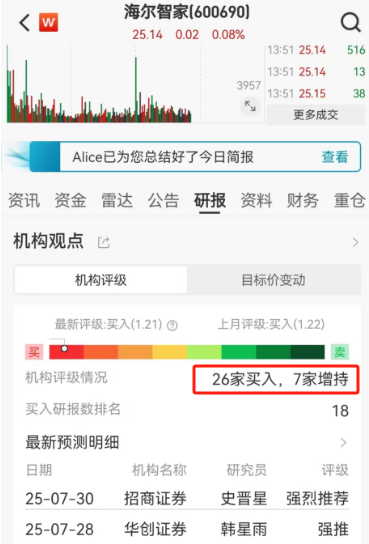
Wind发布:海尔智家获行业“买入”评级最多
Zhong Jin Zai Xian· 2025-08-11 12:46
Group 1 - The core viewpoint is that the home appliance industry is exhibiting strong growth resilience driven by multiple factors, with leading companies like Haier Smart Home being favored by brokerage institutions due to their performance certainty and growth potential [1][3] - The domestic digital transformation is a key driver for Haier Smart Home's stable growth, supported by data showing it achieved the top market share both online and offline in the first seven months of 2025, with significant growth in high-end brands like Casarte [2] - Global high-end brand creation is contributing to growth across various regions, with Haier leading in sales of multi-door refrigerators in Europe and achieving high pricing power in the U.S. market, indicating strong performance in Southeast Asia and Japan as well [2] Group 2 - For home appliance companies to maintain a sustained "buy" rating, they must demonstrate the ability to navigate through cycles, maintaining profitability in complex market environments while also advancing in smart and high-end sectors, which Haier Smart Home is successfully achieving [3]
海尔智家(06690)8月11日耗资401.99万元回购16万股A股
智通财经网· 2025-08-11 11:53
智通财经APP讯,海尔智家(06690)公布,2025年8月11日耗资401.99万元回购16万股A股股份。 ...
海尔智家8月11日耗资401.99万元回购16万股A股
Zhi Tong Cai Jing· 2025-08-11 11:50
海尔智家(600690)(06690)公布,2025年8月11日耗资401.99万元回购16万股A股股份。 ...
海尔智家(06690.HK)8月11日耗资402万元回购16万股A股
Ge Long Hui· 2025-08-11 11:47
格隆汇8月11日丨海尔智家(06690.HK)公告,8月11日耗资402万元回购16万股A股。 ...
海尔智家(06690) - 翌日披露报表
2025-08-11 11:39
FF305 翌日披露報表 (股份發行人 ── 已發行股份或庫存股份變動、股份購回及/或在場内出售庫存股份) 表格類別: 股票 狀態: 新提交 公司名稱: 海爾智家股份有限公司 呈交日期: 2025年8月11日 如上市發行人的已發行股份或庫存股份出現變動而須根據《香港聯合交易所有限公司(「香港聯交所」)證券上市規則》(「《主板上市規則》」)第13.25A條 / 《香港聯合交易所有限公司GEM證券 上市規則》(「《GEM上市規則》」)第17.27A條作出披露,必須填妥第一章節 。 | 第一章節 | | | | | | | | --- | --- | --- | --- | --- | --- | --- | | 1. 股份分類 | 普通股 | 股份類別 A | | 於香港聯交所上市 | 否 | | | 證券代號 (如上市) | 600690 | 說明 | 每股面值人民幣1元之普通股(A股) (於上海證券交易所上市) | | | | | A. 已發行股份或庫存股份變動 | | | | | | | | | | 已發行股份(不包括庫存股份)變動 | | 庫存股份變動 | | | | 事件 | | 已發行股份(不包括庫存 ...