
Bank Of Jiangsu(600919)

Search documents
固收深度报告20250927:从42家上市银行半年报解读银行债券投资“攻守道”




Soochow Securities· 2025-09-27 14:32
1. Report Industry Investment Rating No information about the report industry investment rating is provided in the given content. 2. Core Viewpoints of the Report - External environment factors such as interest rate fluctuations, bond supply - demand, and policy orientation jointly impact bond investment returns. In H1 2025, the bond investment of 42 listed banks showed certain characteristics in scale, structure, and profit and loss, but there are still challenges in maintaining stable returns in the future [1]. - The overall bond investment scale of 42 listed banks expanded steadily in H1 2025. There were differences in the investment structure among different types of banks, with state - owned banks and city commercial banks having stable growth in the bond allocation portfolio, while joint - stock banks and rural commercial banks increased their efforts in the bond trading portfolio. The bond investment portfolio generally presented a pattern of "stable foundation and flexible gain" [1]. - The coupon income of 42 listed banks was generally stable in H1 2025 but showed a slight year - on - year decline. The fair value change loss was significant, and the investment income increased. However, the bond investment of the banking industry still faces pressure to maintain stable returns [1]. 3. Summary According to the Table of Contents 3.1 42 Listed Banks' Bond Investment Volume - **Overall Bond Investment Scale: Steady Expansion**: In H1 2025, the total scale of the three types of bond - type financial assets of 42 listed banks showed a steady expansion trend. The growth of debt investment - type financial assets measured at amortized cost was relatively slow, while the growth of trading financial assets measured at fair value and included in current profits and losses was relatively large, indicating that banks increased the proportion of trading positions [9]. - **Differentiated Bond Investment Distribution Structures among Different Bank Types**: In H1 2025, state - owned banks and city commercial banks showed stable growth in the bond allocation portfolio, which may be related to their participation in the primary - market issuance of important national and regional bond varieties. Joint - stock banks and rural commercial banks slightly weakened their bond allocation power but significantly increased their efforts in the bond trading portfolio, showing a differentiated feature of "stable allocation by large banks and prominent trading flexibility by small and medium - sized banks" [13]. - **Bond Investment Allocation Tilted towards Government - Related Bonds**: In H1 2025, commercial banks increased their allocation of government - related bonds, with an average month - on - month increase of about 10% for state - owned banks, joint - stock banks, and city commercial banks, and a slightly smaller increase for rural commercial banks. The allocation of financial bonds and other bonds was differentiated. All banks held a relatively large scale of government - related bonds, followed by financial bonds and credit - related bonds [18]. - **Correlation between Financial Asset Types and Bond Variety Structures**: The banking industry maintained a stable growth of interest - rate bonds in the bond allocation portfolio and increased the allocation of credit bonds, while the allocation of financial bonds was relatively weak. In the bond trading portfolio, interest - rate bonds and financial bonds were the core varieties, with a more significant increase than credit bonds, showing a "stable foundation and flexible gain" pattern [22]. 3.2 42 Listed Banks' Bond Investment Profit and Loss - **Coupon Income: Generally Stable and Still the Main Source of Income**: In H1 2025, the total coupon income of 42 listed banks decreased slightly year - on - year. Although the scale of held - to - maturity bonds increased, the decline in the coupon rate of newly issued bonds led to a decrease in coupon income. In the future, coupon income is still expected to be the main source of bond investment income for commercial banks [26]. - **Fair Value Change Loss: Losses in the Trading Level**: In H1 2025, the total fair value change loss of 42 listed banks decreased significantly year - on - year, indicating that it was difficult to obtain capital gains through short - term trading in the volatile bond market, and there were floating losses in bond trading [28]. - **Investment Income: Growth in All Bank Types**: In H1 2025, the actual investment income of 42 listed banks in the bond field increased significantly year - on - year. Although the book value appreciation of bond - type trading financial assets and other debt investment - type financial assets was not as good as that of the previous year, banks could still increase their investment income by selling floating - profit old bonds and waiting for the maturity of high - coupon bonds [31]. 3.3 Attribution and Summary - **External Environment Driving Factors: Interest Rate Fluctuations, Bond Supply - Demand, and Policy Orientation Jointly Impact Bond Investment Returns**: In H1 2025, the "more adjustments and fewer opportunities" bond market environment led to a general decline in the prices of existing bonds, resulting in a significant year - on - year decline in the fair value change loss of listed banks' bond investment. The supply of national bonds, local government bonds, and policy - based financial bonds increased, but the coupon rate of newly issued bonds decreased, leading to a decline in coupon income. Regulatory policies indirectly affected bond investment performance [35]. - **Banking Industry's Bond Investment Pressure and Future Outlook** - Overall Income Shows a Positive Trend but There Are Still Hidden Concerns: In H1 2025, the actual bond investment income of 42 listed banks increased slightly year - on - year, but the coupon income faced downward pressure in the interest - rate downward cycle, and it was more difficult to obtain spread income through band trading. Since H2 2025, the "stock - strong and bond - weak" pattern has emerged, and the loss caused by fair value change will be more obvious [3]. - Different Bank Types Show Differentiated Performance, and State - owned Banks' Pressure Is Relatively Controllable: State - owned banks can maintain a certain profit - making ability in the low - interest - rate volatile bond market due to their advantages in bond allocation and trading portfolios. Joint - stock banks, city commercial banks, and rural commercial banks are more vulnerable, and they may increase their capital allocation in the equity market, commodity market, and related structured fixed - income products in the future [3].
双节”将至 银行及理财子公司花式营销“抢闲钱
Zheng Quan Ri Bao· 2025-09-26 22:43
Core Viewpoint - As the Mid-Autumn Festival and National Day "Golden Week" approach, banks and their wealth management subsidiaries are intensifying marketing activities focused on "holiday returns," aiming to attract idle funds from investors through various promotional strategies [1][2]. Group 1: Holiday Investment Strategies - Multiple banks and wealth management companies are releasing holiday investment plans via public platforms, encouraging investors to make early investments to secure returns during the holiday period [2][3]. - Recommended products primarily feature low-risk and stable styles, including open-ended, closed-end, cash management, and products with holding period requirements, catering to different investor needs for liquidity and investment duration [2][3]. Group 2: Specific Product Offerings - ICBC Wealth Management has launched cash management and open-ended products, requiring purchases to be completed by September 29 to enjoy returns from September 30 to October 8 [2]. - Other institutions, such as China Merchants Bank Wealth Management, are promoting cash and short-term debt products, allowing investors to enjoy extended holiday returns if purchased before specified deadlines [2][3]. Group 3: Performance of Wealth Management Products - Some wealth management products from various banks have shown impressive historical performance, with certain products achieving annualized returns of around 12% [4]. - For instance, ICBC Wealth Management offers a product with a risk level of R2 (medium-low risk) that has a recent annualized return of 12.01% over the past month and 8.42% since inception [4]. Group 4: Investor Considerations - Investors are advised to be aware of potential liquidity risks associated with certain products that may have redemption restrictions or lock-up periods, necessitating careful planning of cash flow needs during the holiday [5]. - Different investment strategies are suggested based on risk tolerance, with conservative investors encouraged to prioritize money market funds and fixed-income products for stable returns, while more aggressive investors may consider increasing equity exposure for higher potential returns [6].

“双节”将至 银行及理财子公司花式营销“抢闲钱”
Zheng Quan Ri Bao· 2025-09-26 15:52
Group 1 - As the Mid-Autumn Festival and National Day "Golden Week" approach, banks and their wealth management subsidiaries are intensifying marketing activities around "holiday returns" to attract idle funds from investors [1][2] - Various banks and wealth management companies are releasing holiday investment strategies through public platforms, emphasizing the need for investors to plan ahead and complete investments before the holiday [2][3] - Many institutions are offering low-risk, stable investment products, including cash management and short-term debt products, to cater to different investor needs regarding liquidity and investment duration [2][3] Group 2 - Some wealth management subsidiaries are launching high-yield products, with historical performance benchmarks reaching up to 12% for certain offerings [4] - For instance, ICBC Wealth Management has introduced a product with a risk level of R2 (medium-low risk) that has a recent annualized return of 12.01% over the past month [4] - Other banks, such as Ping An Wealth Management, are also showcasing competitive returns on their products, with annualized returns ranging from 5.09% to 5.98% [4]
《碳核算概论》 新书发布
Jin Rong Shi Bao· 2025-09-26 03:30
Core Insights - The Yangtze River Delta region is recognized for its leading green industry clusters and high-density low-carbon technology R&D platforms, emphasizing a collaborative approach to economic development and ecological protection [1] - The establishment of the "Yangtze River Delta Carbon Accounting Technology Engineering Center" aims to bridge academic consensus with practical resources in carbon accounting [1] - The release of the textbook "Introduction to Carbon Accounting" is part of a broader initiative to enhance the carbon finance academic framework, complementing previous publications on carbon trading and carbon finance [2] Group 1 - The Yangtze River Delta is exploring new paths for economic development and ecological protection through a unified approach [1] - Carbon accounting is highlighted as a critical measurement tool and data foundation for achieving dual carbon goals [1] - Approximately 150 experts and representatives from various institutions participated in the seminar, indicating strong interest and collaboration in the field [1] Group 2 - The "Introduction to Carbon Accounting" textbook is the third in a series aimed at providing comprehensive insights into carbon finance [2] - This series includes previous works on carbon trading and carbon finance, contributing to the development of the carbon finance discipline [2] - The initiative reflects a commitment to advancing education and practical knowledge in carbon finance and accounting [2]
2025年H1中国手机银行APP流量监测报告
艾瑞咨询· 2025-09-26 00:04
Core Insights - The mobile banking app has become a core platform for commercial banks to serve users, optimize experiences, and enhance competitiveness in the context of national digital transformation and financial technology innovation [1] - The market for mobile banking apps is entering a stage of stock competition, with user flow stabilizing between 650 million to 700 million from 2023 to 2025, indicating saturation [2] - User engagement with mobile banking apps is declining, necessitating refined operational strategies for banks to retain customers [4][6] User Flow and Behavior - The overall user flow of mobile banking apps in China is projected to fluctuate between 650 million and 700 million, with a change rate of -1.2% to 4.6% from 2023 to 2025, indicating market saturation [2] - User stickiness has significantly decreased, with average daily effective usage time dropping from 4.93 minutes to 2.70 minutes and daily usage frequency from 4.54 times to 2.86 times [4] Operational Strategies - Refined operations are essential for banks to break through in a saturated market, focusing on precise user insights and intelligent technology applications [6][7] - The strategy involves three layers: foundational user insights, scenario-based and differentiated operations, and establishing emotional connections with users [7] AI Integration - AI technology is recognized for its potential value across industries, aiding banks in refining operations by enhancing interactive experiences, risk management, and data efficiency [9] Rankings and Performance - The top 50 rankings show that state-owned banks dominate, with Agricultural Bank of China leading with an average MAU of 24.8 million, followed by Industrial and Commercial Bank of China and China Construction Bank [11][12] - Among joint-stock commercial banks, China Merchants Bank leads with over 7 million MAU, while many others face declining user engagement [16][17] - City commercial banks have shown strong performance, with Jiangsu Bank leading at 3.5 million MAU, and several banks achieving significant growth rates [19][20] Case Studies of Successful Apps - Agricultural Bank of China continues to lead the industry with a 4.8% increase in MAU, focusing on integrating financial services with daily life scenarios [28][29] - China Merchants Bank is recognized for its innovative digital services, maintaining its position as a leader among joint-stock banks [31] - Jiangsu Bank emphasizes the integration of digital capabilities with wealth management, enhancing its app to meet customer needs [33] - Beijing Bank's app showcases a digital transformation strategy that combines technology, scenarios, and services to create value [35]




国寿安保中证A500红利低波动交易型 开放式指数证券投资基金基金份额发售公告
Zhong Guo Zheng Quan Bao - Zhong Zheng Wang· 2025-09-25 23:57
登录新浪财经APP 搜索【信披】查看更多考评等级 重要提示 1、国寿安保中证A500红利低波动交易型开放式指数证券投资基金(以下简称"本基金") 的募集已获中 国证券监督管理委员会证监许可【2025】1823号文准予募集注册。中国证监会对本基金的注册并不代表 中国证监会对本基金的风险和收益作出实质性判断、推荐或保证。 2、本基金类别为股票型证券投资基金,运作方式为交易型开放式。 3、本基金的基金管理人为国寿安保基金管理有限公司(以下简称"本公司"或"基金管理人"),基金托 管人为江苏银行股份有限公司,登记结算机构为中国证券登记结算有限责任公司。 4、本基金募集对象为符合法律法规规定的可投资于证券投资基金的个人投资者、机构投资者、合格境 外投资者以及法律法规或中国证监会允许购买证券投资基金的其他投资人。 5、本基金自2025年10月9日至2025年10月22日进行发售。投资者可选择网上现金认购和网下现金认购2 种方式。本基金暂不开通网下股票认购。网上现金认购是指投资者通过基金管理人指定的发售代理机构 用上海证券交易所网上系统以现金进行的认购。网下现金认购是指投资者通过基金管理人和/或其指定 的发售代理机构使用证 ...

银行投资基金:现状洞察、费改破局与逻辑重塑
KAIYUAN SECURITIES· 2025-09-25 14:41
Investment Rating - The investment rating for the banking industry is "Positive" (maintained) [1] Core Insights - The banking sector is experiencing a shift in fund investment behavior, with banks redeeming low-yield money market funds and increasing their holdings in credit bond funds to enhance returns [5][57] - The total fund holdings of listed banks reached approximately 6.37 trillion yuan, accounting for 2.03% of total assets as of the end of the first half of 2025 [15][18] - The proportion of fund investments in the fair value through profit or loss (FVTPL) category is 48.5%, with city commercial banks showing even higher ratios [15][22] Summary by Sections 1. Fund Investment Participation and Scale - The self-managed fund holdings of listed banks as of June 2025 were approximately 6.37 trillion yuan, with shareholding banks and city commercial banks having significant investment scales of 2.84 trillion yuan and 1.72 trillion yuan, respectively [15][18] - The investment in money market funds decreased to 9.10%, while the proportion of passive index bond funds increased to 7.90% [23][25] 2. Changes in Fund Investment Behavior - Banks are redeeming money market funds and low-yield rate bond funds while increasing their investment in credit bond funds [5][57] - The redemption pressure for money market funds was primarily concentrated in the first quarter of 2025, driven by liquidity management needs and yield enhancement [49][55] 3. Future Expansion and Impact of Redemption Fee Reform - Smaller banks have greater expansion potential in fund investments, driven by the need for redundant fund screening and tax-exempt income [3][3] - The implementation of redemption fee reforms may catalyze preventive redemptions by banks, leading to a preference for customized bond funds and bond ETFs [3][3]




小长假与林俊杰、张艺兴、林宥嘉、Murda、R.E.D等明星一起狂欢!江苏银行邀您参加南京DNA音乐节
Zhong Jin Zai Xian· 2025-09-25 07:57
Group 1 - The core idea of the article is that Jiangsu Bank is enhancing its promotional activities during the upcoming National Day holiday by offering a variety of consumer benefits and organizing a music festival to stimulate regional economic growth [1] - Jiangsu Bank's "Follow the Super League to Carnival" theme event is designed to leverage millions of consumer vouchers to provide users with discounts across various categories including dining, entertainment, and shopping [1] - The Nanjing DNA Music Festival features a strong lineup of artists including Lin Junjie, Zhang Yixing, and Murda Beatz, and will offer free tickets for the event on October 2 [1] Group 2 - The music festival will be supported by an overseas Grammy music production team, enhancing the quality of the performances and audience experience [1] - Attendees can participate in a lottery for consumer vouchers through the Jiangsu Bank App, with opportunities to win in seven different categories each week during the event [1] - The event aims to create a vibrant atmosphere with upgraded stage designs and a variety of food, leisure, and cultural services available [1]

透视城商银行半年报:房地产贷款超8成投向个人住房,不良率绝大多数低于2%
Jin Rong Jie· 2025-09-25 01:54
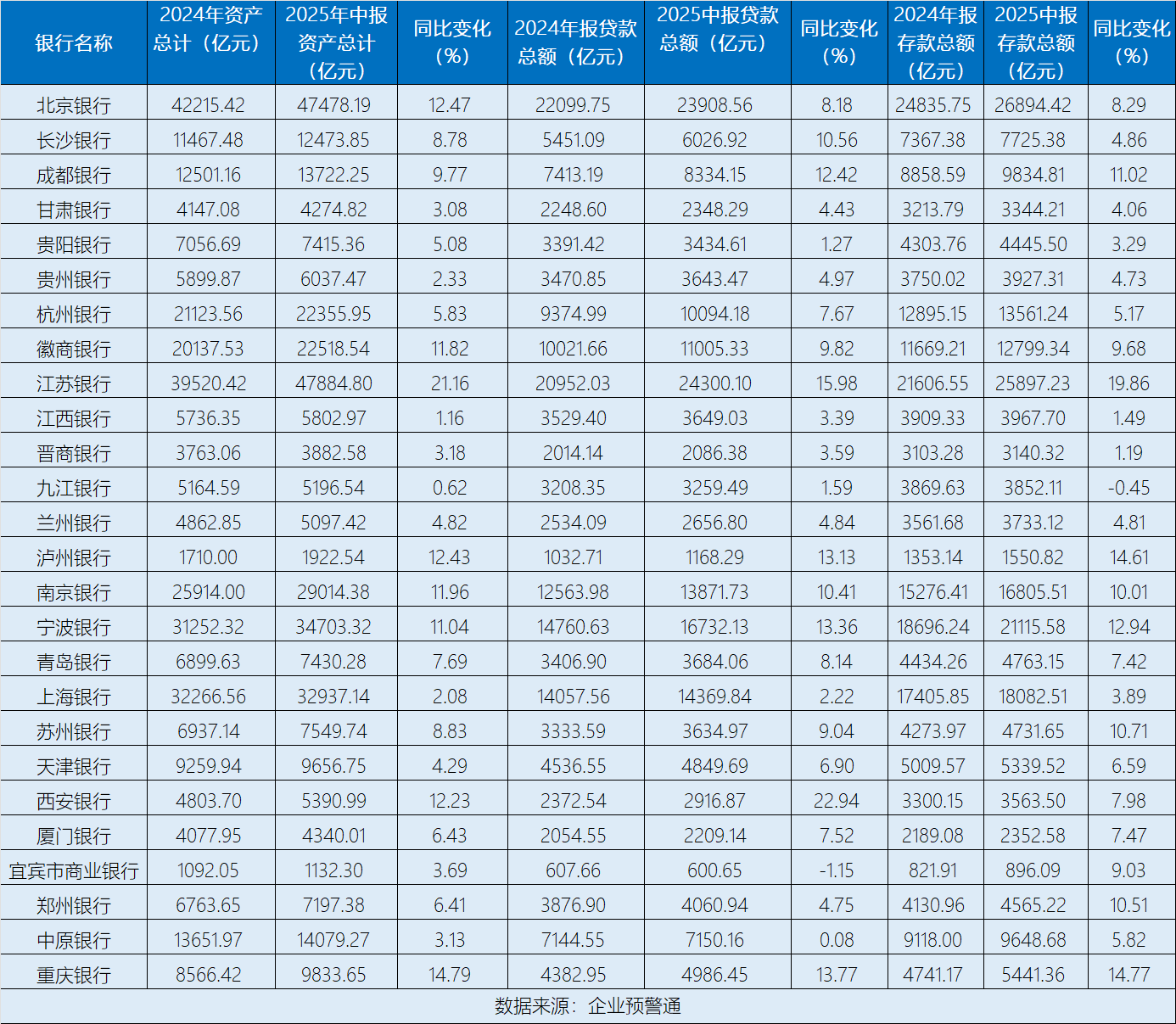
Core Insights - The total assets of 28 city commercial banks reached 38.99 trillion yuan in the first half of 2025, reflecting a year-on-year growth of 9.16% [1] - Jiangsu Bank and Beijing Bank lead in asset size, with 4.79 trillion yuan and 4.75 trillion yuan respectively, indicating strong market positions [2] - The overall loan growth for these banks was 8.66%, with notable increases from Ningbo Bank and Xi'an Bank, which saw growth rates of 13.36% and 22.94% respectively [4][5] Asset Scale - Jiangsu Bank and Beijing Bank are at the forefront with asset totals of 4.79 trillion yuan and 4.75 trillion yuan, respectively [2] - Other banks like Shanghai Bank and Ningbo Bank also show significant asset sizes above 2 trillion yuan, forming a strong first tier in the city commercial bank sector [2] - Year-on-year growth rates vary, with Jiangsu Bank at 21.16% and Chongqing Bank at 14.79%, while Jiujiang Bank showed minimal growth at 0.62% [2][3] Loan Performance - The total loan amount for the 28 banks increased to 19.41 trillion yuan, with a year-on-year growth of 8.66% [1][4] - Jiangsu Bank's loan total rose from 2.10 trillion yuan to 2.43 trillion yuan, marking a growth of 15.98% [3] - Xi'an Bank exhibited the highest loan growth rate at 22.94%, while Central Plains Bank's loan growth was negligible at 0.08% [4][5] Deposit Trends - Jiangsu Bank's deposits surged from 2.16 trillion yuan to 2.59 trillion yuan, reflecting a growth of 19.86% [5] - Other banks like Hangzhou Bank also reported deposit growth, increasing from 1.29 trillion yuan to 1.36 trillion yuan, a rise of 5.17% [5] - Jiujiang Bank experienced a slight decline in deposit growth, with a minimal increase of 0.45% [5] Real Estate Loan Distribution - The real estate loan proportion has generally decreased among city commercial banks, with Guiyang Bank leading at 15.36% [6][7] - Jiangsu Bank, on the other hand, has a low real estate loan ratio of 2.8%, indicating a conservative approach to real estate lending [6][7] - Ningbo Bank holds the highest total real estate loan amount at 1548.93 billion yuan, followed by Beijing Bank and Shanghai Bank [6][7] Personal Housing Loan Insights - Personal housing loans dominate the real estate loan portfolio, with banks like Weihai Bank and Central Plains Bank having high proportions of 36.26% and 17.8% respectively [8] - Most city commercial banks maintain low non-performing loan rates for personal housing loans, with the majority below 2% [8] - Yibin Commercial Bank reported a higher non-performing rate of 4.47% for personal housing loans [8]
江苏银行独家呈现南京DNA音乐节:门票免费送!邀您见证林俊杰×张艺兴同台炸场名场面
Hua Xia Shi Bao· 2025-09-24 10:25
Core Points - Jiangsu Bank is exclusively presenting the Nanjing DNA Music Festival featuring popular artists such as JJ Lin, Zhang Yixing, and others [1] - The festival will take place on October 2 at the Guluo Muyan Binjiang venue, showcasing a mix of pop, hip-hop, and electronic music [1] - Jiangsu Bank is offering free tickets for the music festival through its app, along with other promotional activities [1] Group 1 - Jiangsu Bank is giving away free tickets for the Nanjing DNA Music Festival, which features a star-studded lineup [1] - The festival will include seamless transitions between different music genres, enhancing the overall experience for attendees [1] - Additional promotions include free tickets for the dance drama "Dream of the Red Chamber" valued at 680 yuan and themed blind boxes available for collection [1] Group 2 - The promotional campaign encourages users to engage with the Jiangsu Bank app to access various rewards and benefits [1] - Users can unlock a range of cultural and entertainment vouchers, enhancing consumer engagement and activity [1] - The initiative aims to boost consumer enthusiasm and vitality in daily life through various offerings [1]