
NJBK(601009)

Search documents
黄金白银继续暴跌 轮到银行股机会了?
Di Yi Cai Jing· 2026-02-04 01:02
Core Viewpoint - The A-share market experienced significant declines in various sectors, particularly in metals and banks, with a notable focus on bank stocks as a safe haven amid volatility in precious metals prices [1][3][4]. Group 1: Market Performance - On February 2, A-share non-ferrous metals led the decline with a drop of 7.62%, while steel, chemicals, coal, and oil and gas sectors also fell over 5% [1]. - The Shanghai Composite Index closed down 2.48%, with over 4,600 stocks declining and a trading volume of approximately 2.61 trillion yuan, a decrease of nearly 250 billion yuan from the previous trading day [3][4]. - The banking sector showed resilience, with certain banks like Citic Bank and Shanghai Bank posting gains of 2.64% and 1.62%, respectively, amidst the overall market downturn [4]. Group 2: Bank Sector Analysis - The banking sector has seen a significant correction, with the China Securities Bank Index dropping 6.76% as of January 30, with major banks like Pudong Development Bank and Agricultural Bank of China experiencing declines of 19.29% and 12.5%, respectively [4][5]. - Analysts believe that the peak of fund outflows from the banking sector has passed, with the sector's valuation becoming more attractive, as the median price-to-book (PB) ratio is around 0.57 and the median dividend yield has risen to over 4.5% [5][6]. - Recent reports indicate that passive fund outflows have been a major factor in the banking sector's recent adjustments, but the selling pressure is expected to diminish, allowing for potential recovery in bank stock prices [6][7]. Group 3: Institutional Insights - Institutions are starting to show interest in bank stocks, with reports indicating that active funds had reduced their holdings in bank stocks by 1.3 billion shares by the end of the fourth quarter [7]. - Several regional banks have announced stock buyback plans, which have been positively received by the market, reinforcing confidence in the banking sector's fundamentals [7].





丈量地方性银行(2):浙江163家区域性银行全梳理-20260203
GF SECURITIES· 2026-02-03 13:31
Investment Rating - The industry investment rating is "Buy" [2] Core Insights - The report provides a comprehensive analysis of 163 regional banks in Zhejiang Province, highlighting their asset and liability structures, profitability, and asset quality [6][20] - The asset growth rate for major city commercial banks in Zhejiang is 9.4%, which is lower than the 14.2% growth rate of listed city commercial banks, while major rural commercial banks show an asset growth rate of 8.0%, exceeding the 6.7% growth rate of listed rural commercial banks [6][25] - The report indicates that the loan-to-asset ratio for city commercial banks is projected to reach 55.5% in 2024, an increase of 95 basis points year-on-year, while rural commercial banks will see a decrease to 59.3%, down 19 basis points [31] - Profitability metrics show that the average Return on Assets (ROA) for city commercial banks in Zhejiang is 0.78%, slightly above the average of listed city commercial banks, while rural commercial banks have an average ROA of 0.82%, which is below the average of listed rural commercial banks [6][31] - The asset quality of regional banks in Zhejiang is reported to be better than that of listed banks, with non-performing loan ratios lower by 16 basis points for city commercial banks and 9 basis points for rural commercial banks compared to their listed counterparts [6][31] Summary by Sections Section 1: Economic Structure of Zhejiang Province - Zhejiang Province is focused on high-quality development and aims to become a model for common prosperity [13] - The province's GDP is heavily concentrated in cities like Hangzhou, Ningbo, and Wenzhou, with Hangzhou accounting for 24.3% of the total GDP in 2025 [15] Section 2: Overview of 163 Regional Banks - The report categorizes the banks into city commercial banks, rural banks, and others, with a total of 163 banks in the region [20] - The distribution of registered capital among these banks is relatively balanced, with 63 banks having over 500 million yuan in registered capital [22] Section 3: Asset and Liability Structure - The asset growth of major city and rural commercial banks has been declining since 2019, with city banks showing a growth rate of 9.4% in the first half of 2025 [25] - The liability structure indicates that customer deposits account for 77.5% of liabilities for city commercial banks, which is higher than the 66.2% for listed city banks [44] Section 4: Profitability and Asset Quality - The average ROE for city commercial banks in Zhejiang is 11.98%, slightly lower than the average of listed city banks [6][31] - The report highlights that the non-performing loan ratio for city commercial banks is lower than that of listed banks, indicating better asset quality [6][31]



城商行板块2月3日跌0.59%,重庆银行领跌,主力资金净流入1.74亿元
Zheng Xing Xing Ye Ri Bao· 2026-02-03 09:03
| 代码 | 名称 | 收盘价 | 涨跌幅 | 成交量(手) | 成交额(元) | | --- | --- | --- | --- | --- | --- | | 601963 | 重庆银行 | 10.18 | -1.83% | 12.29万 | 1.25亿 | | 601838 | 成都银行 | 15.82 | -1.62% | 44.70万 | 7.10亿 | | 601665 | 齐鲁银行 | 5.64 | -1.57% | 74.37万 | 4.21亿 | | 601169 | 北京银行 | 5.28 | -1.31% | 196.28万 | 10.39亿 | | 601229 | 上海银行 | 9.27 | -1.28% | 53.77万 | 4.98亿 | | 601577 | 长沙银行 | 9.56 | -0.93% | 19.60万 | 1.87亿 | | 600928 | 西安银行 | 3.69 | -0.81% | 24.44万 | 9033.50万 | | 601997 | 贵阳银行 | 5.69 | -0.70% | 42.61万 | 2.43亿 | | 616009 | 江苏银行 | ...



机构扎堆调研上市银行 信贷投放、净息差等为“最关注”
Xin Lang Cai Jing· 2026-02-02 22:57
Core Viewpoint - The article highlights the ongoing institutional research on listed banks in January, focusing on credit issuance, net interest margin, asset quality trends, and bond investment strategies during the peak marketing season [1][2][7]. Group 1: Institutional Research and Credit Issuance - A total of 373 institutions conducted research on 11 A-share listed banks, with 49 research instances recorded by January 31 [1][7]. - The banks under review include Nanjing Bank, Ningbo Bank, Shanghai Bank, and others, with Nanjing Bank being the most favored, receiving 76 institutional inquiries [2][8]. - Institutions are particularly focused on credit issuance during the marketing peak, with many banks reporting better performance compared to the same period in 2025 [2][8]. - Key areas for credit issuance include manufacturing, infrastructure construction, and green low-carbon transformation projects [3][9]. Group 2: Net Interest Margin Stability - Net interest margin (NIM) is a critical indicator of banking performance, with banks focusing on stabilizing NIM through asset and liability management [4][11]. - Shanghai Bank anticipates a slight decline in NIM due to the expected decrease in loan market quotation rates (LPR) and competitive pressures on deposit pricing [11][12]. - Qilu Bank is optimizing its asset portfolio and enhancing low-cost deposit acquisition to stabilize NIM [11][12]. Group 3: Bond Investment Strategies - The bond market has been volatile since 2025, affecting the bond investment returns of regional small and medium-sized banks [6][12]. - Shanghai Bank expects bond rates to remain in a fluctuating range in 2026, with limited potential for a trend reversal [6][13]. - Hu Nong Bank plans to focus on bond investment for asset allocation while employing risk management strategies, including the use of derivatives [6][13]. Group 4: Asset Quality Management - Banks are implementing measures to maintain stable asset quality, including improving the quality of new loans and increasing efforts to manage non-performing loans [6][13].





赛道边银行暗战: 解码马拉松“金主”的生意经
Zhong Guo Zheng Quan Bao· 2026-02-02 22:07
Core Insights - The article discusses the strategic investment of banks in marathon sponsorships, particularly focusing on the 2026 China Bank Yangzhou Half Marathon, highlighting the banks' intent to deepen customer relationships and redefine the value of offline quality scenarios [1][2][3] Group 1: Strategic Investment in Sports Sponsorship - Banks are increasingly becoming major sponsors of marathon events, viewing this as a strategic investment rather than mere brand exposure [1][3] - The sponsorship allows banks to reach potential customers effectively, especially in a high customer acquisition cost environment [4][6] - The characteristics of marathon participants align closely with the target demographics of banks' retail businesses, making this a key reason for their investment [3][4] Group 2: Enhanced Customer Engagement - The China Bank is providing exclusive support and benefits to marathon participants, including specialized training courses and a range of financial services [2][4] - Banks are leveraging marathons to create multiple touchpoints for interaction with potential customers, enhancing their engagement strategies [4][6] - Local banks are using sponsorships to improve brand penetration in regional markets and build emotional connections with the community [4][6] Group 3: Challenges and Opportunities - While sponsorships provide brand exposure, the real challenge lies in converting event "traffic" into long-term customer retention [5][6] - The increasing number of banks entering the marathon sponsorship space has led to heightened competition and a lack of innovative marketing strategies [6][7] - Banks are encouraged to develop customized products and services that cater specifically to the needs of marathon participants and the sports industry [7]

机构扎堆调研上市银行信贷投放、净息差等为“最关注”
Zheng Quan Ri Bao· 2026-02-02 16:43
Group 1 - In January, 11 A-share listed banks were surveyed by 373 institutions, with a total of 49 survey instances, focusing on credit issuance, net interest margin, asset quality trends, and bond investment strategies during the peak marketing season [1] - The surveyed banks include Nanjing Bank, Ningbo Bank, Shanghai Bank, Hangzhou Bank, Suzhou Bank, Qingdao Bank, Qilu Bank, Xiamen Bank, Hu Nong Bank, Qing Nong Bank, and Zijin Bank, with six banks experiencing stock price increases, led by Qingdao Bank with over 16% growth [2] - Nanjing Bank was the most favored by institutions, receiving 76 surveys, while Shanghai Bank received 75 surveys, indicating strong interest in their credit issuance during the marketing peak [2] Group 2 - The focus of the credit issuance during the peak marketing season is on corporate credit, with banks reporting better performance compared to the same period in 2025, emphasizing manufacturing, infrastructure, and green transformation projects [2][3] - Shanghai Bank anticipates a continued decline in the Loan Prime Rate (LPR) in 2026, which may lead to a slight decrease in net interest margin due to competitive market factors [4] - Qilu Bank aims to stabilize its net interest margin by optimizing asset management and expanding low-cost deposits while managing liabilities effectively [4] Group 3 - The overall pressure on net interest margin for listed banks is expected to ease in 2026, with a narrowing decline anticipated, supported by improvements in funding costs [5] - Shanghai Bank predicts that bond yields will continue to fluctuate within a range in 2026, with low likelihood of a trend reversal [5] - Hu Nong Bank plans to focus on bond investments primarily for allocation, while also employing advanced technologies for trading and risk management [6]
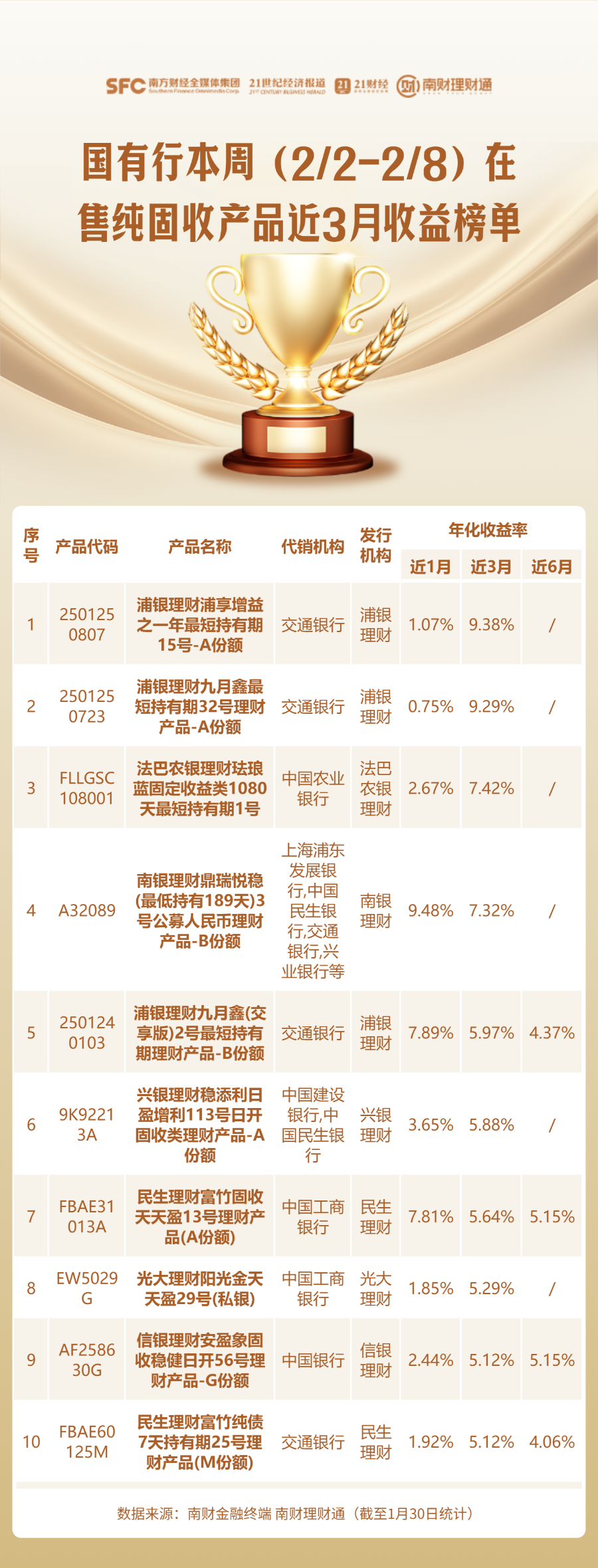
各银行在售高收益纯固收产品一览!合资理财子产品首次上榜
2 1 Shi Ji Jing Ji Bao Dao· 2026-02-02 09:13
Core Insights - The report focuses on the performance of pure fixed-income products issued by wealth management companies, highlighting the best-performing products available for sale through various distribution channels [1][4] Group 1: Product Performance - The ranking of products is based on their annualized returns over the past month, three months, and six months, with a particular emphasis on the three-month annualized yield to reflect their performance amid recent market fluctuations [1] - A total of 28 distribution institutions are involved, including major banks such as Industrial and Commercial Bank of China, Bank of China, Agricultural Bank of China, and others [1] Group 2: Product Availability - The list of products is categorized as "available for sale," but actual availability may vary due to factors such as sold-out quotas or differences in product listings shown to different customers by banks [1] - Investors are advised to refer to the actual displays on the distribution bank's app for the most accurate information regarding product availability [1] Group 3: Data Source - The data presented in the report is sourced from the Nanfang Financial Terminal and Nanfang Wealth Management, with statistics as of January 30 [3][5]
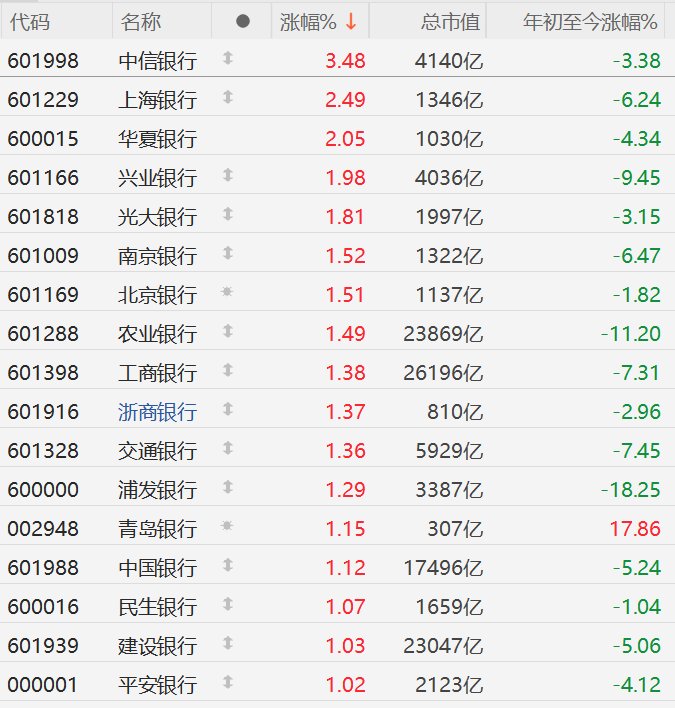
银行股逆势上涨,中信银行涨超3%
Ge Long Hui· 2026-02-02 03:57
Core Viewpoint - The A-share market's banking sector experienced a counter-trend increase, with several banks showing significant gains despite overall market conditions [1]. Group 1: Stock Performance - CITIC Bank saw an increase of 3.48%, with a total market capitalization of 414 billion [2] - Shanghai Bank increased by 2.49%, with a market cap of 134.6 billion [2] - Huaxia Bank rose by 2.05%, with a market cap of 103 billion [2] - Other banks such as Industrial Bank, Everbright Bank, and Nanjing Bank also reported gains exceeding 1% [1][2] - Agricultural Bank, Industrial and Commercial Bank, and China Merchants Bank had market caps of 2386.9 billion, 2619.6 billion, and 2304.7 billion respectively, with slight increases [2] Group 2: Year-to-Date Performance - Year-to-date performance shows that most banks have negative returns, with CITIC Bank down 3.38% and Shanghai Bank down 6.24% [2] - Notably, Qingdao Bank has a positive year-to-date return of 17.86%, indicating strong performance relative to its peers [2] - Other banks like Agricultural Bank and Industrial Bank have year-to-date declines of 11.20% and 7.31% respectively [2]

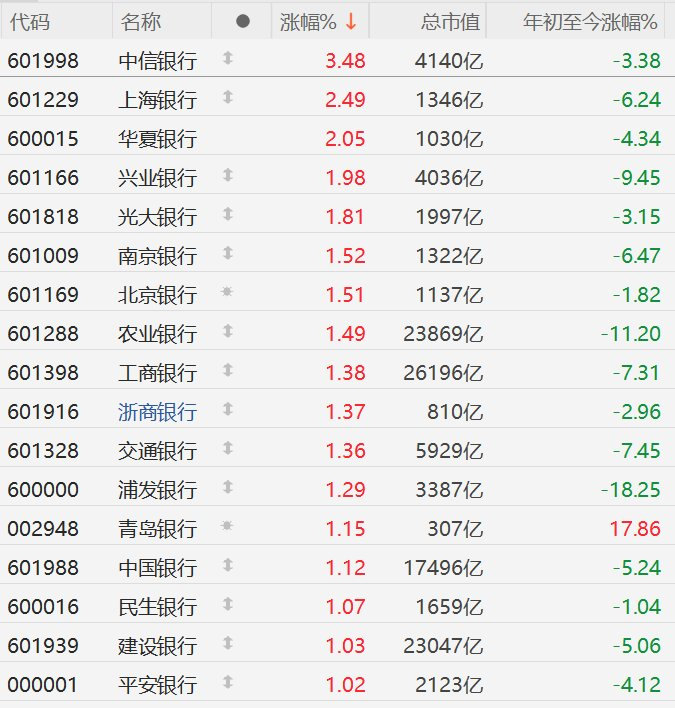
A股银行股逆势上涨,中信银行涨超3%
Ge Long Hui A P P· 2026-02-02 03:54
Core Viewpoint - The A-share market has seen a rise in bank stocks, with several banks experiencing significant gains despite overall market trends [1] Group 1: Stock Performance - CITIC Bank increased by 3.48%, with a total market capitalization of 414 billion [2] - Shanghai Bank rose by 2.49%, with a market cap of 134.6 billion [2] - Huaxia Bank saw a gain of 2.05%, with a market value of 103 billion [2] - Industrial Bank increased by 1.98%, with a market cap of 403.6 billion [2] - Everbright Bank rose by 1.81%, with a total market capitalization of 199.7 billion [2] - Nanjing Bank increased by 1.52%, with a market cap of 132.2 billion [2] - Beijing Bank saw a rise of 1.51%, with a market value of 113.7 billion [2] - Agricultural Bank increased by 1.49%, with a market cap of 23,869 billion [2] - Industrial and Commercial Bank rose by 1.38%, with a market value of 26,196 billion [2] - Zhejiang Bank increased by 1.37%, with a market cap of 81 billion [2] - Bank of Communications rose by 1.36%, with a market value of 592.9 billion [2] - Shanghai Pudong Development Bank increased by 1.29%, with a market cap of 338.7 billion [2] - Qingdao Bank saw a rise of 1.15%, with a market value of 30.7 billion [2] - Bank of China increased by 1.12%, with a market cap of 17,496 billion [2] - Minsheng Bank rose by 1.07%, with a market value of 165.9 billion [2] - China Construction Bank increased by 1.03%, with a market cap of 23,047 billion [2] - Ping An Bank rose by 1.02%, with a market value of 212.3 billion [2] Group 2: Year-to-Date Performance - CITIC Bank has a year-to-date decline of 3.38% [2] - Shanghai Bank has decreased by 6.24% year-to-date [2] - Huaxia Bank has a year-to-date decline of 4.34% [2] - Industrial Bank has decreased by 9.45% year-to-date [2] - Everbright Bank has a year-to-date decline of 3.15% [2] - Nanjing Bank has decreased by 6.47% year-to-date [2] - Beijing Bank has a year-to-date decline of 1.82% [2] - Agricultural Bank has decreased by 11.20% year-to-date [2] - Industrial and Commercial Bank has a year-to-date decline of 7.31% [2] - Zhejiang Bank has decreased by 2.96% year-to-date [2] - Bank of Communications has a year-to-date decline of 7.45% [2] - Shanghai Pudong Development Bank has decreased by 18.25% year-to-date [2] - Qingdao Bank has increased by 17.86% year-to-date [2] - Bank of China has a year-to-date decline of 5.24% [2] - Minsheng Bank has decreased by 1.04% year-to-date [2] - China Construction Bank has a year-to-date decline of 5.06% [2] - Ping An Bank has decreased by 4.12% year-to-date [2]
金融工程市场跟踪周报 20260131:市场交易情绪回落-20260131
EBSCN· 2026-01-31 14:30
Quantitative Models and Construction Methods 1. Model Name: Volume Timing Model - **Model Construction Idea**: The model uses volume-based timing signals to assess market sentiment and provide trading signals[23] - **Model Construction Process**: - The model evaluates the volume timing signals of major broad-based indices - Signals are categorized as "cautious" or "optimistic" based on volume trends - As of January 30, 2026, all major indices (e.g., SSE Composite Index, CSI 300, etc.) showed "cautious" volume timing signals[24] - **Model Evaluation**: The model provides a straightforward approach to gauge market sentiment but may lack granularity in capturing nuanced market dynamics[23][24] 2. Model Name: Momentum Sentiment Indicator - **Model Construction Idea**: This model identifies market sentiment by analyzing the proportion of stocks with positive returns in the CSI 300 Index over a specific period[24] - **Model Construction Process**: - The indicator is calculated as: $ \text{CSI 300 N-day Upward Stock Proportion} = \frac{\text{Number of CSI 300 stocks with positive returns over N days}}{\text{Total number of CSI 300 stocks}} $ - The indicator is smoothed using two moving averages with different window periods (N1 = 50, N2 = 35) to create a "fast line" and a "slow line" - A buy signal is generated when the fast line exceeds the slow line, and a neutral signal is generated when the fast line falls below the slow line[26][28] - **Model Evaluation**: The indicator is effective in capturing upward market opportunities but may fail to predict downturns accurately. It also tends to miss gains during prolonged market exuberance[25] 3. Model Name: Moving Average Sentiment Indicator - **Model Construction Idea**: This model uses an eight-moving-average system to assess the trend state of the CSI 300 Index and generate trading signals[32] - **Model Construction Process**: - Calculate the eight moving averages of the CSI 300 Index closing price with parameters: 8, 13, 21, 34, 55, 89, 144, and 233 - Assign values to the indicator based on the number of moving averages the current price exceeds: - If the price exceeds more than five moving averages, the sentiment is bullish - Generate a buy signal when the current price exceeds five moving averages[36] - **Model Evaluation**: The model provides a clear framework for trend analysis but may oversimplify complex market dynamics[36] --- Model Backtesting Results 1. Volume Timing Model - All major indices (e.g., SSE Composite Index, CSI 300, CSI 500, etc.) showed "cautious" volume timing signals as of January 30, 2026[24] 2. Momentum Sentiment Indicator - The CSI 300 N-day upward stock proportion indicator was above 60% as of January 30, 2026, indicating high market sentiment[25] - The fast line was above the slow line, suggesting a bullish outlook for the CSI 300 Index[26] 3. Moving Average Sentiment Indicator - The CSI 300 Index was in a "sentiment prosperity zone" as of January 30, 2026, indicating a bullish sentiment[36] --- Quantitative Factors and Construction Methods 1. Factor Name: Cross-sectional Volatility - **Factor Construction Idea**: Measures the dispersion of returns among index constituents to assess the Alpha environment[37] - **Factor Construction Process**: - Calculate the cross-sectional volatility of index constituents (e.g., CSI 300, CSI 500, CSI 1000) - Compare the recent quarter's average volatility to historical percentiles to evaluate the Alpha environment[38] - **Factor Evaluation**: The factor effectively captures short-term Alpha opportunities but may not fully reflect long-term trends[37] 2. Factor Name: Time-series Volatility - **Factor Construction Idea**: Measures the volatility of index constituents over time to assess the Alpha environment[38] - **Factor Construction Process**: - Calculate the time-series volatility of index constituents (e.g., CSI 300, CSI 500, CSI 1000) - Compare the recent quarter's average volatility to historical percentiles to evaluate the Alpha environment[41] - **Factor Evaluation**: The factor provides insights into market stability but may be less effective in highly volatile markets[38] --- Factor Backtesting Results 1. Cross-sectional Volatility - CSI 300: Recent quarter average volatility at 2.14%, in the 69.55th percentile of the past two years[38] - CSI 500: Recent quarter average volatility at 2.45%, in the 50.79th percentile of the past two years[38] - CSI 1000: Recent quarter average volatility at 2.61%, in the 66.93rd percentile of the past two years[38] 2. Time-series Volatility - CSI 300: Recent quarter average volatility at 0.96%, in the 57.20th percentile of the past two years[41] - CSI 500: Recent quarter average volatility at 1.22%, in the 50.79th percentile of the past two years[41] - CSI 1000: Recent quarter average volatility at 1.17%, in the 64.94th percentile of the past two years[41]



