Longi(601012)

Search documents
产量增加叠加需求下滑,光伏涨价遭遇拦路虎
Jing Ji Guan Cha Wang· 2025-08-29 07:52
Core Viewpoint - The photovoltaic industry is currently facing challenges due to upstream inventory accumulation and a decline in terminal demand, leading to a complex situation of rising prices amidst high inventory levels [1][3][11]. Upstream Price and Inventory Dynamics - The recent surge in multi-crystalline silicon prices has not effectively transmitted through the industry chain to downstream sectors, raising concerns about the sustainability of the price increase [1][3]. - In the first half of the year, domestic multi-crystalline silicon production was approximately 596,000 tons, a significant year-on-year decrease of 44.1%, while inventory dropped from about 400,000 tons at the end of 2024 to approximately 366,000 tons by the end of June [1][2]. - Despite a production increase to around 107,800 tons in July (up 5.7% month-on-month), the anticipated production for September is projected to be between 125,000 and 130,000 tons, leading to an expected inventory rise to approximately 390,000 tons by the end of September [2][3]. Midstream Pricing Challenges - The price increase in multi-crystalline silicon has not led to a corresponding rise in photovoltaic module prices due to sufficient supply and resistance from downstream demand [5][6]. - The recent reports of "shortages and price increases" in photovoltaic modules are primarily structural and phase-related, rather than a direct result of upstream price hikes [6][7]. Downstream Demand Decline - The newly installed solar power capacity in July was only 11.04 million kilowatts, a significant year-on-year decline of 47.55%, indicating a downward trend in demand [8][9]. - The decline in demand is attributed to a combination of policy changes, market conditions, and the industry's transition from rapid growth to high-quality development [9][10]. Industry Outlook and Solutions - The "anti-involution" policy is expected to help stabilize the market by curbing low-price competition, but its effectiveness in addressing upstream inventory issues remains uncertain [11][12]. - Key strategies for overcoming the current challenges include industry self-discipline, technological innovation, and expanding into new value chains such as energy storage and digital services [12].


“反内卷”纠偏初显成效!光伏行业扭困现曙光!
Zheng Quan Shi Bao Wang· 2025-08-29 07:26
Core Viewpoint - The photovoltaic industry is facing significant losses across the supply chain, with major manufacturers reporting substantial deficits in their financial results for the first half of the year [1][3][4]. Financial Performance - The top five manufacturers in terms of module shipments reported a combined loss of approximately 160 billion yuan in the first half of the year [1][4]. - JinkoSolar reported a revenue of 31.83 billion yuan, a year-on-year decrease of 32.63%, with a net loss of 2.91 billion yuan, a year-on-year increase in losses of 342.4% [3]. - Longi Green Energy's revenue was 32.81 billion yuan, down 14.83%, with a net loss of 2.57 billion yuan, a reduction in losses of 26.61% compared to the previous year [3]. - Trina Solar's revenue was 31.06 billion yuan, down 27.72%, with a net loss of 2.92 billion yuan, a year-on-year increase in losses of 654.47% [3]. - JA Solar reported revenue of 23.90 billion yuan, down 36.01%, with a net loss of 2.58 billion yuan, an increase in losses of 195.13% [3][4]. - Tongwei Co. achieved revenue of 40.51 billion yuan, down 7.51%, with a net loss of 4.96 billion yuan, an increase in losses of 58.35% [4]. Cash Flow Health - Cash flow has become a critical indicator of survival for photovoltaic companies, with some firms reporting improved cash flow despite overall losses [5][6]. - TCL Zhonghuan reported a net cash flow from operating activities of 0.523 billion yuan, a year-on-year increase of 308.40% [5]. - Trina Solar's net cash flow from operating activities was 1.843 billion yuan, with a second-quarter figure of 2.679 billion yuan [5]. - Canadian Solar reported a net cash flow from operating activities of 3.78 billion yuan, a year-on-year increase of over 150% [5]. - However, companies like Daqo New Energy reported a negative cash flow of -1.608 billion yuan [6]. Industry Pricing and Policy - The photovoltaic industry is undergoing a "reverse involution" movement, with a reduction in low-price sales and fierce competition [1][7][8]. - The Chinese government has initiated measures to combat low-price, disorderly competition, emphasizing the need for quality improvement and the orderly exit of outdated production capacity [7]. - Recent meetings and legislative changes have aimed to regulate below-cost sales practices, indicating a shift towards maintaining stable pricing in the industry [7][8].




隆基绿能涨2.01%,成交额12.69亿元,主力资金净流入1.36亿元
Xin Lang Cai Jing· 2025-08-29 03:08
Core Viewpoint - Longi Green Energy's stock has shown a positive trend with a year-to-date increase of 9.68%, reflecting strong market performance and investor interest [1][2]. Company Overview - Longi Green Energy Technology Co., Ltd. is based in Xi'an, Shaanxi Province, and was established on February 14, 2000. It was listed on April 11, 2012. The company specializes in the research, production, and sales of monocrystalline silicon rods, wafers, cells, and modules, providing products and system solutions for photovoltaic ground power plants and distributed rooftop applications, including BIPV [1]. - The company's main business revenue composition includes 93.51% from photovoltaic product sales, 3.54% from power station operations, and 2.95% from other businesses [1]. Financial Performance - As of July 31, the number of shareholders for Longi Green Energy was 714,200, a decrease of 3.75% from the previous period. The average number of circulating shares per person increased by 3.90% to 10,609 shares [2]. - For the first half of 2025, Longi Green Energy reported operating revenue of 32.813 billion yuan, a year-on-year decrease of 14.83%. The net profit attributable to shareholders was -2.569 billion yuan, an increase of 51.00% year-on-year [2]. Dividend Information - Since its A-share listing, Longi Green Energy has distributed a total of 9.271 billion yuan in dividends, with 4.32 billion yuan distributed over the past three years [3]. Shareholding Structure - As of June 30, 2025, the top ten circulating shareholders included Hong Kong Central Clearing Limited as the second-largest shareholder with 426 million shares, a decrease of 5.9901 million shares from the previous period. Other notable shareholders include Huaxia SSE 50 ETF and Huatai-PineBridge CSI 300 ETF, which increased their holdings by 7.972 million and 8.8798 million shares, respectively [3].
光伏行业扭困现曙光 "反内卷"纠偏初显成效
Zheng Quan Shi Bao· 2025-08-29 02:36
Core Viewpoint - The photovoltaic industry is facing significant losses across the supply chain, with major manufacturers reporting substantial financial setbacks in the first half of the year, despite some signs of cash flow improvement and a reduction in aggressive price competition [1][2][3][4]. Financial Performance - The top five global manufacturers of photovoltaic modules, including JinkoSolar, LONGi Green Energy, Trina Solar, JA Solar, and Tongwei Co., all reported losses in the first half of the year, with a combined loss of approximately 160 billion yuan [2][3]. - JinkoSolar's revenue decreased by 32.63% to 31.83 billion yuan, with a net loss of 2.91 billion yuan, a decline of 342.4% year-on-year [2]. - LONGi Green Energy's revenue fell by 14.83% to 32.81 billion yuan, resulting in a net loss of 2.57 billion yuan, although this was an improvement compared to the previous year [2]. - Trina Solar's revenue dropped by 27.72% to 31.06 billion yuan, with a net loss of 2.92 billion yuan, marking a shift from profit to loss [2]. - JA Solar reported a revenue decline of 36.01% to 23.90 billion yuan, with a net loss of 2.58 billion yuan, an increase in loss of 195.13% [2]. - Tongwei Co. achieved a revenue of 40.51 billion yuan, down 7.51%, with a net loss of 4.96 billion yuan, an increase in loss of 58.35% [3]. Cash Flow Situation - Cash flow health is critical for the survival of photovoltaic companies, with some firms reporting improved cash flow despite overall losses [4]. - TCL Zhonghuan reported a net cash flow of 523 million yuan, an increase of 308.40% year-on-year [4]. - Trina Solar's net cash flow was 1.843 billion yuan, with a second-quarter cash flow of 2.679 billion yuan [4]. - Canadian Solar reported a net cash flow of 3.78 billion yuan, an increase of over 150% [4]. - However, companies like Daqo Energy reported negative cash flow of -1.608 billion yuan, and JinkoSolar, Tongwei, and LONGi Green Energy also reported negative cash flows [4]. Industry Trends - The photovoltaic industry is undergoing a "reverse involution" movement, with efforts to reduce low-price competition and improve product quality [6][7]. - The Chinese government has initiated measures to regulate low-price competition, including new laws to classify below-cost sales as illegal [6]. - Industry associations have called for enhanced self-regulation to maintain fair competition and promote the exit of outdated production capacity [6][7]. - Recent trends indicate a recovery in prices across various segments of the supply chain, with manufacturers hopeful for a return to sustainable pricing [6][7].
光伏半年报观察:龙头企业员工薪酬普降、有高管“零报酬”,天合研发人员涨薪7300元
Sou Hu Cai Jing· 2025-08-28 09:54
Core Viewpoint - The photovoltaic industry continues to face significant losses, with only one out of eight leading companies reporting profitability in the first half of 2025, while the others are struggling with expanding losses [3][4]. Financial Performance - Among the eight leading photovoltaic companies, only Aters maintained profitability, while the others reported losses, with Longi Green Energy and Aiko Solar showing reduced losses of 50% and 80% respectively [3][4]. - Total revenues for the companies showed a decline, with Tongwei Co. reporting 40.51 billion yuan, down 7.51%, and JinkoSolar reporting 31.83 billion yuan, down 32.72% [4]. - The overall net loss for 31 A-share listed photovoltaic companies reached 12.58 billion yuan in Q1 2025, a year-on-year increase of 274.3% [7]. Employee Compensation and Management Costs - Employee compensation across the leading companies has generally decreased, with Tongwei's employee compensation dropping from 2.025 billion yuan to 1.342 billion yuan, leading to a 37.33% reduction in management costs [8][9]. - Key management personnel compensation also saw reductions, with Longi Green Energy's key management remuneration decreasing from 7.03 million yuan to 5.80 million yuan [10][11]. Strategic Shifts and New Growth Areas - Companies are increasingly focusing on energy storage as a new growth area, with Aters reporting a significant increase in its energy storage sales, achieving 3.1 GWh in the first half of 2025, a 19.23% year-on-year increase [13][14]. - Trina Solar is also pivoting towards energy storage, with a notable increase in its second-quarter shipments [14]. Market Dynamics and Future Outlook - The industry is experiencing a shift towards quality, technology, and service competition rather than price wars, as indicated by TCL Zhonghuan's management [15]. - Despite the ongoing challenges, there are signs of price recovery in the supply chain, with recent bidding prices for components showing an upward trend [15].

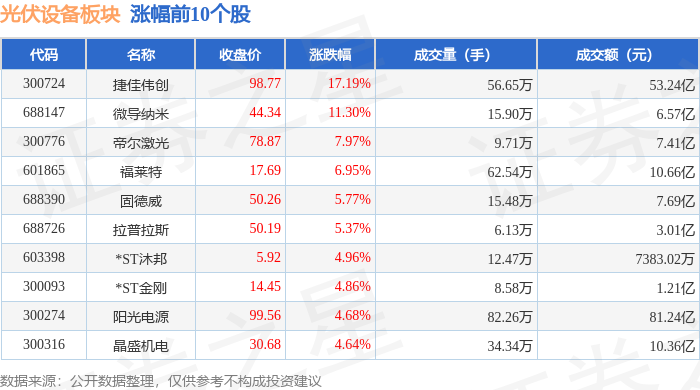
光伏设备板块8月28日涨2.8%,捷佳伟创领涨,主力资金净流出6054.36万元
Zheng Xing Xing Ye Ri Bao· 2025-08-28 08:42
Market Overview - On August 28, the photovoltaic equipment sector rose by 2.8%, with Jiejia Weichuang leading the gains [1] - The Shanghai Composite Index closed at 3843.6, up 1.14%, while the Shenzhen Component Index closed at 12571.37, up 2.25% [1] Stock Performance - Jiejia Weichuang (300724) closed at 98.77, up 17.19% with a trading volume of 566,500 shares and a transaction value of 5.324 billion [1] - Weidao Nano (688147) closed at 44.34, up 11.30% with a trading volume of 159,000 shares and a transaction value of 657 million [1] - Other notable performers include: - Dier Laser (300776) at 78.87, up 7.97% [1] - Fulete (601865) at 17.69, up 6.95% [1] - Goodwe (688390) at 50.26, up 5.77% [1] Fund Flow Analysis - The photovoltaic equipment sector experienced a net outflow of 60.54 million from institutional investors, while retail investors saw a net inflow of 542 million [2] - Key stocks with significant fund flow include: - Sunshine Power (300274) with a net inflow of 18.1 million from institutional investors [3] - Tongwei Co. (600438) with a net inflow of 16.8 million from institutional investors [3] - Fulete (601865) with a net inflow of 13.7 million from institutional investors [3]


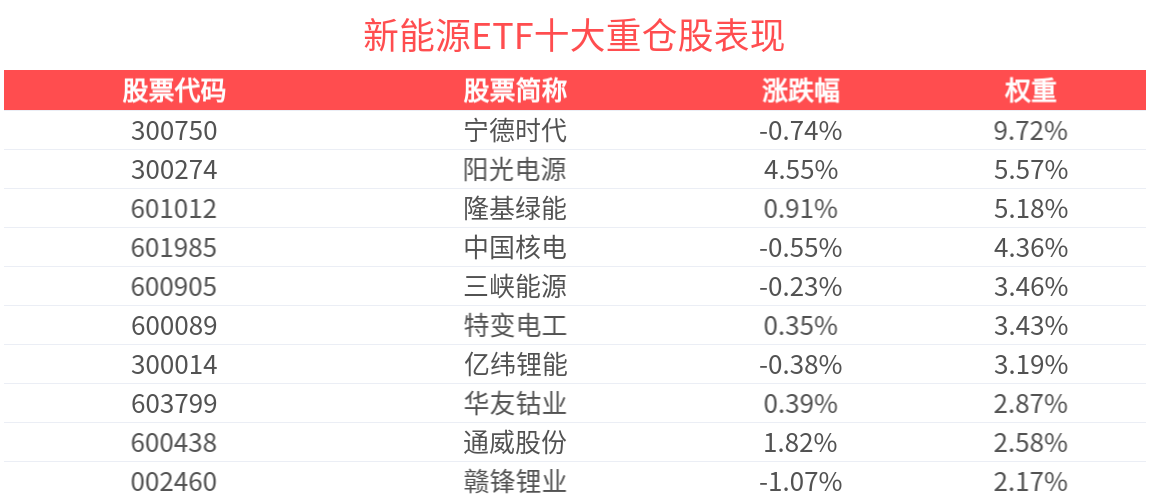
政策刺激下新能源消纳有望迎来边际改善,新能源ETF(159875)红盘蓄势
Sou Hu Cai Jing· 2025-08-28 05:45
Group 1 - The core viewpoint of the articles highlights the positive performance of the new energy sector, with the China Securities New Energy Index rising by 0.70% and significant gains in key stocks such as Jiejia Weichuang and Zhengtai Electric [1][4] - The New Energy ETF (159875) has shown a weekly average trading volume of 65.82 million yuan and a net asset value increase of 8.81% over the past six months, indicating strong investor interest and market activity [1] - The top ten weighted stocks in the China Securities New Energy Index account for 43.41% of the index, with notable companies including Ningde Times and Sunshine Power [4] Group 2 - The National Energy Administration and the National Development and Reform Commission are advancing the construction of the electricity market, aiming for equal market participation for new energy storage and the establishment of a provincial-level electricity spot market by the end of 2025 [3] - The "2025 Energy Work Guidance Opinion" emphasizes the need for a coordinated approach to new energy development and consumption systems, suggesting that policy improvements may lead to marginal enhancements in new energy consumption and pricing [4]



光伏半年报密集出炉,六大主链企业亏损超180亿元,逆变器企业业绩大爆发
Hua Xia Shi Bao· 2025-08-28 05:20
Core Insights - The performance of photovoltaic companies in the first half of 2025 shows significant divergence, with 35 out of 57 listed companies reporting profits while 22 incurred losses [1] - Major factors affecting performance include overcapacity, overall industry losses, policy governance, technological iteration, financial strength, and market demand [1] Group 1: Inverter and Equipment Companies - Inverter companies reported substantial profits, with Sunshine Power leading at a net profit of 77.35 billion yuan, a year-on-year increase of 55.97% [2] - Sunshine Power's revenue from energy storage systems surged by 127.78% to 178.03 billion yuan, with 58.30% of revenue coming from overseas [2] - Other inverter companies like Jinlang Technology and Hewei Electric also reported significant profit increases, with Jinlang's net profit growing by 70.96% to 6.02 billion yuan [2] Group 2: Photovoltaic Equipment Companies - Equipment companies, except for Dier Laser, experienced declines in both revenue and net profit, with Jing Sheng Machinery's revenue dropping by 42.85% to 57.99 billion yuan and net profit down 69.52% [3] - Maiwei's revenue decreased by 13.48% to 42.13 billion yuan, while net profit fell by 14.59% [3] - The decline in performance is attributed to cyclical adjustments in the photovoltaic industry and a slowdown in customer expansion [3] Group 3: Auxiliary Material Companies - Auxiliary material companies faced significant challenges, with Mingguan New Materials reporting a net loss of 0.53 billion yuan, a drop of 713.54% [5] - Other companies like Zhonglai and Foster also reported losses or declines in net profit, indicating a tough market environment [5] - The price of auxiliary materials continues to be under pressure, with significant declines in sales revenue for products like encapsulation films [6] Group 4: Main Chain Companies - Major companies in the photovoltaic supply chain reported substantial losses, with six leading firms collectively losing over 180 billion yuan [8] - Trina Solar experienced the largest loss, with a net loss of 29.18 billion yuan, marking a decline of 654.47% [8] - Some companies, like Hongyuan Green Energy, showed signs of improvement, significantly reducing their losses compared to the previous year [9]
华能新能源、隆基绿能成立清洁能源公司
Zheng Quan Shi Bao Wang· 2025-08-28 05:16
Core Viewpoint - The establishment of Tengchong Zhongtan Clean Energy Co., Ltd. indicates a growing focus on renewable energy solutions in the market, particularly in solar and wind power technologies [1] Company Summary - Tengchong Zhongtan Clean Energy Co., Ltd. has been recently established with Liu Yu as the legal representative [1] - The company's business scope includes solar power generation technology services, wind power generation technology services, and research and development of emerging energy technologies [1] - The company is jointly owned by Huaneng New Energy Co., Ltd. and Xi'an Longi Clean Energy Co., Ltd., a wholly-owned subsidiary of Longi Green Energy [1]
涨超1.0%,光伏ETF基金(516180)连续4天净流入
Xin Lang Cai Jing· 2025-08-28 02:23
Group 1 - The photovoltaic industry is experiencing a steady advancement in reversing internal competition, with a focus on short-term rebounds and long-term investment opportunities due to low valuations [1] - As of August 28, 2025, the CSI Photovoltaic Industry Index (931151) increased by 0.87%, with notable stock performances including Zhengtai Electric (601877) up 9.16% and Meichang Co., Ltd. (300861) up 8.50% [1] - The Photovoltaic ETF (516180) rose by 1.06%, with a recent price of 0.67 yuan, and has accumulated a 1.39% increase over the past week [1] Group 2 - As of July 31, 2025, the top ten weighted stocks in the CSI Photovoltaic Industry Index (931151) include Yangguang Electric (300274) and Longi Green Energy (601012), collectively accounting for 56.16% of the index [2]