Longi(601012)

Search documents
"反内卷"持续加码 光伏行业半年报隐现回暖信号
Zheng Quan Ri Bao· 2025-09-01 00:57
Core Insights - The photovoltaic industry is showing signs of recovery despite many companies still facing losses, with a notable performance improvement among leading firms with advantages in technology, channels, and funding [1][2] Group 1: Industry Performance - The overall performance of the photovoltaic industry in the first half of the year has been mixed, with some leading companies beginning to recover while second and third-tier companies continue to face operational pressures [1] - Longi Green Energy reported a net loss of 2.569 billion yuan in the first half of the year, a reduction of over 50% compared to a loss of 5.231 billion yuan in the same period last year [2] - Shanghai Aiko Solar Energy Co., Ltd. also showed improvement, with a net loss of 238 million yuan, down 86.38% from a loss of 1.745 billion yuan year-on-year, and achieved a profit of 63 million yuan in the second quarter [2][3] Group 2: Technological Advancements - The technological advancements in the industry are primarily focused on BC technology, HJT technology, perovskite technology, and tandem technology, with BC technology seeing accelerated mass production and market penetration [2][3] - Longi Green Energy's BC cell efficiency reached 27.81% and BC module efficiency surpassed 26%, demonstrating strong technological iteration capabilities [5] Group 3: Market Dynamics - The "anti-involution" trend in the photovoltaic industry is gaining momentum, with policies aimed at curbing low-price competition and promoting quality improvements [4] - Recent government initiatives include the central financial committee's call for regulated competition and the Ministry of Industry and Information Technology's emphasis on enhancing product quality [4] - The industry is expected to shift towards comprehensive competition based on technology, cost, and quality, as indicated by recent policy signals [4] Group 4: Cost Management - GCL-Poly Energy Holdings reported an average cash cost of granular silicon at 26.22 yuan per kilogram, showing a decreasing trend from 37.84 yuan in Q1 2024 to 25.31 yuan in Q2 2025 [5] - The average cost of electricity generated from wind and photovoltaic projects in China has decreased by 60% and 80% respectively over the past decade, contributing significantly to global green transition efforts [5]


美方重建加沙计划被披露:欲控制该地区至少10年;巴基斯坦与亚美尼亚建交;多地公布七夕结婚登记数据
第一财经· 2025-09-01 00:46
Group 1 - Russian President Putin arrived in Tianjin to attend the 2025 SCO Summit, accompanied by a large delegation including three deputy prime ministers and numerous ministers [2] - The wedding registration data for the Qixi Festival shows a peak in registrations, with Shanghai reaching a ten-year high of 2,310 couples [3] - The manufacturing PMI rose to 49.4% in August, indicating a slight improvement in economic conditions [7] Group 2 - The U.S. is considering a plan to control the Gaza Strip for at least ten years, aiming to transform it into a tourism and manufacturing hub [4][5] - Pakistan and Armenia have established diplomatic relations, with discussions on cooperation in various sectors [6] - The Chinese film box office surpassed 40 billion yuan in 2025, with domestic box office reaching 39.23 billion yuan and over 909 million admissions [11] Group 3 - The China Automobile Dealers Association reported an inventory warning index of 57.0% for August, indicating a decline in the automotive circulation industry's prosperity [10] - The personal account mutual aid under employee medical insurance reached 231 million instances with a total amount of 30.457 billion yuan from January to July 2025 [8] - A total of 29 companies will have their restricted shares released this week, amounting to 2.013 billion shares with a total market value of approximately 18.877 billion yuan [27] Group 4 - The new group insurance products are being developed in Shanghai, focusing on expanding coverage for employees' family members and exploring risk-sharing mechanisms [32] - The upcoming IPO of Aifenda is set for September 1, with an issue price of 27.69 yuan per share [30][31]



隆基绿能、晶澳科技、天合光能、迈为股份 2025 年上半年业绩_盈利回顾
2025-08-31 16:21
Summary of Conference Call Notes on Solar Industry in China Industry Overview - The solar industry in China is experiencing mixed results in 1H25, with major companies like LONGi, JA Solar, and Trina Solar reporting varying performance metrics. [1][2][3][4] - There is optimism regarding anti-involution policies, which are expected to support price increases above total costs in the second half of 2025. [1][4] Company-Specific Insights LONGi Green Energy - Reported a net loss of -RMB2.6 billion in 1H25, consistent with prior profit warnings. [2] - Gross margin improved to 1.6% in 2Q25 from -4.2% in 1Q25. [2] - Module shipment volume increased to 22.6GW in 2Q25, a 23% YoY increase, compared to 16.9GW in 1Q25. [2] - Capital expenditures rose to RMB4.4 billion in 1H25, up from RMB3.4 billion in 1H24, as the company expands its Back-Contact (BC) capacity. [2] - Asset impairments totaled RMB1.2 billion, significantly lower than RMB5.8 billion in 1H24. [2] - Maintains a strong balance sheet with RMB49.3 billion in cash and a net debt to equity ratio of -18.6%. [2] JA Solar - Reported a net loss of -RMB2.6 billion in 1H25, at the lower end of its profit warning range. [3] - Cell and module shipments totaled 33.79GW in 1H25, a 17% YoY decline. [3] - Unit revenue improved by 6% QoQ, likely due to increased installations. [3] - Announced a share repurchase plan of RMB200-400 million, representing approximately 0.5-1% of its current market cap. [3] Trina Solar - Experienced a wider net loss of -RMB1.6 billion in 2Q25, compared to -RMB1.3 billion in 1Q25. [4] - Solar module segment reported a net loss of -RMB3.3 billion on 32GW module shipments, equating to a net loss of -RMB10c/W. [4] - Management is optimistic about US module demand, particularly in the <1.5MW distributed segment, and anticipates price hikes in 2H25. [4] Maxwell Technologies - Reported a 15% YoY decline in net profit to RMB394 million in 1H25, with 2Q earnings rising by 15% YoY due to reduced operating costs. [8] - Revenue fell 14% YoY, primarily due to a 31% decline in solar equipment sales. [8] - R&D expenses increased by 10% YoY to RMB463 million in 1H25. [8] Key Market Trends - Companies are adjusting their production targets in response to market conditions, with CSI Solar reducing its 3Q25 module shipment target to 5-5.3GW from 8GW. [1] - There is an expectation of further consolidation in the industry, with smaller companies likely to exit the market by 2026. [1] - The overall sentiment remains cautiously optimistic regarding US demand and potential price increases due to tariffs. [1][4] Financial Metrics Overview - LONGi's gross profit margin improved to 1.6% in 2Q25, while JA Solar's gross profit margin was -1.0%. [10] - Trina Solar's gross profit margin was reported at 4.5% in 2Q25. [10] - The net income margins for LONGi, JA Solar, and Trina Solar were -5.9%, -7.1%, and -9.6% respectively in 2Q25. [11] Conclusion - The solar industry in China is navigating through a challenging landscape with mixed financial results among major players. [1][2][3][4] - The focus on anti-involution policies and potential price increases in the latter half of 2025 may provide a pathway for recovery and growth in the sector. [1][4]


陕西3家企业跻身2025中国民营企业500强
Shan Xi Ri Bao· 2025-08-30 00:56
Group 1 - The "2025 China Top 500 Private Enterprises" list was released, with three companies from Shaanxi making the list: Longi Green Energy Technology Co., Ltd. at rank 128, Shaanxi Taifeng Shenghe Holding Group Co., Ltd. at rank 133, and Rongmin Holding Group Co., Ltd. at rank 347 [1] - The list was formed after a survey of 6,379 private enterprises with annual revenues of 1 billion yuan or more, highlighting characteristics such as steady growth in scale, profit recovery, manufacturing leadership, accelerated technological innovation, and upgraded governance [1] - The competitiveness of leading private enterprises continues to enhance globally, achieving double-digit growth in overseas revenue despite pressures from de-globalization [1] Group 2 - Shaanxi has prioritized the development of private enterprises, with the Provincial Development and Reform Commission formulating "Seven Measures to Promote the Development of the Private Economy" [2] - To address the issues of weak competitiveness and low local matching rates, support will be provided for private enterprises to participate in key industrial chain extensions and enhancements, aiming for at least 30% of chain leader enterprises and 60% of key supporting enterprises to be private [2] - The goal is to cultivate 1,000 innovative small and medium-sized enterprises by 2025, add 600 specialized and innovative enterprises, nurture 60 manufacturing champions, and increase the number of registered private enterprises by approximately 1,500 [2]
产量增加叠加需求下滑,光伏涨价遭遇拦路虎
经济观察报· 2025-08-29 12:01
Core Viewpoint - The "anti-involution" policy is expected to lead to price increases in upstream silicon materials, which could help the photovoltaic industry escape the low-price competition dilemma. However, due to weak terminal demand, the price transmission effect has been poor, resulting in new issues such as upstream inventory accumulation and increased costs in the midstream [1][17]. Upstream Price and Inventory Issues - The photovoltaic industry is currently facing challenges such as inventory accumulation and declining terminal demand. The China Nonferrous Metals Industry Association's silicon division reported that while there is still bullish sentiment, the supply-demand fundamentals have not improved, with September's polysilicon production expected to be around 125,000 to 130,000 tons, continuing to face inventory risks [2][4]. - In the first half of the year, domestic polysilicon production was approximately 596,000 tons, a significant decrease of 44.1% year-on-year. However, due to a sharp price increase in July, the market has reversed from a "reduction, quality improvement, and destocking" process to a situation of "price increase and inventory accumulation" [3][4]. - Despite the inventory accumulation, polysilicon prices have surged, with the average price of N-type polysilicon rising from 34,400 yuan/ton at the end of June to 47,900 yuan/ton by August 27, marking a short-term increase of about 38% [4][5]. Midstream Price Transmission Challenges - Following the significant price increase in upstream polysilicon, there have been reports of "shortages and price increases" in photovoltaic modules. However, major companies indicate that there is sufficient supply of photovoltaic components, and any shortages are likely isolated incidents. The price increases in modules have not been substantial due to weak downstream demand [8][9]. - The recent price increases in high-efficiency components are attributed to structural and phase adjustments in the market, driven by technological iterations and differentiated demand in the downstream market [9][10]. Declining Terminal Demand - The recent data indicates a significant decline in terminal demand, with July's newly installed solar power capacity at only 11.04 million kilowatts, a year-on-year decrease of 47.55% [12][13]. - The decline in demand is attributed to a combination of policy changes, market factors, and the industry's transition from rapid growth to high-quality development. The "136 document" has led to a cautious approach among investors, delaying new project approvals and installations [13][14][15]. Potential Solutions for Industry Challenges - To address the inventory accumulation in polysilicon, industry self-discipline in production reduction is necessary. The "anti-involution" policy may help mitigate low-price competition, but the industry must focus on self-regulation and collaboration to avoid blind expansion and price wars [17][19]. - Key strategies for breaking the industry deadlock include enhancing self-discipline and collaboration, driving technological innovation, extending value chains into storage and energy operations, and strengthening global presence to reduce reliance on single markets [19][20].

产量增加叠加需求下滑,光伏涨价遭遇拦路虎
Jing Ji Guan Cha Bao· 2025-08-29 09:42
Core Viewpoint - The photovoltaic industry is currently facing challenges due to upstream inventory accumulation and a decline in terminal demand, leading to a complex situation of rising prices amidst high inventory levels [1][2][3]. Upstream Price and Inventory Issues - The recent surge in multi-crystalline silicon prices has occurred despite an increase in inventory, with production in July rising to approximately 107,800 tons, a month-on-month increase of 5.7% [2]. - The expected production for September is projected to be between 125,000 to 130,000 tons, exceeding the monthly demand by about 16,000 tons, indicating a growing oversupply situation [2][3]. - The average price of N-type raw materials increased from 34,400 yuan per ton at the end of June to 47,900 yuan per ton by August 27, marking a short-term increase of approximately 38% [2]. Midstream Price Transmission Challenges - Despite the price increases in upstream multi-crystalline silicon, midstream photovoltaic module manufacturers report that supply remains sufficient, and any price increases are limited due to weak downstream demand [5][6]. - The recent price hikes in modules are not uniformly successful, as the demand side does not support significant price increases, leading to only moderate adjustments [5][6]. Downstream Demand Decline - The newly installed solar power generation capacity in July was only 11.04 million kilowatts, a significant year-on-year decrease of 47.55% and a month-on-month decrease of 23.12% [8][9]. - This decline in demand is attributed to a combination of policy changes, market conditions, and the industry's transition from rapid growth to a focus on high-quality development [9][10]. Industry Outlook and Solutions - The "anti-involution" policy is expected to help the industry escape low-price competition, but the current weak terminal demand hampers effective price transmission across the supply chain [11][12]. - To address the inventory issues, companies are encouraged to self-regulate production and avoid blind expansion and price wars [12]. - Key strategies for breaking the industry deadlock include industry self-discipline, technological innovation, and expanding into new value chains such as energy storage and digital services [12].
光伏设备板块8月29日涨1.26%,永臻股份领涨,主力资金净流入10.45亿元
Zheng Xing Xing Ye Ri Bao· 2025-08-29 08:48
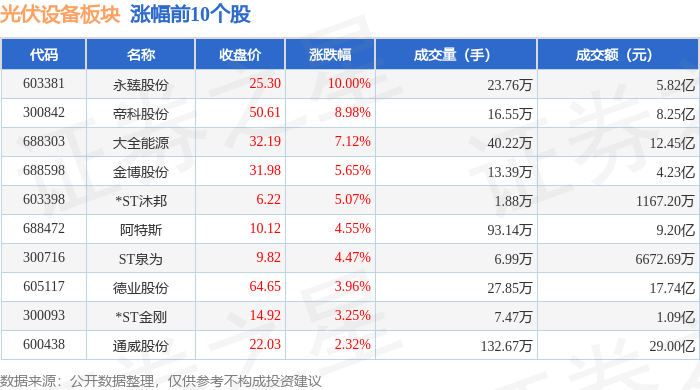
Core Insights - The photovoltaic equipment sector experienced a rise of 1.26% on August 29, with Yongzhen Co. leading the gains [1] - The Shanghai Composite Index closed at 3857.93, up 0.37%, while the Shenzhen Component Index closed at 12696.15, up 0.99% [1] Stock Performance - Yongzhen Co. (603381) closed at 25.30, with a gain of 10.00% and a trading volume of 237,600 shares, amounting to a transaction value of 582 million [1] - Jinke Co. (300842) saw a closing price of 50.61, up 8.98%, with a trading volume of 165,500 shares and a transaction value of 825 million [1] - Daqian Energy (688303) closed at 32.19, increasing by 7.12%, with a trading volume of 402,200 shares and a transaction value of 1.245 billion [1] - Other notable performers include Jinbo Co. (688598) with a 5.65% increase and a closing price of 31.98, and Artes (688472) with a 4.55% increase and a closing price of 10.12 [1] Capital Flow - The photovoltaic equipment sector saw a net inflow of 1.045 billion in main funds, while retail investors experienced a net outflow of 484 million [2][3] - Major stocks like Tongwei Co. (600438) had a net inflow of 269 million, while Longi Green Energy (601012) saw a net inflow of 252 million [3] - Daqian Energy (688303) recorded a net inflow of 218 million, indicating strong institutional interest [3]



请签收!一封来自“光储盛宴”的请柬
Chang Jiang Shang Bao· 2025-08-29 08:21
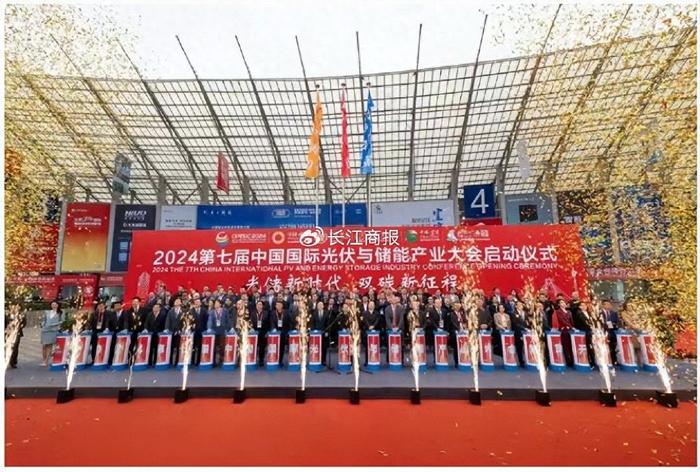
Core Insights - The 8th China International Photovoltaic and Energy Storage Industry Conference (PESIC 2025) will be held in Chengdu from November 17 to 20, 2025, focusing on the integration of photovoltaic and energy storage industries [1][3] - The conference has become one of the top three global events in the photovoltaic and energy storage sectors, serving as a strategic platform for companies to tap into a trillion-level market [1][3] Event Scale and Participation - The 2024 conference attracted over 34,000 attendees and facilitated more than 60 cooperation projects with a total signing amount exceeding 30 billion yuan, covering key areas such as high-efficiency batteries and smart energy [3][5] - The upcoming event is expected to set a new record with over 60,000 square meters of exhibition space and more than 30 concurrent activities, anticipating participation from over 5,000 exhibiting companies and over 50,000 professional visitors [3][5] International Collaboration - The conference will invite representatives from over 10 countries, including Germany, Spain, and Brazil, as well as officials from international organizations and various Chinese government departments [5][10] - Nearly 200 international buyers from countries such as the USA, Russia, and Mexico will attend, providing opportunities for long-term cooperation [10] Industry Trends and Innovations - The conference will showcase advancements in the entire renewable energy value chain, including photovoltaic, energy storage, and electric vehicle sectors, with participation from leading companies like JinkoSolar, Trina Solar, and BYD [9][10] - The event will also feature the unveiling of the "2025 China and Global Photovoltaic and Energy Storage Industry Development White Paper," analyzing industry trends and providing insights for business development [16][18] Regional Development and Policy Support - Sichuan province is positioning itself as a global photovoltaic industry hub, with significant investments from top global companies and a comprehensive industry chain established [23][24] - The provincial government has introduced measures to support the photovoltaic manufacturing sector, aiming to reduce production costs and enhance competitiveness [24][26] Future Outlook - By 2027, Sichuan aims to cultivate 30 influential industry-leading enterprises and establish five trillion-level emerging industry clusters, with a focus on new energy storage technologies [28] - The province is actively promoting various energy storage technologies, including lithium, sodium, and all-vanadium flow batteries, to support the construction of a new power system [28]



“反内卷”纠偏初显成效!光伏行业扭困现曙光
证券时报· 2025-08-29 08:14
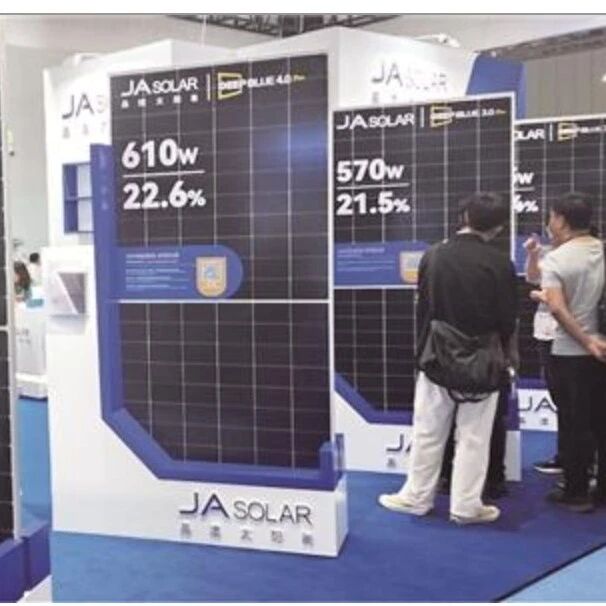
Core Viewpoint - The photovoltaic industry is facing significant losses across the supply chain, with major manufacturers reporting substantial deficits in their financial results for the first half of the year [1][4][6]. Financial Performance - The top five manufacturers in terms of module shipments reported a combined loss of approximately 160 billion yuan in the first half of the year [1][6]. - JinkoSolar reported a revenue of 31.83 billion yuan, a year-on-year decrease of 32.63%, with a net loss of 2.91 billion yuan, a year-on-year increase in losses of 342.4% [4]. - Longi Green Energy's revenue was 32.81 billion yuan, down 14.83% year-on-year, with a net loss of 2.57 billion yuan, a reduction in losses of 26.61% compared to the previous year [4]. - Trina Solar and JA Solar both reported significant revenue declines and net losses, with Trina Solar's revenue at 31.06 billion yuan (down 27.72%) and a net loss of 2.92 billion yuan (up 654.47%) [4]. - Tongwei Co. achieved a revenue of 40.51 billion yuan, down 7.51%, with a net loss of 4.96 billion yuan, an increase in losses of 58.35% [5]. Cash Flow Health - Cash flow has emerged as a critical indicator of survival for photovoltaic companies, with several firms reporting improvements in cash flow despite overall losses [8][9]. - TCL Zhonghuan reported a net cash flow from operating activities of 523 million yuan, a year-on-year increase of 308.4% [9]. - Trina Solar's net cash flow was 1.843 billion yuan, with a second-quarter figure of 2.679 billion yuan [9]. - However, companies like Daqo New Energy reported negative cash flow, with a net cash flow of -1.608 billion yuan [9]. Industry Pricing and Competition - The photovoltaic industry is undergoing a "reverse involution" movement, with a reduction in low-price sales and fierce competition [1][10]. - Regulatory bodies have initiated measures to combat low-price, disorderly competition, emphasizing the need for quality improvement and the orderly exit of outdated production capacity [11]. - Recent trends indicate a recovery in prices across various segments of the supply chain, with manufacturers expressing hope for prices to stabilize above cost levels [11][12].
电力设备及新能源行业双周报(2025、8、15-2025、8、28):建议关注新型储能环节-20250829
Dongguan Securities· 2025-08-29 08:10
Investment Rating - The report maintains an "Overweight" rating for the electric equipment and new energy industry [2] Core Viewpoints - The report suggests focusing on the new energy storage segment, highlighting the need for system-friendly new energy power plants to address the instability of renewable energy output [2][39] - The report emphasizes the importance of enhancing the predictive accuracy of wind and solar power generation to improve grid integration [39] - It recommends paying attention to leading inverter companies that benefit from the development of new energy storage technologies [39] Market Review - As of August 28, 2025, the electric equipment industry has increased by 6.08% over the past two weeks, underperforming the CSI 300 index by 0.88 percentage points, ranking 9th among 31 industries [11] - The electric equipment industry has risen by 11.88% this month, outperforming the CSI 300 index by 2.35 percentage points, ranking 7th [11] - Year-to-date, the electric equipment sector has increased by 15.01%, outperforming the CSI 300 index by 1.56 percentage points, ranking 16th [11] Valuation and Industry Data - As of August 28, 2025, the PE (TTM) for the electric equipment sector is 28.32 times, with sub-sectors showing varied valuations: - Electric motor II: 57.18 times - Other power equipment II: 54.33 times - Photovoltaic equipment: 21.08 times - Wind power equipment: 35.53 times - Battery: 27.20 times - Grid equipment: 26.13 times [22][25] Industry News - The report discusses the Chinese government's initiatives to promote green and low-carbon urban development, emphasizing energy efficiency and the adoption of advanced technologies [35] - It highlights the National Energy Administration's focus on enhancing the adaptability of the power system to renewable energy, including the construction of a new power system and the promotion of energy storage solutions [36] Company Announcements - The report includes recent financial performance announcements from various companies, such as: - GreenMe achieved a revenue of 17.56 billion yuan in the first half of 2025, a year-on-year increase of 1.28% [41] - XianDai Intelligent reported a revenue of 6.61 billion yuan, up 14.92% year-on-year [41] - Euro Continental's revenue reached 2.12 billion yuan, reflecting a growth of 32.59% [41]