
Longi(601012)

Search documents
周观点0208:太空光伏催化不断,CSP大厂资本开支超预期-20260208
Changjiang Securities· 2026-02-08 14:21
Investment Rating - The report maintains a "Positive" investment rating for the industry [3] Core Insights - The space photovoltaic industry is progressing, with significant capital expenditures from major CSP manufacturers exceeding expectations [1] - The demand for energy storage is driven by ongoing electricity shortages in the U.S., highlighting the cost-effectiveness of leading companies [14] - The report emphasizes the importance of new directions such as space photovoltaics, AIDC, and robotics, which are catalyzing investment opportunities [14] Summary by Sections Photovoltaics - The space photovoltaic sector is gaining traction, with SpaceX's application for 1 million satellites accepted by the FCC, indicating a robust future for space-based data centers [20] - The China Photovoltaic Industry Association released cost analysis, indicating that the average full cost of mainstream photovoltaic products is expected to stabilize, providing support for price recovery [21] - The report highlights the potential for significant growth in global photovoltaic installations, with annual additions projected between 725-870 GW during the 14th Five-Year Plan [22] Energy Storage - Sunshine Power announced plans to establish a production base in Poland, aiming for 20 GW of inverter capacity and 12.5 GWh of energy storage systems [39] - The report notes a 45% year-on-year increase in EU battery storage capacity, with large-scale storage systems becoming the main growth driver [39] - January saw a significant increase in independent storage projects, with a total of 12.3 GW/36 GWh of bids, despite a year-on-year decline due to procurement timing [40] Lithium Batteries - The demand for lithium batteries continues to strengthen, with all segments showing a willingness to maintain prices, indicating ongoing profitability improvements [14] - The report recommends focusing on battery segments, particularly companies like CATL and EVE Energy, which are expected to perform well in the medium term [14] Wind Power - The report emphasizes the start of a new wind power cycle during the 14th Five-Year Plan, with significant opportunities in commercial aerospace and offshore wind projects [14] - Companies involved in wind turbine manufacturing and components are highlighted as key investment opportunities [14] Power Equipment - The domestic power grid's investment plan is projected at 5 trillion yuan, with significant improvements in pricing and demand driven by electricity shortages in the U.S. [14] - The report suggests focusing on opportunities in AI for power management and virtual power plants [14] New Directions - The report highlights the importance of developments in humanoid robotics and AIDC technology, with specific companies recommended for investment based on their potential in these sectors [14]






钙钛矿:迎来GW级量产
GOLDEN SUN SECURITIES· 2026-02-06 13:26
Investment Rating - The report maintains a rating of "Increase" for the industry [4] Core Insights - Perovskite solar cells are entering the era of GW-level mass production, with leading companies like JinkoSolar and LONGi Green Energy accelerating capacity release [2][35] - The efficiency of perovskite cells is rapidly improving, with laboratory efficiencies reaching 27.3% for single-junction cells and 35.0% for perovskite-silicon tandem cells, significantly surpassing the maximum efficiency of silicon cells at 27.9% [15][19] - The cost competitiveness of perovskite cells is expected to improve, with unit production costs projected to drop to 1.0 RMB/W by 2026, potentially surpassing silicon cells [2][35] Summary by Sections Section 1: Perovskite as the Next Generation Photovoltaic Solution - Perovskite solar cells utilize a hybrid organic-inorganic metal halide semiconductor as the light-absorbing material, offering advantages such as high efficiency, low cost, and lightweight [8][11] Section 2: Efficiency and Stability Breakthroughs - The report highlights significant advancements in efficiency and stability, with perovskite cells achieving rapid efficiency improvements compared to silicon cells [15][18] - The industry is overcoming stability challenges through material modifications and process optimizations, with some products achieving IEC commercial standard certification [25][26] Section 3: GW-Level Production Era - The first GW-level production line for perovskite solar cells has been launched, marking the beginning of large-scale production [35] - By 2027, global production capacity is expected to exceed 5GW, with a complete supply chain being established [2][35] Section 4: Investment Recommendations - The report suggests focusing on leading companies in the perovskite supply chain, particularly those with clear capacity deployment and advancements in tandem technology, such as LONGi Green Energy and Trina Solar [3] - Equipment manufacturers with high domestic production rates and sufficient orders, like JinkoSolar and Mibet, are also recommended for investment [3]




——电新行业2025年年报业绩前瞻:锂电储能周期拐点明显,光伏盈利探底
Shenwan Hongyuan Securities· 2026-02-06 12:01
Investment Rating - The report rates the industry as "Overweight" indicating a positive outlook for investment in the sector [1]. Core Insights - The lithium battery sector is expected to see a significant increase in both volume and price in Q4 2025, with production levels rising across various components, including a 15% increase in ternary cathodes and a 24% increase in lithium batteries [1]. - The photovoltaic industry is experiencing a reduction in losses, but Q4 is anticipated to be under pressure due to rising costs in silver paste and silicon materials, leading to expected losses for major companies [1]. - The wind power sector is witnessing a substantial recovery in profits driven by demand, with a 50.4% year-on-year increase in installed capacity in 2025, although Q4 performance may fall short of expectations due to reduced shipment volumes [1]. - The energy storage market is projected to maintain high growth rates, with independent storage becoming a key growth driver, supported by increasing demand in emerging markets and improved profitability models [1]. Summary by Sections Lithium Batteries - Q4 2025 is expected to see a significant increase in production across various lithium battery components, with production figures reaching 250,000 tons for ternary cathodes and 600 GWh for lithium batteries, reflecting a robust demand [1]. - Price increases in key materials such as lithium hexafluorophosphate and lithium iron phosphate are anticipated, contributing to stable profitability in the battery segment [1]. Photovoltaics - The industry faced substantial losses in the first three quarters of 2025, but there is a marginal improvement. Q4 is expected to be challenging due to rising costs and asset impairment [1]. - The cash flow in the silicon material segment is showing signs of recovery, with financing inflows increasing, although the overall industry remains under pressure [1]. Wind Power - The installed capacity for wind power in China reached 119.33 GW in 2025, marking a 50.4% increase year-on-year, leading to a significant recovery in profits for the sector [1]. - Despite a strong demand outlook, Q4 performance may be impacted by reduced shipment volumes and impairment factors [1]. Energy Storage - The energy storage sector is expected to continue its rapid growth, with independent storage becoming a core growth driver through capacity leasing and market transactions [1]. - The outlook for 2026 is positive, with anticipated demand growth in overseas markets and improved utilization rates in domestic large-scale storage [1]. Investment Recommendations - The report suggests focusing on four main investment lines: 1. Cyclical growth companies such as CATL and EVE Energy 2. Technological innovation firms like Rongbai Technology and Dingsheng Technology 3. Supply-side optimization companies including Tongwei and LONGi Green Energy 4. Companies expanding into AIDC as a secondary business [1].


电新行业2025年年报业绩前瞻:锂电储能周期拐点明显,光伏盈利探底
Shenwan Hongyuan Securities· 2026-02-06 08:51
Investment Rating - The report maintains an "Overweight" rating for the new energy sector, indicating a positive outlook for the industry compared to the overall market performance [2]. Core Insights - The lithium battery sector is expected to see a significant increase in both volume and price in Q4 2025, with production across various segments showing substantial year-on-year growth [2]. - The photovoltaic (PV) industry is experiencing a reduction in losses, but Q4 is anticipated to face renewed pressure due to rising costs in silver paste and silicon materials [2]. - The wind power sector is projected to recover significantly, driven by a 50.4% year-on-year increase in installed capacity, with expectations of improved profitability in 2025 [2]. - The energy storage market is expected to maintain high growth rates, with independent storage becoming a key growth driver [2]. - The report suggests focusing on four main investment lines: cyclical growth, technological innovation, supply-side optimization, and expanding into AIDC as a secondary business [2]. Summary by Sections Lithium Battery - Q4 2025 is projected to see a significant increase in production across various lithium battery components, with production volumes for ternary cathodes, lithium iron phosphate cathodes, anodes, separators, electrolytes, and batteries showing increases of 15% to 26% quarter-on-quarter [2]. - Prices for key materials such as lithium hexafluorophosphate and lithium iron phosphate are expected to rise, contributing to stable profitability in the battery segment [2]. Photovoltaic - The PV industry reported significant losses in the first three quarters of 2025, but with marginal improvements. Q4 is expected to be challenging due to cost increases and asset impairment provisions [2]. - The cash flow in the silicon material segment is beginning to recover, and financing inflows are increasing, indicating structural improvements [2]. Wind Power - The installed capacity of wind power in China is expected to reach 119.33 GW in 2025, marking a 50.4% increase year-on-year, leading to a substantial recovery in net profits for the sector [2]. - The report anticipates that the profitability of wind turbine manufacturing will improve significantly, especially with the clearing of low-price orders from 2025 [2]. Energy Storage - The energy storage sector is expected to continue its rapid growth, with independent storage becoming a core growth driver through capacity leasing and electricity market transactions [2]. - The report forecasts a strong demand for large-scale and commercial energy storage in 2026, driven by emerging markets and improved utilization rates in China [2].

深市规模最大的光伏ETF(159857)标的指数涨超2%,机构:白银价格高位回落有助于缓解电池片环节的成本压力
Mei Ri Jing Ji Xin Wen· 2026-02-06 07:08
Group 1 - The photovoltaic sector showed strong performance with the photovoltaic ETF (159857) rising over 2% during trading, with a transaction volume of 268 million yuan [1] - The ETF has seen a net inflow of 260 million yuan over the last ten trading days, with a current fund size of 2.322 billion yuan, making it the largest in its category in the Shenzhen market [1] - The ETF closely tracks the photovoltaic industry index, with major allocations in photovoltaic equipment (61.53%), grid equipment (13.3%), and electricity (8.57%) [1] Group 2 - Recent discussions by the Ministry of Industry and Information Technology emphasized guiding the photovoltaic industry towards healthy competition and avoiding "involution" [1] - The Ministry of Finance announced that it will phase out the export tax rebate for photovoltaic products starting April 1, 2026 [1] - The space photovoltaic concept is gaining attention, with Elon Musk's space energy plan bringing new momentum to the industry [1] Group 3 - High silver prices are pushing the photovoltaic metallization sector towards a technological revolution, with copper alternatives like silver-coated copper and electroplated copper becoming key cost-reduction strategies [2] - Successful large-scale application of these alternatives could significantly enhance the performance of related materials and equipment companies [2]



事关“太空光伏” 天合光能、协鑫集成回应
2 1 Shi Ji Jing Ji Bao Dao· 2026-02-05 15:41
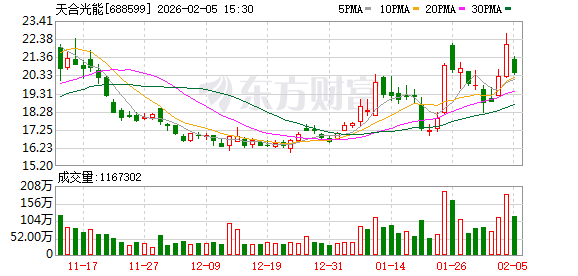
Core Viewpoint - The recent visit of SpaceX to several Chinese photovoltaic companies led to a surge in the space photovoltaic concept stocks on February 4, but the momentum could not be sustained, resulting in a significant decline in the space photovoltaic index on February 5 [2][3]. Group 1: Market Performance - On February 5, the space photovoltaic index (8841929) dropped by 4.86%, closing at 3837.43, with notable declines in stocks such as JunDa Co., JinCheng Co., and Shuangliang Energy, which hit the daily limit down [2][3]. - Other companies like GaoCe Co., JieJia WeiChuang, MaiWei Co., JingSheng JiDian, and HaiYou New Materials saw declines exceeding 9%, while Trina Solar fell over 7% and JinkoSolar dropped over 6% [2][4]. Group 2: Company Announcements - Trina Solar announced that it has not engaged in any cooperation with SpaceX and has no related orders in the "space photovoltaic" sector, clarifying that its main products are focused on ground photovoltaic applications [5][6]. - GCL-Poly Energy stated that it has not received any orders in the "space photovoltaic" field and emphasized that the technology is still in the exploratory phase, with uncertain commercial prospects [8]. - JinkoSolar confirmed it has not collaborated with SpaceX and highlighted that the "space photovoltaic" concept remains in the early exploration stage [10]. - Other companies like Guosheng Technology, Shuangliang Energy, and JingSheng JiDian also reported no involvement in "space photovoltaic" business, reiterating the uncertainty surrounding the commercialization of this technology [11][12][13]. Group 3: Financial Forecasts - Trina Solar projected a net loss of between 6.5 billion to 7.5 billion yuan for the year 2025 [7]. - GCL-Poly Energy expects a net loss of between 890 million to 1.29 billion yuan for the same year [8].




硅业分会:单晶硅需求疲软成交清淡 硅片价格承压下行
智通财经网· 2026-02-05 13:14
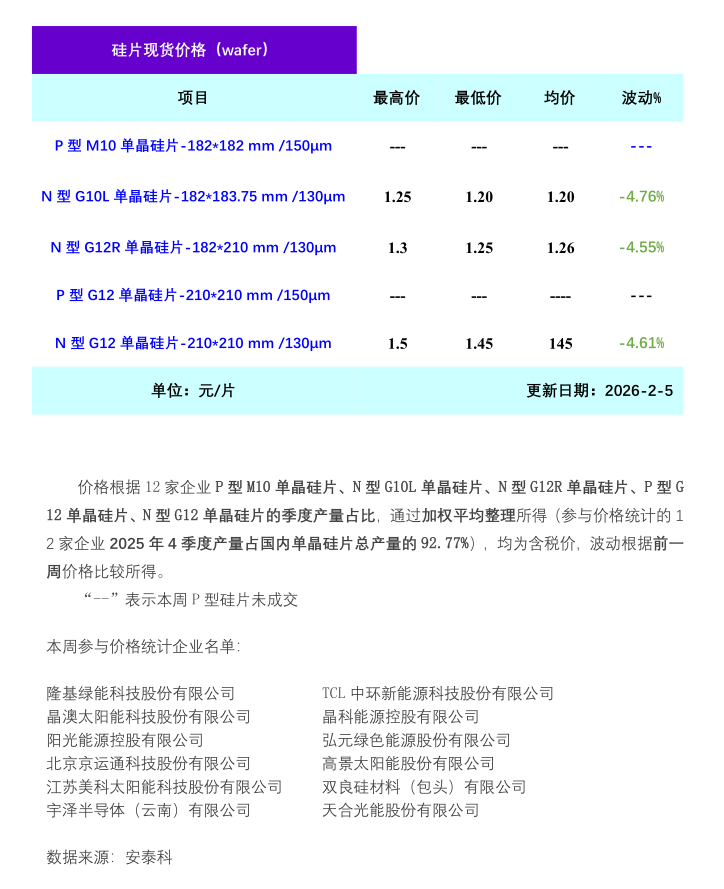
Core Insights - The silicon wafer prices are under pressure, with significant declines observed in various types of wafers, indicating a weak market demand [1][2] - The overall operating rates in the industry have slightly decreased, reflecting reduced production levels among major companies [1][2] Price Trends - N-type G10L monocrystalline silicon wafers (182*183.75mm/130μm) have an average transaction price of 1.20 yuan per piece, down 4.76% week-on-week [1][3] - N-type G12R monocrystalline silicon wafers (182*210mm/130μm) have an average price of 1.26 yuan per piece, down 4.55% week-on-week [1][3] - N-type G12 monocrystalline silicon wafers (210*210mm/130μm) have an average price of 1.45 yuan per piece, down 4.61% week-on-week [1][3] Market Conditions - The downstream demand remains weak, leading to a significant reduction in silicon wafer procurement [1][2] - The overall industry operating rate has been slightly adjusted, with major companies operating at rates of 50% and 46%, while integrated companies maintain rates between 50%-68% [1][2] Future Outlook - Short-term demand for silicon wafers is expected to remain weak, with a projected monthly production decrease of about 5% due to reduced battery cell production [2] - Post-holiday, as rigid orders from downstream gradually release, the supply-demand relationship for silicon wafers may gradually improve, potentially providing some market support [2]


主力个股资金流出前20:紫金矿业流出22.75亿元、新易盛流出18.16亿元
Jin Rong Jie· 2026-02-05 07:43
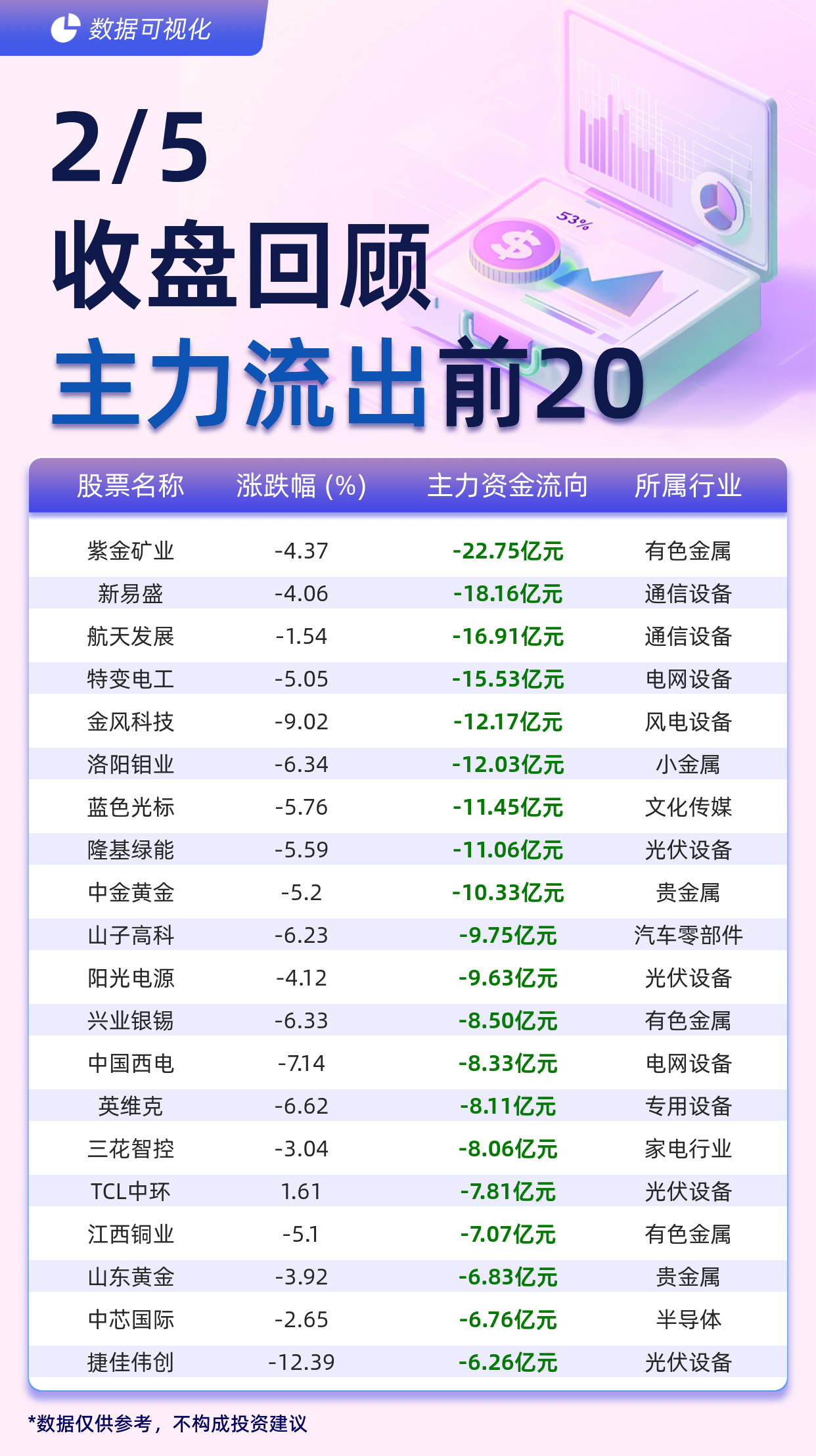
Core Viewpoint - The data indicates significant outflows of capital from various stocks, with notable losses in both percentage and monetary terms across multiple sectors, particularly in metals, communication equipment, and renewable energy [1][2][3] Group 1: Stock Performance and Capital Outflow - Zijin Mining experienced a capital outflow of 2.275 billion, with a decline of 4.37% [2] - Xinyi Technology saw an outflow of 1.816 billion, with a decrease of 4.06% [2] - Aerospace Development had a capital outflow of 1.691 billion, reflecting a drop of 1.54% [2] - TBEA reported an outflow of 1.553 billion, with a decline of 5.05% [2] - Goldwind Technology faced a capital outflow of 1.217 billion, down by 9.02% [2] - Luoyang Molybdenum experienced an outflow of 1.203 billion, with a decrease of 6.34% [2] - BlueFocus Media saw an outflow of 1.145 billion, down by 5.76% [2] - Longi Green Energy had a capital outflow of 1.106 billion, with a decline of 5.59% [2] - Zhongjin Gold experienced an outflow of 1.033 billion, down by 5.20% [2] - Shanzhi High-Tech saw an outflow of 0.975 billion, with a decrease of 6.23% [2] - Sungrow Power Supply experienced an outflow of 0.963 billion, down by 4.12% [2] Group 2: Additional Stocks and Their Performance - Xinyi Silver experienced a capital outflow of 0.850 billion, with a decline of 6.33% [3] - China Western Power saw an outflow of 0.833 billion, down by 7.14% [3] - Inovance Technology had a capital outflow of 0.811 billion, with a decrease of 6.62% [3] - Sanhua Intelligent Control experienced an outflow of 0.806 billion, down by 3.04% [3] - TCL Zhonghuan saw an outflow of 0.781 billion, with a slight increase of 1.61% [3] - Jiangxi Copper experienced a capital outflow of 0.707 billion, down by 5.10% [3] - Shandong Gold saw an outflow of 0.683 billion, with a decline of 3.92% [3] - SMIC experienced a capital outflow of 0.676 billion, down by 2.65% [3] - Jiejia Weichuang faced an outflow of 0.626 billion, with a significant drop of 12.39% [3]



“马斯克团队调研”消息引爆太空光伏概念!多家公司回应
Sou Hu Cai Jing· 2026-02-05 02:17
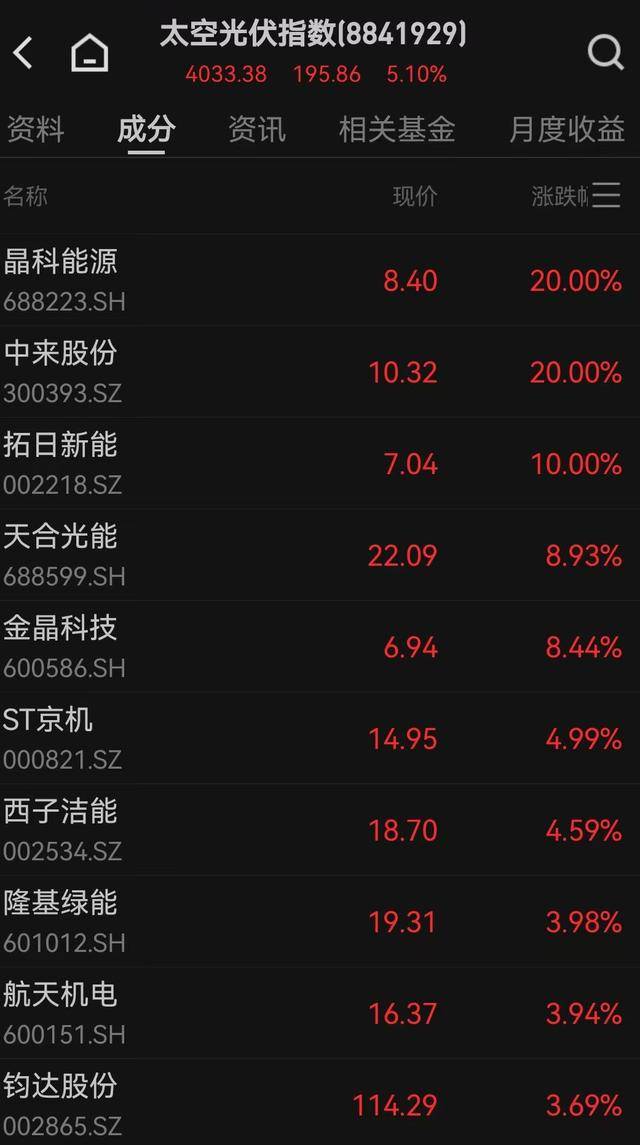
Core Viewpoint - The news highlights the recent interest in space photovoltaic technology sparked by Elon Musk's teams from SpaceX and Tesla conducting research on Chinese photovoltaic companies, leading to significant stock price movements in related A-share companies. Group 1: Market Reactions - The space photovoltaic index saw increases of 7.48% and 5.10% on February 3 and 4, respectively, with companies like JinkoSolar and Zhonglai Co. hitting the 20% daily limit up [4]. - Several companies, including JinkoSolar and Trina Solar, experienced significant stock price increases, with JinkoSolar's stock reaching a closing price of 22.09, up 8.93% [2][4]. Group 2: Company Responses - JinkoSolar issued a statement clarifying that while there were rumors of contact with Musk's team, no formal agreements or orders have been established, and the technology is still in the exploratory phase [4][5]. - High Measurement Co. confirmed it has not engaged in any space photovoltaic business or collaborations with Musk's teams, emphasizing the uncertainty surrounding the commercialization of space photovoltaic technology [5][6]. - Other companies like Guosheng Technology and Shuangliang Energy also stated they have not been approached by Musk's team and are not involved in space photovoltaic projects, reiterating the exploratory nature of the technology [8][9]. Group 3: Industry Insights - Space photovoltaic energy refers to harnessing solar energy in outer space and transmitting it wirelessly to Earth or powering satellites and space stations, positioning it as a strategic solution for commercial space and high-end applications [9]. - According to research from China International Capital Corporation, the demand for space photovoltaic technology is expected to grow significantly, potentially reaching a market size of hundreds of billions by 2030, particularly as low Earth orbit satellites become more prevalent [10].


未知机构:高盛闭门会详解中国工业的三大主题机器人aidc电力太空光伏20260201dl36-20260205
未知机构· 2026-02-05 01:40
Summary of Conference Call Records Industry or Company Involved - Humanoid Robotics Industry - Electric Power Supply Sector - Data Center Electrical Equipment - Space Solar Energy Industry Key Points and Arguments Humanoid Robotics Industry - **Cautious Outlook**: The humanoid robotics sector is viewed with caution as optimistic long-term growth expectations are already reflected in current stock prices. The rating for Sunwah Intelligent Control Asia will be downgraded from neutral starting November 2025 due to this concern [1][2] - **Challenges in Development**: Achieving general humanoid robot capabilities is more challenging and time-consuming than anticipated. For instance, Tesla's Optimus has a long-term shipment target of one million units, which is already priced into related stocks. The release of Optimus 3 has been delayed from February to the coming months, and it is still in early development stages [1][2] - **Market Demand and Growth**: The global humanoid robotics market is still in its early stages, with an expected shipment of approximately 15,000 units by 2025, which is only 3% of the annual shipment of industrial robots. Domestic leading companies are expected to achieve tens of thousands of units shipped by 2025 [3] - **Application Trends**: The demand structure is evolving, with 2025 focusing on early research applications. Future demand will shift towards specialized scenarios like guided tours, which require lower navigation and interaction capabilities [4] Electric Power Supply Sector - **Investment Logic**: The mainstream solutions for power shortages face significant bottlenecks, with 60% of AIDC power demand in the U.S. potentially met by natural gas. However, OEM manufacturers are at full capacity, leading to limited short-term expansion [5] - **Growth Projections**: INL is expected to see a 40% compound annual growth rate (CAGR) in EPS and a 25% CAGR in revenue over the next five years, driven by product structure optimization and improved profit margins [6] - **Market Share Growth**: By 2030, INL aims to achieve a revenue of 10 billion yuan, with significant contributions from partnerships with major companies like Siemens Energy and Baker Hughes [5][6] Data Center Electrical Equipment - **K Star's Competitive Edge**: K Star is a leading UPS supplier and the only Chinese company in the U.S. AI data center supply chain, with a projected 60% year-on-year profit growth in 2025. The company is expected to see a significant increase in orders from core clients [9] - **MKM's Transition Challenges**: MKM is transitioning to the global AI server power market but faces execution challenges, including managing complex supply chains and meeting project-based demands [9] Space Solar Energy Industry - **Demand Logic**: Elon Musk's plans for solar satellites have sparked expectations for increased demand in space solar energy. If Tesla and SpaceX's production plans materialize, the Chinese solar sector is expected to benefit significantly [10] - **Market Trends**: Domestic solar demand is projected to decline by 25% in 2026 but is expected to rebound by 14% in 2027, marking a critical turning point for the industry [15][19] Other Important but Possibly Overlooked Content - **Data Acquisition Challenges**: The humanoid robotics industry faces significant challenges in acquiring training data, which is crucial for AI development. Solutions include data factories and simulation training, but achieving high success rates remains a challenge [12][16] - **Electric Power Equipment Cycle**: The current cycle is driven by AI demand, contrasting with previous cycles driven by domestic policies. This shift presents new opportunities for Chinese companies in high-value markets like the U.S. [13][17] - **Execution Risks**: INL's capacity expansion plans face execution risks related to equipment yield and the need for skilled labor. MKM's transition to mass production is also under scrutiny due to potential delivery challenges [14][18]