
Longi(601012)

Search documents
多数光伏企业2025年延续亏损状态,部分企业锚定2026年业绩扭亏
Di Yi Cai Jing· 2026-01-27 10:56
Core Viewpoint - The keyword "pre-loss" has become prominent in the 2025 performance forecasts of various photovoltaic companies, indicating that most firms continue to face losses due to operational challenges and supply-demand imbalances in the industry [1] Group 1: Financial Performance - Leading photovoltaic companies are forecasting significant losses for 2025, with Tongwei Co. expecting a loss of 9 to 10 billion yuan, LONGi Green Energy forecasting a loss of 6 to 6.5 billion yuan, and JinkoSolar projecting a loss of 5.9 to 6.9 billion yuan [1] - The overall photovoltaic industry has experienced nine consecutive quarters of losses since Q4 2023, driven by a decline in component prices due to intense competition and insufficient end-user demand [1][2] Group 2: Industry Challenges - The photovoltaic industry is facing a supply surplus, with core raw material prices rising while product prices continue to decline, leading to significant operational pressure on companies [2] - The ongoing low operating rates and the deepening market reforms in the domestic electricity sector, along with increasing trade barriers abroad, have created a complex and challenging operating environment for photovoltaic companies [2] Group 3: Recovery Efforts - Some companies are beginning to emerge from the loss cycle, with LONGi Green Energy expecting to reduce losses by up to 30.38% and Aiko Solar by up to 77.44% compared to 2024 [2] - The China Photovoltaic Industry Association reported a 16.9% year-on-year decline in revenue for the main industry chain in the first three quarters of 2025, although gross margins improved to 3.64% [2] Group 4: Future Goals - Companies like Trina Solar have set profit targets for 2026, aiming for a net profit of no less than 200 million yuan, with increasing targets for subsequent years [3] - LONGi Green Energy's employee stock ownership plan also includes targets for positive net profit in 2026, with specific profit goals for 2027 and 2028 [3] Group 5: Price Adjustments - Trina Solar has raised its component prices three times this month, with prices now ranging from 0.88 to 0.92 yuan per watt, reflecting a response to industry self-discipline [4] - Major component manufacturers are increasing prices by 0.02 to 0.04 yuan per watt, and there is a growing willingness among intermediate suppliers to support price increases [4]






隆基绿能创始人李振国:光伏出海不止是“卖东西”,更输出了最好的技术
Feng Huang Wang Cai Jing· 2026-01-27 10:30
Core Viewpoint - Technological leadership is the primary factor for globalization in the solar industry, with China's photovoltaic sector significantly contributing to global energy transition [1]. Group 1: Technological Advancements and Cost Reduction - Over the past 15 years, the cost of solar power has decreased by 95%, making it the cheapest energy source in most countries today, thus supporting global energy transition and carbon neutrality [1]. - China currently accounts for 80% of global solar module production [2]. Group 2: Contribution to Sustainable Development - China's photovoltaic industry supports global energy transition and contributes to sustainable development, producing approximately 500GW of solar modules annually, which requires about 200 billion kWh of electricity, equivalent to the output of 25 nuclear reactors [3]. Group 3: International Expansion Strategy - The strategy for Chinese companies to "go global" should prioritize technological leadership, emphasizing that the technology exported is the best available [3]. - Hong Kong serves as an effective intermediary platform for companies to collaborate with overseas funds and secure capital support during international expansion [3].
壹快评丨光伏反内卷攻坚,政企同心方得始终
Di Yi Cai Jing· 2026-01-27 04:26
Core Viewpoint - The photovoltaic industry is undergoing a significant transformation towards high-quality development, driven by both internal corporate self-discipline and external government support, as evidenced by recent regulatory measures and policy adjustments aimed at combating price competition and fostering innovation [1][4][7]. Industry Performance - The photovoltaic sector is currently facing severe financial challenges, with major companies like Tongwei Co. and LONGi Green Energy projected to incur substantial losses in 2025, highlighting the industry's struggle with low-price competition and rising material costs [1][2]. - The average gross margin for the industry has plummeted to just 3.64%, leading many companies into a cycle of "production equals loss" [2]. Competitive Landscape - The industry is experiencing an oversupply of homogeneous production capacity, with silicon material capacity exceeding global demand by more than double, resulting in a fierce price war among companies [2][3]. - Companies that previously relied on scale advantages are now also facing revenue declines and negative profits, indicating a widespread crisis across the sector [2]. Material Costs and Innovation - The price of silver, a critical component in photovoltaic cells, has surged by 231% in 2025, pushing companies to adopt cost-reduction technologies such as "less silver" or "silver-free" approaches [3]. - The focus on price competition has led some companies to neglect technological innovation and quality improvement, which are essential for long-term survival [3]. Government Role and Policy Recommendations - Government intervention is crucial for the success of the anti-involution measures, requiring a unified and clear policy direction to stabilize market expectations and foster industry consensus [4][6]. - There is a need for coordinated regulatory efforts across various government departments to effectively combat unfair competition and ensure sustainable industry practices [5][6]. Future Outlook - The current challenges in the photovoltaic industry present an opportunity for transformation, shifting from a focus on quantity to value creation, which is expected to be a long-term process [7]. - Some companies are beginning to reduce losses, and there is optimism that the industry may see a profitability turning point in early 2026 [7].

隆基绿能参建欧洲最大光伏项目
Zhong Guo Hua Gong Bao· 2026-01-27 02:15
Core Viewpoint - Longi Green Energy has signed a cooperation agreement with Solarpro to jointly build the largest BC photovoltaic power station in Europe, located in Heves, Hungary, with a total installed capacity of 450 megawatts [1] Group 1: Project Details - The project will utilize Longi's Hi-MO 9 BC modules, which are based on HPBC 2.0 technology, ensuring high efficiency in harsh environmental conditions such as high temperatures and low light [1] - The expected annual electricity generation of the power station is 470 gigawatt-hours, sufficient to meet the annual electricity needs of approximately 106,000 households [1] - The project is projected to reduce greenhouse gas emissions by about 415,000 tons annually, equivalent to the carbon emissions reduction of over 100,000 fuel-powered vehicles [1] Group 2: Strategic Importance - Solarpro's CEO, Krasen Mateev, emphasized that this 450 megawatt solar power station will set a new benchmark for utility-scale solar projects in Europe, highlighting the importance of Longi's advanced BC technology for maximizing performance and reliability [1] - Longi Green Energy's Europe President, Zhang Sheng, stated that the Hi-MO 9 modules will contribute significantly to Hungary's energy transition, aligning with both companies' commitment to innovation and sustainable development [1]
2026年债券信用风险展望
Si Lu Hai Yang· 2026-01-26 11:35
Group 1: Report Industry Investment Rating - No information provided in the given content. Group 2: Core Viewpoints of the Report - In 2026, focus on provinces with large maturity scales of industrial bonds, such as Inner Mongolia, Heilongjiang, and Jilin, and avoid entities with industry downturns, weakened profitability, and financing channels, or those with non - bond debt risks [2]. - The broad private real estate developers still face challenges, and other industries have a low probability of concentrated risks, but entities with weak competitiveness, significant profit decline, cash - flow pressure, and concentrated debt maturities should be focused on [2]. - For convertible bonds, weak - quality entities with low - priced underlying stocks and high conversion premiums may face difficulties in exiting through conversion, and potential losses should be watched out for [2]. Group 3: Summary by Relevant Catalogs 1. Overall Bond Market Situation - As of January 6, 2026, the national credit bond balance was 36.18 trillion yuan, with urban investment bonds at 17.73 trillion yuan (49.00%) and industrial bonds at 18.45 trillion yuan (51.00%, down from 54.57% last year) [5]. - Beijing has the largest bond balance, followed by Jiangsu, Guangdong, Zhejiang, and Shandong. Inner Mongolia has the highest short - term bond maturity ratio at 81.09%, followed by Heilongjiang at 40.39% [5]. 2. Urban Investment Bonds - Since 2023, with a series of policies and measures, the debt pressure of urban investment platforms has been relieved, the issuance cost and credit spread of urban investment bonds have decreased, the financing cost is generally below 3%, and the debt term has been significantly extended [10]. 3. Industrial Bonds Provincial - level Analysis - Excluding urban investment bonds, Beijing has the largest industrial bond scale at over 7 trillion yuan, mainly central - enterprise bonds. Inner Mongolia has the highest short - term industrial bond maturity ratio at 82.64%, followed by Tibet, Heilongjiang, Tianjin, and Jilin [11]. - Inner Mongolia, Heilongjiang, and Jilin have a bond issuance coverage ratio of less than 1 for the next - year's maturity scale, indicating weak refinancing ability [14]. Industry - level Analysis - In 2025, default industries included 12 sectors such as automobile services and real estate development. The industrial holding and power industries have the largest bond balances, over 2 trillion yuan each [15]. - The paper - making, automobile services, medical devices, medical services, and publishing media industries have a short - term debt ratio of over 50%, with poor debt term structures [15]. - Industries with large short - term debt repayment pressures include rail transit, packaging, heating, furniture and home appliances, textiles, automobile services, and information technology [15]. 4. Real Estate Industry - In 2025, the default rate of real estate development entities remained high, with Vanke and Zhengxinglong defaulting. As of January 6, 2026, the real estate development enterprise bond balance was 11,528.76 billion yuan, mainly held by local and central state - owned enterprises [18]. - The short - term bond maturity pressure of public, Sino - foreign joint - venture, and private enterprises is over 40%. The broad private enterprises still face pressure, with an issuance amount of only 234.38 billion yuan in the past year, 76.93% of the next - year's maturity amount [20]. - In 2026, private real estate enterprises to focus on are Longfor and Yida Development [23]. 5. Loss - making Industrial Entities - Large - loss entities (losses over 10 billion yuan in 2024 and still in losses in the first three quarters of 2025) are mainly in the real estate development industry, including state - owned enterprises such as Overseas Chinese Town Group and financial street - related companies, as well as steel giant Ansteel Group [24]. - Entities with losses between 5 and 10 billion yuan involve industries such as electrical equipment, chemical, steel, and airport [26]. 6. ABS Market - From 2023 - 2025, the default rate of CSRC - regulated ABS was 1.10%, 0.77%, and 0.88% respectively. As of January 6, 2026, the ABS balance was 25,021.96 billion yuan, with a one - year maturity amount of 3,541.59 billion yuan (14.15%). The 2025 issuance amount covered the next - year's maturity amount 3.97 times, with good continuation [32]. 7. Convertible Bond Market - Since 2024, the convertible bond repayment risk has increased. As of January 6, 2026, the convertible bond balance was 5553.51 billion yuan, a 22.89% year - on - year decrease. The broad private enterprises accounted for 64.73%, with a relatively large proportion [33]. - Entities such as Anhui Honglu Steel Structure, Shenzhen Huayang International Engineering Design, and Shanghai Kehua Bio - Engineering face large convertible bond repayment pressures, but the conversion mechanism can reduce credit risks to some extent [35]. - Entities such as Dongfang Fashion Driving School, Hainan Pulili Pharmaceutical, and Jiangsu Fumiao Technology, although not facing immediate repayment pressures, have negative information such as business fluctuations, financial fraud, and equity freezes, and their dynamic changes should be continuously monitored [36].




隆基冬季达沃斯发声:太阳能正成为全球能源安全的关键支柱
中国能源报· 2026-01-26 10:27
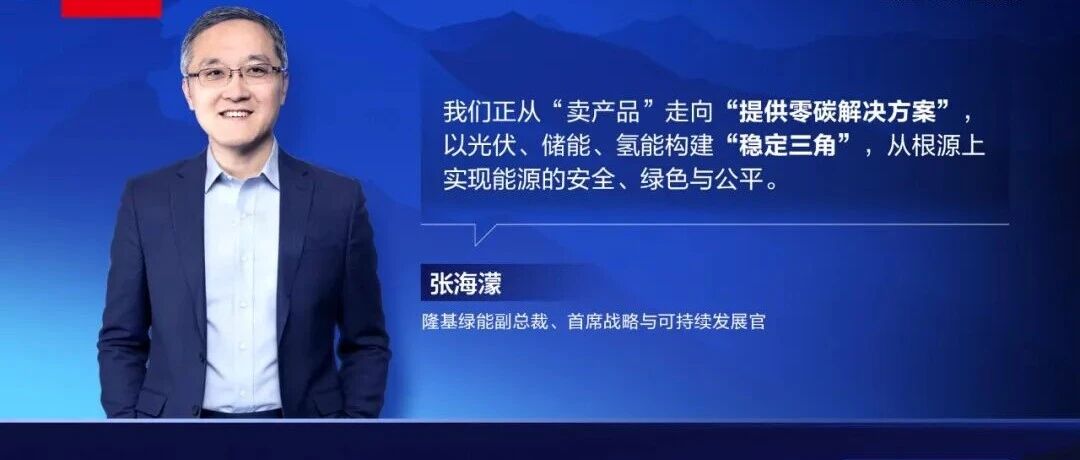
Core Viewpoint - The article emphasizes the transformation of Longi Green Energy from a single product provider to a comprehensive energy service provider, highlighting the role of solar energy in achieving global energy security and the importance of technological innovation and ecological collaboration in building a zero-carbon power system [1][5]. Group 1: Technological Innovation - Longi focuses on bifacial and BC solar cell technologies, achieving world records and international validation, emphasizing that innovation must be coupled with commercialization capabilities [3]. - The company has launched mass production of BC modules and established "lighthouse factories" utilizing digitalization and AI to ensure product reliability in large-scale applications, providing essential components for zero-carbon transitions [3]. Group 2: Integrated Energy Solutions - Longi has developed a "solar + storage + hydrogen" collaborative framework to address systemic challenges in energy transition, integrating solar energy into various sectors such as construction and transportation [5]. - This comprehensive solution is a collaborative effort with global industry partners, marking Longi's shift to a comprehensive energy service provider [5]. Group 3: Global Collaboration and Market Dynamics - The decreasing cost of solar energy and its expanding application scenarios position it as a core driver of global energy structure transformation, with Longi contributing approximately 27% to global solar installations [7]. - In developed markets, the combination of solar and storage is seen as the optimal solution for increasing energy demand, while in developing regions, solar energy is crucial for achieving energy accessibility and sustainable development [7]. Group 4: Addressing Non-Technical Barriers - Longi faces non-technical challenges such as weak grid infrastructure and supply chain resilience, which need to be addressed for the global proliferation of solar energy [7]. - The company has implemented global practices, such as integrating solar with water pumps in Pakistan and providing on-demand solutions in Africa, to enhance local livelihoods and business operations [7]. Group 5: Future Outlook and Collaboration - Longi aims to tackle supply chain challenges through localized production and technological cooperation, positioning itself as a reliable partner in global energy transition [9]. - The company advocates for open collaboration across the globe, emphasizing the need for long-term value investment, flexible regulatory mechanisms, and supportive policies for technological innovation and cross-border cooperation [9].

电力设备行业资金流出榜:金风科技、隆基绿能等净流出资金居前
Zheng Quan Shi Bao Wang· 2026-01-26 09:25
Market Overview - The Shanghai Composite Index fell by 0.09% on January 26, with 10 industries experiencing gains, led by non-ferrous metals and petroleum & petrochemicals, which rose by 4.57% and 3.18% respectively. Conversely, the defense & military and automotive industries saw declines of 4.47% and 2.31% respectively [1] Capital Flow Analysis - The main capital outflow from the two markets totaled 114.32 billion yuan, with six industries seeing net inflows. The non-bank financial sector led with a net inflow of 3.493 billion yuan and a daily increase of 0.79%, followed by the pharmaceutical & biological sector, which had a net inflow of 2.839 billion yuan and a daily increase of 0.29% [1] Electric Power Equipment Industry - The electric power equipment industry experienced a decline of 1.42%, with a total net capital outflow of 20.306 billion yuan. Out of 365 stocks in this sector, 76 rose, including 5 that hit the daily limit, while 289 fell, with 1 hitting the lower limit. There were 83 stocks with net capital inflows, with the top inflow being from Dike Co., which saw 300 million yuan, followed by Penghui Energy and Kehua Data with inflows of 278 million yuan and 272 million yuan respectively [2] Top Gainers in Electric Power Equipment - The top gainers in the electric power equipment sector included: - Dike Co. (-7.45%, turnover rate 18.99%, capital flow 299.66 million yuan) - Penghui Energy (3.77%, turnover rate 16.15%, capital flow 277.74 million yuan) - Kehua Data (3.60%, turnover rate 8.34%, capital flow 271.53 million yuan) - Other notable gainers included DeYe Co. (6.11%), Yamaton (10.00%), and Mingyang Smart Energy (10.02%) [2] Top Losers in Electric Power Equipment - The top losers in the electric power equipment sector included: - Goldwind Technology (-3.99%, capital outflow -1.836 billion yuan) - Longi Green Energy (-1.34%, capital outflow -1.539 billion yuan) - CATL (-1.43%, capital outflow -975.71 million yuan) - Other significant outflows were seen in Jiejia Weichuang, Sunshine Power, and Precision Holdings [3]


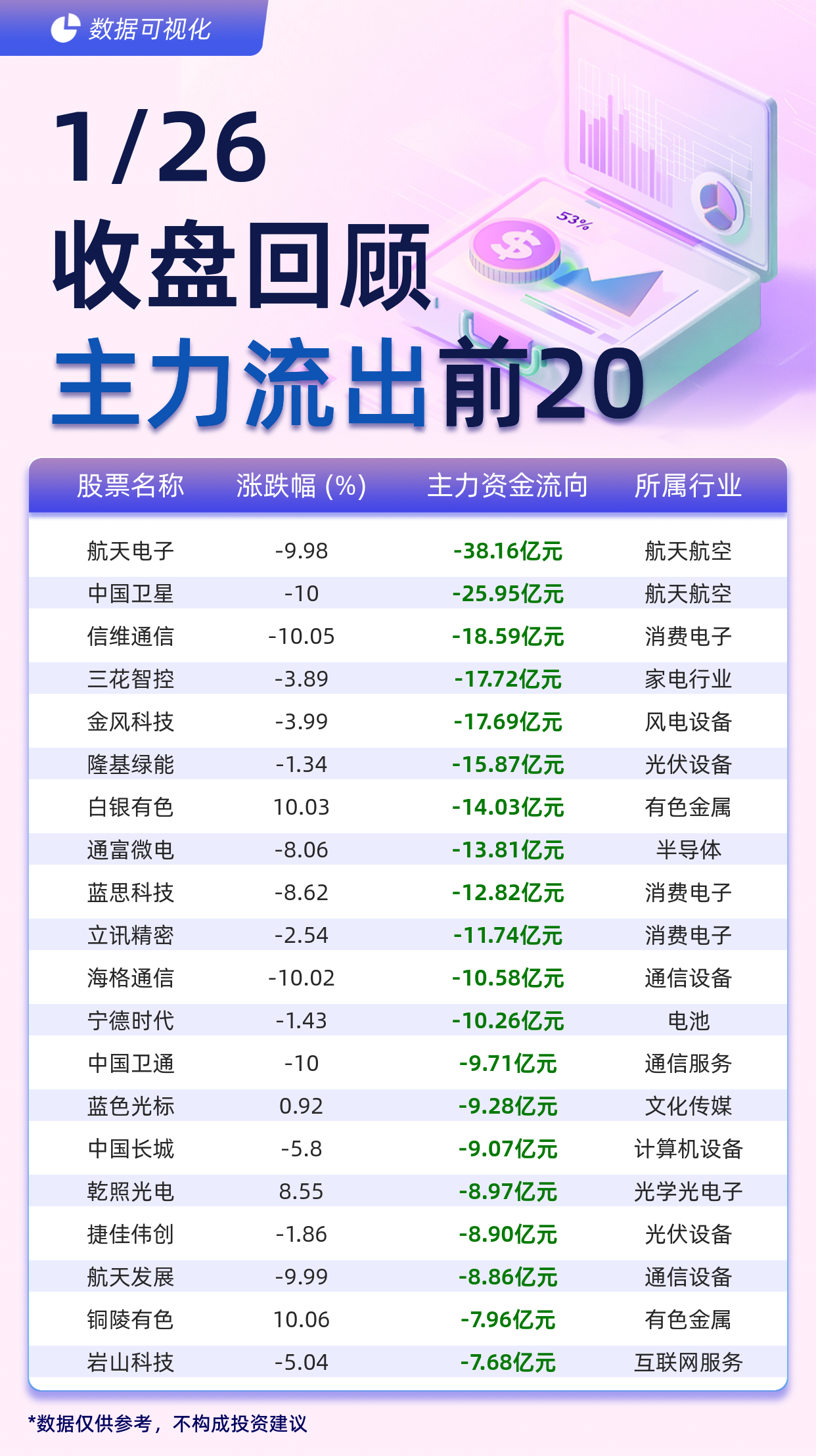
主力个股资金流出前20:航天电子流出38.16亿元、中国卫星流出25.95亿元
Jin Rong Jie· 2026-01-26 07:37
Core Viewpoint - The data indicates significant outflows of main funds from various stocks, particularly in the aerospace and consumer electronics sectors, reflecting a bearish sentiment among investors. Group 1: Stock Performance and Fund Flow - Aerospace stocks, such as Aerospace Electronics and China Satellite, experienced the largest fund outflows, with -38.16 billion and -25.95 billion respectively, and declines of -9.98% and -10% in their stock prices [1][2] - Other notable stocks with significant outflows include Xinwei Communication (-18.59 billion, -10.05%), Sanhua Intelligent Control (-17.72 billion, -3.89%), and Goldwind Technology (-17.69 billion, -3.99%) [1][2] - The outflow from Longi Green Energy was -15.87 billion with a stock price decrease of -1.34%, indicating a relatively smaller decline compared to others in the same sector [1][2] Group 2: Sector Analysis - The consumer electronics sector saw major outflows, particularly from companies like Xinwei Communication and Lens Technology, with outflows of -18.59 billion and -12.82 billion respectively [1][2] - The wind power equipment sector, represented by Goldwind Technology, also faced significant outflows, reflecting potential challenges in the renewable energy market [1][2] - The communication equipment sector, including companies like Haige Communication and China Satellite, showed substantial fund outflows, indicating investor caution in this area [1][3]


隆基绿能成交额超上一日全天
Zheng Quan Shi Bao Wang· 2026-01-26 07:09
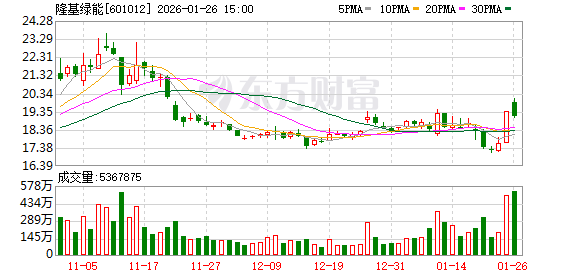
Group 1 - The core point of the article indicates that Longi Green Energy's trading volume reached 10.007 billion yuan, surpassing the previous day's total trading volume [2] - The latest stock price of Longi Green Energy has decreased by 1.60%, with a turnover rate of 6.78% [2] - The total trading volume for the previous trading day was 9.394 billion yuan [2]
今日焦:(2026年第4周)-20260126
新华汇富· 2026-01-26 05:24
Price Trends in the Photovoltaic Industry - In the fourth week of January 2026, polysilicon prices remained stable at RMB 54.00 per kg, with a monthly increase of 4%[1] - Prices for mainstream silicon wafer models (183N, 210RN, and 210N) were approximately RMB 1.40, RMB 1.40, and RMB 1.55 per piece, respectively, reflecting a significant monthly rebound of 12%[1] - Mono cell prices for 183N, 210N, and 210RN models increased by 5% week-on-week and surged 24% month-on-month to RMB 0.42 per watt[1] Market Dynamics and Demand - The market is experiencing a stalemate due to weak domestic demand, despite rising silver prices providing cost support[1] - The overall market sentiment is low, with new orders largely postponed until late January, leading to increased inventory levels[3] - The export demand is currently strong, but domestic demand remains weak, causing a reliance on overseas orders for market stability[6] Policy and Future Outlook - The Ministry of Finance announced the cancellation of export tax rebates for battery cells and modules starting April 1, 2026, aiming to curb low-price competition and promote industry upgrades[7] - The National Development and Reform Commission set a target for renewable energy to account for 30% of total power generation by 2030, indicating potential market growth[7] - Despite short-term price strength driven by export orders, the overall demand outlook remains uncertain, with expectations of continued industry losses due to supply-demand imbalances[7]