
CSC(601066)

Search documents
中信建投2026年低空经济展望:eVTOL应用加速落地 基础设施与市场前景广阔
Zhi Tong Cai Jing· 2025-12-05 00:04
中信建投(601066)发布研报称,我国低空经济市场近年来持续增长,政策提出到2030年形成万亿级市 场规模。以2027年为节点,我国将致力于通用航空装备供给能力与产业创新的提升。低空经济的发展有 望带动上下游基础设施迎来发展周期,如卫星、航空器以及低空飞行器运行提供空管环境(软硬件)、基 础设施、算力等。2025年多家eVTOL公司接到国内外意向订单,反映低空经济市场空间广阔。 中信建投主要观点如下: 2024年是低空经济发展元年,未来中国低空经济市场万亿元蓝海。2023年我国低空经济市场规模超5000 亿元,随着下游应用领域的不断扩大,未来有望继续保持增长,按照民航和物流数据,设备价值量占运 营收入的5-15%,基础建设占运营收入的20%。根据《通用航空装备创新应用实施方案(2024-2030年)》 提出到2030年形成万亿级市场规模。以2027年为节点,我国将致力于通用航空装备供给能力与产业创新 的提升。以增强技术创新,完善产品谱系,加速示范应用等20个重点任务为核心,推动航空制造业新型 工业化探索和实践。 低空智能融合基础设施划为"四张网",包括"设施网"、"空联网"、"航路网"和"服务网"。设施网指 ...

中信建投:朱雀三号首飞入轨成功,商业航天可复用探索迈入新阶段
Xin Lang Cai Jing· 2025-12-04 23:40
Core Viewpoint - The successful launch of the Zhuque-3 rocket marks a significant breakthrough in China's commercial space industry, particularly in reusable liquid oxygen-methane launch vehicle technology [1] Group 1: Technological Achievements - On December 3, the Zhuque-3 rocket successfully entered orbit, becoming China's first reusable liquid oxygen-methane launch vehicle to achieve orbital flight [1] - Although the first-stage recovery did not achieve a soft landing due to abnormal combustion, the entire testing, launch, and flight process was fully validated [1] Group 2: Industry Implications - The Zhuque-3's successful orbit entry represents a critical turning point for China's commercial space industry, addressing the current bottleneck in launch vehicles [1] - The successful launch provides a lower-cost option for the addition of new satellite constellations, which is expected to accelerate the construction of satellite networks and lead to an explosion in application demand [1] Group 3: Future Developments - Upcoming launches of rockets such as Tianlong-3, Lijian-2, Chang-12 series, and Zhishen-1 are planned, which will include recovery tests and are anticipated to further alleviate industry bottlenecks [1] - The advancements in rocket technology are expected to streamline the entire industry chain logic, enhancing the overall growth of the commercial space sector [1]
中信建投:低空经济市场规模有望继续保持增长
Xin Lang Cai Jing· 2025-12-04 23:40
中信建投研报指出,2024年是低空经济发展元年,未来中国低空经济市场万亿元蓝海。2023年我国低空 经济市场规模超5000亿元,随着下游应用领域的不断扩大,未来有望继续保持增长,按照民航和物流数 据,设备价值量占运营收入的5-15%,基础建设占运营收入的20%。根据《通用航空装备创新应用实施 方案(2024-2030年)》提出到2030年形成万亿级市场规模。以2027年为节点,我国将致力于通用航空 装备供给能力与产业创新的提升。以增强技术创新,完善产品谱系,加速示范应用等20个重点任务为核 心,推动航空制造业新型工业化探索和实践。2025年多家eVTOL公司接到国内外意向订单,反映低空 经济市场空间广阔。 ...
中信建投:量子科技承载着成为新经济增长点的重任
Xin Lang Cai Jing· 2025-12-04 23:40
Core Viewpoint - Quantum technology is highlighted as a key future industry by the state, tasked with becoming a new economic growth point [1] Group 1: National Strategy - The Central Committee's proposal emphasizes accelerating high-level technological self-reliance and leading the development of new productive forces [1] - The focus on quantum technology in the 14th Five-Year Plan indicates the government's strong commitment to the industry [1] Group 2: Future Industry Development - The strategy includes exploring diverse technological routes, typical application scenarios, feasible business models, and market regulatory rules [1] - Other emerging industries mentioned alongside quantum technology include biomanufacturing, hydrogen energy, nuclear fusion energy, brain-computer interfaces, embodied intelligence, and sixth-generation mobile communication [1]
中信建投 | 阿里AI模型:产品矩阵丰富,开源生态卡位B端份额
Xin Lang Cai Jing· 2025-12-04 11:28
Core Insights - Alibaba is leveraging the Qwen large model foundation to comprehensively reshape its business and accelerate the construction of B-end ecological barriers through an open-source strategy and strong performance [2][42] - The company is committed to increasing capital expenditure to meet strong demand for computing power, with cloud revenue continuing to grow significantly, validating the closed-loop logic of "infrastructure investment - technology iteration - commercial monetization" [2][42] AI Model Development - Alibaba has been early in the AI model layout, with its flagship Qwen series iterating three major versions and multiple minor versions in just over two years, covering vertical scenarios such as text, mathematics, code, and multi-modal applications [3][43] - As the only major player adhering to an open-source strategy, Alibaba has accelerated model iterations since 2024, narrowing the capability gap with overseas models and is expected to surpass closed-source models in the B-end market [3][43] Model Capabilities and Updates - Alibaba's AI model layout has achieved "full size," "full modality," and "multi-scenario" coverage, with the first trillion-parameter multi-modal model M6 released in March 2021, and subsequent expansions in parameter size [4][43] - As of October 2025, the Qwen model series has iterated three major versions and multiple minor versions, covering model sizes from 0.5 billion to one trillion parameters [4][43] - The Qwen series has open-sourced a total of 357 models, with a significant acceleration in update frequency since 2024, including 71 models in the first half of 2024 and 120 in the second half [5][45] Competitive Positioning - Alibaba's model capabilities rank in the global first tier, with the gap to leading overseas firms reduced from over six months to approximately three months [12][51] - The Qwen3 235B model, released on July 22, 2025, is comparable to DeepSeek-V3.1 Terminus, while the Qwen2.5 Instruct-72B model was the first domestic model to exceed an overseas model in the open-source arena [12][51] Market Strategy and Ecosystem - The company has formed a complete layout for both B-end and C-end markets, with open-source serving as the foundation for business and product support [35][74] - As of the 2025 Yunqi Conference, the Tongyi series models have achieved 600 million downloads and served over 1 million customers, with the Mota community further enhancing the open-source ecosystem [35][74] Future Outlook - The focus will be on the official release of Qwen3-Next (equivalent to Qwen3.5) and optimizing vertical models based on it, with Qwen4 expected to be released in Q2 2026 [21][60] - The ongoing open-source strategy is anticipated to maintain the frequency of model updates, further enhancing capabilities while narrowing the time gap with leading overseas models [21][60]


紫光股份,递交IPO招股书,拟赴香港上市,中信建投、法巴、招银国际联席保荐
Xin Lang Cai Jing· 2025-12-04 11:25
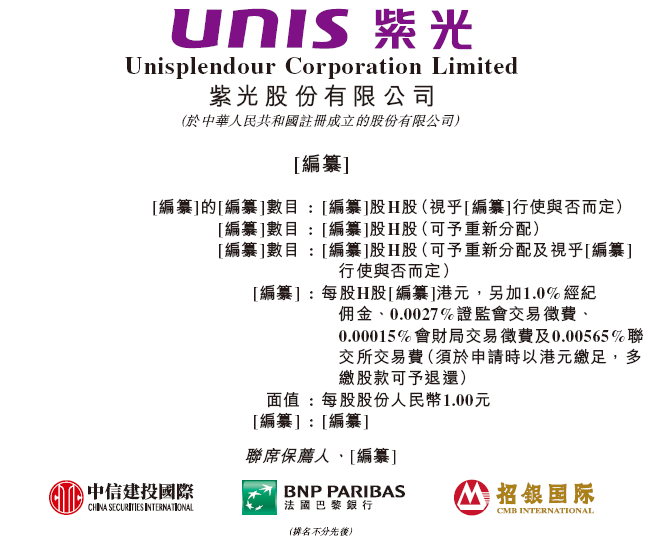
Core Viewpoint - Unisplendour Corporation Limited (紫光股份) has submitted a prospectus to list on the Hong Kong Stock Exchange, marking its second attempt after a previous application lapsed in May 2025. The company is a leading provider of digital and AI solutions, with a market capitalization of approximately RMB 70.96 billion as of December 3, 2025 [2][16]. Business Overview - Established in 1999 and listed on the Shenzhen Stock Exchange, Unisplendour is recognized as one of the three companies in China providing comprehensive digital solutions. It offers a full-stack intelligent ICT infrastructure, software, and cloud services primarily for AI training and big data processing [3][18]. - The company's main business segments include (i) digital solutions and (ii) ICT product distribution. Digital solutions support clients' digital transformation and AI applications, while ICT product distribution involves selling a wide range of products sourced from well-known domestic and international brands [4][18]. Financial Performance - For the fiscal years ending December 31, 2022, 2023, and 2024, and the first half of 2025, Unisplendour reported revenues of RMB 73.75 billion, RMB 77.54 billion, RMB 79.02 billion, and RMB 47.42 billion, respectively. Corresponding net profits were RMB 3.74 billion, RMB 3.68 billion, RMB 1.98 billion, and RMB 1.28 billion [13][28]. - The revenue breakdown for 2024 indicates that digital solutions accounted for 70.5% of total revenue, while ICT product distribution contributed 29.3% [19][22]. Market Position - According to Frost & Sullivan, Unisplendour ranks third in China's digital infrastructure market with an 8.6% market share as of 2024. It holds the second position in the network market with a 12.8% share and is also second in the computing infrastructure market with an 8.2% share. In the storage infrastructure market, it ranks fifth with a 3.1% share [7][20]. Shareholder Structure - Prior to its listing in Hong Kong, the major shareholder of Unisplendour is Tibet Unisplendour Communication, which holds approximately 28% of the company. This entity is fully owned by Beijing Unisplendour Communication, which in turn is wholly owned by New Unisplendour Group [23][24]. Management Team - The board of directors consists of nine members, including two executive directors: Yu Yingtao (Chairman) and Wang Hongtao (President). There are three non-executive directors and four independent non-executive directors, ensuring a diverse governance structure [11][26].

华曦达科技,递交IPO招股书,拟赴香港上市,中信建投独家保荐
Xin Lang Cai Jing· 2025-12-04 06:25
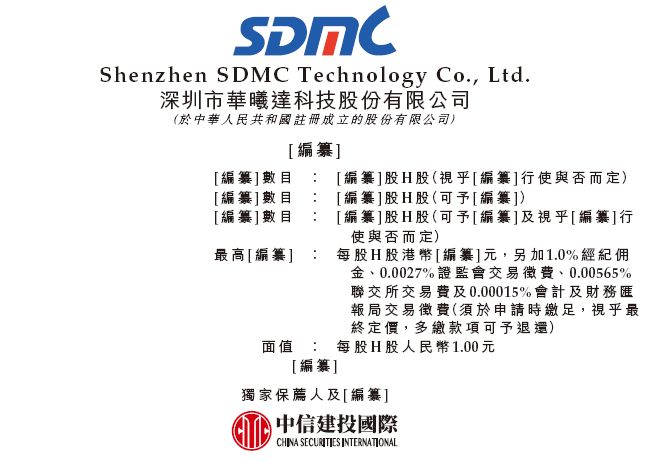
Core Viewpoint - Shenzhen SDMC Technology Co., Ltd. (referred to as "SDMC Technology") has submitted a prospectus for an IPO on the Hong Kong Stock Exchange, marking its second attempt after a previous application lapsed in May 2025 [2]. Company Overview - SDMC Technology was established in 2003 and specializes in smart home solutions for enterprise clients, developing and selling digital video and network communication devices [5]. - The company was the eighth largest provider of smart home solutions globally and the third largest in China as of 2024, according to Frost & Sullivan [5]. - Initially focused on the development and sales of encryption chips, SDMC Technology expanded its business to include digital TV modules and sticks, and became a leading supplier of Android TV smart terminals by 2023 [5]. Business Model and Revenue Sources - The company offers a comprehensive smart home solution that integrates software platforms, hardware devices, and an open ecosystem, providing AI-driven services [6]. - Major revenue sources include hardware and software solutions, with specific platforms such as XMediaTV and XHome contributing to income [7]. Financial Performance - SDMC Technology's revenue for the years 2022, 2023, 2024, and the first half of 2025 was RMB 2.53 billion, RMB 2.37 billion, RMB 2.54 billion, and RMB 1.54 billion respectively, with corresponding net profits of RMB 250 million, RMB 191 million, RMB 137 million, and RMB 103 million [15][16]. - The sales of digital video equipment accounted for 70.3% of revenue in 2024, while network communication devices contributed 20.8% [8]. Shareholder Structure - Prior to the IPO, the major shareholder is Mr. Li Bo, holding approximately 36.61% of the shares, with other shareholders including various investment platforms [11]. Board of Directors - The board consists of seven members, including four executive directors and three independent non-executive directors, with Mr. Li Bo serving as the chairman and general manager [13][14].
事关A股,重大调整!纳入这些股票
Zheng Quan Shi Bao Wang· 2025-12-04 05:30
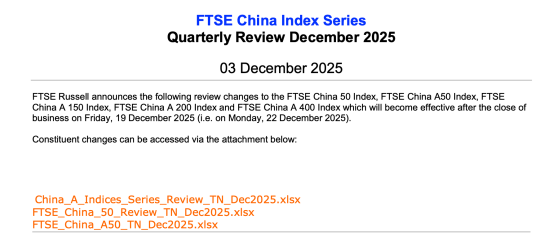
Core Viewpoint - FTSE Russell announced changes to several indices, including the FTSE China 50 Index, FTSE China A50 Index, FTSE China A150 Index, FTSE China A200 Index, and FTSE China A400 Index, effective after the market close on December 19, 2025 [1]. Group 1: Index Adjustments - The FTSE China A50 Index will include Luoyang Molybdenum (603993) and Sungrow Power Supply (300274), while removing Jiangsu Bank (600919) and SF Holding (002352) [4][6]. - The FTSE China 50 Index will add China Hongqiao, CATL (300750), and Hengrui Medicine (600276), while excluding CITIC Securities (601066), Great Wall Motors (601633), and Li Auto [6][8]. - The FTSE China A150 Index will incorporate Ying Shi Innovation, Jiangsu Bank, Huadian New Energy, SF Holding, Jiangbolong, and Huayou Cobalt (603799), while removing Luoyang Molybdenum, Desay SV (002920), Changdian Technology (600584), Baoxin Software (600845), Shanghai Pharmaceuticals (601607), and Sungrow Power Supply [10][12]. - The FTSE China A200 Index will add Ying Shi Innovation, Huadian New Energy, Jiangbolong, and Huayou Cobalt, while excluding Desay SV, Changdian Technology, Baoxin Software, and Shanghai Pharmaceuticals [12]. - The FTSE China A400 Index will see a broader adjustment, adding Anji Technology (688019), Baiyin Nonferrous (601212), Yitang Co., and Bluefocus Communication Group (300058), while removing Chipbond Technology, Yipin Hong (300723), Guanghui Network (300383), and Huaxi Biological [13][14]. Group 2: Market Impact - The adjustments by FTSE Russell are expected to attract passive fund allocations to the newly included stocks and increase overseas interest in Chinese assets [17]. - In the first ten months of 2025, foreign capital inflow into the Chinese stock market reached $50.6 billion, significantly surpassing the total of $11.4 billion for the entire year of 2024, marking an increase of over three times [17]. - UBS forecasts that A-share market earnings growth will rise from 6% this year to 8% next year, driven by improved nominal GDP growth and a narrowing of PPI declines [17]. - JPMorgan upgraded its rating on Chinese stocks to "overweight," citing a higher likelihood of significant gains next year compared to potential downside risks [18]. - Morgan Stanley set a target for the CSI 300 Index at 4840 points by December 2026, indicating a stable outlook for Chinese stocks amid moderate earnings growth and higher valuation levels [18].






宁德时代、恒瑞医药及中国宏桥获纳入富时中国50指数,12月22日生效
Ge Long Hui· 2025-12-04 04:27
Core Viewpoint - FTSE Russell announced the quarterly review results for the FTSE China Index Series, effective from December 22, 2025, with changes in constituent stocks for various indices [1] Group 1: FTSE China A50 Index Changes - Two new constituents added: Luoyang Molybdenum (603993) and Sunshine Energy [1] - Two constituents removed: SF Express (002352) and Jiangsu Bank (600919) [1] Group 2: FTSE China 50 Index Changes - Three new constituents added: China Hongqiao, CATL (300750), and Hengrui Medicine (600276) [1] - Three constituents removed: CITIC Securities (601066), Great Wall Motors (601633), and Li Auto [1] Group 3: Future Review Schedule - The next quarterly review for the FTSE China Index will be announced in March [1]
宁德时代、恒瑞及宏桥获纳入富时中国50指数,12月22日生效
Ge Long Hui A P P· 2025-12-04 03:42
Group 1 - FTSE Russell announced the quarterly review results for the FTSE China Index Series, effective from December 22, 2025 [1] - The FTSE China A50 Index added two constituents: Luoyang Molybdenum and Sunshine Energy, while removing SF Express and Jiangsu Bank [1] - The FTSE China 50 Index added three constituents: China Hongqiao, CATL, and Heng Rui Medicine, while removing CITIC Securities, Great Wall Motors, and Li Auto [1] - The next quarterly review for the FTSE China Index will be announced in March [1]
