Chongqing Rural Commercial Bank(601077)

Search documents
银行业周度追踪2025年第21周:房地产贷款增速转正,按揭多增-20250603
Changjiang Securities· 2025-06-02 23:30
Investment Rating - The investment rating for the banking industry is "Positive" and maintained [11] Core Insights - The banking index increased by 0.1% as of May 30, 2025, outperforming the CSI 300 index by 1.2% and the ChiNext index by 1.5%. The market's focus on bank stocks has increased significantly due to active fund allocation, with a continued upward trend in the sector, particularly for city commercial banks with relatively strong performance [2][6][19] - The growth rate of real estate loans turned positive for the first time since Q3 2023, with a year-on-year increase of 0.04% as of the end of March. This was primarily driven by a recovery in mortgage demand, with new personal housing loans amounting to 2,144 billion, a year-on-year increase of 2,093 billion [7][34][40] - The inclusion of Chongqing Rural Commercial Bank and Shanghai Rural Commercial Bank into the CSI 300 index is expected to attract more index funds, providing a positive outlook for these constituent stocks [8][47] Summary by Sections Market Performance - As of May 30, 2025, the banking index has shown a cumulative increase of 0.1%, with significant gains in city commercial banks like Hangzhou Bank, which saw its stock price rise after triggering a strong redemption condition for its convertible bonds [2][6][19] Loan Trends - In Q1 2025, the growth of corporate medium and long-term loans decreased, with industrial loans adding 1.52 trillion, down 140 billion year-on-year, and service sector loans adding 2.99 trillion, down 550 billion year-on-year. However, personal housing loans saw a significant increase, indicating a recovery in the housing market [7][34][40] Index Adjustments - The adjustment of the CSI 300 index, which includes Chongqing Rural Commercial Bank and Shanghai Rural Commercial Bank, is expected to lead to increased capital inflow into these stocks, enhancing their market performance [8][47] Convertible Bonds - The recent surge in bank stocks has narrowed the price gap to the strong redemption price for banks issuing convertible bonds. Hangzhou Bank's stock price has remained above the strong redemption price for 15 consecutive trading days, indicating strong investor confidence [9][48]


金融工程:2025年6月重点指数调样会带来哪些投资机会
Tianfeng Securities· 2025-05-31 07:28
Quantitative Models and Construction Methods 1. Model Name: Comprehensive Impact Coefficient - **Model Construction Idea**: The model aims to quantify the combined impact of multiple index adjustments on individual stocks, considering the overlap and exchange of sample stocks across different indices[23][24] - **Model Construction Process**: The comprehensive impact coefficient is defined as follows: $$ effect_{\_}total_{s} = \sum_{i=1}^{n} \frac{wt_{\_}chg_{s\_i} \times fund_{\_}size_{i}}{amount_{\_}avg_{s,20}} $$ - \( wt_{\_}chg_{s\_i} \): Weight change of stock \( s \) in index \( i \) - \( fund_{\_}size_{i} \): Fund size tracking index \( i \) - \( amount_{\_}avg_{s,20} \): 20-day average trading volume of stock \( s \)[23][24] - **Model Evaluation**: The model effectively captures the correlation between the comprehensive impact coefficient and the adjustment effect, making it a valuable tool for identifying stocks with significant adjustment impacts[29] --- Model Backtesting Results 1. Comprehensive Impact Coefficient - **Key Metrics**: - Stocks with a coefficient above 1: Average excess return per period = 3.82% - Stocks with a coefficient above 2: Average excess return per period = 5.13%[2][16] - **Historical Performance**: - December 2020: Coefficient > 2, average absolute return = 13.75%, excess return = 14.64% - June 2021: Coefficient > 2, average absolute return = 10.67%, excess return = 11.33% - December 2021: Coefficient > 2, average absolute return = 6.64%, excess return = 2.83% - June 2022: Coefficient > 2, average absolute return = 10.29%, excess return = 5.02% - December 2022: Coefficient > 2, average absolute return = 8.33%, excess return = 3.40% - June 2023: Coefficient > 2, average absolute return = 0.99%, excess return = 0.90% - December 2023: Coefficient > 2, average absolute return = 4.96%, excess return = 6.55% - June 2024: Coefficient > 2, average absolute return = -1.45%, excess return = 0.57% - December 2024: Coefficient > 2, average absolute return = 2.28%, excess return = 0.96%[13][14][15] --- Quantitative Factors and Construction Methods 1. Factor Name: Weight Rules - **Factor Construction Idea**: Weight rules are applied to ensure that the influence of individual stocks or sectors within an index remains balanced and aligned with the index's design objectives[25][26] - **Factor Construction Process**: - Different indices impose specific constraints on individual stock weights, such as: - Maximum weight for a single stock (e.g., 10%, 15%) - Combined weight limits for the top N stocks (e.g., top 5 stocks ≤ 40%) - Sector weight alignment with free-float market capitalization[26][27] --- Factor Backtesting Results 1. Comprehensive Impact Coefficient (Factor-Level Results) - **Top Stocks by Impact Coefficient (as of May 30, 2025)**: - **Stock: 601825 (沪农商行)** - Net Impact: 28.98 billion - Daily Average Turnover: 2.07 billion - Free-Float Market Cap: 493.66 billion - Impact Coefficient: 13.98 - **Stock: 601077 (渝农商行)** - Net Impact: 25.08 billion - Daily Average Turnover: 4.15 billion - Free-Float Market Cap: 427.52 billion - Impact Coefficient: 6.04 - **Stock: 601211 (国泰海通)** - Net Impact: 42.66 billion - Daily Average Turnover: 7.71 billion - Free-Float Market Cap: 1874.48 billion - Impact Coefficient: 5.53 - **Stock: 688608 (恒玄科技)** - Net Impact: 31.45 billion - Daily Average Turnover: 8.42 billion - Free-Float Market Cap: 283.59 billion - Impact Coefficient: 3.74[30]



A股银行板块小幅拉升,渝农商行涨逾2%,杭州银行、青农商行、沪农商行涨逾1%。
news flash· 2025-05-30 01:50
A股银行板块小幅拉升,渝农商行涨逾2%,杭州银行、青农商行、沪农商行涨逾1%。 ...

股息率高达8%!存款买理财不如买银行股?
21世纪经济报道· 2025-05-28 13:33
作 者丨林秋彤 编 辑丨曾芳 低利率环境下,银行股股息率"逆势而上"。 据wind数据,截至5月28日最新收盘, 42家A股上市银行中有15家银行的股息率已自2023年至今连续上升。 例如,南京银行2023年、2024年 和最新收盘的股息率分别为4.92%、5.11%、7.67%;江苏银行2023年、2024年和最新收盘的股息率分别为4.32%、4.78%、7.13%;渝农商 行2023年、2024年和最新收盘的股息率分别为3.95%、4.17%和6.60%。 此外,平安银行、民生银行、厦门银行和北京银行等,其股息率已经突破7%,且较今年年初有大幅上涨。截至最新收盘,上述几家银行股息 率分别为8.40%、8.10%、7.26%和7.02%,较2024年末分别上涨了3.11、3.60、2.36和1.91个百分点。 整体来看,42家A股上市银行中共有21家银行的最新收盘股息率较去年末有所上涨,有9家银行与去年末有所持平。 银行股走势稳健 与股息率"逆势而上"相对应的,是银行股走势稳健延续。 记者梳理发现,15家股息率连续上涨的银行中,除兰州银行和苏州银行外,其余13 家银行2024年全年股价涨幅均超过了40%。 ...




渝农商行(601077) - 重庆农村商业银行股份有限公司关于召开2024年度暨2025年第一季度业绩说明会的公告
2025-05-28 09:15
证券代码:601077 证券简称:渝农商行 公告编号:2025-025 重庆农村商业银行股份有限公司 关于召开 2024 年度暨 2025 年第一季度业绩说明会的公告 本行董事会及全体董事保证本公告内容不存在任何虚假记载、误导性陈述或 者重大遗漏,并对其内容的真实性、准确性和完整性承担法律责任。 重要内容提示: 重庆农村商业银行股份有限公司(以下简称"本行")已分别于 2025 年 3 月 26 日和 2025 年 4 月 26 日披露了 2024 年年度报告和 2025 年第一季度报告, 为使广大投资者更加全面、深入地了解本行经营成果、财务状况,本行计划于 2025 年 6 月 5 日(星期四)上午 10:00-11:00 举行 2024 年度暨 2025 年第一季度 业绩说明会,就投资者普遍关注的问题进行回答。 一、业绩说明会类型 本次业绩说明会以网络互动形式召开,本行将针对 2024 年度及 2025 年第一 季度的经营成果及财务指标的具体情况与投资者进行互动交流和沟通,在信息披 露允许的范围内就投资者普遍关注的问题进行回答。 会议召开时间:2025 年 6 月 5 日(星期四)上午 10:00-11: ...
高分答卷:重庆国企改革加速系统重塑
Sou Hu Cai Jing· 2025-05-28 00:46
Core Insights - The article highlights significant progress in the restructuring and integration of state-owned enterprises (SOEs) in Chongqing, achieving major breakthroughs in reform and efficiency improvements since the Fourth Plenary Session of the Sixth Municipal Party Committee [1][2]. Financial Performance - In 2024, the total profit of key municipal SOEs exceeded 37.7 billion yuan, representing a year-on-year growth of 12.8%, with an added value of 128.8 billion yuan, up 6.3% year-on-year [12]. - From January to April 2024, key municipal SOEs reported a total profit of 12.12 billion yuan, a year-on-year increase of 9.6%, and achieved operating revenue of 104.5 billion yuan, with an added value of 39.7 billion yuan, reflecting growth rates of 4.3% and 7.2% respectively [12]. Restructuring and Integration - A total of 19 groups of strategic restructuring have been implemented across five batches, reducing the number of key municipal SOEs from 51 to 33, and completing 13 specialized integrations, resulting in a reduction of the total number of legal entities to 690 [12]. - The restructuring efforts have led to the activation of assets worth 151 billion yuan and the recovery of 59.5 billion yuan [2][3]. Sector-Specific Developments - The hotel industry has seen significant consolidation, with the Chongqing Cultural Tourism Group leading the integration of over 100 municipal hotels, enhancing brand recognition and market competitiveness [3]. - The Chongqing Water Environment Group, after merging with the Municipal Water Investment Group, has accelerated management optimization and internal specialization, ranking first in net assets among China's top 50 environmental enterprises [2]. Project Investment and Economic Impact - As of April 2024, municipal SOEs have invested 46.19 billion yuan in 180 key municipal projects, accounting for 30.3% of the total investment in the city [4][6]. - The Chongqing Logistics Group reported a 20.3% year-on-year increase in container volume and a 5.3% increase in port cargo throughput from January to April 2024 [6]. Innovation and Technology Development - Chongqing's SOEs have established a gradient cultivation system, nurturing 221 technology-based enterprises and 158 high-tech enterprises, with a significant increase in R&D investment [7][8]. - The Chongqing Machinery and Electronics Group has improved the efficiency of technology transfer from laboratories to production lines, with R&D investment reaching 625 million yuan in 2024 [7]. Digital Transformation and Risk Management - The "State-owned Assets Intelligent Management" digital platform has been developed to enhance regulatory oversight, achieving 100% digitalization of core business processes [9][10]. - The platform has facilitated real-time monitoring of investment projects and risk indicators, identifying compliance issues and providing intelligent risk alerts [10][11].



银行:消费贷走出“规模竞赛”
Bei Jing Shang Bao· 2025-05-27 13:39
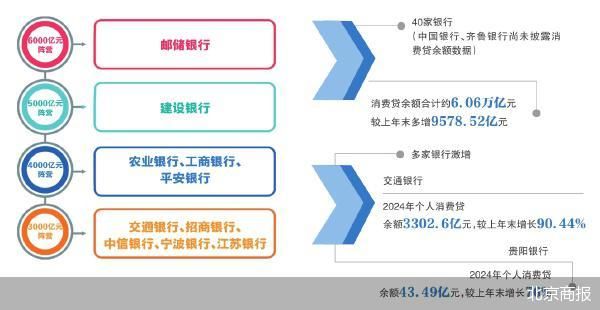
Core Viewpoint - The competition in consumer loans among banks has shifted from a focus on low interest rates to enhancing loan limits and extending loan terms, as banks seek to adapt to changing market conditions and regulatory guidance [1][11][15] Consumer Loan Growth - In 2024, the total consumer loan balance of 40 A-share listed banks increased by over 950 billion yuan, with some banks experiencing growth rates exceeding 90% compared to the previous year [1][3] - The consumer loan balance for these banks reached approximately 6.06 trillion yuan by the end of 2024, marking an increase of 957.85 billion yuan from the previous year [3][4] Interest Rate Trends - Consumer loan interest rates dropped to the "2" range, with some banks offering rates as low as 1.88% for select customers, but this trend has reversed with many banks raising rates to no less than 3% by April 2024 [1][9][10] - The shift back to "3" range interest rates is aimed at preventing excessive competition and potential financial risks associated with low-rate loans [10][11] Bank Strategies - Banks are now focusing on enhancing consumer loan products by increasing limits and extending terms, responding to government initiatives to boost consumption [11][12] - Various banks have begun to raise loan limits and extend repayment periods, with some institutions increasing the maximum loan amount from 300,000 yuan to 500,000 yuan and extending terms from five to seven years [12][16] Market Segmentation - The consumer loan market is showing significant differentiation, with some banks rapidly expanding their loan portfolios through low-rate strategies, while others are contracting due to concerns over rising non-performing loan rates [5][10] - Banks are increasingly targeting specific consumer scenarios, such as home renovations and electric vehicle purchases, to drive loan growth [15][16] Risk Management - The rise in consumer loan balances has led to an increase in non-performing loans, prompting banks to enhance their risk management practices and focus on quality customer segments [9][10][14] - Regulatory bodies are emphasizing the need for banks to monitor the flow of consumer loan funds to mitigate systemic risks [14]



存银行,还不如买银行股?
第一财经· 2025-05-26 01:26
Core Viewpoint - The decline in domestic deposit rates has diminished the attractiveness of traditional savings, leading to a "substitution effect" where bank stocks are favored over deposits, resulting in strong performance in the banking sector [1][3][10]. Summary by Sections Deposit Rate Decline - Since 2025, domestic deposit rates have been continuously decreasing, with the one-year fixed deposit rate falling below 1%, marking a historical low [3]. - The diminishing returns from traditional savings have reignited discussions around the benefits of investing in bank stocks instead of saving [3]. Dividend Yield Comparison - As of May 23, 2025, among 42 A-share listed banks, 31 banks have a dividend yield exceeding 4%, with some banks like Ping An Bank and Minsheng Bank surpassing 8% [3]. - The significant yield difference has prompted a "substitution effect," where investors see greater returns from bank stocks compared to deposits [3]. Strong Performance of Bank Stocks - The banking sector has shown robust performance, with a year-to-date increase of 7.66%, outperforming the Shanghai and Shenzhen 300 Index, which has declined by 1.34% [3][4]. - Investors, including insurance funds and public funds, have increased their holdings in bank stocks significantly [4][5]. Insurance and Public Fund Involvement - Insurance funds have been the primary players in increasing bank stock holdings, with a 27.2% holding ratio as of Q1 2025, up 4.3 percentage points from the end of 2023 [5]. - Public funds have also increased their allocation to bank stocks, with the proportion rising from 1.2% to 2.5% by the end of Q1 2025 [5]. Sector Performance Disparity - There is a noticeable divergence in performance within the banking sector, with regional banks like Qingdao Bank and Chongqing Rural Commercial Bank showing strong gains, while some larger banks have underperformed [7]. - As of Q1 2025, state-owned banks experienced a 1.5% decline in revenue, while city commercial banks saw a 3% increase [8]. Asset Quality and Non-Performing Loans - The non-performing loan generation rate for large banks has increased, while it has decreased for joint-stock and rural commercial banks [9]. - Regional banks, benefiting from local economic support, maintain lower non-performing loan ratios compared to national banks [9]. Future Outlook - Analysts believe that high dividend strategies will continue to drive bank stock prices in the short term, while net interest margins and asset quality will be critical for long-term performance [11][12]. - The banking sector is facing challenges from asymmetric interest rate cuts, which may pressure net interest margins but could also lower funding costs in the long run [12].


本周聚焦:多家银行下调存款挂牌利率
GOLDEN SUN SECURITIES· 2025-05-25 06:18
Investment Rating - The report indicates a positive outlook for the banking sector, suggesting that certain stocks may have alpha potential due to policy catalysts and a cyclical recovery [4]. Core Insights - Multiple banks have lowered their deposit rates, with the one-year and five-year Loan Prime Rate (LPR) reduced by 10 basis points on May 20, 2025. This trend reflects a broader market-driven decline in deposit costs [1][2]. - The average deposit cost rate for China Merchants Bank decreased significantly by 25 basis points to 1.29% in Q1 2025, indicating a trend of improving deposit costs across the sector [1]. - The report highlights that banks like Chongqing Bank, Minsheng Bank, and CITIC Bank have substantial room for further deposit cost reductions, suggesting a favorable environment for banks to optimize their funding costs [2]. Summary by Sections Section 1: Focus of the Week - Several banks have adjusted their deposit rates downward, with over half of listed banks participating in this trend by May 24, 2025 [1]. - The report notes that the average deposit cost rate for China Merchants Bank has shown improvement since Q2 2024, aligning with previous forecasts of enhanced cost reduction in liabilities [1]. Section 2: Sector Perspective - The banking sector is expected to benefit from expansionary policies aimed at stabilizing the economy, with specific banks like Ningbo Bank, Postal Savings Bank, and China Merchants Bank highlighted as potential investment opportunities [4]. - The report emphasizes that the cyclical recovery may take time, but the ongoing interest rate cuts could sustain the dividend strategy for banks like Shanghai Bank and Jiangsu Bank [4]. Section 3: Key Data Tracking - The report tracks various financial metrics, including the issuance of interbank certificates and the average rates for different types of bank notes, indicating a dynamic market environment [9][8]. - It also notes the increase in the proportion of deposits with a remaining maturity of less than one year, which rose by 3 percentage points to 37.4% by the end of 2024, suggesting a trend towards concentrated deposit maturities [2][16].




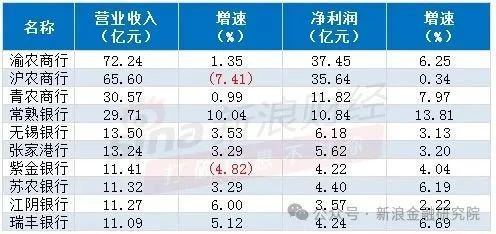
聚焦10家A股农商行一季报:沪农商行营收降超7%,紫金银行净息差仅1.23%
Xin Lang Cai Jing· 2025-05-23 00:34
Core Viewpoint - The A-share listed rural commercial banks demonstrated strong resilience in Q1 2025, with all 10 banks achieving positive net profit growth, highlighting their robust financial performance despite market pressures [1][5][6]. Financial Performance - All 10 A-share listed rural commercial banks reported positive net profit growth in Q1 2025, with Changshu Bank leading at a 13.81% year-on-year increase [1][7]. - Eight banks experienced positive revenue growth, while two banks, Shanghai Rural Commercial Bank and Zijin Bank, reported declines in revenue [1][5][6]. - Revenue figures for major banks include: - Chongqing Rural Commercial Bank: 72.24 billion yuan, up 1.35% - Shanghai Rural Commercial Bank: 65.60 billion yuan, down 7.41% - Qingnong Bank: 30.57 billion yuan, up 0.99% - Changshu Bank: 29.71 billion yuan, up 10.04% [3][5][6]. Asset Quality - As of the end of March, seven banks had non-performing loan (NPL) ratios below 1%, with Changshu Bank, Wuxi Bank, and Jiangyin Bank all below 0.9% [1][15]. - Qingnong Bank had the highest NPL ratio at 1.77%, despite a slight decrease from the previous year [1][15]. Asset Scale - Chongqing Rural Commercial Bank and Shanghai Rural Commercial Bank both exceeded 1.5 trillion yuan in total assets, with Chongqing leading at 1.61 trillion yuan, a 6.3% increase [9][11]. - Qingnong Bank ranked third in total assets at 511.58 billion yuan, while Changshu Bank followed closely with 389.01 billion yuan [11][12]. Interest Margin - The net interest margin for several banks has narrowed, with Zijin Bank reporting the lowest at 1.23%, below the industry average of 1.52% [4][7].